Reply With Quote
Yeah, I'm surprised it snows anywhere in the world these days.

-------------------------------------------------------------------
WASHINGTON, (KUNA): Snow storm New York & snow storm East Coast: Snowstorm to dump up to 2 feet of snow on US Eastcoast. The second major winter storm of the season was headed for the mid-Atlantic region on Friday with up to two feet of snow forecast in the U.S. capital, prompting federal employees to stay home in droves, and area schools to close for the day or let schoolchildren out a half-day early.
Airlines canceled flights in the region as the National Weather Service warned of snow ac ulations of 16 inches to 24 inches from Baltimore to northern Virginia and parts of West Virginia. The snow was expected to fall from midday on Friday until Saturday evening.
Southwest Airlines canceled Friday afternoon flights at Baltimore, Philadelphia and Washington airports, and Amtrak canceled most train service south from Washington.
A mid-December storm left some 20 inches of snow in the Washington area, and the latest storm surprised residents who seldom see even one snowstorm of these magnitudes.

Yeah, I'm surprised it snows anywhere in the world these days.
mmm mmm mmm

Ever heard of El Nino?

in related news, Tim Duncan set a career high in rebounds the other night, which proves he hasn't lost a step.

I didn't know El Nono could cause that...
All I can say is "Thank God for Global Warming, or it would really be bad!"

El nino actually warms and dries the eastern seaboard.
I don't mind some warming in winter, but I want nothing to do with a hot and dry summer again. Last year was ridiculous in south texas. I didnt see a raindrop for like 90 days in a row.

Lol You guys suck! I am starting to REALLY hate snow.

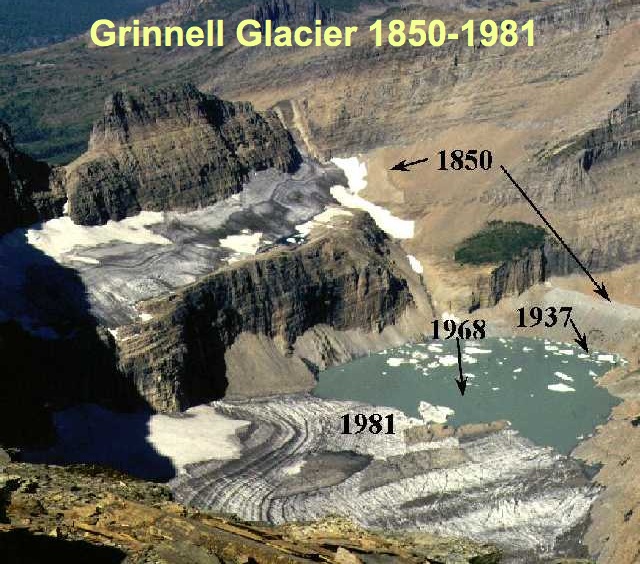
And here's a few square miles of global warming

Behind The Weather: Strongest El Nino In A Decade
by Christopher Joyce
http://www.npr.org/templates/story/s...57&sc=fb&cc=fp
February 4, 2010
Major snowstorms are set to bury the mid-Atlantic states this weekend after record snowfalls in December. Last month California was awash in rain. The Gulf states have seen heavy weather lately as well.
Turns out it's not just a run of bad luck. What's behind a lot of this winter's weather is El Nino, the tropical weather pattern that starts in the Pacific.
Scientists knew last summer that this was going to be an El Nino year. But it wasn't until the winter that its effects really hit the United States.
The strong El Nino and the subsequent precipitation are a result of something that started thousands of miles out in the Pacific Ocean.
"Ocean temperatures across the equatorial and tropical Pacific Ocean are somewhere upwards of two degrees above average," says Mike Halpert, deputy director of the Climate Prediction Center at the National Oceanic and Atmospheric Administration. "So we have had what we would characterize as a strong El Nino."
How El Nino Impacts Weather
Scientists at the center say this is the strongest El Nino since the winter of 1997-98. What happens is that unusually warm sea surface temperatures in the western Pacific move east. That changes the heating pattern of the atmosphere, which in turn pulls the Pacific jet stream farther south. A jet stream is a fast and narrow current of air that travels high up in the atmosphere.
"And that jet stream is where we see a lot of storminess typically," says Halpert. "And we saw a very classical case of that, a superstrong jet extended all the way across the Pacific with storms impacting California one after the other."
A strong El Nino also alters another jet stream nearer to the equator that brings more storms to the Gulf area.
In fact, a strong El Nino plays havoc with weather from Indonesia to the Atlantic, but in different ways. Indonesia gets unusually dry weather, and in fact fires in parts of Indonesia have been frequent recently. Peru, on the west coast of South America, tends to get what California gets — flooding rains.
Halpert says storms are local events and no single storm can be attributed directly to the phenomenon. "One way to think of it is that El Nino conditions the atmosphere for these types of storms," he says.
Weather Changes
Halpert also points out that scientists don't know yet whether climate change is influencing the frequency or strength of El Ninos.
Scientists say El Nino will very likely persist another month or two. That usually means drier than usual weather in the Pacific Northwest and Ohio Valley, wetter in the West and Southwest, and colder in the Southeast.
El Nino has done some good, though, in the Southwestern United States.
"Nobody can remember seeing such a small amount of drought on the map," he says, "So this El Nino has taken a pretty big bite out of some pretty severe drought conditions that had developed last summer."
And by altering jet streams, El Nino also helped moderate last year's hurricane season in the Atlantic.

Especially after global cooling in the 70s
@ global Warming still having any credit at all

Im very sceptical with this so called dangerous treat of global warming. Of course there is changes in climate, but these changes are natural, these have always been on earth. It's not something new, it's not something we have a big portion in causing this, it's a natural phenomena.
The other thing is, they also want to make the people a bit scared. If people are scared, you can do anything with them and people will spend. This global warming fear and hype is very good for economics----> certain peoples pockets and power

Whiny little east coast es! Two weeks ago almost six feet of snow dumped on Flagstaff, Az. in a 4-day stretch. We had almost 30 inches over a 24-hour period. The city was on complete lockdown and the National Guard was called in to help.
Two feet? OHHHH NOOOO!!!
As Marini's article explained, El Nino alters the jet stream which means different weather across the entire North American continent, and all the way across the Pacific in SE Asia and Australia.
Or you could pretend that somehow a snow storm obviates numerous streams of scientific evidence for EGW and bury your head in the sand as per usual. Well done to the ignoramouses.
Dude, the changes we are seeing right now are far greater and faster than the background natural rate of change. Try going to your local university and talking to some climatologists about the subject - learn something and educate yourself. Changes to the earth's climate are not new, but rapid warming caused by levels of CO2 that haven't been seen in the earth's atmosphere for at least 650,000 years are.
I am going to university and I have read and listened to climatologists and other sources on this matter. Still, im highly sceptical about this. I think this is just more a natural phenomena which has been here always. Of course I believe there are some human causes, industry etc... but not in such an extent as they make us believe.
If you have actually read the science I find it difficult to believe that you could form the opinion that what we are seeing is a natural rate of change. For example, how do you explain the fact that atmospheric CO2 levels are currently 385ppm, about 35% higher than they have been at any time in recent geological history (ie. throughout the last 10 or so glacial-interglacial cycles CO2 has stayed between 200-300ppm - it is currently at 385ppm and rising). That has clearly been caused by humans. We know we're injecting over 8Gt of 'artificial' (ie fossil fuel) carbon into the natural carbon cycle every year. We know that the sinks in the carbon cycle, particularly the oceans, are slowing their rate of absorbtion of carbon as their buffers are overwhelmed. Sorry mate, I don't think you've actually looked at the science very closely at all.
The earth has as always been changing in climate mate. If this everything you state is 100% true, why did this always happened? How do you explain the warmings and climate changes in the past? There were no industries back then, there were no gasses back then, but just natural climate fluctuations without any effect of CO2. I think human influence is minimal, and even if, it's not in such proportions as they make us believe.
There are also scientists from which ive read who mention an important role of solar activity.
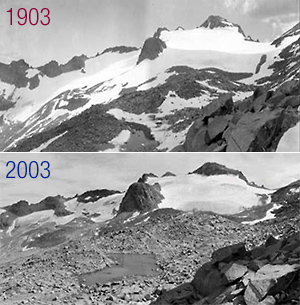
What is that?
January 1903 to August 2003?
I can show you some radical snow changes on Mt. Hood. I have a pretty good view of it from the park I live next to. Should I take a picture tomorrow, and compare it with another in August?
Grinell Glacier is a poor example of Global warming.
No relevance. It is an ice covered lake, left over from the ice age. Being in a big bowl. Above the timber-line. 7000 ft elevation, at 48.753 degrees la ude. Just cold enough cold enough year round to melt really slowly.
How can anyone think a measly 0.6 C increase in temperature has enough of a change to melt that volume of ice?
Funny how we see the same two or three photographs. If this was real, we should have hundreds of examples. However, the truth is, about as many glaciers are gaining ice as are losing ice.
Last edited by Wild Cobra; 02-06-2010 at 09:12 PM.
Those are clearly late-season photos in both images. If it was an early-season picture, you'd never see the darker glacier because it'd be covered by snow fields. Seasonal snow is white, not grey. You can easily make out the difference between that seasonal snow field and the glacier in the 1903 image.
See, that post just shows me that you don't understand the science at all. Milankovitch cycles (look them up) trigger CO2/CH4 release, and that triggers changes in climate. The concentration of CO2 in the atmosphere has naturally oscillated from 200-300ppm in recent geological history - humans have pushed that to 385ppm and rising, well beyond the natural range. "No gasses"!? Sorry? Before humanity there was no carbon cycle? Come on now, you simply don't know what you are talking about. The issue is that humans have dumped a huge quan y of 'artificial' carbon (that is, carbon that has been stored underground as fossil fuels for tens of millions of years) into the carbon cycle, which has changed the equilibrium of the cycle and thus the climate. It's all explained by the science.
As for solar activity, since the 80s it has been declining while the warming continues. Solar activity is currently as low as it has been in the last century.
There are currently 1 users browsing this thread. (0 members and 1 guests)
 Posting Permissions