Reply With Quote
no mention of the breakdown of the types of crimes prisoners are in jail for.
non-violent offenders/defendants awaiting trial should absolutely be released using ankle bracelets and/or gps trackers.
Op-Ed Contributor
By SHIMA BARADARAN
Published: May 30, 2011
http://www.nytimes.com/2011/05/31/op...=4&ref=opinion
LAST week the Supreme Court ordered California to reduce its prison population after finding that the state’s penal system was so overcrowded that it cons uted cruel and unusual punishment. What the court didn’t do, however, was provide any guidance about how to do it, giving rise to fears of violent convicts being set free and increasing crime rates.
Rather than seek major criminal justice reforms to reduce the prisoner numbers, including scrapping California’s harsh “three strikes” sentencing laws, Gov. Jerry Brown has proposed simply moving the surplus state prisoners to county jails. This does nothing to reduce California’s disproportionately high incarceration rates and could just transfer the overcrowding to local jails.
Fortunately, there is a more lasting solution to overcrowding, one that gets to the heart of exploding inmate populations nationwide: reform the rules governing pretrial detention, in part by using formulas to help judges better determine which defendants are unlikely to commit crimes while on bail. Doing so not only would make the system more fair, but also would significantly reduce the number of people who are unnecessarily jailed and even reduce crime rates.
Every year America spends close to $66 billion to keep people behind bars. But almost 500,000 of the 2.3 million prisoners aren’t convicts; rather, they are accused individuals awaiting trial.
While some defendants are able to pay their bail and go free, most cannot, because many judges, lacking firm insight into what types of prisoners are too dangerous to release, set high bail amounts knowing the accused can’t afford them. Though some of these defendants will eventually be found not guilty and go free, keeping them incarcerated before their trials creates a burden on the prison system.
What’s more, detention begets more detention. Defendants detained before trial are more likely to be convicted if they go to trial, more likely to receive prison sentences rather than probation when sentenced, and, given their weak bargaining power with prosecutors while locked up, are more likely to have longer sentences.
A few jurisdictions, however, have begun to think outside the prison cell. In line with recommendations endorsed by the American Bar Association, Miami-Dade County cut costs associated with detention by supervising defendants outside jail at a total cost of around $400 per defendant per year, compared with $20,000 for incarcerated defendants. In Iowa, alternatives to pretrial detention saved the state’s Southern District $1.7 million in 2009.
These and other jurisdictions have also cut costs using technology, like G.P.S. trackers and ankle bracelets, that allow defendants to remain at home — with supervision — while awaiting trial.
True, while these solutions may make sense from a budgetary standpoint, critics worry that increasing pretrial releases will present a threat to public safety, especially since judges are typically left to make bail decisions based simply on a gut feeling.
The risk of release can be largely reduced by arming judges with more data to inform their decisions. Frank McIntyre, an economist, and I recently examined data from over 100,000 felony defendants over a 15-year period, and we found very clear trends regarding which defendants are more likely to commit crimes while free on bail.
For example, judges often detain too many older defendants (people over 30), defendants with clean records and defendants charged with fraud or public order offenses — in other words, people who are less likely to commit crimes while out on bail. On the other hand, judges release too many young defendants with extensive records, people who are more likely to break the law while awaiting trial.
This data could be used to create a set of guidelines that would give judges a better sense of which defendants to release. Of course, judges must use individual discretion and carefully consider local data with pretrial detention decisions. However, our models indicate that such guidelines could safely lead to the release of up to 25 percent more defendants — and a significant reduction in prison costs and crime rates.
Given eye-popping local, state and federal deficits, it’s unlikely that California will be the only state to face the tough choices involved in reducing its prison population. With the right data on pretrial defendants, though, judges can help make that task a lot easier.
Shima Baradaran is an associate professor of law at Brigham Young University and the chairwoman of the American Bar Association Pretrial Release Task Force.
A version of this op-ed appeared in print on May 31, 2011, on page A23 of the New York edition with the headline: The Right Way to Shrink Prisons.

no mention of the breakdown of the types of crimes prisoners are in jail for.
non-violent offenders/defendants awaiting trial should absolutely be released using ankle bracelets and/or gps trackers.

"Defendant released pre-trial goes on killing spree."
wouldn't want to be that judge.
Yep. The idea sounds good in theory, but it's success is dependent on judges (often elected ones) who stand to lose their job by being wrong on as few as one defendant.

Convicted Murderers to Be Freed if California State Senator Gets His Way
http://blog.heritage.org/2011/06/02/...-gets-his-way/
"......and likely to relocate to texas"
you're welcome
Ultimately the decision is up to the trial judges discretion. State legislatures could lighten the burden on the judges by adopting laws that specificially target pre-trial detainees and bail.
I participated in several criminal cases the past couple of years where bail was denied or set at rediculously high amounts for no good reason. (Mind you, when bail is set high, there is a solid arguemtn that the court is using bail as punishment, but appeal that and you might have a client sitting in jail for 6 extra months). In several instances, my client plead and served no time and in others, we got the case dismissed. The court denying bail made no sense.
States use grids for criminal punishment all the time, it would be possible to adopt a similar grid for bail that looks at the level of offense, the nature of the crime, the criminals past history and then determines whether bail would be appropriate and at what price it should be set. Most states have laws that give guidance, but a grid would take it out of the judges hands for the most part.
I like this idea:
if they ever were to come up with a set formula, that judge would be able to sleep at night.
then something happens, and the formula's competence goes on trial.
Is it any different from a released convict who served his/her time and then commits a violent crime after being released?
Any repeat offender or convicted criminal who has later commited a violent crime has already served jail time under a formula. States have not stopped using formulas to determine how long a convict should serve, why should it be any different for pre-trial detainees?
That article offers nothing by way of suggesting how to mediate and correct the current problem with overcrowding, underfunded prisons in California. This of course is aproblem that is facing all of America, California just had case that went to the Supreme Court.
Your article does not take into account what the state will pay out on 1983 lawsuits for cruel and unusual punishment.
yes, it would be different.
thats why its different.Any repeat offender or convicted criminal who has later commited a violent crime has already served jail time under a formula. States have not stopped using formulas to determine how long a convict should serve, why should it be any different for pre-trial detainees?
If they set up a formula, most likely the formula/grid computation will spit out a tougher ability to get out on bail for repeat offenders, especially for those that committed violent crimes.
who are the people that would create this formula that would release a repeat offender?
dunno exactly.
hopefully the formula would come from and include opinions from judges, prosecutors, law enforcement agencies, and maybe even some private practice lawyers along with other legal en ies or interest groups I might not be thinking of at the moment before being introduced into any bill.
you mean those judges that previously set ridiculously high bail?
we're ready to burden a judge with fiscal responsibility in the equation?

If only there was a huge population of non-violent offenders that could be cut out of the system by reasonable laws.

What's the free market solution?
The state legislature. Like they do in all states now.
Corrections Corporation of America
GEO Group, Inc.
Community Education Centers.
There are other smaller companies but these are the giants, CCA being the biggest.
However, the contracts are expensive and I am not so sure that the state or federal government save money using private companies.
I am sure a committee would be formed made up of legislators, judges, attorneys and other interested parties. I know plenty of judges who would like some of the discretion taken out of their hands in this matter. Then, a judge who goes outside the guidlines must have a compelling reason to do so.
What suggestions would you offer to California to reduce the overpopulation, underfunded, human rights violating state that thier jails are currently in?
so....this already exists, and it's been taken out of the judges decisions?
for starters, just what baseline bum suggested.
having a "commitee" of people determining the release based on statistics is spooky.
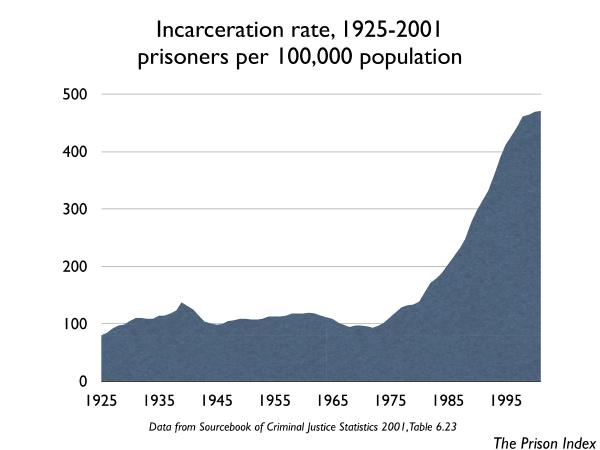
Damn, seems like the prison population started exploding with St Ronnie's election and getting the VRWC (includes the PIC) ball rolling
http://www.prisonpolicy.org/graphs/incrate19252001.html
=======
A ava Job, Ronnie!
Wouldn't those guys actually push for more incarcerations and stiffer penalties? It only makes business sense to them.
There are currently 1 users browsing this thread. (0 members and 1 guests)
 Posting Permissions