Page 35 of 65 FirstFirst ... 2531323334353637383945 ... LastLast
Results 851 to 875 of 1608
  1. #851
    dangerous floater Winehole23's Avatar
    My Team
    San Antonio Spurs
    Join Date
    Nov 2008
    Post Count
    113,765
    the war on Iran as conducted so far has some stratgeic problems

    If the war in Ukraine was a wake-up call for the Western defence industrial base, the first 16 days of the Iran conflict are a fire alarm signalling a crisis of endurance. The intense consumption of advanced munitions during Operation Epic Fury has revealed a critical vulnerability: a strategically ruinous cost-exchange ratio that the West’s industrial capacity is not prepared to sustain.While American and Israeli forces achieve some tactical success by striking thousands of targets, the wider coalition is also downing drones and intercepting missiles by expending multi-million-dollar missiles that cost a fraction of the price. These tactics have ‘astonished’ Ukrainian military advisors deployed to the region because they have observed coalition air defences ‘firing thoughtlessly.’

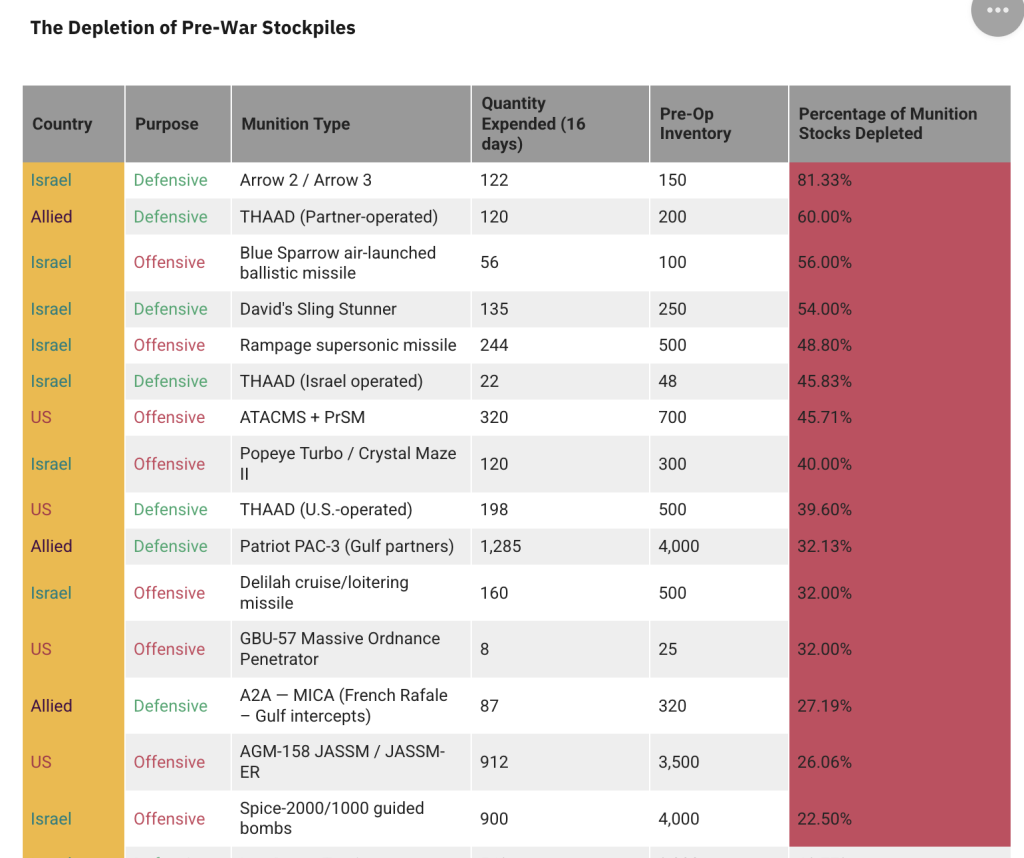
    This asymmetry is rapidly depleting high-end stockpiles. As shown in Table 1, our Payne Ins ute proprietary ledger tool tracked Iran war munition expenditures, which shows coalition forces expending 11,294 munitions in the first 16 days of the conflict, at a cost of approximately $26 billion.

    After an initial salvo of over 5,000 munitions in the first 96 hours, the conflict has settled into a grinding trial of attrition. While Iran’s daily missile and drone attacks have fallen by 80-90% from their initial peak, the sustained pace continues to drain the coalition’s most critical assets. Accordingly, our analysis has tracked that since day 5 and after, Iranian missile and drone attacks have averaged 33 and 94 strikes per day respectively.


    The true strategic risk, however, is not the total expenditure but the uneven rate of depletion. Inventories of some munitions remain deep and scalable, while others – particularly long-range interceptors and precision strike weapons – are nearing exhaustion.depletion. Inventories of some munitions remain deep and scalable, while others – particularly long-range interceptors and precision strike weapons – are nearing exhaustion.

    This dynamic marks the convergence of several established strategic logics. Bertrand Badie’s ‘impotence of power’ captured the paradox of modern warfare, where American hyperpower of battlefield dominance fails to secure political outcomes. Barry Posen’s ‘Command of the Commons’ grounded US military primacy in its ability to project power across global sea, air and space. Yet, as Martin van Creveld warned back in 1991 that advanced militaries become uniquely fragile when their power depends on complex, low-density systems that are difficult to replace under stress.

    This emerging imperative demands a new strategic framework: ‘Command of the Reload.’ In a salvo-based environment, where ‘missile math’ governs the intensity of warfighting, the decisive advantage shifts to the actor that can sustain its defensive economy and replenish its most critical assets. Operation Epic Fury is the first test of this new reality, and its initial results are a stark warning.


    The Anatomy of Endurance: Critical Categories and the Second-Theatre Tax

    The core lesson from the first 16 days is that ‘critical’ is becoming a material condition. A munition becomes critical when its replenishment is gated by thin suppliers, long qualification cycles, or constrained components like rocket motors and guidance electronics. Prior to the conflict, multiple reports had already warned of a ‘deteriorating US defence industrial base’ and its ‘empty bins in a wartime environment.’ The mass of the weapon is not the measure; a few kilograms of a constrained input, such as gallium, battery-chemicals or graphite, can stall the production of various weapons, while a warehouse full of steel is useless if a system is bottlenecked at the sub-tier.

    This industrial fragility is exacerbated by both policy inertia and geopolitical realities. Even after the Trump Administration met with defence industry executives on 6 March, our discussions with defence firms indicate that no production surge has occurred because no funded orders have been placed. Industry leaders are reluctant to increase production without firm commitments, having been ‘burned’ in the past by promises of funding that did not materialize. Compounding this, the sole American factory for high explosives, Holston Army Ammunition Plant, has not received orders to increase production. Industrial base production is only made worse by the closure of the Strait of Hormuz, which threatens upstream supply chains for vital materials like sulphur.

    As Table 2 shows, over a dozen munition types have been expended by the coalition at a rate that appears to be unsustainable. Already, Rheinmetall CEO Armin Papperger noted on 19 March that global stockpiles are ‘empty or nearly empty’ and that if the war continues another month ‘we nearly have no missiles available’.


    This analysis points to three watchlists that govern endurance: interceptors, long-range standoff strike, and the sensor-and-command layer. These categories determine whether bases stay protected, whether the coalition can strike at low risk, and whether the engagement picture remains coherent. Volume munitions are plentiful, but they do not subs ute for defeating threats at scale, nor can they compensate for the loss of radar coverage that keeps interception economical. Given that Iran has damaged at least a dozen US and allied radars and satellite terminals, the efficiency of interception decreases; using 10 or 11 interceptors for one missile or 8 patriot missiles for one drone becomes unsustainable.
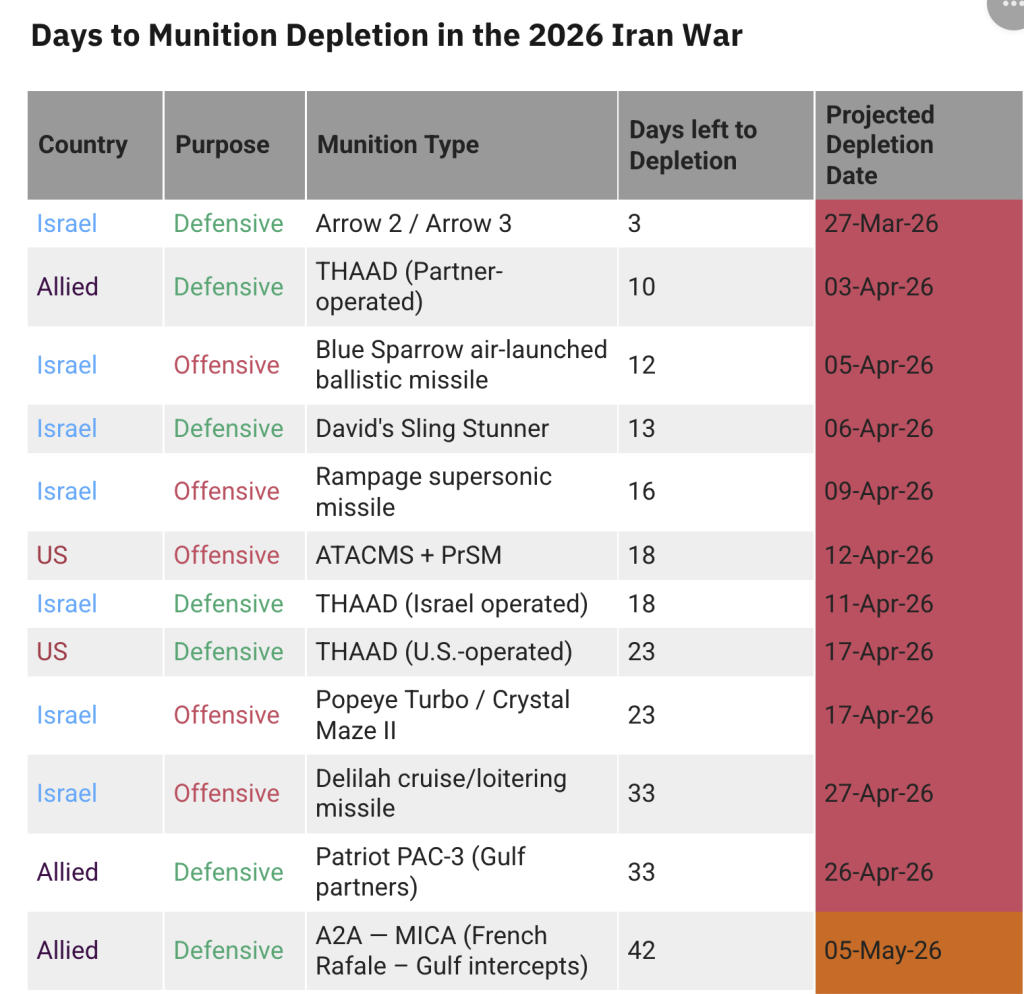
    As seen in Table 3, our analysis shows the magazine abyss for the coalition is coming soon.


    What stands out most about Table 3 is that the US military is approximately a month, or less, away from running out of ATACMS/PrSM ground-attack missiles and THAAD interceptors. Israel is in an even more precarious spot, with its Arrow interceptor missiles likely to be completely expended by the end of March. While the war could proceed with other munitions, this implies accepting greater risk for aircraft and tolerating more missile and drone ‘leakers’ damaging forces and infrastructure. The precariousness of this ‘empty bins’ issue could possibly explain why President Trump is already suggesting the ‘winding down‘ of the Iran war; it could take years to replace what was expended in only 16 days.

    While the defence industrial base is producing most of these munitions at present, they are incredibly complex and difficult to surge, meaning it will likely take at least 5 years to replenish the 500 plus Tomahawk missiles already fired in the war. Worse, sourcing critical defence minerals, rare earths, and materials to make the weapons and munitions is complicated by China. China controls most of the world’s gallium and germanium, and Beijing has imposed numerous mineral export controls since 2023, to prevent the US and its allies from acquiring these necessary inputs for the defence industrial base.

    These dynamics create the strategic consequence Epic Fury makes hard to ignore: the second-theatre tax. Our analysis shows that the coalition can continue fighting Iran, but with increased risk to forces in-theatre. The bigger risk, however, is what continued fighting against Iran does to deterrence and defence elsewhere.

    https://www.rusi.org/explore-our-res...erns-endurance

  2. #852
    dangerous floater Winehole23's Avatar
    My Team
    San Antonio Spurs
    Join Date
    Nov 2008
    Post Count
    113,765
    We really started a high tempo conflict with zero understanding of munitions replenishment or magazine depth or just basic industrial policy. Our leaders had a cartoonish idea of military capabilities.

  3. #853
    dangerous floater Winehole23's Avatar
    My Team
    San Antonio Spurs
    Join Date
    Nov 2008
    Post Count
    113,765

  4. #854
    dangerous floater Winehole23's Avatar
    My Team
    San Antonio Spurs
    Join Date
    Nov 2008
    Post Count
    113,765


  5. #855
    dangerous floater Winehole23's Avatar
    My Team
    San Antonio Spurs
    Join Date
    Nov 2008
    Post Count
    113,765
    Israeli chief of staff warns military will ‘collapse in on itself’ due to soldier shortage


    The chief of staff of the Israeli military has warned that it will “collapse in on itself” due to growing demand and a shortfall of manpower as it fights multiple fronts.


    “I am raising 10 red flags before you,” Eyal Zamir told a security cabinet meeting on Wednesday, according to Israeli media reports. He said that it wouldn’t be long before the military was unable to perform routine missions.


    He said the military needs a “conscription law, a reserve duty law, and a law to extend mandatory service”.
    https://www.aljazeera.com/news/liveb...update=4437797

  6. #856
    Veteran velik_m's Avatar
    My Team
    San Antonio Spurs
    Join Date
    Jul 2005
    Post Count
    9,147
    That can't be true, Trump would never lie:

    Trump Says “Wars Can Be Fought ‘Forever’” as US and Israel Unleash Terror in Iran

    President Donald Trump ominously said on Monday that the U.S. has the weaponry to fight “forever,” as the administration’s refusal to state a definitive timeline or end goals for its war on Iran sparks worries of yet another prolonged, disastrous U.S. conflict in the Middle East.

    In a post on Truth Social just before midnight on Tuesday, Trump said that the U.S. has a “virtually unlimited supply” of munitions — which reports have said is not true — that would allow the U.S. to continue fighting indefinitely.

    “Wars can be fought ‘forever,’ and very successfully, using just these supplies (which are better than other countries finest arms!),” Trump wrote.
    ...
    https://truthout.org/articles/trump-...error-in-iran/

  7. #857
    dangerous floater Winehole23's Avatar
    My Team
    San Antonio Spurs
    Join Date
    Nov 2008
    Post Count
    113,765
    AEP in the Tory Telegraph on the looming man-made food crisis

    The war in the Gulf has hit the epicentre of global fertiliser production. It has shut off the supply of urea, ammonia and sulphur for 27 critical days in the agricultural calendar.


    China, Russia and Turkey have now greatly compounded the shortage by imposing their own curbs on fertiliser exports in recent days. Close to 45pc of globally traded nitrogen is cut off, disrupted or at risk.


    The crunch is happening just as the big farming belts of the northern hemisphere near the spring planting season and just as Australia approaches winter planting. It is the blackest of black swans.


    Abdolreza Abbassian, the former head of commodities at the United Nations’ Food and Agriculture Organization, said the markets did not yet seem to grasp the full gravity of what was already in the pipeline.


    “It will be bad enough even if the Strait of Hormuz is reopened tomorrow but if the war goes on for another month or more, it is going to be a really horrifying crisis unlike anything any of us have ever seen before,” he said.


    A second crisis is building up in parallel. The two risk colliding in 2027. Atmospheric scientists expect an El Niño pattern in the South Pacific this year and next, leading to hotter weather, longer droughts and lower crop yields.


    A team at Columbia University has warned the world could hit 1.7 degrees above pre-modern levels in 2027, a “regime shift” that smashes through the heat thresholds of wheat and corn, and increases the risk of multiple breadbasket failures. Could it go non-linear? We will find out.
    Jean-Marie Paugam, from the World Trade Organization, said the fertiliser shock is a greater immediate threat than the oil and gas shock….


    China is the world’s biggest producer of fertilisers by far, accounting for 15pc of global urea exports and 30pc of phosphate fertilisers. It tightened export curbs on most of its output last week, hitting the market at the worst possible moment.


    Russia is the second largest. It followed suit this week, imposing a one-month ban (for now) on shipments of ammonium nitrate in order to meet “the needs of the domestic market during the spring field work period”.


    Turkey has joined the stampede, even blocking the transport of urea.
    America is scarcely in better shape. It imports a fifth of its applied nitrogen. The Fertilizer Ins ute says the US does produce its own phosphates, but it needs sulphur from the Gulf to make it possible.


    American farmers were in a structural depression before this crisis because of spiralling input costs. They now face a 70pc jump in diesel prices. The fuel tracks the global market regardless of Donald Trump’s “energy
    supremacy”.

    A quarter of US farmers did not pre-buy their fertilisers. None will escape the long-tail consequences later this year.
    https://archive.is/gSx3E#selection-2255.4-2255.76

  8. #858
    dangerous floater Winehole23's Avatar
    My Team
    San Antonio Spurs
    Join Date
    Nov 2008
    Post Count
    113,765
    US/Israel aggression has massively strengthened the hand of IRGC hardliners


    The US and Israel have removed Iran’s Foreign Minister Abbas Araghchi and Parliamentary Speaker Mohammad Ghalibaf from their hit list after mediators said that peace talks would be dead without them, according to multiple reports.

    Ghalibaf and Araghchi were in Israel’s crosshairs when mediators from Pakistan, Turkey, and Egypt warned the US that their deaths would likely sink any hopes of a diplomatic end to the war.
    ttps://nypost.com/2026/03/26/world-news/us-removes-irans-top-two-negotiators-from-kill-list-for-now/

  9. #859
    wrong about pizzagate TSA's Avatar
    My Team
    Sacramento Kings
    Join Date
    Feb 2007
    Post Count
    22,596
    The Coercive Sequence: How Trump’s Iran War Actually Works
    Why negotiation and war are part of the same strategy and what critics still fail to see

    The Misreading of the War

    In recent weeks, much of the media commentary on the Iran war has followed the same line. Trump, we are told, entered the conflict without a strategy. His goals are unclear. The Islamic Republic is still functioning. It is still firing missiles. Its leaders are still speaking in the language of defiance. Therefore, the argument goes, the United States must be failing. Much of the commentary has described the war as lacking a plan, marked by confusion over its aims, and driven by shifting goals. Some have gone further, arguing that even an American victory over Iran would be bad for the United States and for the wider world.

    This reading is wrong. The war is not the absence of strategy. It is coercive diplomacy: terms first, pressure second, pause third, then renewed pressure from a stronger position.

    To judge the war only by missile launches, angry speeches, and the continued movement of a battered regime is to miss the larger picture. What critics call a war without a strategy is, in fact, an attempt to end twenty years of failed policy.
    The Logic of Coercion

    For two decades, Washington tried different ways to stop the Islamic Republic’s nuclear advance. Some administrations leaned more on sanctions. Others leaned more on diplomacy. Some tried both. Yet through all of it, the Islamic Republic moved from zero enrichment to 60 percent. By June 2025, the IAEA said Iran had 440.9 kilograms of uranium enriched to that level, enough for multiple nuclear bombs if enriched further. At the same time, the IRGC’s missile stockpile grew, its range and destructive power increased, and those capabilities spread to proxies from Lebanon to Iraq and Yemen. That was the result of the old approach.

    The war has costs for the United States, politically and financially. But inaction was costlier. Washington began negotiating with Iran when enrichment was at 3 to 5 percent. It was still negotiating two decades later, after that level had reached 60 percent. By then, from a technical point of view, reaching weapons-grade material was no longer a scientific hurdle. It was a political decision. For years, diplomacy was politically and financially preferable to war. But there was no longer another twenty-year window. Iran was a nuclear-threshold state, shielded by a large missile arsenal and aligned with China and Russia. And Iran is not North Korea. It sits in the middle of the world’s most strategic region, close to major energy routes, trade corridors, and American allies. Its weaponisation would have carried far wider consequences. The price the United States is paying now is heavy. But it is still far less than the political, economic, and geopolitical price it would have paid for allowing the Islamic Republic to harden into an entrenched nuclear-threshold power.

    The war has costs for the United States. But inaction was costlier.

    Trump’s answer was different. He was no longer trying to manage the problem or secure another temporary arrangement. After returning to office in January 2025, he demanded rollback: an end to enrichment, limits on the missile programme, and the dismantling of the proxy network through which the Islamic Republic had built regional power. Tehran refused, as it had through two decades of diplomacy and negotiation. The result was a shift from bargaining to attrition. The regime began to lose, by force, the very instruments through which it had built deterrence and projected power. In that sense, coercion was producing the rollback that diplomacy had failed to secure.

    The 12-day war began in June 2025, after diplomacy failed and Israel struck the Islamic Republic’s nuclear and military infrastructure. The attack came at the end of a two-month negotiating window set by Trump. It marked the shift from coercive diplomacy to open war.

    Trump stopped the war after twelve days. That pause, too, was part of the strategy. The June war did not target the political leadership. It was meant to shock the regime and force a choice, while giving its political leaders time to assess the damage and decide whether saving the system now required giving up some of its strategic assets.

    That did not happen. A few months later, negotiations resumed, but within the same coercive framework. They were not a fresh search for compromise. They were another attempt to force acceptance of the same core demands.

    Ali Khamenei rejected those terms again and was killed in the opening moments of the second war. This followed the same logic. If Khamenei himself was the main barrier to surrender, then removing him could create space for others inside the system to accept what the Islamic Republic had long refused.

    But the regime remained defiant. Seventeen days after Khamenei’s death, Ali Larijani, another senior political figure, was also killed. Now, Ghalibaf’s name is being floated as the man who could be pushed to accept those demands. But the deeper reality is that Ghalibaf is not the man calling the shots in Iran today. Nor was Larijani. After Khamenei, no one is fully in command. This, too, is a sign of a system struck at the centre and beginning to unravel.

    The administration’s refusal to recognise Mojtaba Khamenei, along with Trump’s dismissal of him as “a lightweight” who would be “unacceptable” as Iran’s leader, is part of the same coercive sequence. By denying him legitimacy from the outset, Washington is floating names, testing possibilities, and searching for someone within the regime willing to sign. At the same time, the regime’s nuclear, missile, naval, and proxy assets, together with the wider military machinery on which its regional power depended, are being steadily degraded. The Islamic Republic still has a choice: relinquish what remains by agreement, or lose it by force.

    Negotiation and war are not opposites. They are successive phases of the same campaign.

    This is the point many critics miss. In Trump’s approach, negotiation and war are not opposites. They are successive phases of the same campaign. Negotiation presented the terms. Force raised the cost of refusal. The pause tested whether the strikes had altered the regime’s calculations. Negotiation then resumed from a position of greater pressure. That is not incoherence. It is strategy.
    The End of the Old Status Quo

    Whatever happens next, Trump has already changed the strategic picture. If this war ends with the fall of the Islamic Republic, he will have secured a historic victory. If the regime survives, it will survive in a diminished form. In less than a month, Washington has already achieved what twenty years of negotiations did not: an Islamic Republic with its nuclear and missile programmes sharply pushed back and its regional reach greatly reduced. Either way, the old status quo is gone.

    Two analytical mistakes have made this harder to see.

    The first is to mistake visible continuity for strength. In an earlier essay on the Islamic Republic’s collapse plan, I argued that a system can still fire missiles, repress, broadcast, and project fragments of normality after its centre has been hit. None of that proves it is strategically healthy.

    The second is to act surprised by escalation. Before the war, I described the Islamic Republic’s logic as deterrence through escalation. Anyone who thought the regime would collapse through decapitation alone misunderstood it. The administration clearly did not make that mistake. That is why it deployed hundreds of tons of ammunition to the region before the war began. Continued missile fire does not prove that Trump has no strategy. It shows that the Islamic Republic has one too: absorb punishment, escalate where possible, and hope that fear, market shock, and regional pressure weaken American resolve before the regime is forced into real surrender.

    The very states Iran hoped to intimidate are moving in the opposite direction.

    But that strategy has limits. The more the regime threatens shipping, attacks infrastructure, and uses missiles, drones, and proxies as tools of pressure, the more it convinces its neighbours that their own trade, investment, and long-term stability cannot safely coexist with the Islamic Republic as it is. Tehran’s calculation was that regional havoc would frighten neighbouring Arab states into pressing Washington to stop the war. Instead, the logic has begun to reverse. Qatar and Saudi Arabia have declared Iranian diplomatic personnel persona non grata, while the UAE has closed its embassy in Tehran and withdrawn its diplomatic mission. The very states Iran hoped to intimidate are moving in the opposite direction, concluding that its capacity for disruption must be reduced, not accommodated.

    So the central argument is simple. Much of the prevailing media reading is wrong because it mistakes visible continuity for strategic success and escalation for surprise. It sees a regime still speaking, still firing, still standing in some form, and concludes that Washington must have no plan. But the plan is visible. Trump appears to have concluded that sanctions, diplomacy, delay, and partial restriction did not stop the Islamic Republic’s nuclear advance. They only slowed it while the programme moved closer to threshold status. His answer was not to manage the problem more carefully, but to try to end it.

    One may say this strategy is dangerous. One may say it is too blunt, too risky, or too ambitious. But it is not absent. The question is no longer whether Trump has a strategy. The question is whether the Islamic Republic, under the greatest pressure it has faced in decades, will accept strategic retreat before the cost of refusal becomes existential.

    With or without another war, the regime’s days are numbered

    The war may continue until the regime falls. It may also pause again, to give Tehran one more chance to accept the terms. But if the regime persists on the same path and tries to rebuild what it has lost, a third war will be hard to avoid. In the meantime, it will face crippling sanctions and a far more hostile region after firing hundreds of missiles and drones at neighbouring states. They will not forget this episode. For two decades, those same states were Tehran’s economic lifeline, tolerating the Islamic Republic’s elaborate sanctions-busting networks and the thousands of front companies through which it kept trade alive. That lifeline is now fraying. The old status quo is gone. With or without another war, the regime’s days are numbered. That is the strategic shift many analysts still fail to see.

    https://parpanchi.substack.com/p/the...nce-how-trumps
    Mehdi Parpanchi
    @parpanchi
    Writing on Iran: power, repression, protest, and regional strategy. Executive Editor, Iran International TV. Former Iran Service Director at RFE/RL’s Radio Farda; former lead presenter at BBC Persian.

  10. #860
    dangerous floater Winehole23's Avatar
    My Team
    San Antonio Spurs
    Join Date
    Nov 2008
    Post Count
    113,765
    ^^^ that's just a long way of saying "we've already won"

  11. #861
    right about pizzagate Blake's Avatar
    My Team
    San Antonio Spurs
    Join Date
    Jan 2006
    Post Count
    83,636
    the war on Iran as conducted so far has some stratgeic problems

    https://www.rusi.org/explore-our-res...erns-endurance
    There was no strategy to begin with

  12. #862
    right about pizzagate Blake's Avatar
    My Team
    San Antonio Spurs
    Join Date
    Jan 2006
    Post Count
    83,636
    The Coercive Sequence: How Trump’s Iran War Actually Works
    Why negotiation and war are part of the same strategy and what critics still fail to see

    The Misreading of the War

    In recent weeks, much of the media commentary on the Iran war has followed the same line. Trump, we are told, entered the conflict without a strategy. His goals are unclear. The Islamic Republic is still functioning. It is still firing missiles. Its leaders are still speaking in the language of defiance. Therefore, the argument goes, the United States must be failing. Much of the commentary has described the war as lacking a plan, marked by confusion over its aims, and driven by shifting goals. Some have gone further, arguing that even an American victory over Iran would be bad for the United States and for the wider world.

    This reading is wrong. The war is not the absence of strategy. It is coercive diplomacy: terms first, pressure second, pause third, then renewed pressure from a stronger position.

    To judge the war only by missile launches, angry speeches, and the continued movement of a battered regime is to miss the larger picture. What critics call a war without a strategy is, in fact, an attempt to end twenty years of failed policy.
    The Logic of Coercion

    For two decades, Washington tried different ways to stop the Islamic Republic’s nuclear advance. Some administrations leaned more on sanctions. Others leaned more on diplomacy. Some tried both. Yet through all of it, the Islamic Republic moved from zero enrichment to 60 percent. By June 2025, the IAEA said Iran had 440.9 kilograms of uranium enriched to that level, enough for multiple nuclear bombs if enriched further. At the same time, the IRGC’s missile stockpile grew, its range and destructive power increased, and those capabilities spread to proxies from Lebanon to Iraq and Yemen. That was the result of the old approach.

    The war has costs for the United States, politically and financially. But inaction was costlier. Washington began negotiating with Iran when enrichment was at 3 to 5 percent. It was still negotiating two decades later, after that level had reached 60 percent. By then, from a technical point of view, reaching weapons-grade material was no longer a scientific hurdle. It was a political decision. For years, diplomacy was politically and financially preferable to war. But there was no longer another twenty-year window. Iran was a nuclear-threshold state, shielded by a large missile arsenal and aligned with China and Russia. And Iran is not North Korea. It sits in the middle of the world’s most strategic region, close to major energy routes, trade corridors, and American allies. Its weaponisation would have carried far wider consequences. The price the United States is paying now is heavy. But it is still far less than the political, economic, and geopolitical price it would have paid for allowing the Islamic Republic to harden into an entrenched nuclear-threshold power.

    The war has costs for the United States. But inaction was costlier.

    Trump’s answer was different. He was no longer trying to manage the problem or secure another temporary arrangement. After returning to office in January 2025, he demanded rollback: an end to enrichment, limits on the missile programme, and the dismantling of the proxy network through which the Islamic Republic had built regional power. Tehran refused, as it had through two decades of diplomacy and negotiation. The result was a shift from bargaining to attrition. The regime began to lose, by force, the very instruments through which it had built deterrence and projected power. In that sense, coercion was producing the rollback that diplomacy had failed to secure.

    The 12-day war began in June 2025, after diplomacy failed and Israel struck the Islamic Republic’s nuclear and military infrastructure. The attack came at the end of a two-month negotiating window set by Trump. It marked the shift from coercive diplomacy to open war.

    Trump stopped the war after twelve days. That pause, too, was part of the strategy. The June war did not target the political leadership. It was meant to shock the regime and force a choice, while giving its political leaders time to assess the damage and decide whether saving the system now required giving up some of its strategic assets.

    That did not happen. A few months later, negotiations resumed, but within the same coercive framework. They were not a fresh search for compromise. They were another attempt to force acceptance of the same core demands.

    Ali Khamenei rejected those terms again and was killed in the opening moments of the second war. This followed the same logic. If Khamenei himself was the main barrier to surrender, then removing him could create space for others inside the system to accept what the Islamic Republic had long refused.

    But the regime remained defiant. Seventeen days after Khamenei’s death, Ali Larijani, another senior political figure, was also killed. Now, Ghalibaf’s name is being floated as the man who could be pushed to accept those demands. But the deeper reality is that Ghalibaf is not the man calling the shots in Iran today. Nor was Larijani. After Khamenei, no one is fully in command. This, too, is a sign of a system struck at the centre and beginning to unravel.

    The administration’s refusal to recognise Mojtaba Khamenei, along with Trump’s dismissal of him as “a lightweight” who would be “unacceptable” as Iran’s leader, is part of the same coercive sequence. By denying him legitimacy from the outset, Washington is floating names, testing possibilities, and searching for someone within the regime willing to sign. At the same time, the regime’s nuclear, missile, naval, and proxy assets, together with the wider military machinery on which its regional power depended, are being steadily degraded. The Islamic Republic still has a choice: relinquish what remains by agreement, or lose it by force.

    Negotiation and war are not opposites. They are successive phases of the same campaign.

    This is the point many critics miss. In Trump’s approach, negotiation and war are not opposites. They are successive phases of the same campaign. Negotiation presented the terms. Force raised the cost of refusal. The pause tested whether the strikes had altered the regime’s calculations. Negotiation then resumed from a position of greater pressure. That is not incoherence. It is strategy.
    The End of the Old Status Quo

    Whatever happens next, Trump has already changed the strategic picture. If this war ends with the fall of the Islamic Republic, he will have secured a historic victory. If the regime survives, it will survive in a diminished form. In less than a month, Washington has already achieved what twenty years of negotiations did not: an Islamic Republic with its nuclear and missile programmes sharply pushed back and its regional reach greatly reduced. Either way, the old status quo is gone.

    Two analytical mistakes have made this harder to see.

    The first is to mistake visible continuity for strength. In an earlier essay on the Islamic Republic’s collapse plan, I argued that a system can still fire missiles, repress, broadcast, and project fragments of normality after its centre has been hit. None of that proves it is strategically healthy.

    The second is to act surprised by escalation. Before the war, I described the Islamic Republic’s logic as deterrence through escalation. Anyone who thought the regime would collapse through decapitation alone misunderstood it. The administration clearly did not make that mistake. That is why it deployed hundreds of tons of ammunition to the region before the war began. Continued missile fire does not prove that Trump has no strategy. It shows that the Islamic Republic has one too: absorb punishment, escalate where possible, and hope that fear, market shock, and regional pressure weaken American resolve before the regime is forced into real surrender.

    The very states Iran hoped to intimidate are moving in the opposite direction.

    But that strategy has limits. The more the regime threatens shipping, attacks infrastructure, and uses missiles, drones, and proxies as tools of pressure, the more it convinces its neighbours that their own trade, investment, and long-term stability cannot safely coexist with the Islamic Republic as it is. Tehran’s calculation was that regional havoc would frighten neighbouring Arab states into pressing Washington to stop the war. Instead, the logic has begun to reverse. Qatar and Saudi Arabia have declared Iranian diplomatic personnel persona non grata, while the UAE has closed its embassy in Tehran and withdrawn its diplomatic mission. The very states Iran hoped to intimidate are moving in the opposite direction, concluding that its capacity for disruption must be reduced, not accommodated.

    So the central argument is simple. Much of the prevailing media reading is wrong because it mistakes visible continuity for strategic success and escalation for surprise. It sees a regime still speaking, still firing, still standing in some form, and concludes that Washington must have no plan. But the plan is visible. Trump appears to have concluded that sanctions, diplomacy, delay, and partial restriction did not stop the Islamic Republic’s nuclear advance. They only slowed it while the programme moved closer to threshold status. His answer was not to manage the problem more carefully, but to try to end it.

    One may say this strategy is dangerous. One may say it is too blunt, too risky, or too ambitious. But it is not absent. The question is no longer whether Trump has a strategy. The question is whether the Islamic Republic, under the greatest pressure it has faced in decades, will accept strategic retreat before the cost of refusal becomes existential.

    With or without another war, the regime’s days are numbered

    The war may continue until the regime falls. It may also pause again, to give Tehran one more chance to accept the terms. But if the regime persists on the same path and tries to rebuild what it has lost, a third war will be hard to avoid. In the meantime, it will face crippling sanctions and a far more hostile region after firing hundreds of missiles and drones at neighbouring states. They will not forget this episode. For two decades, those same states were Tehran’s economic lifeline, tolerating the Islamic Republic’s elaborate sanctions-busting networks and the thousands of front companies through which it kept trade alive. That lifeline is now fraying. The old status quo is gone. With or without another war, the regime’s days are numbered. That is the strategic shift many analysts still fail to see.

    https://parpanchi.substack.com/p/the...nce-how-trumps
    Mehdi Parpanchi
    @parpanchi
    Writing on Iran: power, repression, protest, and regional strategy. Executive Editor, Iran International TV. Former Iran Service Director at RFE/RL’s Radio Farda; former lead presenter at BBC Persian.
    OBLITERATED!!*

    - TSA six months ago

  13. #863
    Alleged Michigander ChumpDumper's Avatar
    My Team
    San Antonio Spurs
    Join Date
    May 2003
    Post Count
    154,406
    The Coercive Sequence: How Trump’s Iran War Actually Works
    Why negotiation and war are part of the same strategy and what critics still fail to see

    The Misreading of the War

    In recent weeks, much of the media commentary on the Iran war has followed the same line. Trump, we are told, entered the conflict without a strategy. His goals are unclear. The Islamic Republic is still functioning. It is still firing missiles. Its leaders are still speaking in the language of defiance. Therefore, the argument goes, the United States must be failing. Much of the commentary has described the war as lacking a plan, marked by confusion over its aims, and driven by shifting goals. Some have gone further, arguing that even an American victory over Iran would be bad for the United States and for the wider world.

    This reading is wrong. The war is not the absence of strategy. It is coercive diplomacy: terms first, pressure second, pause third, then renewed pressure from a stronger position.

    To judge the war only by missile launches, angry speeches, and the continued movement of a battered regime is to miss the larger picture. What critics call a war without a strategy is, in fact, an attempt to end twenty years of failed policy.
    The Logic of Coercion

    For two decades, Washington tried different ways to stop the Islamic Republic’s nuclear advance. Some administrations leaned more on sanctions. Others leaned more on diplomacy. Some tried both. Yet through all of it, the Islamic Republic moved from zero enrichment to 60 percent. By June 2025, the IAEA said Iran had 440.9 kilograms of uranium enriched to that level, enough for multiple nuclear bombs if enriched further. At the same time, the IRGC’s missile stockpile grew, its range and destructive power increased, and those capabilities spread to proxies from Lebanon to Iraq and Yemen. That was the result of the old approach.

    The war has costs for the United States, politically and financially. But inaction was costlier. Washington began negotiating with Iran when enrichment was at 3 to 5 percent. It was still negotiating two decades later, after that level had reached 60 percent. By then, from a technical point of view, reaching weapons-grade material was no longer a scientific hurdle. It was a political decision. For years, diplomacy was politically and financially preferable to war. But there was no longer another twenty-year window. Iran was a nuclear-threshold state, shielded by a large missile arsenal and aligned with China and Russia. And Iran is not North Korea. It sits in the middle of the world’s most strategic region, close to major energy routes, trade corridors, and American allies. Its weaponisation would have carried far wider consequences. The price the United States is paying now is heavy. But it is still far less than the political, economic, and geopolitical price it would have paid for allowing the Islamic Republic to harden into an entrenched nuclear-threshold power.

    The war has costs for the United States. But inaction was costlier.

    Trump’s answer was different. He was no longer trying to manage the problem or secure another temporary arrangement. After returning to office in January 2025, he demanded rollback: an end to enrichment, limits on the missile programme, and the dismantling of the proxy network through which the Islamic Republic had built regional power. Tehran refused, as it had through two decades of diplomacy and negotiation. The result was a shift from bargaining to attrition. The regime began to lose, by force, the very instruments through which it had built deterrence and projected power. In that sense, coercion was producing the rollback that diplomacy had failed to secure.

    The 12-day war began in June 2025, after diplomacy failed and Israel struck the Islamic Republic’s nuclear and military infrastructure. The attack came at the end of a two-month negotiating window set by Trump. It marked the shift from coercive diplomacy to open war.

    Trump stopped the war after twelve days. That pause, too, was part of the strategy. The June war did not target the political leadership. It was meant to shock the regime and force a choice, while giving its political leaders time to assess the damage and decide whether saving the system now required giving up some of its strategic assets.

    That did not happen. A few months later, negotiations resumed, but within the same coercive framework. They were not a fresh search for compromise. They were another attempt to force acceptance of the same core demands.

    Ali Khamenei rejected those terms again and was killed in the opening moments of the second war. This followed the same logic. If Khamenei himself was the main barrier to surrender, then removing him could create space for others inside the system to accept what the Islamic Republic had long refused.

    But the regime remained defiant. Seventeen days after Khamenei’s death, Ali Larijani, another senior political figure, was also killed. Now, Ghalibaf’s name is being floated as the man who could be pushed to accept those demands. But the deeper reality is that Ghalibaf is not the man calling the shots in Iran today. Nor was Larijani. After Khamenei, no one is fully in command. This, too, is a sign of a system struck at the centre and beginning to unravel.

    The administration’s refusal to recognise Mojtaba Khamenei, along with Trump’s dismissal of him as “a lightweight” who would be “unacceptable” as Iran’s leader, is part of the same coercive sequence. By denying him legitimacy from the outset, Washington is floating names, testing possibilities, and searching for someone within the regime willing to sign. At the same time, the regime’s nuclear, missile, naval, and proxy assets, together with the wider military machinery on which its regional power depended, are being steadily degraded. The Islamic Republic still has a choice: relinquish what remains by agreement, or lose it by force.

    Negotiation and war are not opposites. They are successive phases of the same campaign.

    This is the point many critics miss. In Trump’s approach, negotiation and war are not opposites. They are successive phases of the same campaign. Negotiation presented the terms. Force raised the cost of refusal. The pause tested whether the strikes had altered the regime’s calculations. Negotiation then resumed from a position of greater pressure. That is not incoherence. It is strategy.
    The End of the Old Status Quo

    Whatever happens next, Trump has already changed the strategic picture. If this war ends with the fall of the Islamic Republic, he will have secured a historic victory. If the regime survives, it will survive in a diminished form. In less than a month, Washington has already achieved what twenty years of negotiations did not: an Islamic Republic with its nuclear and missile programmes sharply pushed back and its regional reach greatly reduced. Either way, the old status quo is gone.

    Two analytical mistakes have made this harder to see.

    The first is to mistake visible continuity for strength. In an earlier essay on the Islamic Republic’s collapse plan, I argued that a system can still fire missiles, repress, broadcast, and project fragments of normality after its centre has been hit. None of that proves it is strategically healthy.

    The second is to act surprised by escalation. Before the war, I described the Islamic Republic’s logic as deterrence through escalation. Anyone who thought the regime would collapse through decapitation alone misunderstood it. The administration clearly did not make that mistake. That is why it deployed hundreds of tons of ammunition to the region before the war began. Continued missile fire does not prove that Trump has no strategy. It shows that the Islamic Republic has one too: absorb punishment, escalate where possible, and hope that fear, market shock, and regional pressure weaken American resolve before the regime is forced into real surrender.

    The very states Iran hoped to intimidate are moving in the opposite direction.

    But that strategy has limits. The more the regime threatens shipping, attacks infrastructure, and uses missiles, drones, and proxies as tools of pressure, the more it convinces its neighbours that their own trade, investment, and long-term stability cannot safely coexist with the Islamic Republic as it is. Tehran’s calculation was that regional havoc would frighten neighbouring Arab states into pressing Washington to stop the war. Instead, the logic has begun to reverse. Qatar and Saudi Arabia have declared Iranian diplomatic personnel persona non grata, while the UAE has closed its embassy in Tehran and withdrawn its diplomatic mission. The very states Iran hoped to intimidate are moving in the opposite direction, concluding that its capacity for disruption must be reduced, not accommodated.

    So the central argument is simple. Much of the prevailing media reading is wrong because it mistakes visible continuity for strategic success and escalation for surprise. It sees a regime still speaking, still firing, still standing in some form, and concludes that Washington must have no plan. But the plan is visible. Trump appears to have concluded that sanctions, diplomacy, delay, and partial restriction did not stop the Islamic Republic’s nuclear advance. They only slowed it while the programme moved closer to threshold status. His answer was not to manage the problem more carefully, but to try to end it.

    One may say this strategy is dangerous. One may say it is too blunt, too risky, or too ambitious. But it is not absent. The question is no longer whether Trump has a strategy. The question is whether the Islamic Republic, under the greatest pressure it has faced in decades, will accept strategic retreat before the cost of refusal becomes existential.

    With or without another war, the regime’s days are numbered

    The war may continue until the regime falls. It may also pause again, to give Tehran one more chance to accept the terms. But if the regime persists on the same path and tries to rebuild what it has lost, a third war will be hard to avoid. In the meantime, it will face crippling sanctions and a far more hostile region after firing hundreds of missiles and drones at neighbouring states. They will not forget this episode. For two decades, those same states were Tehran’s economic lifeline, tolerating the Islamic Republic’s elaborate sanctions-busting networks and the thousands of front companies through which it kept trade alive. That lifeline is now fraying. The old status quo is gone. With or without another war, the regime’s days are numbered. That is the strategic shift many analysts still fail to see.

    https://parpanchi.substack.com/p/the...nce-how-trumps
    Mehdi Parpanchi
    @parpanchi
    Writing on Iran: power, repression, protest, and regional strategy. Executive Editor, Iran International TV. Former Iran Service Director at RFE/RL’s Radio Farda; former lead presenter at BBC Persian.
    But we don't need the "straight" or regime change, right?

    Tell us why we are there and about to put boots on the ground.

    Be specific

  14. #864
    Alleged Michigander ChumpDumper's Avatar
    My Team
    San Antonio Spurs
    Join Date
    May 2003
    Post Count
    154,406
    Is Trump going to choose a leader of a Muslim religion?

    How does this work?

  15. #865
    wrong about pizzagate TSA's Avatar
    My Team
    Sacramento Kings
    Join Date
    Feb 2007
    Post Count
    22,596
    OBLITERATED!!*

    - TSA six months ago
    There was no strategy to begin with!!*

    -Blake one minute before quoting the strategy to begin with


  16. #866
    wrong about pizzagate TSA's Avatar
    My Team
    Sacramento Kings
    Join Date
    Feb 2007
    Post Count
    22,596
    OBLITERATED!!*

    - TSA six months ago
    There was no strategy to begin with!!*

    -Blake one minute before quoting the strategy to begin with


  17. #867
    Alleged Michigander ChumpDumper's Avatar
    My Team
    San Antonio Spurs
    Join Date
    May 2003
    Post Count
    154,406
    What happens next, TSA?

    You're the expert.

    After all, you gave us the precise location of our LCS vessels with only a 3000 nautical mile margin of error.

  18. #868
    dangerous floater Winehole23's Avatar
    My Team
    San Antonio Spurs
    Join Date
    Nov 2008
    Post Count
    113,765
    The Houthis will release an "important statement" in the coming hours, according to the Houthi-affiliated Al Masirah.

  19. #869
    right about pizzagate Blake's Avatar
    My Team
    San Antonio Spurs
    Join Date
    Jan 2006
    Post Count
    83,636
    There was no strategy to begin with!!*

    -Blake one minute before quoting the strategy to begin with


    There's no strategy other than just bomb them and see what happens. Just because you post a long text wall doesn't mean it's not just a mental gymnastic Trump love opinion piece. You believe everything positive you're told to believe about Trump's crazy moves.

    You'll also never admit you were wrong about parroting the Trump party line that Iran's nuclear program was OBLITERATED!*...... among many other things you're so wrong about.

  20. #870
    right about pizzagate Blake's Avatar
    My Team
    San Antonio Spurs
    Join Date
    Jan 2006
    Post Count
    83,636
    What happens next, TSA?

    You're the expert.

    After all, you gave us the precise location of our LCS vessels with only a 3000 nautical mile margin of error.
    STRATEGY!*

  21. #871
    dangerous floater Winehole23's Avatar
    My Team
    San Antonio Spurs
    Join Date
    Nov 2008
    Post Count
    113,765

  22. #872
    Believe.
    My Team
    San Antonio Spurs
    Join Date
    Aug 2018
    Post Count
    12,591
    Protecting pedophile/child rapists such as trump and his sick friends- sure is expensive as …just release the files and save the planet from all this destruction already…

  23. #873
    dangerous floater Winehole23's Avatar
    My Team
    San Antonio Spurs
    Join Date
    Nov 2008
    Post Count
    113,765
    Rubio admits the US strategic blunder to the G7, tells them it's their problem now

    Iran wasn't the tollkeeper of Hormuz before we attacked them

    “I did describe to our allies, however, that immediately after this thing ends, and we’re done with our objectives, the immediate challenge we’re going to face is an Iran that may decide that they want to set up a tolling system in the Strait of Hormuz. Not only is this illegal, it’s unacceptable, it’s dangerous for the world. And it’s important that the world have a plan to confront it.”
    But these countries have a lot at stake, not just the G7 countries, but countries in Asia and all over the world have a lot at stake and should contribute greatly to that effort, to ensure that neither the Strait of Hormuz or, frankly, any international waterways should ever be something that’s controlled or tolled by a nation-state or by a terroristic government like the one that exists in Iran today and that clerical, radical clerical regime.”
    https://talkingpointsmemo.com/edblog...-a-huge-bummer

  24. #874
    Alleged Michigander ChumpDumper's Avatar
    My Team
    San Antonio Spurs
    Join Date
    May 2003
    Post Count
    154,406
    Depends on the tolls tbh. Countries are already paying it. That's their plan. What is Trump's plan?

  25. #875
    dangerous floater Winehole23's Avatar
    My Team
    San Antonio Spurs
    Join Date
    Nov 2008
    Post Count
    113,765
    There was no strategy to begin with
    would be just like Trump to do it based on a vibe

Thread Information

Users Browsing this Thread

There are currently 1 users browsing this thread. (0 members and 1 guests)

Posting Permissions

  • You may not post new threads
  • You may not post replies
  • You may not post attachments
  • You may not edit your posts
  •