

Page 4 of 5 FirstFirst 12345 LastLast
Results 76 to 100 of 114
  1. #76
    dangerous floater Winehole23's Avatar
    My Team
    San Antonio Spurs
    Join Date
    Nov 2008
    Post Count
    113,762
    I heard DOD restored this at the 11th hour, so good on them for that

  2. #77
    dangerous floater Winehole23's Avatar
    My Team
    San Antonio Spurs
    Join Date
    Nov 2008
    Post Count
    113,762
    Trump's war on data looks feels and supers ious, but what it's really about is cir scribing the ability of non-political ins utions to define reality -- Trump thinks he should get to define it without any interference from pesky scientists and statisticians

    More children ages 1 to 4 die of drowning than any other cause of death. Nearly a quarter of adults received mental health treatment in 2023, an increase of 3.4 million from the prior year. The number of migrants from Mexico and northern Central American countries stopped by the U.S. Border Patrol was surpassed in 2022 by the number of migrants from other nations.

    We know these things because the federal government collects, organizes and shares the data behind them. Every year, year after year, workers in agencies that many of us have never heard of have been amassing the statistics that undergird decision-making at all levels of government and inform the judgments of business leaders, school administrators and medical providers nationwide.

    The survival of that data is now in doubt, as a result of the Department of Government Efficiency’s comprehensive assault on the federal bureaucracy.

    Reaction to those cuts has focused understandably on the hundreds of thousands of civil servants who have lost their jobs or are on the verge of doing so and the harm that millions of people could suffer as a result of the shuttering of aid programs.

    Overlooked amid the turmoil is the fact that many of DOGE’s cuts have been targeted at a very specific aspect of the federal government: its collection and sharing of data. In agency after agency, the government is losing its capacity to measure how American society is functioning, making it much harder for elected officials or others to gauge the nature and scale of the problems we are facing and the effectiveness of solutions being deployed against them.

    The data collection efforts that have been shut down or are at risk of being curtailed are staggering in their breadth. In some cases, datasets from past years now sit orphaned, their caretakers banished and their future uncertain; in others, past data has vanished for the time being, and it’s unclear if and when it will reappear. Here are just a few examples:

    The Department of Health and Human Services, now led by Robert F. Kennedy Jr., laid off the 17-person team in charge of the National Survey on Drug Use and Health, which for more than five decades has tracked trends in substance abuse and mental health disorders. The department’s Administration for Children and Families is weeks behind on the annual update of the Adoption and Foster Care Analysis and Reporting System, the nationwide database of child welfare cases, after layoffs effectively wiped out the team that compiles that information. And the department has placed on leave the team that oversees the Pregnancy Risk Assessment Monitoring System, a collection of survey responses from women before and after giving birth that has become a crucial tool in trying to address the country’s disconcertingly high rate of maternal mortality.

    The Centers for Disease Control and Prevention has eviscerated divisions that oversee the WISQARS database on accidental deaths and injuries — everything from fatal shootings to poisonings to car accidents — and the team that maintains AtlasPlus, an interactive tool for tracking HIV and other sexually transmitted diseases.

    The Environmental Protection Agency is planning to stop requiring oil refineries, power plants and other industrial facilities to measure and report their greenhouse gas emissions, as they have done since 2010, making it difficult to know whether any of the policies meant to slow climate change and reduce disaster are effective. The EPA has also taken down EJScreen, a mapping tool on its website that allowed people to see how much industrial pollution occurs in their community and how that compares with other places or previous years.

    The Office of Homeland Security Statistics has yet to update its monthly tallies on deportations and other indices of immigration enforcement, making it difficult to judge President Donald Trump’s triumphant claims of a crackdown; the last available numbers are from November 2024, in the final months of President Joe Biden’s tenure. (“While we have submitted reports and data files for clearance, the reporting and data file posting are delayed while they are under the new administration’s review,” Jim Scheye, director of operations and reporting in the statistics unit, told ProPublica.)

    And, in a particularly concrete example of ceasing to measure, deep cutbacks at the National Weather Service are forcing it to reduce weather balloon launches, which gather a vast repository of second-by-second data on everything from temperature to humidity to atmospheric pressure in order to improve forecasting.

    Looked at one way, the war on measurement has an obvious potential motivation: making it harder for critics to gauge fallout resulting from Trump administration layoffs, deregulation or other shifts in policy. In some cases, the data now being jettisoned is geared around concepts or presumptions that the administration fundamentally rejects: EJScreen, for instance, stands for “environmental justice” — the effort to ensure that communities don’t suffer disproportionately from pollution and other environmental harms. (An EPA spokesperson said the agency is “working to diligently implement President Trump’s executive orders, including the ‘Ending Radical and Wasteful Government DEI Programs and Preferencing.’” The spokesperson added: “The EPA will continue to uphold its mission to protect human health and the environment” in Trump’s second term.) The White House press office did not respond to a request for comment.

    Laura Lindberg, a Rutgers public health professor, lamented the threatened pregnancy-risk data at the annual conference of the Population Association of America in Washington last week. In an interview, she said the administration’s cancellation of data collection efforts reminded her of recent actions at the state level, such as Florida’s withdrawal in 2022 from the CDC’s Youth Risk Behavior Survey after the state passed its law discouraging classroom discussion of sexual orientation. (The state’s education secretary said the survey was “inflammatory” and “sexualized.”) Discontinuing the survey made it harder to discern whether the law had adverse mental health effects among Florida teens. “States have taken on policies that would harm people and then are saying, ‘We don’t want to collect data about the impact of the policies,’” Lindbergsaid. “Burying your head in the sand is not going to be a way to keep the country healthy.” (HHS did not respond to a request for comment.)

    Making the halt on data gathering more confounding, though, is the fact that, in some areas, the information at risk of being lost has been buttressing some of the administration’s own claims. For instance, Trump and Vice President JD Vance have repeatedly cited, as an argument for tougher border enforcement, the past decade’s surge in fentanyl addiction — a trend that has been definitively captured by the national drug use survey that is now imperiled. That survey’s mental health components have also undergirded research on the threat being posed to the nation’s young people by smartphones and social media, which many conservatives have taken up as a cudgel against Big Tech.

    Or take education. The administration and its conservative allies have been able to argue that Democratic-led states kept schools closed too long during the pandemic because there was nationwide data — the National Assessment of Educational Progress, aka the Nation’s Report Card — that showed greater drops in student achievement in districts that stayed closed longer. But now NAEP is likely to be reduced in scope as part of crippling layoffs at the Department of Education’s National Center for Education Statistics, which has been slashed from nearly 100 employees to only three, casting into doubt the future not only of NAEP but also of a wide array of long-running longitudinal evaluations and the department’s detailed tallies of nationwide K-12 and higher education enrollment. The department did not respond to a request for comment but released a statement on Thursday saying the next round of NAEP assessments would still be held next year.

    Dan Goldhaber, an education researcher at the University of Washington, cast the self- defeating nature of the administration’s war on educational assessment in blunt terms: “The irony here is that if you look at some of the statements around the Department of Education, it’s, ‘We’ve invested X billion in the department and yet achievement has fallen off a cliff.’ But the only reason we know that is because of the NAEP data collection effort!”

    S y Burns, a mathematical statistician who worked at NCES for about 35 years before her entire team was laid off in March, made a similar point about falling student achievement. “How does the country know that? They know it because we collected it. And we didn’t spin it. We didn’t say, ‘Biden is president, so let’s make it look good,’” she said. “Their new idea about how to make education great again — how will you know if it worked if you don’t have independent data collection?”
    https://www.propublica.org/article/t...rnal-mortality

  3. #78
    dangerous floater Winehole23's Avatar
    My Team
    San Antonio Spurs
    Join Date
    Nov 2008
    Post Count
    113,762
    is this cancel culture?


  4. #79
    Veteran velik_m's Avatar
    My Team
    San Antonio Spurs
    Join Date
    Jul 2005
    Post Count
    9,147
    Why a NASA satellite that scientists and farmers rely on may be destroyed on purpose

    The Trump administration has asked NASA employees to draw up plans to end at least two major satellite missions, according to current and former NASA staffers. If the plans are carried out, one of the missions would be permanently terminated, because the satellite would burn up in the atmosphere.

    The data the two missions collect is widely used, including by scientists, oil and gas companies and farmers who need detailed information about carbon dioxide and crop health. They are the only two federal satellite missions that were designed and built specifically to monitor planet-warming greenhouse gases.

    It is unclear why the Trump administration seeks to end the missions. The equipment in space is state of the art and is expected to function for many more years, according to scientists who worked on the missions. An official review by NASA in 2023 found that "the data are of exceptionally high quality" and recommended continuing the mission for at least three years.

    ...

    The missions are called Orbiting Carbon Observatories because they were originally designed to measure carbon dioxide in the atmosphere. But soon after they launched, scientists realized that they were also accidentally measuring plant growth on Earth.

    Basically, when plants are growing, photosynthesis is happening in their cells. And that photosynthesis gives off a very specific wavelength of light. The OCO instruments in space measure that light all over the planet.

    "NASA and others have turned this happy accident into an incredibly valuable set of maps of plant photosynthesis around the world," explains Scott Denning, a longtime climate scientist at Colorado State University who worked on the OCO missions and is now retired. "Lo and behold, we also get these lovely, high resolution maps of plant growth," he says. "And that's useful to farmers, useful to rangeland and grazing and drought monitoring and forest mapping and all kinds of things, in addition to the CO2 measurements."

    For example, the U.S. Department of Agriculture and many private agricultural consulting companies use the data to forecast and track crop yield, drought conditions and more.
    ...
    The cost of maintaining the two OCO satellite missions up in space is a small fraction of the amount of money taxpayers already spent to design and launch the instruments. The two missions cost about $750 million to design, build and launch, according to David Crisp, the retired NASA scientist, and that number is even higher if you include the cost of an initial failed rocket launch that sent an identical carbon dioxide measuring instrument into the ocean in 2009.

    By comparison, maintaining both OCO missions in orbit costs about $15 million per year, Crisp says. That money covers the cost of downloading the data, maintaining a network of calibration sensors on the ground and making sure the stand-alone satellite isn't hit by space debris, according to Crisp.

    "Just from an economic standpoint, it makes no economic sense to terminate NASA missions that are returning incredibly valuable data," Crisp says.

    ...
    https://www.npr.org/2025/08/04/nx-s1...ion-threatened

  5. #80
    dangerous floater Winehole23's Avatar
    My Team
    San Antonio Spurs
    Join Date
    Nov 2008
    Post Count
    113,762
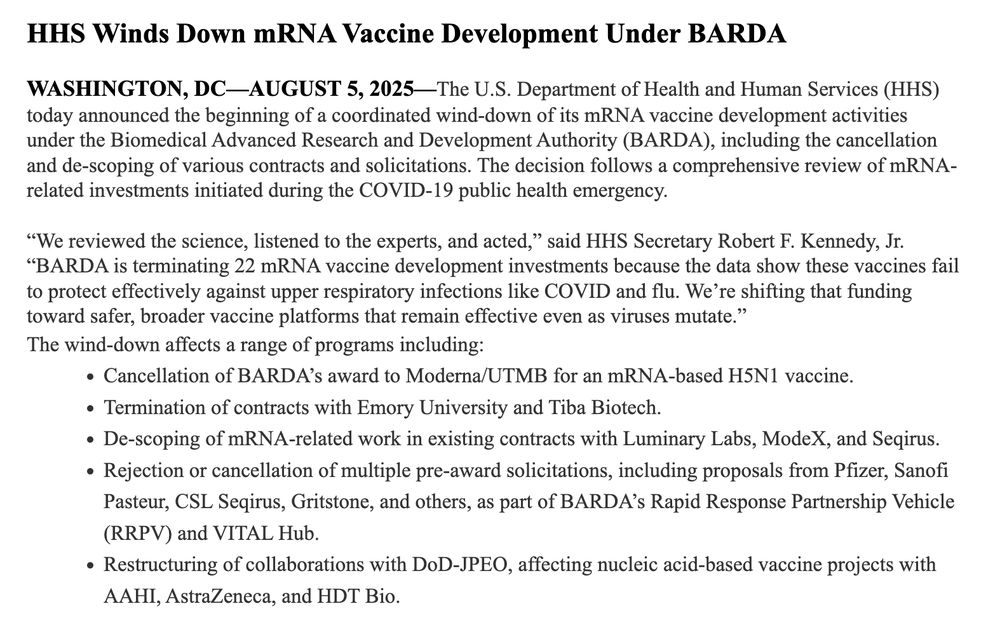
    Just going to point out in passing that by winding down mRNA development, RFK Jr. is leaving probably vaccines for AIDS and two cancers on the shelf, to say nothing of COVID vaccines proven safe in nation-level cohort studies

    Mind-boggling aversion to technical breakthrough, lots of people will suffer and die needlessly

  6. #81
    dangerous floater Winehole23's Avatar
    My Team
    San Antonio Spurs
    Join Date
    Nov 2008
    Post Count
    113,762
    partisan streamlining appears as a solution to arbitrary RIFs

    The 1 December memo says the changes are meant to help the agency cope with a reduced workforce. Some of NSF’s eight directorates reportedly have lost as many as one-third of their program officers through buyouts, early retirements, and voluntary departures. Scientific staff spend a considerable amount of time finding outside reviewers to assess grant applications and then assembling a panel of experts to discuss those written reviews in more detail. The final step in the merit-review process is a one-page summary of the strengths and weaknesses of each project that includes a recommendation to fund or decline the proposed research.
    https://www.science.org/content/arti...ide-scientists

  7. #82
    dangerous floater Winehole23's Avatar
    My Team
    San Antonio Spurs
    Join Date
    Nov 2008
    Post Count
    113,762
    Congress bestirring itself to resist Trump's illegal impoundments

    The U.S. Congress has delivered another rebuke of President Donald Trump’s plans to slash this year’s budgets of several science agencies. Today, lawmakers hammering out final bills covering the National Science Foundation (NSF), NASA science, and Department of Energy (DOE) research programs unveiled an agreement to spend very close to current levels.


    The three appropriations bills were negotiated by a panel of senators and members of the House of Representatives. The proposed spending package would shrink NSF’s $9.06 billion budget by 3.4% this year, or $300 million, compared with Trump’s request for a 55% reduction. Its research account would hold steady at $7.18 billion and its education programs, which Trump sought to essentially eliminate, would receive $938 million. However, that total is $180 million less than NSF received in 2025.


    At NASA, science missions would receive $7.25 billion, $84 million less than this year. That 1.1% dip compares with the 47% cut to its programs that Trump wanted. The space agency’s education activities, which Trump sought to eliminate, would receive $143 million, the same as last year.
    https://www.science.org/content/arti...energy-science

  8. #83
    dangerous floater Winehole23's Avatar
    My Team
    San Antonio Spurs
    Join Date
    Nov 2008
    Post Count
    113,762
    Congress rolls back Trump's draconian cuts to science funding

    The U.S. Congress is moving to reverse President Donald Trump’s proposed steep cuts to federal science programs, signaling strong bipartisan resistance to what would have been the largest reduction in scientific funding since World War II.In his budget proposal, President Trump sought to reduce overall federal science spending from $198 billion to $154 billion, a 22 percent cut that alarmed researchers, universities, and science advocacy groups across the country.However, the Senate Appropriations Committee has released a bipartisan package of spending bills that largely abandons those proposed reductions. If approved, the legislation would allocate approximately $188 billion for federal research, representing a modest 4 percent decrease compared to the previous fiscal year—far less severe than the administration’s proposal.Notably, funding for basic scientific research could actually increase by more than 2 percent under the Senate plan. This stands in sharp contrast to the Trump administration’s proposal, which aimed to cut basic research funding by more than one-third.
    https://internationalnewsandviews.co...ding-394920-2/

  9. #84
    Veteran velik_m's Avatar
    My Team
    San Antonio Spurs
    Join Date
    Jul 2005
    Post Count
    9,147
    U.S. government has lost more than 10,000 STEM Ph.D.s since Trump took office

    Some 10,109 doctoral-trained experts in science and related fields left their jobs last year as President Donald Trump dramatically shrank the overall federal workforce. That exodus was only 3% of the 335,192 federal workers who exited last year but represents 14% of the total number of Ph.D.s in science, technology, engineering, and math (STEM) or health fields employed at the end of 2024 as then-President Joe Biden prepared to leave office.

    The numbers come from employment data posted earlier this month by the White House Office of Personnel Management (OPM). At 14 research agencies Science examined in detail, departures outnumbered new hires last year by a ratio of 11 to one, resulting in a net loss of 4224 STEM Ph.D.s. The graphs that follow show the impact is particularly striking at such scientist-rich agencies as the National Science Foundation (NSF). But across the government, these departing Ph.D.s took with them a wealth of subject matter expertise and knowledge about how the agencies operate.

    ...
    https://www.science.org/content/arti...mp-took-office

  10. #85
    dangerous floater Winehole23's Avatar
    My Team
    San Antonio Spurs
    Join Date
    Nov 2008
    Post Count
    113,762
    civilizatonal suicide

  11. #86
    Veteran velik_m's Avatar
    My Team
    San Antonio Spurs
    Join Date
    Jul 2005
    Post Count
    9,147
    ‘We’re no longer attracting top talent’: the brain drain killing American science

    ...
    The magazine looked at 14 research agencies, including NIH, and found that the number of employees departing outstripped new hires by 11 to one.

    The brain drain is prompting existential fears that American science, a powerhouse of the US economy and of global public health, is being deprived of its lifeblood. The source of young researchers – the next generation of scientists who are the fount of new ideas and innovation – is being throttled.

    “The talent pool is developed by letting young people flourish among like-minded, excited scientists,” said John Prensner, a pediatric brain cancer doctor who leads a research laboratory at the University of Michigan. “If that ceases, then that intellectual discovery, that drive to make the next great insight into cancer or other challenges, will be planted in another country’s soil.”

    The NIH drives scientific progress globally across biomedical and behavioral sciences, including defenses against infectious diseases and possible future pandemics. It pushes at the frontier of new therapies geared to the genetic makeup of individual patients, and can claim numerous breakthroughs in cancer treatment, vaccinations and much more.

    Without the NIH driving innovation at its core, the US would cease to have the largest biomedical ecosystem in the world.

    ...

    So inson redirected her energies abroad. She began applying for posts in Spain and Germany, in the end landing a spot at a prestigious program at a Barcelona infectious disease research ins ution.

    For the foreseeable future, she sees her future in Europe. “It’s important for me to feel I can be myself in my science, and that’s just not possible right now in the US,” she said.

    She is not alone. A growing number of young American scientists are quitting the country for positions in Europe, Australia or Asia. Universities across Europe have been swift to exploit the opportunity, openly enticing young Americans to join the exodus and seek “scientific asylum” with them.

    The response has been overwhelming. Aix-Marseille University, which launched one of the first European programs to lure people from the US, was inundated by hundreds of applications from early-career researchers hoping to flee the US.

    The outflow of young scientists has been exacerbated by deep cuts to NIH training programs, which acts as a breeding ground of the US’s future top scientists. At least 50 training programs, targeted at undergraduates through early-career lab researchers, have been shut down under the Trump administration.
    ...

    In the long run, the damage done to the next generation of researchers threatens to harm not just scientific knowledge itself, but also the US economy. NIH funding supports basic biomedical research out of which new drugs and other commercial spin-offs emerge.

    As such, it provides the foundations for the almost trillion-dollar US pharmaceutical industry. A 2018 study of the 210 new drugs approved by the Food and Drug Administration (FDA) in the six years to 2016 found that all of them had been developed out of early basic research funded by NIH.

    “We are leaving discoveries on the table,” warned Donna Ginther, an economics professor at the University of Kansas who is an authority on the science labor market. “Those discoveries are the ones that in 10, 20 years will contribute to economic growth, improved health, human longevity. That’s what we are choking off.”
    https://www.theguardian.com/us-news/...e-funding-cuts

  12. #87
    Veteran velik_m's Avatar
    My Team
    San Antonio Spurs
    Join Date
    Jul 2005
    Post Count
    9,147
    U.S. science agency moves to restrict foreign scientists from its labs

    In the past few weeks, hundreds of foreign scientists working at the National Ins ute of Standards and Technology (NIST) campuses in Boulder, Colorado, and Gaithersburg, Maryland, have been barred from their labs on evenings and weekends unless escorted by a federal employee. Those from certain countries could lose access altogether as soon as the end of next month. The changes are part of proposed rules aimed at increasing security that would limit, to 3 years, the maximum length of time visiting international researchers can work at NIST.

    The ins ute’s researchers and onlookers worry the new rules could strip labs throughout NIST of up to 500 highly trained researchers and prevent foreign graduate students and postdocs from completing their Ph.D.s or other projects. “This is an absolute disaster,” says one physicist at the University of Colorado (CU) Boulder with close ties to NIST who asked not to be identified for fear of retribution. Maya Miklos, a physics Ph.D. student and U.S. citizen at CU Boulder who works at JILA, a joint ins ute with NIST, agrees. “The mood at NIST is extremely grim right now,” she says. If adopted, Miklos notes, the proposed rules are “going to be extremely detrimental to science.”

    Sources at NIST contacted by ScienceInsider say they have yet to see any written versions of the proposed rules, which have been conveyed in meetings. Patrick Gallagher, a former NIST director now at the University of Pittsburgh, says the lack of clear communication and the short notice being given to foreign scientists is creating a sense of chaos. “I’m as disappointed as to how this is unfolding as to what is unfolding,” Gallagher says. “At the very least NIST owes an explanation to the country. If there is a good reason for what they are doing, they should flat out say what it is.”

    ...
    https://www.science.org/content/arti...tists-its-labs

  13. #88
    dangerous floater Winehole23's Avatar
    My Team
    San Antonio Spurs
    Join Date
    Nov 2008
    Post Count
    113,762
    god how dumb

  14. #89
    dangerous floater Winehole23's Avatar
    My Team
    San Antonio Spurs
    Join Date
    Nov 2008
    Post Count
    113,762
    Trump 2.0 is basically attempted civilizational suicide


  15. #90
    dangerous floater Winehole23's Avatar
    My Team
    San Antonio Spurs
    Join Date
    Nov 2008
    Post Count
    113,762

  16. #91
    dangerous floater Winehole23's Avatar
    My Team
    San Antonio Spurs
    Join Date
    Nov 2008
    Post Count
    113,762
    China to overtake US on investment in science

    China is on the cusp of becoming the world’s biggest public funder of research, according to a forecast by US academics, as stalled growth in government investment in the United States coincides with consistent rises in spending by the Chinese authorities.


    The analysis — produced exclusively for Nature Index — was the work of researchers from Frontiers in Science and Innovation Policy (FSIP), a programme at the University of California, San Diego, that studies the US research and development (R&D) system and examines the extent to which public and private funding boost technological development.


    Government spending on R&D in China increased by 90% to US$133 billion in the decade leading up to 2023, according to the most recent purchasing-power-adjusted data from the Organisation for Economic Co-operation and Development (OECD). By contrast, in the United States, spending rose by just 12%, to $155 billion.


    According to the FSIP’s forecast, China’s public spending on research is likely to overtake that of the United States in the next two to three years.


    “I think the earliest likely is 2028, plus [or] minus one year,” says Robert Conn, a specialist in research policy and science philanthropy, who co-leads the FSIP. “It could be next year, could be 2029.”
    https://www.nature.com/articles/d41586-026-00618-5

  17. #92
    dangerous floater Winehole23's Avatar
    My Team
    San Antonio Spurs
    Join Date
    Nov 2008
    Post Count
    113,762
    There is still a large gap between China and the United States for overall spending on fundamental research. If US expenditure stays broadly flat, then China might not catch up until around 2035, but a real-terms cut in US spending could bring about this scenario sooner.

  18. #93
    dangerous floater Winehole23's Avatar
    My Team
    San Antonio Spurs
    Join Date
    Nov 2008
    Post Count
    113,762
    killing the golden goose


  19. #94
    dangerous floater Winehole23's Avatar
    My Team
    San Antonio Spurs
    Join Date
    Nov 2008
    Post Count
    113,762

  20. #95
    Veteran velik_m's Avatar
    My Team
    San Antonio Spurs
    Join Date
    Jul 2005
    Post Count
    9,147
    Trump fires all 24 members of the U.S. National Science Foundation’s governing body

    U.S. President Donald Trump yesterday fired all 24 members of the National Science Board (NSB), the body that oversees the National Science Foundation (NSF). Many science advocates see it as the latest step by his administration to erode—some would say destroy—the independence of the 76-year-old research agency.

    “On behalf of President Donald J Trump, I am writing to inform you that your position as a member of the National Science Board is terminated, effective immediately,” reads a 24 April email from Mary Sprowls of the presidential personnel office to each NSB member. “Thank you for your service.”

    The NSB is a unique en y within the U.S. government. In addition to advising the administration and Congress on national science policy, it has statutory authority to oversee the actions of the $9-billion NSF, setting policy and approving large expenditures. Its presidentially appointed members, typically prominent academics and industry leaders, serve 6-year terms, with eight members chosen every 2 years.

    ...
    https://www.science.org/content/arti...versight-board

  21. #96
    dangerous floater Winehole23's Avatar
    My Team
    San Antonio Spurs
    Join Date
    Nov 2008
    Post Count
    113,762
    Basically at this point Trump is presiding over cargo cult fascism that lacks the public capacity to consolidate -- the very first thing Trump wrecked was the US civil service, but he didn't wait long to start purging science too.

    The vandalistic elimination of US science is momentous...this could be akin to the prestige German universities and science forfeit in the 1930s-40s

  22. #97
    Veteran velik_m's Avatar
    My Team
    San Antonio Spurs
    Join Date
    Jul 2005
    Post Count
    9,147

  23. #98
    Veteran velik_m's Avatar
    My Team
    San Antonio Spurs
    Join Date
    Jul 2005
    Post Count
    9,147
    Video transcript: A message from President Kornbluth about funding and the talent pipeline

    ...

    First, although Congress restored substantial agency funding, we can see in the numbers that federal funding is not actually flowing to MIT the way it typically has. Relatedly, some federal agencies are discussing the possibility of factoring in geography when they allocate their funds, rather than basing decisions on scientific merit alone.

    Compared to this time last year, MIT has experienced a decline in campus research activity funded by federal awards of more than 20%. Still more concerning is that our number of new federal research awards is also down more than 20%.

    While we’ve seen encouraging growth in research funding from other sponsors, it’s not nearly enough to offset the federal decline.

    So here’s the big picture: Counting federal and non-federal sources together, our campus sponsored-research activity is now 10% smaller than it was a year ago. That is a striking loss for one of the most influential and productive research communities in the world.

    ...

    As I’m sure you all understand, responding to these new pressures is not just a matter of belt-tightening – and it’s not “just trimming around the edges.”

    Last week, I spoke with several senior faculty members, in very different fields, all with long records of winning significant grants. All of them are now having to cut graduate students, postdocs and particular avenues of research.

    At the Ins ute level, we are working on plans to help support groups whose operations are seriously impacted by current federal funding lapses. But that will not be a long-term solution.

    The fact is that we’re looking at a real drop in research being done by the people of MIT. It’s a loss of momentum for faculty and students.

    And frankly, it’s a loss for the nation: When you shrink the pipeline of basic discovery research, you choke off the flow of future solutions, innovations and cures – and you shrink the supply of future scientists.

    ...
    https://president.mit.edu/writing-sp...alent-pipeline

  24. #99
    Veteran velik_m's Avatar
    My Team
    San Antonio Spurs
    Join Date
    Jul 2005
    Post Count
    9,147
    House Republicans propose cutting science budgets, but by less than Trump

    ...
    The House Appropriations Committee proposes level funding for NASA overall, at $24.4 billion. The Trump administration’s budget request proposes $18.8 billion for the space agency, a 23% cut. Rogers said during the CJS markup that the House bill “maintains strong levels of funding for NASA.”

    “With the recent success of Artemis II, it is a critical time to invest in human space exploration and ensure that American astronauts are the first to return to the Moon. With its sights on Mars, NASA will lead the way to the next frontier and safeguard our national security by ensuring America maintains a compe ive advantage over China,” Rogers said.

    While the Trump administration proposes approximately halving SMD funding from $7.3 billion to $3.9 billion, the House proposes a budget of roughly $6 billion — an 18% cut. CJS Subcommittee Ranking Member Grace Meng (D-NY) said the reductions would be “shortsighted.”

    “I disagree with this bill’s approach,” Meng said during the markup. “As I have said repeatedly, I believe we should be doubling down on the investments in science that grow our economy and incentivize advancements that improve life for all Americans.”

    The House proposes funding NSF at $7 billion, a 20% cut, while the Trump administration requested around $4 billion — a more than 50% cut that would reduce funding across NSF’s directorates — including a 67% cut to the Mathematical and Physical Sciences Directorate and 58% to the Geosciences Directorate, as well as the elimination of much of the agency’s social and behavioral sciences funding. The House proposal includes $6.4 billion for research and related activities (down 10% from last year) and $173 million for major research equipment and facilities, down 31%.

    Organizations such as the American Association of Universities have stated that the House’s proposed budget for NSF, though more generous than the Trump administration’s request, is insufficient to keep up with compe ion from China, which recently overtook the U.S. in R&D spending. AAU noted, however, that it was pleased to see that the House preserved language from last year’s bill instructing science agencies to keep indirect cost rates for research at fiscal year 2024 levels.

    ...
    https://www.aps.org/apsnews/2026/05/...g-budgets-less

  25. #100
    Veteran velik_m's Avatar
    My Team
    San Antonio Spurs
    Join Date
    Jul 2005
    Post Count
    9,147
    U.S. researchers face new restrictions on publishing with foreign collaborators

    Grants managers at two of the U.S. government’s largest funders of scientific research have recently placed unprecedented limitations on the ability of U.S. scientists to publish with co-authors from other countries, researchers say. Units of the National Ins utes of Health (NIH) are privately directing grantees to request permission in advance for any co-authorship with a scholar affiliated with a foreign ins ution, even if all the work was done in the United States. NASA, meanwhile, is reportedly telling some grantees that papers co-authored with researchers in China may have violated its rules.

    Neither agency has publicly issued new formal guidance describing these requirements. Instead, officials are informing grantees individually, leaving researchers confused and concerned. In several cases, NIH grantees say they have been asked to remove published papers with foreign co-authors from annual progress reports to the agency. Observers say the policy creates an incentive to preemptively remove foreign co-authors from forthcoming papers.

    At NIH, co-authorship by scientists with foreign affiliations—including ones working at U.S. ins utions—has historically been accepted, and relatively common: According to the most recent analysis available, 30% of papers produced with NIH funding in 2017 had both U.S. and non-U.S. authors. Some oversight of these collaborations for national security considerations is reasonable, says Tobin Smith, senior vice president at the Association of American Universities, a group of leading research ins utions. “You’ve got to assess the risk in each collaboration.” But, he says, “I worry, based upon what we’re hearing, that agencies are now shifting to a blanket mode, and it’s more about who you publish with than what science you are actually publishing. And that will hurt science.”

    ...
    https://www.science.org/content/arti...-collaborators

Thread Information

Users Browsing this Thread

There are currently 1 users browsing this thread. (0 members and 1 guests)

Posting Permissions

  • You may not post new threads
  • You may not post replies
  • You may not post attachments
  • You may not edit your posts
  •