Reply With Quote
that's a very prevalent sentiment
I expect a judicially imposed embargo on environmental avenues of relief before long

Great, let's not do any of it.

that's a very prevalent sentiment
I expect a judicially imposed embargo on environmental avenues of relief before long
https://inpreparation.substack.com/p...dRedirect=trueI recently interviewed for a tenure-track position at a major research university that I will not name because I am still on the job market and cannot afford to burn bridges, although I will say it is located in Connecticut and rhymes with “Fail.” The interview was going well. I had prepared extensively. My research seminar was well-received. My one-on-one meetings were productive. And then came the chalk talk.
For those unfamiliar with the format, a chalk talk is a tradition in academic hiring in which candidates are asked to present their future research plans using only a chalkboard or whiteboard, without slides, to demonstrate their ability to think on their feet and explain complex ideas spontaneously. It is, in other words, a ritual designed in 1974 and never updated.
I walked into the room. I saw the whiteboard. I saw the markers. And then I placed my laptop on the table, opened a browser window to ChatGPT, and prepared to do what I do every single day in my actual scientific practice: type a prompt and receive a coherent, well-structured response that I would then lightly edit and present as my own thinking.
The room went silent.
“What are you doing?” asked the search committee chair.
“I’m preparing to answer your questions,” I said.
“With ChatGPT?”
“Yes,” I said. “How else would I do it?”
Apparently, “how else would I do it” is “from memory, using only my brain, like some kind of medieval peasant.” This was news to me.
Let me be clear about something: I am an excellent scientist. My publication record speaks for itself. I have first-author papers in high-impact journals. I have secured independent funding. I have mentored students. I have done all of the things that one is supposed to do to earn a tenure-track position. And I have done approximately 85% of them by typing prompts into a large language model and then moderately editing the output.
This is not a secret. This is how science works now. When I write a paper, I prompt ChatGPT to “write an introduction for a manuscript about [topic] that establishes significance and identifies the gap in the literature.” When I design experiments, I ask Claude to “suggest controls for a CRISPR knockout study in mammalian cells.” When I draft grants, I request “specific aims for an R01 on [research area] that are innovative but not so innovative that study section will be confused.” This is my scientific process. It is efficient. It is modern. And it produces results.
But apparently, at the chalk talk, I was expected to simply... know things. From my head. Without prompting anything.
My own words? I haven’t used my own words since 2022. I’m not even sure I have my own words anymore. When I try to think without a prompt box in front of me, my mind returns only a vague sense of fog and the faint echo of a cursor blinking. My thoughts are not organized into paragraphs. They do not have topic sentences. They are just fragments. Impressions. My job is just… prompt.
NYT headline change

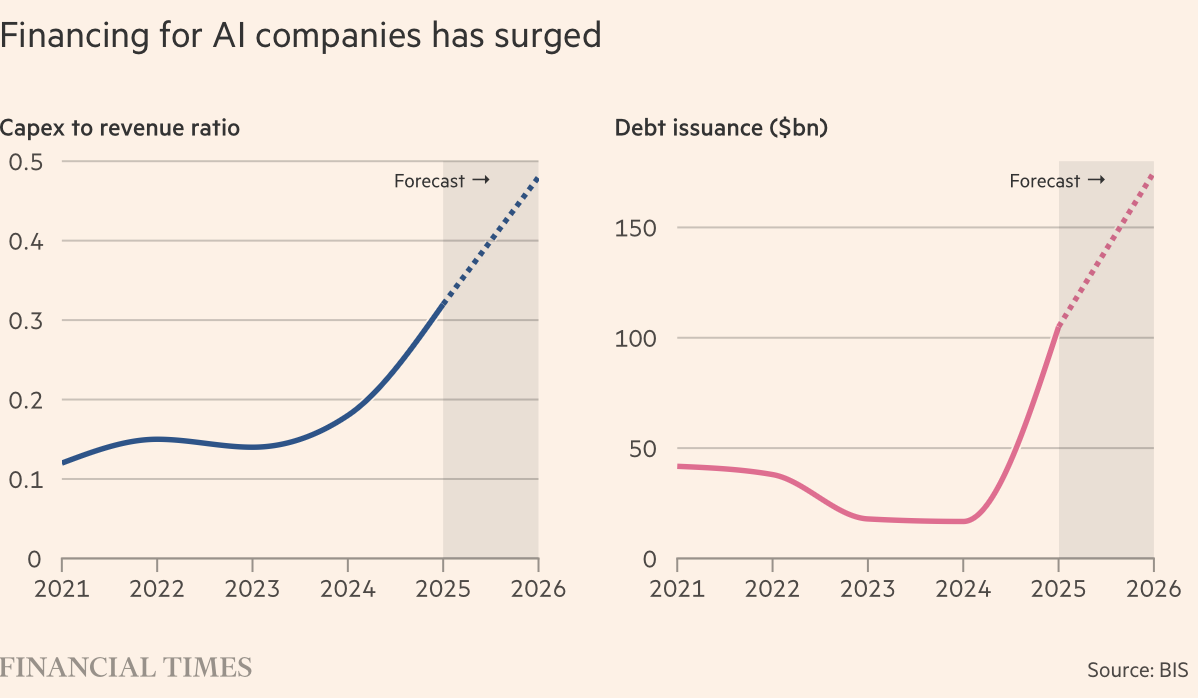
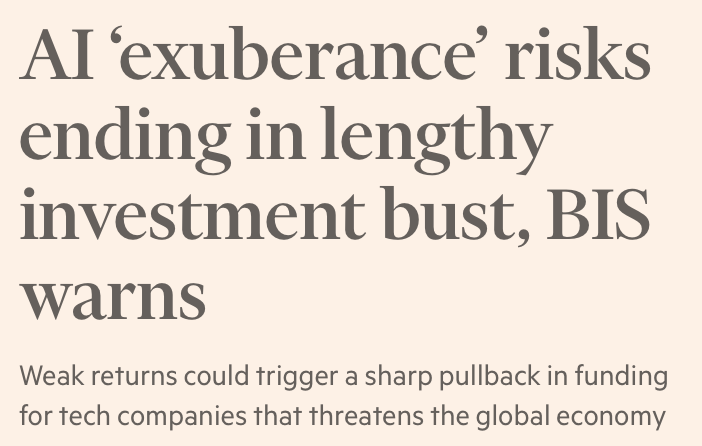 Big Tech’s AI spending spree risks ending in a prolonged “investment bust” that could rattle financial markets and damage the global economy, the Bank for International Settlements has warned.https://www.ft.com/content/e81ce414-...syn-25a6b1a6=1The Basel-based organisation, which advises the world’s central banks, said the prospect of worse than expected returns in the tech sector could prompt investors to rapidly curb financing for AI companies, at a time when the five biggest “hyperscalers” are expected to invest more than $1tn from 2025 to the end of 2026.
The warning comes amid mounting concerns over the scale of equity and debt issuance fuelling the AI revolution and the turbulence this is creating in global markets. Tech groups have flooded into the global credit market, raising hundreds of billions of dollars to fund AI projects, taking advantage of corporate credit spreads that are close to their lowest level this century…
Big investors have warned that this rush to issue debt could test investors’ appe e, especially if the AI investment does not deliver an adequate return…
Allianz’s investment chief warned this week that SpaceX’s decision to launch a $25bn bond sale so soon after its IPO was a sign that markets had entered “bubble territory”….
A major equity market correction associated with AI could have broader implications today than in the past, the BIS added, because households have greater exposure to shares relative to their wealth and income.
Financial stability could also be endangered, given the volumes of debt being sold by AI companies to finance their investment, it warned.
Oracle suggests similar
hyperscaling capex might have been undertaken in a mood of irrational exuberance
www.bloomberg.com/news/newslet...”Some of our customers may be highly leveraged and subject to their own operating and regulatory risks and even if our credit review and analysis mechanisms work properly we may experience risks of non-payment in our dealings with such parties.”

https://www.cnbc.com/2026/07/02/open...-blowback.htmlOpenAI proposes 5% stake to Trump administration to ease Washington pressure: Report
OpenAI has proposed handing the U.S. government a 5% stake in the company, the Financial Times reported Thursday, as the artificial intelligence startup seeks to defuse mounting political pressure in Washington.
A 5% holding would be worth roughly $42.6 billion, after the AI lab closed a record-breaking funding round in March at a post-money valuation of $852 billion.
OpenAI CEO Sam Altman argued that giving the public a financial interest in the company is the best way to share the upside of AI, the FT reported, citing two people familiar with the talks.
Altman suggested a stake of that size in early discussions with the Trump administration, as part of a broader arrangement under which Washington would hold 5% of each of the leading U.S. AI developers via a government vehicle, according to the report.
...
The Trump administration has previously taken stakes in private companies, investing in Intel Corp, IBM, and other quantum and critical mineral companies during the president’s second term.
The government obtained a 10% stake in Intel after a landmark $8.9 billion investment in the chipmaker’s common stock in August last year. In May, President Donald Trump said he should have asked for a bigger stake in the company.
Trump has described the U.S. taking an ownership stake in AI giants as “a beautiful thing” that would make Americans “partners in this revolution.”
some noise about this in the UK too
https://www.wsj.com/politics/nationa...nixed-cbb87e75The Spanish government is instructing state-owned enterprises to ban the US company Palantir Technologies from public contracts, according to a report by El Confidencial, which Cybernews machine-translated.
Sources say the ban stems from concerns about the company’s software handling classified information linked to national security.
furtive pollution
META contaminated Wyoming's wastewater
https://cowboystatedaily.com/2026/07...inated-system/

Meta's Cheyenne campus, one of the largest private construction projects in the city's history, spans hundreds of acres in the High Plains Business Park and is expected to encompass roughly 800,000 square feet when completed.
memory costs rising
the AI bubble is inflationary


Once global oil reserves reach their operational minimum within the next few weeks, oil will e.
This will almost certainly burst the AI bubble, which is massive.
The big AI players like NVIDIA are moving certain liabilities off their books and into the special purpose vehicles, a type of special corporate en y used by Enron to hide its mounting losses.
Teslas first and second quarter financials were propped up by a series of accounting tricks to hide losses. When it runs out of tricks, its mounting losses will cause its stock valuation to plummet, piercing Elons aura of infallibility.
Since Elons brand is propping up SpaceEx and twitter is dying a slow death, much of his financial empire will crumble.
We are approaching a stock market crash and asset bubble devaluation potentially worse than the Great Depression.
hope not, the energy cliff is real though
There are currently 1 users browsing this thread. (0 members and 1 guests)
 Posting Permissions