Reply With Quote
Depends on what you're reading....
Carbon dating labs know about these issues, it's not meant to be hidden like you want to believe.

Then why not correct the text books? I get it when certain anomalies are found in our theories we are dead wrong, and need to not be so much of an ignorant moron. when certain anomalies are found in your theories, it's expected?
Have you ever thought of a career in writing comedy?
Depends on what you're reading....
Carbon dating labs know about these issues, it's not meant to be hidden like you want to believe.
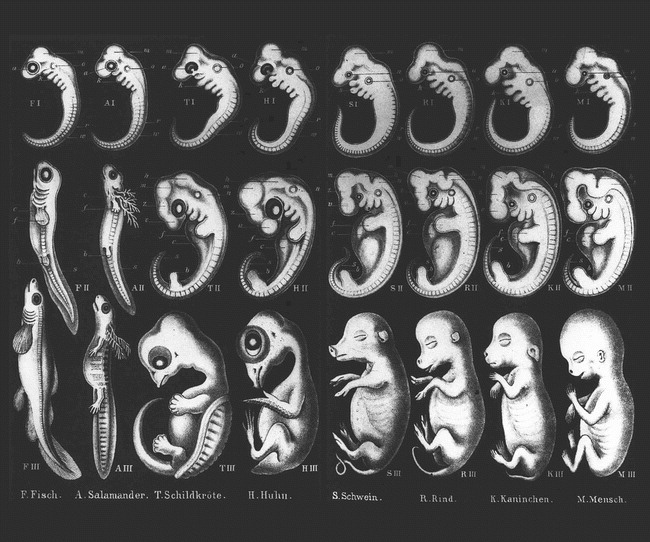
Those same banana eating Scientist also know the fossil chart is wrong and vertebrate embryos chart was faked by your hero Ernst Haeckel and yet much of it is still in many text books today.
Funny how your pals get all bent out of shape when someone points out flaws in Evolution... I can only imagine how you guys would really react if the real truth was taught in class, 98% of parents would begin home schooling overnight.
This type of comedy writes itself.

Nobody has it "all" figured out, but I can tell you that the universe is around 14 billion years old based on observations of the rate of universe expansion.
If it weren't for religion, I'm betting nobody would argue it.
seen that one before in evolution vs creation threads #4, 28, 88 and 102.One last thought... if the singularity that began it all, is by most models infintessimally small... almost to the point of non-existence (we really can't build models where the laws of the universe break down)... that means that everything in the universe was produced by nothing. That's right. It all came from NOTHING.
Think about that for a second... nothing... nothing... nothing... POOF... EVERYTHING!!! Space... Time... Matter... Order... Physical Laws
If that doesn't yell supernatural, I don't know what does...
Queue insults.... 3, 2, 1....
abiogenesis is a different subject.
did you actually read the link? he got thrown into jail for something else. The ID/Darwinism just happened to be in the same paragraph.
I dont think angel luv really wants you fighting her battles for her.Last week, a German court sentenced a 55-year old Lutheran pastor to one year in jail for “Volksverhetzung� (incitement of the people) because he compared the killing of the unborn in contemporary Germany to the holocaust. Next week, the Council of Europe is going to vote on a resolution imposing Darwinism as Europe’s official ideology.
You left out information and made it look like the pastor got thrown in for teaching ID.
That's pretty low and pathetic, even for you, troll.
the only reason I can think of why you posted this is that you misread when I said "what school says teaches that there are no gaps?"
distorting facts are one of the reasons nobody takes you serious in a real debate.
I can call you a jackass because you are a liar and a troll that is doing more harm than good in this thread for anyone trying to figure out real truth.

Only because we speculate as to when sub-atomic particles, and later atoms condensed out of the expanding "Big Bang" energy wave. We also have to assume when the physical laws of the universe actually 'locked into place'. Pretty big assumptions considering these two guesses provide the origin for most regression fits attempting to determine when the universe began. Oddly enough, the Universe is still expanding and accelerating towards faster expansion... which brings me to my next point... one I'll expound on in the last section of this response.
Funny how you would advocate the suppression of truth-seeking questions... when by and large that has been the primary criticism against religious adherents...
I'm not talking about abiogenesis (the creation of life from nothing). I'm talking about the creation of EVERYTHING from absolutely NOTHING... an event which poses a pretty significant philosophical question well before a quan ative one. A big WHY???
As to how that singularity came into existence, the observations of universal expansion mentioned above deal a fatal blow to the presumption that the Big Bang is supposed to be followed by a Big Crunch and that this cyclical process has been going on forever... had such a convenient theory been supported by the evidence it would have spared the scientific community from having to address that 'elephant-in-the-room' question...
The fact of the matter is that the universe came into existence from absolutely nothing... It had a defined beginning... In fact, that very dilemma is what eventually drove Einstein into a Deist belief. The concept is awestrikingly powerful... and vastly overlooked. Especially in light of the fact that the Big Bang theory remains the prevailing explanation for how it all began... amidst recent attempts to eliminate this glaring dilemma no less...
Anyways, believe what you want... and relish the fact that you are in the majority. One that affords you a far more comfortable position to defend...
Last edited by Phenomanul; 10-15-2009 at 12:23 AM.
great. I still wager that the scientific community as a whole is smarter than you when it comes to age of the universe, so you could post a 10 page theory in this thread and it still equals jack squat on the credibilty meter.
Unfunny how you make such a weird assumption and yes, by and large it has been religious adherents that have suppressed truth.Funny how you would advocate the suppression of truth-seeking questions... when by and large that has been the primary criticism against religious adherents...
you're weren't that far off of abiogenesis to begin with. The "why" still works in your questioning.I'm not talking about abiogenesis (the creation of life from nothing). I'm talking about the creation of EVERYTHING from absolutely NOTHING... an event which poses a pretty significant philosophical question well before a quan ative one. A big WHY???
And another yes, your post is philosophical by nature and should stay that way.
it is only a glaring dilemma to you.As to how that singularity came into existence, the observations of universal expansion mentioned above deal a fatal blow to the presumption that the Big Bang is supposed to be followed by a Big Crunch and that this cyclical process has been going on forever... had such a convenient theory been supported by the evidence it would have spared the scientific community from having to address that 'elephant-in-the-room' question...
The fact of the matter is that the universe came into existence from absolutely nothing... It had a defined beginning... In fact, that very dilemma is what eventually drove Einstein into a Deist belief. The concept is awestrikingly powerful... and vastly overlooked. Especially in light of the fact that the Big Bang theory remains the prevailing explanation for how it all began... amidst recent attempts to eliminate this glaring dilemma no less...
really though, this has little to do with the topic.
It's definitely harder to argue against a 14 billion year old universe, and you definitely failed in your attempt to do so.Anyways, believe what you want... and relish the fact that you are in the majority. One that affords you a far more comfortable position to defend...
I gave it a shot. I found Intelligent design and jail in the same story I think I did dam good considering how fast I was pushing the comebacks and doing another 9/11 debate a another forum. Hey Mr. perfect! don't you ever give credit? E for effort? Nah... that's to civilized for your primate way of thinking. Besides you can't, your bias, why ruin your reputation.
!
And I don't think she needs a step father looking over her shoulder let her reply if I was out of line, all of a sudden you care about people? (a Christan at that how ironic.)I don't think angel luv really wants you fighting her battles for her.
Kinda like the way the Schools leave out the gaps and holes in Darwin's half baked theories? It doesn't feel good to be misinformed does it to bad your not so fast to patrol your own lies and mistakes. Pot meet kettle and feel what many have felt for years. (I know it sucks welcome to the club)You left out information and made it look like the pastor got thrown in for teaching ID.
Then I take it you will move on to some other lonely posters? and somehow make them your new targets so you can finally release your sexual frustrations of being a bitter lonely soul all these years who can't really show any love it's against Darwin's law. It's to Christ like. Hey! It's all good dog! (and by dog I mean in evolution terms a man only 20 million years later)That's pretty low and pathetic, even for you, troll.
Go on my brother! This is great news I rather debate with someone who can control their insults and name calling.
But I really don't blame you for being bitter your like 99% of all the Atheist as you go to bed tonight wondering if you somehow have all this very wrong, and you could maybe die in your sleep how ed will it be to wake up in ?
Ps: Say high to George Carlin and David Carradine in case I don't see your pretty face in the morning.
Last edited by mouse; 10-15-2009 at 01:42 AM.
Since you had 14 Billion years more than the rest of us to master this Evoulution feel free to go back a page and address any of my postings.
And to show you I am not a head I even supplied you with a link.
http://www.spurstalk.com/forums/show...=136498&page=4
Ten Reasons Evolution is Wrong
Revised 3/2006
1. Introduction
1a Microevolution Defined
2. Reason 1 Genetics is not Evolution's Friend
2a Were Darwin's Galapagos Finches Evolution?
2b What About Mutations
2c Population Genetics Factors
2d Beneficial verses Positive Mutations
2e Molecular Biology and Irreducible Complexity
2f Do Hox (Homeotic) Genes Save Evolution?
2g Evolution Fails to Predict Genetic Complexity
3. Reason 2 Statistics is not Evolution's Friend
3a A Short Primer on Probability
3b Weasely Dawkins
4. Reason 3 Biochemistry is not Evolution's Friend
4a. Primitive Atmospheres
4b Sydney Fox's Protenoids?
4c The Problem with Chirality
4d Outer Space?
5. Reason 4 Information Theory is not Evolution's Friend
5a Complex Life Information verses Simple Information
5b Specified Complexity
6. Reason 5 Physics is not Evolution's Friend
6a The Laws of Thermodynamics
6b Entropy and Evolution
7. Reason 6 Astronomy is not Evolution's Friend
7a How Old is the Universe?
7b Strange Quasar - Galaxy Connections
7c What do Extra Solar Planets Tell us?
7d What About the Sun?
7e What do the Planets in our Solar System tell us?
7f The Oort cloud and the Kuiper belt
8. Reason Number 7 Paleontology is not Evolution’s Friend
8a The Cambrian Explosion
8b Problems with the Fossil Record
8c Those Pesky Transitional Fossils
8d Bird Evolution
8e Tetrapod Evolution Fact or Fancy
8f A Whale of a Tale
8g Horse Evolution
8h Hominid Evolution or Paleoanthropology
8i Hall of Hoaxes
8j Recent Finds or is Lucy Really a Lady?
8k What Are They Thinking?
9. Reason Number 8 Radiometric Dating is not Evolution’s Friend
9a What is Radiometric Dating?
9b Some Dating Games
9c What About Carbon Dating?
9d Are Decay Rates Constant?
10. Reason Number 9 Evolutionists are not Evolution's Friends
10a Neo-Darwinism
Mae-Wan Ho and Peter Sanders
George Gaylord Simpson
Francis Crick
Richard Dawkins
Stephen Jay Gould
Pierre Grasse
Fred Hoyle
Robert Jastrow
Roger Lewin
Richard Lewontin
Ernst Mayr
Colin Patterson
Michale Ruse
W.R. Thompson
George Wald
10b Paleontology
George Gaylord Simpson
Richard Dawkins
Niles Eldredge
Stephen Jay Gould
Pierre Grasse
Richard Leaky
Ernst Mayr
Colin Patterson
W.R. Thompson
10c Ernst Haeckel - Apostle of Deceit
11. Reason Number 10 Morality is not Evolution's Friend
11a Is Evolution Science or Philosophy?
11b So What if Evolution is an Atheistic Philosophy?
11c The Cartesian Divide and The Kantian Contradiction
11d The Blood Drenched Century of Evolution
11e What About Hitler?
11f What About Stalin?
11g What About Mao?
Before we take on the ten reasons evolution is wrong we must first define what we are talking about. Evolutionists will say the word evolution to you and you may think you know what they are saying, but you probably don’t. There are at least five concepts of evolution that the evolutionist speaks of as one. They are:
1. Cosmic Evolution – Their Cosmology or how the Universe came into being.
2. Stellar Evolution – How the stars, galaxies etc. formed
3. Earth’s Evolution – How the Sun and the planets formed in our solar system.
4. Macroevolution – The postulate that says all life formed from earlier organized non-life and through some form of mutation, natural selection, and enormous amounts of time.
5. Microevolution – The limited variation that takes place in a species or families complex gene pool or genome.
As creationists we may not agree with all these as being evolution and so it helps to understand what we are saying. In this article I agree that microevolution occurs, but the other four are imminently debatable.
Now another issue needs to be face before we go on. Evolutionists are fond of talking down and attacking creationists as being less “scientific” than they. They use ad-hominen attacks and accuse creationists as being stupid and unable to understand their “science”. We need to understand what science is and how our arguments fit in its’ framework.
Science. According to the Oxford Dictionary science is "A branch of study which is concerned either with a connected body of demonstrated truths or with observed facts systematically classified and more or less colligated by being brought under general laws, and which includes trustworthy methods for the discovery of new truth within its own domain."
The process is for a postulate is first formulated and then announced. Then there are three things about this postulate that must be true before it can be considered a theory.
1. The postulate must be observable.
2. The postulate must be capable of repeatable experimental verification
3. The postulate must withstand a fasifiability test, or an experiment conceived which the failure of the experiment would disprove the postulate.
When you talk with evolutionists make sure you have these points covered. They will talk circles around you and call you stupid if you don’t know what they are talking about. As Evolutionists have never observed any of the first four supposed evolutions they assume are true, they only talk about the last microevolution and try to define it as all five! The constantly point out microevolution as being the proof of all the other four. The sooner we creationists figure this out the sooner we can win this debate.
From the points given above is shows us that both evolution and creation are postulates. Neither have much of a chance of becoming a theory because of the difficulty of observing events that happened in the distant past and trying to have those events become repeatable. When evolutionists become dogmatic in their speech as if evolution had been proven beyond any shadow of a doubt, they are talking about microevolution and they are bluffing because the lack real proof.
What we are left to do then is look forensically into such things as fossils, microbiology, biochemistry, information theory, etc. to try and see if we can catch the process in its’ act. We will talk about all these things in this article.
.Microevolution Defined
We now need to define carefully the concept of microevolution as we and the evolutionists both understand it differently. Microevolution to the creationist is the limited variation that can be expressed by the genome of a “species’ or family of plants or animals. It is the variation in the alleles of a genome as they are expressed in sexual reproduction and the mixing of alleles that occurs. These alleles are mostly not the product of mutations, but rather reside in the total genome of a population. See the genetics section for a further treatment of alleles in a genome.
The Evolutionist sees microevolution as the cornerstone of evolutionary theory. They believe that it is billions of microevolution mutations in the genome, creating new alleles, and natural selection preserving those changes that is the process of evolution.
Creationists do not see microevolution as being able to drive the massive information gain that needs to occur for evolution to be possible, that is the ameoba to man evolution concept. Microevolution changes mainly occur through the practice of selective breeding. There are no “mutations” in selective breeding or in genome adaptation to the environment. The complex changes that occur are already in the genome and are merely being brought out from human or environmental pressure.
For instance sugar beets in the early 1800’s had a 6% sugar content, by selective breeding that sugar content had risen to 17% by 1878. That was as far as the breeders were able to stretch the genome and they certainly didn’t create a potato from the sugar beet.
Another instance of microevolution is the English peppered moth (Biston betularia). In pre-industrial England the peppered moth lived on the white bark of the birch tree. The moth came in two basic varieties, peppered white and dark. These two varieties hatch out at about a 50% ratio. But when the dark variety landed on the white birch bark, the birds saw them and ate them at a higher rate than the peppered white moth. But as industrialization occurred and coal dust darkened the birch trees, the peppered white moth became rarer because the birds ate them and the dark variety blended into the tree. But they still hatched out at a 50% ratio. (This has since been proven to have 'staged' photographs of the moths 'glued' to tree trunks - so much for evolutionists objectivity)
Other microevolution issues we look at are selective breeding in dogs, cats or cows for example. If we let these all breed together they would all fall back to some common denominator animal. But you can see how far the genome will stretch when you look at a teacup poodle and a rottweiler. But they never created another species.
In fact evolutionists are experimenting with microevolution experiments to see if mutations, a cornerstone in their postulate, will really cause enough positive changes to move one species to another. Since 1910 there have been accelerated mutation experiments with the fruit fly. To date no success. Since about 1950 there have been accelerated mutation experiments with bacteria and again not much success. Come to think of it these would be really good falsifiability experiments too wouldn’t they?
So with all that said we are now ready to begin our ten reasons evolution is wrong.
Reason Number 1
Genetics is Not Evolution’s Friend
1. Genome – the total genetic structure of a species or kind or its gene pool.
2. Mutation – a mistake in the copying of the DNA; can be caused by radiation, or chemicals.
3. Recombination – the genetic mixing in sexual or asexual reproduction
4. Gene – the stuff of life, the sequence of amino acids in the double helix of DNA
5. Allele – variants of genes in the Genome that are for the same structure but that express a characteristic differently, such as brown eyes vs. blue eyes.
6. Taxon – Category in classification such as species, phylum.
7. Phylogeny – The (supposed) evolutionary history or family tree of a species or other group.
As we stated before evolution depends on beneficial mutation, natural selection and enormous amount of time for it to occur. Therefore we will now look at genetics and see if this is true.
But first let us look at the comments of an amateur evolutionist.
“EVOLUTION IS NOT RANDOM, FOR (probably not) THE LAST TIME. Variety is there because evolution causes random mutation, hence the variety.” From a debate on talkorigins.org
Ummm a little double talk. Well it also appears this is perilously close to evolution being an intelligent designer. But it is also a tautology or circular reasoning to say that “evolution causes random mutation” because evolutionists say random mutation causes evolution.
But to be correct, evolution is a religious philosophy that operates with a lot of faith. So evolution isn’t necessarily any more random than the person’s thoughts and it certainly cannot be some kind of force driving the random mutation. Nor can it cause mutations random or otherwise.
Mutation and natural selection are the engine of evolution. Creationists believe in natural selection but we doubt the role mutations play in evolution and know if we can show that mutations cannot be part of the engine, then evolution will have lost its power.
Genetics and evolution have been enemies from the beginning. Gregor Mendel and Charles Darwin were contemporaries. Mendel is the father of modern genetics and Darwin is the father of evolution. In Darwin’s day genetics was just starting and Darwin knew really very little about how genetics worked. His idea of change in species was based on erroneous and untested ideas of inheritance. Mendel’s ideas were based on careful experimentation and showed that individual characteristics were surprisingly resilient and constant.
Darwin believed in the idea that variations caused by environment could be inherited. Thus the giraffe’s long neck was a result of the “inherited effects of the increased use of parts”. The Origin of Species, 6th ed, London 1902, p 278. Darwin believed that if parent giraffes strained their necks to reach the top leaves then the progeny would inherit longer necks. While even evolutionists today would see this a patently false, they still accept with apparent ease the change in the genetic structure it represents and throw that change to the magic of mutation. It wasn’t until much later that mutations were used as the change agent in evolution because it became apparent this idea of Darwin didn’t work.
In reality there are multiple mutation processes that can impact a genome but evolutionists only choose one. I will explain why in a bit. First the types of mutations:
1. Duplication or Amplification of a segment of DNA
2. Inversion of a segment of DNA
3. Deletion of a segment of DNA
4. Insertion of a segment of DNA
5. Transposition of a segment of DNA from one place to another.
6. Point Mutation of a single nucleotide.
The first five are interesting genetic processes. Each is a complex and precise process that has much biochemical signaling and purpose. We don’t really know much about why the genes do this as we are still very weak in our knowledge of how our genome works. But none of these processes can add any data to the genome, they just move data around. I must add another point here: some evolutionists place recombination in this list, but recombination is sexual mixing and once again cannot add any data to the genome. Recombination just takes the genome and mixes what is there. There are tens of maybe hundreds or trillions of combinations in our genome to recombine. We are wonderfully and fearfully made.
The type of mutations called point mutations are the only genetic processes that can actually add information to the genome and that is why evolutionists have chosen point mutations as the mutational driver of evolution. We will hereafter call point mutations simply mutations to simplify the writing.
Were Darwin's Galapagos Finches Evolution?
What does happen in a population as the genome reacts to the environment? Darwin looks at the finches on the Galapagos Islands and notices variations in beak size. He thought that the harder seed in the dry time was causing the beaks of the finches to grow stouter from the use of the part. But what was happening was that natural selection or a long term drought in the islands was causing the seed cases to harden. The heavier beaked finch allele in the genome was favored and the lighter beaked finch allele was not. The heavier beaked finch became more dominant because it passed on the heavy beak alleles. The heavy beak was not the result of a mutation! It was already an allele in the genome and was just brought out as a result of the environment. When the rains came back the lighter beak became the more efficient beak and the number of heavy beaks reduced. This is microevolution at its best. But there was no change in the genome of the finch and certainly no new species has arisen from this. The genome expresses its variety by recombination of the alleles and causing the phenotype to show its wonderful God given types.
What About Mutations?
But what about mutations then? What are they and how can they be beneficial? Mutations are mistakes in the genetic copying process. They effect one nucleotide base at a time and are called point mutations. Once in every 10,000 to 100,000 copies there is a mistake made. Our bodies have a compare – correct process that is very efficient. In fact it is 1016 times better than the best computer code, but once in every 1,000,000,000 or 10,000,000,000 copies a mutation “gets out” so to speak. That is equal to a professional typist making a mistake in 50,000,000 pages of typescript. You see mutations are predominately bad and the cell tries to make sure they don’t happen.
The Neo-Darwinists made random mutations the engine of evolution. They claim that many very small mutations are the basis of the “goo to you” hypothesis of evolution. For mutations to be the driver of the massive amount of information there must be two things true of those mutations.
1. The mutations must be positive and allow the organism to procreate and pass them on.
2. The mutations must add information to the genome of the organism.
To date no evolutionist has pointed out such a mutation and if they exist they must be exceedingly rare.
The smallness of the point mutation is also in question. Dawkins seems to think that the mutation can be as small as needed to make the hypothesis work, but it appears that one nucleotide base is as small as you can get. So a positive mutation cannot add but a single bit of information to the genome or one nucleotide’s worth. But is that enough? And if that truly does occur will natural selection grab and go with it?
Population Genetics Factors
Population Genetics show that a positive mutation in a population has a poor chance of surviving the “noise” of random events in the population. In a stable population of organisms each organism must reproduce one of itself to keep the stability of the population. But we see in nature that animals must produce many more than one for themselves because of the randomness of death. Even elephants produce 5 to 10 offspring to overcome this random noise factor. Some organisms produce thousands or even millions to assure replacing themselves. Evolutionists want many mutations to occur so positive mutations can be captured by natural selection but a high mutation rate for a population is not good as the overwhelming number of mutations are not good and can destroy a population.
But let’s say that one point mutation occurs and gives an individual a positive value of 0.1 percent for survival and passing on that positive gene. Let us also say that this population needs 5 offspring to keep the population stable or 20 percent growth. The survival rate increase would be 20.02 for the mutation. Sir Ronald Fisher was a mathematician and one of the world’s experts on the mathematics of evolution and one of the founders of the field of population genetics. He was also one of the architects of the Neo Darwinian Theory. He calculated that most mutations with positive survival values would not survive, and he believed that the answer was many positive mutations. He said: “A mutation, even if favorable, will have only a very small chance of establishing itself in the species if it occurs once only.” Fisher R.A. (1958). The Genetical Theory of Natural Selection, Oxford, Second revised edition, New York: Dover.
Let us continue our example above with Fisher’s calculations. Our organism with a 0.1% survival factor would have one chance in 500 of surviving. If there were 500 organisms with the mutation their odds would be about 5 out of 8. With 1000 with the same mutation their odds would be about 6 out of 7 and with 2500 organisms with the same mutation the odds are about even. What are the odds of 2500 organisms having the same point mutation (it has to be the same for that particular information to get into the genome) in a population? The chances that 500 organisms would have the very same point mutation in the very same nucleotide is 1 in 3.6 x 102,738. Lee M. Spentner, Not By Chance – Shattering the Modern Theory of Evolution, The Judica Press, New York, p. 103.
A mutation almost always involves a loss of information or just a copy of information. They have never added new information to the genome, so it appears that they can never bring that genome added complexity. Are there beneficial mutations? Yes there are for certain environments. Blind cave catfishes are the result of the mutation that lost the information of an eye. This mutation caused the eye, which was useless and prone to disease and injury in the cave to be lost and it actually helped the catfish survive in the cave. But the catfish genome did not have any new information added for it to become a perch genome or any other genome. In fact the eye genes were lost to the genome. If that blind fish were to be swept out of the cave by a flood, and that does happen, it won’t survive to pass on those no eye alleles. So natural selection, working in the cave worked to keep the eyeless going, outside the cave will kill it quick. The important thing to keep in mind is that we all along were only working with the genome of the catfish and at no point was there any new information to change that genome to another. Genomes are like rubber bands that you can stretch out very far, but they will always snap back to the original when released.
If we look at the accelerated fruit fly experiments that used radiation to accelerate the copying errors of DNA to try to produce another species, we have only seen fruit flies with parts missing or dead flies or flies too crippled to pass on its genes. They never got a house fly out of the deal. Why? Because the mutation lost information in the fruit fly genome and did not add the information to become a house fly.
Beneficial verses Positive Mutations
How do we define “beneficial” mutations? It is interesting that a mutation such as an orange without seeds is considered useful, that is to orange eaters like me, but to oranges it is not such a good idea, for the seedless orange cannot pass on its genes. It is a useful mutation, but not a positive mutation. A positive mutation would enable the species to pass on its genes more efficiently and would add information to the genome. Evolutionists get this definition confused too.
Another problem is that evolutionists confuse mutations with recombination and alleles. They are not the same. Some variant alleles in a genome are the result of mutation, but most are from recombination and were there at the beginning of that species. All alleles that arise from mutation are either neutral or excessively deleterious. There are not really any positive mutations in literature today, even evolution literature. In one instance the single nucleotide substation in a genome was responsible for the resistance to a weed herbicide. This herbicide was made to attach and deactivate a protein needed by the weed. A single change in the genetic code for this protein, in the sector used for defining the herbicide attachment, deprived the herbicide of its attachment point and nullified its effectiveness.
Was this a positive mutation? We have no way of knowing if this was the result of a mutated allele or the expression of an allele in the genome that was already there. It may have been a very rare, neutral mutation of an allele that had been in the genome too. But it was specific to the man-made herbicide and had no selective value outside of that. It did not create another function and did not help the weed to adapt any other way. It added no information to the genome and thus no new complexity. There was no evolution here.
So you see, mutations can produce an allele of a gene that is neutral (rarely) or produce alleles that are dangerous, but cannot be the driver of massive amount of change that needs to occur to change one species into another. Most people don’t appreciate the massive amount of point change that must occur. For that to occur we should be seeing many positive mutations in the population. Instead we are seeing massive information loss mutations in the population. The X-Men just couldn’t happen outside of the movies.
Last edited by mouse; 10-16-2009 at 01:55 AM.
What is Radiometric Dating?
Radiometric dating is based on the premise that there are radioactive isotopes in nature that decay at a regular rate from the parent element to the daughter element. If we know three things we can use them to date items that contain those isotopes.
1. The original concentration of the parent isotope.
2. The concentration of the daughter element or isotope
3. The beta decay rate
For instance all living things contain carbon-14, or 14C, or radio carbon that decays to normal carbon 12C. 14C decays to 12C at a particular rate defined as half-life. One half-life of 14C is 5,730 years or half of the 14C is 12C in that amount of time. In 11,460 years another half will be gone leaving only a quarter of the 14C and so on. Because of the speed of 14C decay rate the range of dates that can be derived before any detectable 14C is left, is about 50,000 years. Anything over that has a bit of speculation built in.
There are other radiometric dating methods too. For example potassium-40 decays to argon-40; uranium-238 decays to lead-206 via other elements like radium; uranium-235 decays to lead-207; rubidium-87 decays to strontium-87; etc. All these methods are used in igneous rocks and are normally given as the time since solidification.
But these methods are not as infallible as the evolutionists would have us think. Let us look again at the three things we need to know to set a date.
1. The original concentration of the parent isotope. We must know how much of the parent was originally there and that there was no parent injected in during the time we are measuring.
2. The daughter concentration must not be compromised by an injection of daughter element or isotope during the time line.
3. The decay rate must be constant.
But evidence proves that all these assumption are fraught with error. It is well know that argon gas does intrude into igneous rock and skew dates in the most popular K-Ar dating method. In fact all the parent and daughter elements are water soluble and are known to leach into and out of igneous rocks thus potentially skewing the dates derived from their ratios.
Some Dating Games
Evolutionists do play with the figures at times too. When a radiometric “date” is out of line with their premise it is rejected and another found. For instance, researchers applied posterior reasoning to the dating of Australopithecus ramidus fossils. Most samples of basalt closest to the fossil bearing strata give dates of 23 Ma or 23 million years by the argon-argon method. The authors decided that was ‘too old’, according to their beliefs about the place of fossils in their evolutionary scheme. So they looked at some basalt further removed from the fossils and selected 17 of 26 samples to get a more acceptable maximum age of 4.4 Ma. The other samples gave much older dates but the authors decided they must have been contaminated and discarded them.
G. WoldeGabriel et al., ‘Ecological and Temporal Placement of Early Pliocene Hominids at Aramis, Ethiopia,’ Nature, 371:330-333, 1994
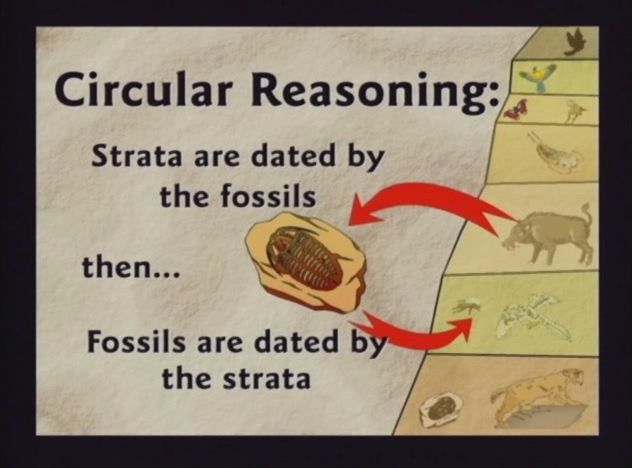
One could question their assumptions and ask if the 17 samples they used for the dates they wanted were the compromised samples and the ones the discarded because they had the ‘wrong’ dates were actually the ‘good’ dates. It is form of tautology to get a fossil you assume to be at 4.4 Ma and then select a radiometric date that corresponds to the date you want and then claim the date your assumed is true from the radiometric data!
There is a similar story around the primate skull known as KNM-ER 1470. The radiometric dates from surrounding basalt started with an initial 212 to 230 Ma, which according to the fossils was far off the mark as “humans weren’t around then’. After various attempts to find rock that would yield lower dates a date of 2.9 Ma was accepted due to an agreement between several different published studies although those studies also had ‘good’ and ‘bad’ dates just like the original study of KNM-ER 1470.
Later from some work with some pig fossils in Africa, evolutionists became convinced that the 2.9 Ma for KNM-ER 1470 was too ‘old’. Further studies of the rocks brought the age down to 1.9 Ma and those studies now ‘confirmed’ the new dates. Circular reasoning at its best my friends!
M. Lubenow, The Pigs Took It All, Creation 17(3):36-38, 1995
But you have to say that the evolutionists are not really conscience that they are involved in a tight tautology here, they are letting their presumptions lead them rather than the data. This is very common in radiometric dating methods and paleontology.
Mt. Ngauruhoe in New Zealand’s northern Island is the most active volcano in New Zealand. It is thought to have been active for at least 2,500 years, with more than 70 eruptive periods since 1839. In 1948 and 49 Mt. Ngauruhoe went through a strong eruptive phase with lava flows and then again in 1954 and 55 another strong eruptive phase with lave flows of about 280 million cubic feet.
Eleven samples were taken from the slopes of the mountain, two each from the 11 February 1949, 4 June 1954, and 14 July 1954 flows and from the 19 February 1975 avalanche deposits, and three from the 30 June 1954 flow. All the samples were sent to Geochron Laboratories in Cambridge, Boston for whole rock K-Ar dating – first a piece of one sample from each flow, then a piece of the second from each flow after the first set of results was received, and finally a piece of the third sample from the 30 June 1954 flow. To also test the consistency of results within the samples, second pieces of the two 30 June 1954 lave samples were also sent. The samples were also describes as young with little argon so as to require extra care in sampling. Geochron is a respected commercial laboratory.
Potassium-argon ‘dates’ of recent Mt. Ngauruhoe lava flows.
As you can see lava flows that were less than 55 years old were given dates from 267,000 years to 3.5 million plus or minus 20 thousand years.
What About Carbon Dating?
Carbon dating fares a little better but is still not very accurate. In 1984 Hansruedi Stutz found some sandstone with fossilized mussels in it and with fragments of coalified wood. The sandstone described as coming from Magenwil, Switzerland is said to be 20 million years old and thus the coalified wood found in the sandstone along side the mussels could be at the approximate same age. Mr. Stutz sent samples to the Physikalisches Ins ute of the University of Bern, Switzerland. This is a very prestigious laboratory and could be counted on in processing the samples with utmost care to eliminate any contamination. Given the ‘assumed’ date of the sandstone the 14C reading in the wood, assuming it was the same age, should read as an infinite age as all perceptible 14C would have been converted to 12C in around 100,000 years.
Instead the laboratory gave the date of 36,440 years +/- 330 years. That all the 14C is not gone shows that the sandstone is probably not near the date ‘assumed’ either.
Are Decay Rates Constant?
The decay rate is limited by the light constant c and if c has changed over the years as Barry Setterfield (in physics section above) says then past decay rate could have been much substantially faster.
But some recent experiments in beta decay of ionized atoms have been accelerated up to a billion fold. During experimentation 163Dy, a stable nuclide under normal earth conditions would found to decay to 163Ho in 47 days when the conditions were bare nucleus of the completely ionized state. That is 1400 times the normal half life in the 163Dy - 163Ho decay rate. In the rhenium – osmium dating system, which is an isotopic clock used by evolutionists, the 187Re decays to 187Os with a half life of only 33 years. The experiment involved the fully ionized 187Re in a storage ring which were found to decay at a rate of almost a billion times faster than normal decay. The normal 187Re – 187Ho half life is 42 billion years.
Bosch, F. et al., Observation of bound-state b– decay of fully ionized 187Re, Physical Review Letters 77(26)5190–5193, 1996. For further discussion of this experiment, see: Kienle, P., Beta-decay experiments and astrophysical implications, in: Prantzos, N. and Harissopulus, S., Proceedings, Nuclei in the Cosmos, pp. 181–186, 1999.
We will now leave radiometric dating. I could put much more, but I believe I have shown the problems in the dating game played by the evolutionists and their circular way of thinking.
Reason Number 9
Evolutionists are not Evolution's Friend (Or with a theory this broken, why don't they get a new one?)
Neo-Darwinism
Mae-Wan Ho and Peter Saunders
Much of the problem is that neo-Darwinism appears completely invincible to falsification by observations or by experiments, so much so that many doubt if it is a scientific theory at all. Partly, the stochastic nature of evolutionary changes must demand that there should be an unique explanation for each event, so that any difficulty raised by observations could be explained or explained away with ease, and partly, the prac ioners of neo-Darwinism exhibit a great power of assimilation, incorporating any opposing viewpoint as yet another “mechanism” in the grand “synthesis”. But a real synthesis should begin by identifying conflicting elements in the theory, rather than in accommodating contradictions as quickly as they arise. “Beyond neo- Darwinism - An Epigenetic Approach to Evolution” Journal of Theoretical Biology Vol. 78, 1979 p.574
It is now approximately half a century since the neo-Darwinian synthesis was formulated. A great deal of research has been carried on within the paradigm it defines. Yet the successes of the theory are limited to the interpretation of the minutiae of evolution, such as the adaptive change in coloration of moths; while it has remarkably little to say on the questions which interest us most, such as how there came to be moths in the first place. Beyond Neo-Darwinism: An Introduction to the New Evolutionary Paradigm (1984) p.ix
George Gaylord Simpson (1902 – 84) Alexander Agassiz Professor of Vertebrate Paleontology at Harvard
A telescope, a telephone, or a typewriter is a complex mechanism serving a particular function. Obviously, its manufacturer had a purpose in mind, and the machine was designed and built in order to serve that purpose. An eye, an ear, or a hand is also a complex mechanism serving a particular function. It, too, looks as if it had been made for a purpose. This appearance of purposefulness is pervading in nature, in the general structure of animals and plants, in the mechanisms of their various organs, and in the give and take of their relationships with each other. Accounting for this apparent purposefulness is a basic problem for any system of philosophy or of science. ''The problem of plan and purpose in Nature" Scientific Monthly June 1947 p. 481
The origin of life was necessarily the beginning of organic evolution and it is among the greatest of all evolutionary problems. The Meaning of Evolution (1949) p.14
Francis Crick (1916–2004) Co-discoverer of the structure of DNA, Nobel laureate 1962, Professor at the Salk Ins ute
Biologists must constantly keep in mind that what they see was not designed, but rather evolved. It might be thought, therefore, that evolutionary arguments would play a large part in guiding biological research, but this is far from the case. It is difficult enough to study what is happening now. To figure out exactly what happened in evolution is even more difficult. Thus evolutionary achievements can be used as hints to suggest possible lines of research, but it is highly dangerous to trust them too much. What Mad Pursuit (1988) pp.138-139
An honest man, armed with all the knowledge available to us now, could only state that in some sense, the origin of life appears at the moment to be almost a miracle, so many are the conditions which would have had to have been satisfied to get it going. Life Itself (1981) p.88
Every time I write a paper on the origin of life, I determine I will never write another one, because there is too much speculation running after too few facts. Life Itself (1981) p.153
Richard Dawkins (b. 1941) Charles Simonyi Professor of the Public Understanding of Science at Oxford University
The account of the origin of life that I shall give is necessarily speculative; by definition, nobody was around to see what happened. The Selfish Gene (1989) p.14
It is absolutely safe to say that if you meet somebody who claims not to believe in evolution, that person is ignorant, stupid or insane (or wicked, but I'd rather not consider that). “Put Your Money on Evolution” The New York Times (April 9, 1989) section VII p.35
Evolution is very possibly not, in actual fact, always gradual. But it must be gradual when it is being used to explain the coming into existence of complicated, apparently designed objects, like eyes. For if it is not gradual in these cases, it ceases to have any explanatory power at all. Without gradualness in these cases, we are back to miracle, which is simply a synonym for the total absence of explanation. River out of Eden (1995) p.83
Biology is the study of complicated things that give the appearance of having been designed for a purpose. The Blind Watchmaker
It is almost as if the human brain were specifically designed to misunderstand Darwinism, and to find it hard to believe. The Blind Watchmaker (1996) p.316
As an academic scientist I am a passionate Darwinian, believing that natural selection is, if not the only driving force in evolution, certainly the only known force capable of producing the illusion of purpose which so strikes all who contemplate nature. The Devil's Chaplain (2003) p.10
It is forever true that DNA is a double helix, true that if you are a chimpanzee (or an octopus or a kangaroo) trace your ancestors back far enough you will eventually hit a shared ancestor. To a pedant, these are still hypotheses which might be falsified tomorrow. But they never will be. The Devil's Chaplain (2003) pp.17-18
The world is divided into things that look designed (like birds and airliners) and things that don't (rocks and mountains). Things that look designed are divided into those that really are designed (submarines and tin openers) and those that aren't (sharks and hedgehogs). The diagnostic of things that look (or are) designed is that their parts are assembled in ways that are statistically improbable in a functional direction. They do something well: for instance, fly.
Darwinian natural selection can produce an uncanny illusion of design. An engineer would be hard put to decide whether a bird or a plane was the more aerodynamically elegant. So powerful is the illusion of design, it took humanity until the mid-19th century to realise that it is an illusion. NewScientist September 17 2005 p.33
I should have been talking about the combined probability of life's originating on a planet and leading, eventually, to the evolution of intelligent beings capable of anthropic reflection. It could be that the chemical origin of a self-replicating molecule (the necessary trigger for the origin of natural selection) was a relatively probable event but later steps in the evolution of intelligent life were highly improbable. Intelligent Thought (2006) p. 95-6
Stephen Jay Gould (1941 – 2002) Professor of Zoology and Geology at Harvard University
I can understand such an at ude directed toward photographs of objects -- through opportunities for subtle manipulation are legion even here. But many of our pictures are incarnations of concepts masquerading as neutral descriptions of nature. These are the most potent sources of conformity, since ideas passing as descriptions lead us to equate the tentative with the unambiguously factual. Suggestions for the organization of thought are transformed to established patterns in nature. Guesses and hunches become things. Wonderful Life (1991) p.28
These shortest-term studies are elegant and important, but they cannot represent the general mode for building patterns in the history of life. The reason strikes most people as deeply paradoxical, even funny-but the argument truly cannot be gainsaid. Evolutionary rates of a moment, as measured for guppies and lizards, are vastly too rapid to represent the general modes of change that build life’s history through geological ages. ... These measured changes over years and decades are too fast by several orders of magnitude to build the history of life by simple ulation. Reznick’s guppy rates range from 3,700 to 45,000 darwins (a standard metric for evolution, expressed as change in units of standard deviation-a measure of variation around the mean value of a trait in a population-per million years). By contrast, rates for major trends in the fossil record generally range from 0.1 to 1.0 darwins. Reznick himself states that “the estimated rates [for guppies] are...four to seven orders of magnitude greater than those observed in the fossil record” (that is, ten thousand to ten million times faster!). “The Paradox of the Visibly Irrelevant”
Pierre Grasse (1895 - 1985) Editor of the 28-volume "Traite de Zoologie" Chair of Evolution at Sorbonne University
Any living thing possesses an enormous amount of 'intelligence'... Today, this 'intelligence' is called 'information,' but it is still the same thing... This 'intelligence' is the sine qua non of life. If absent, no living being is imaginable. Where does it come from? This is a problem which concerns both biologists and philosophers, and, at present, science seems incapable of solving it. Evolution of Living Organisms (1977) p.2
Zoologists and botanists are nearly unanimous in considering evolution as a fact and not a hypothesis. I agree with this position and base it primarily on do ents provided by paleontology, i.e., the history of the living world. Evolution of Living Organisms (1977) p.3
Through use and abuse of hidden postulates, of bold, often ill-founded extrapolations, a pseudoscience has been created. It is taking root in the very heart of biology and is leading astray many biochemists and biologists, who sincerely believe that the accuracy of fundamental concepts has been demonstrated, which is not the case. Evolution of Living Organisms (1977) p.6
Today, our duty is to destroy the myth of evolution, considered as a simple, understood, and explained phenomenon which keeps rapidly unfolding before us. Biologists must be encouraged to think about the weaknesses of the interpretations and extrapolations that theoreticians put forward or lay down as established truths. The deceit is sometimes unconscious, but not always, since some people, owing to their sectarianism, purposely overlook reality and refuse to acknowledge the inadequacies and the falsity of their beliefs. Evolution of Living Organisms (1977) p.8
It follows that any explanation of the mechanism in creative evolution of the fundamental structural plans is heavily burdened with hypotheses. This should appear as an epigraph to every book on evolution. The lack of direct evidence leads to the formation of pure conjectures as to the genesis of the phyla; we do not even have a basis to determine the extent to which these opinions are correct. Evolution of Living Organisms (1977) p.31
What is the use of their unceasing mutations, if they do not change? In sum, the mutations of bacteria and viruses are merely hereditary fluctuations around a median position; a swing to the right, a swing to the left, but no final evolutionary effect. Evolution of Living Organisms (1977) p.87
Bacteria, the study of which has formed a great part of the foundation of genetics and molecular biology, are the organisms which, because of their huge numbers, produce the most mutants. This is why they gave rise to an infinite variety of species, called strains, which can be revealed by breeding or tests. Like Erophila verna, bacteria, despite their great production of intraspecific varieties, exhibit a great fidelity to their species. The bacillus Escherichia coli, whose mutants have been studied very carefully, is the best example. The reader will agree that it is surprising, to say the least, to want to prove evolution and to discover its mechanisms and then to choose as a material for this study a being which practically stabilized a billion years ago! Evolution of Living Organisms (1977) p.87
Some contemporary biologists, as soon as they observe a mutation, talk about evolution. They are implicitly supporting the following syllogism: mutations are the only evolutionary variations, all living beings undergo mutations, therefore all living beings evolve. This logical scheme is, however, unacceptable: first, because its major premise is neither obvious nor general; second, because its conclusion does not agree with the facts. No matter how numerous they may be, mutations do not produce any kind of evolution. Evolution of Living Organisms (1977) p.88
Once one has noticed microvariations (on the one hand) and specific stability (on the other), it seems very difficult to conclude that the former (microvariation) comes into play in the evolutionary process. Evolution of Living Organisms (1977) p.88
Although everything is not as it should be, the living world is not at all chaotic and life results from a very well-defined order. As soon as some disorder, even slight, appears in an organized being, sickness, then death follow. There is no possible compromise between the phenomenon of life and anarchy. Evolution of Living Organisms (1977) p.98
The opportune appearance of mutations permitting animals and plants to meet their needs seems hard to believe. Yet the Darwinian theory is even more demanding: a single plant, a single animal would require thousands and thousands of lucky, appropriate events. Thus, miracles would become the rule: events with an infinitesimal probability could not fail to occur. Evolution of Living Organisms (1977) p.103
There is no law against day dreaming, but science must not indulge in it. Evolution of Living Organisms (1977) p.104
The genic differences noted between separate populations of the same species that are so often presented as evidence of ongoing evolution are, above all, a case of the adjustment of a population to its habitat and of the effects of genetic drift. The fruitfly (drosophila melanogaster), the favorite pet insect of the geneticists, whose geographical, biotropical, urban, and rural genotypes are now known inside out, seems not to have changed since the remotest times. Evolution of Living Organisms (1977) p.130
Fred Hoyle (1915 – 2001) Professor of Astronomy at Cambridge University
If you wanted to produce carbon and oxygen in roughly equal quan ies by stellar nucleosynthesis, these are the two levels you would have to fix, and your fixing would have to be just about where these levels are actually found to be... A common sense interpretation of the facts suggests that a superintellect has monkeyed with physics, as well as with chemistry and biology, and that there are no blind forces worth speaking about in nature. The numbers one calculates from the facts seem to me so overwhelming as to put this conclusion almost beyond question.
To press the matter further, if there were a basic principle of matter which somehow drove organic systems toward life, its existence should easily be demonstrable in the laboratory. One could, for instance, take a swimming bath to represent the primordial soup. Fill it with any chemicals of a non- biological nature you please. Pump any gases over it, or through it, you please, and shine any kind of radiation on it that takes your fancy. Let the experiment proceed for a year and see how many of those 2,000 enzymes have appeared in the bath. I will give the answer, and so save the time and trouble and expense of actually doing the experiment. You would find nothing at all, except possibly for a tarry sludge composed of amino acids and other simple organic chemicals. How can I be so confident of this statement? Well, if it were otherwise, the experiment would long since have been done and would be well known and famous throughout the world. The cost of it would be trivial compared to the cost of landing a man on the Moon... In short there is not a shred of objective evidence to support the hypothesis that life began in an organic soup here on Earth. The Intelligent Universe (1983) pp.20-21, 23
At all events, anyone with even a nodding acquaintance with the Rubik cube will concede the near-impossibility of a solution being obtained by a blind person moving the cube faces at random. Now imagine 1050 blind persons each with a scrambled Rubik cube, and try to conceive of the chance of them all simultaneously arriving at the solved form. You then have the chance of arriving by random shuffling of just one of the many biopolymers on which life depends. The notion that not only the biopolymers but the operating programme of a living cell could be arrived at by chance in a primordial organic soup here on the Earth is evidently nonsense of a high order. "The Big Bang in Astronomy" New Scientist November 19, 1981 pp.521-527
The chance that higher life forms might have emerged in this way is comparable with the chance that 'a tornado sweeping through a junk yard might assemble a Boeing 747 from the materials therein'. "Hoyle on Evolution" Nature November 12, 1981 p.105
Robert Jastrow (b. 1925) PhD Theoretical Physics recipient of NASA Medal for Exceptional Scientific Achievement (Agnostic)
At present, science has no satisfactory answer to the question of the origin of life on the earth. Perhaps the appearance of life on the earth is a miracle. Scientists are reluctant to accept that view, but their choices are limited; either life was created on the earth by the will of a being outside the grasp of scientific understanding, or it evolved on our planet spontaneously, through chemical reactions occurring in nonliving matter lying on the surface of the planet. The first theory places the question of the origin of life beyond the reach of scientific inquiry. It is a statement of faith in the power of a Supreme Being not subject to the laws of science. The second theory is also an act of faith. The act of faith consists in assuming that the scientific view of the origin of life is correct, without having concrete evidence to support that belief. Until the Sun Dies (1977) pp. 62-63
The details differ, but the essential elements in the astronomical and biblical accounts of Genesis are the same: the chain of events leading to man commenced suddenly and sharply at a definite moment in time, in a flash of light and energy ... For the scientist who has lived by his faith in the power of reason, the story ends like a bad dream. He has scaled the mountain of ignorance; he is about to conquer the highest peak; as he pulls himself over the final rock, he is greeted by a band of theologians who have been sitting there for centuries. God and the Astronomers (1992) pp.106-107
Roger Lewin PhD Biochemistry News Editor of Science Magazine
The central question of the Chicago conference was whether the mechanisms underlying microevolution can be extrapolated to explain the phenomena of macroevolution. At the risk of doing violence to the positions of some of the people at the meeting, the answer can be given as a clear No. Science November 21 1980 p. 883
The key issue is the ability correctly to infer a genetic relationship between two species on the basis of a similarity in appearance, at gross and detailed levels of anatomy. Sometimes this approach...can be deceptive, partly because similarity does not necessarily imply an identical genetic heritage: a shark (which is a fish) and a porpoise (which is a mammal) look similar. Bones of Contention (1987) p.123
Richard Lewontin (b. 1929) PhD Zoology Alexander Agassiz Research Professor at Harvard University
Darwin's theory of evolution by natural selection in particular is hopelessly metaphysical, according to the rules of etiquette laid down in the Logic of Scientific Inquiry and widely believed in by practicing scientists who bother to think about the problem. The first rule for any scientific hypothesis ought to be that it is at least possible to conceive of an observation that would contradict the theory. For what good is a theory that is guaranteed by its internal logical structure to agree with all conceivable observations, irrespective of the real structure of the world? If scientists are going to use logically unbeatable theories about the world, they might as well give up natural science and take up religion. Yet is that not exactly the situation with regard to Darwinism? The theory of evolution by natural selection states that changes in the inherited characters of species occur, giving rise to differentiation in space and time, because different genetical types leave different numbers of offspring in different environments... Such a theory can never be falsified, for it asserts that some environmental difference created the conditions for natural selection of a new character. It is existentially quantified so that the failure to find the environmental factor proves nothing, except that one has not looked hard enough. Can one really imagine observations about nature that would disprove natural selection as a cause of the difference in bill size? The theory of natural selection is then revealed as metaphysical rather than scientific. Natural selection explains nothing because it explains everything. “Testing the Theory of Natural Selection” Nature March 24, 1972 p.181
It is the great irony of modern evolutionary genetics that the spirit of explanation has moved more and more towards optimal adaptation, while the technical developments of population genetics of the past 30 years have been increasingly to show the efficacy of non adaptive forces in evolution. "A natural selection" Nature May 11,1989 p.107
As to assertions without adequate evidence, the literature of science is filled with them, especially the literature of popular science writing. Carl Sagan's list of the "best contemporary science-popularizers" includes E.O. Wilson, Lewis Thomas, and Richard Dawkins, each of whom has put unsubstantiated assertions or counterfactual claims at the very center of the stories they have retailed in the market. "Billions and Billions of Demons"
It is said that there is no place for an argument from authority from science. The community of science is constantly self-critical ... It is certainly true that within each narrowly defined scientific field there is constant challenge to new technical claims and to old wisdom. ... But when scientists transgress the bounds of their own specialty they have no choice but to accept the claims of authority, even though they do not know how solid the grounds of those claims may be. Who am I to believe that quantum physics if not Steven Weinberg, or about the solar system if not Carl Sagan? What worries me is that they may believe what Dawkins and Wilson tell them about evolution. "Billions and Billions of Demons"
Ernst Mayr (1904 – 2005) Professor of Zoology at Harvard University
The basic framework of the theory is that evolution is a two-stage phenomenon the production of variation and the sorting of the variants by natural selection. Yet agreement on this basic thesis does not mean that the work of the evolutionist is completed. The basic theory is in many instances hardly more than a postulate and its application raises numerous questions in almost every concrete case. Populations, Species and Evolution (1970) p. 6
The occurrence of genetic monstrosities by mutation, for instance the homeotic mutant in Drosophila, is well substantiated, but they are such evident freaks that these monsters can be designated only as 'hopeless.' They are so utterly unbalanced that they would not have the slightest chance of escaping elimination through stabilizing selection. Giving a thrush the wings of a falcon does not make it a better flier. Indeed, having all the other equipment of a thrush, it would probably hardly be able to fly at all. It is a general rule, of which every geneticist and breeder can give numerous examples, that the more drastically a mutation affects the phenotype, the more likely it is to reduce fitness. To believe that such a drastic mutation would produce a viable new type, capable of occupying a new adaptive zone, is equivalent to believing in miracles.
The finding of a suitable mate for the 'hopeless monster' and the establishment of reproductive isolation from the normal members of the parental population seem to me insurmountable difficulties. Populations, Species, and Evolution (1970) p.253
Colin Patterson (1933 – 1998) Senior Palaeontologist at British Museum of Natural History
Just as pre-Darwinian biology was carried out by people whose faith was in the Creator and His plan, post-Darwinian biology is being carried out by people whose faith is in, almost, the deity of Darwin. They've seen their task as to elaborate his theory and to fill the gaps in it, to fill the trunk and twigs of the tree. But it seems to me that the theoretical framework has very little impact on the actual progress of the work in biological research. In a way some aspects of Darwinism and of neo-Darwinism seem to me to have held back the progress of science. The Listener October 8, 1981 p.392
So what about the tree here and the numbers on the branches? As Steve said, it is produced by a program. Those numbers don't pop out of the data in any way, so I suppose those come from massaging the data with evolutionary theory. It is a program that assumes evolution to be true and tells the computer to find a tree. So my question will be: What is the tree telling us about? Is it telling us something about nature or something about evolutionary theory? "Evolutionism and Creationism" November 5, 1981 p.10
One of the reasons I started taking this anti-evolutionary view, or let's call it a non- evolutionary view, was last year I had a sudden realization for over twenty years I had thought I was working on evolution in some way. One morning I woke up and something had happened in the night and it struck me that I had been working on this stuff for twenty years and there was not one thing I knew about it. That's quite a shock to learn that one can be so misled so long. Either there was something wrong with me or there was something wrong with evolutionary theory. Naturally, I know there is nothing wrong with me, so for the last few weeks I've tried putting a simple question to various people and groups of people.
Question is: Can you tell me anything you know about evolution, any one thing, that is true? I tried that question on the geology staff at the Field Museum of Natural History and the only answer I got was silence. I tried it on the members of the Evolutionary Morphology Seminar in the University of Chicago, a very prestigious body of evolutionists, and all I got there was silence for a long time and eventually one person said, "I do know one thing - it ought not to be taught in high school." "Evolutionism and Creationism" November 5, 1981 p.1 1 2 3
Michael Ruse (b. 1940) Editor of the Cambridge University Press Series in the Philosophy of Biology
But we did talk much more about the whole question of metaphysics, the whole question of philosophical bases. And what Johnson was arguing was that, at a certain level, the kind of position of a person like myself, an evolutionist, is metaphysically based at some level, just as much as the kind of position of let us say somebody, some creationist, someone like Gish or somebody like that. Speech at 'The New Antievolutionism' symposium February 13,1993
I think that we should recognize, both historically and perhaps philosophically, certainly that the science side has certain metaphysical assumptions built into doing science, which -- it may not be a good thing to admit in a court of law -- but I think that in honesty that we should recognize, and that we should be thinking about some of these sorts of things. Speech at 'The New Antievolutionism' symposium February 13,1993
It's certainly been the case that evolution has functioned, if not as a religion as such, certainly with elements akin to a secular religion. Those of us who teach philosophy of religion always say there's no way of defining religion by a neat, necessary and sufficient condition. The best that you can do is list a number of characteristics, some of which all religions have, and none of which any religion, whatever or however you sort of put it. And certainly, there's no doubt about it, that in the past, and I think also in the present, for many evolutionists, evolution has functioned as something with elements which are, let us say, akin to being a secular religion. Speech at 'The New Antievolutionism' symposium February 13,1993
Certainly, though, as I say, for Thomas Henry Huxley, I don't think there's any question but that evolution functioned, at a level, as a kind of secular religion...If you look both at his printed stuff, and if you go down to Rice University which has got all his private papers, again and again in the letters, it comes through very strongly that for Julian Huxley evolution was functioning as a kind of secular religion...I think that today also, for more than one eminent evolutionist, evolution in a way functions as a kind of secular religion...Certainly, if you look for instance in On Human Nature, Wilson is quite categorical about wanting to see evolution as the new myth, and all sorts of language like this. That for him, at some level, it's functioning as a kind of metaphysical system. Speech at 'The New Antievolutionism' symposium February 13,1993
W.R. Thompson (1887 - ?) Entomologist and Director of the Commonwealth Ins ute of Biological Control, Ottawa, Canada
Darwin considered that the doctrine of origin of living forms by descent with modification, even if well founded, would be unsatisfactory unless the causes at work were correctly identified, so his theory of modification by natural selection was, for him, of absolutely major importance. Since he had at the time the Origin was published no body of experimental evidence to support his theory, he fell back on speculative arguments. The argumentation used by evolutionists. Said de Quatre es, makes the discussion of their ideas extremely difficult. Personal convictions, simple possibilities, are presented as if they were proofs, or at least valid arguments in favour of the theory. As an example de Quatre es cited Darwin’s explanation of the manner in which the mouse might become transformed into the nutcracker, by the ac ulation of small changes in structure and instinct owing to the effect of natural selection; and then proceeded to show that it is just as easy to transform the nutcracker in to the mouse. The demonstration can be modified without difficulty to fit any conceivable case. It is without scientific value, since it cannot be verified; but since the imagination has free rein, it is easy to convey the impression that a concrete example of real transmutation has been given. This is the more appealing because of the extreme fundamental simplicity of the Darwinian explanation. The reader may be completely ignorant of the biological processes yet he feels that he really understands and in a sense dominates the machinery by which the marvelous variety of living forms has been produced. Introduction to The Origin of Species 6th Edition (1956) p. xi
As we know, there is a great divergence of opinion among biologists, not only about the causes of evolution but even about the actual process. This divergence exists because the evidence is unsatisfactory and does not permit any certain conclusion. It is therefore right and proper to draw the attention of the non-scientific public to the disagreements about evolution. But some recent remarks of evolutionists show that they think this unreasonable. This situation, where scientific men rally to the defence of a doctrine they are unable to define scientifically, much less demonstrate with scientific rigour, attempting to maintain its credit with the public by the suppression of criticism and the elimination of difficulties, is abnormal and undesirable in science. Introduction to The Origin of Species 6th Edition (1956) p.xxii
George Wald (1906 - 1997) Professor of Biology at Harvard University Nobel Laureate
The reasonable view was to believe in spontaneous generation; the only alternative, to believe in a single, primary act of supernatural creation. There is no third position. For this reason many scientists a century ago chose to regard the belief in spontaneous generation as a "philosophical necessity." It is a symptom of the philosophical poverty of our time that this necessity is no longer appreciated. Most modern biologists, having reviewed with satisfaction the downfall of the spontaneous generation hypothesis, yet unwilling to accept the alternative belief in special creation, are left with nothing. "The origin of life" Scientific American August 1954 p.46
One has only to contemplate the magnitude of this task to concede that the spontaneous generation of a living organism is impossible. Yet here we are as a result, I believe, of spontaneous generation. "The origin of life" Scientific American August 1954 p.46
Paleontology
George Gaylord Simpson (1902 – 84) Alexander Agassiz Professor of Vertebrate Paleontology at Harvard
This regular absence of transitional forms is not confined to mammals, but is an almost universal phenomenon, as has long been noted by paleontologists. It is true of almost all orders of all classes of animals, both vertebrate and invertebrate. A fortiori, it is also true of the classes, and of the major animal phyla, and it is apparently also true of analogous categories of plants. Tempo and Mode in Evolution (1944) p. 107
Richard Dawkins (b. 1941) Charles Simonyi Professor of the Public Understanding of Science at Oxford University
In the Cambrian strata of rocks, vintage about 600 million years (evolutionists are now dating the beginning of the Cambrian at about 530 million years), are the oldest in which we find most of the major invertebrate groups. And we find many of them already in an advanced state of evolution, the very first time they appear. It is as though they were just planted there, without any evolutionary history. Needless to say, this appearance of sudden planting has delighted creationists. The Blind Watchmaker (1996) p.229
Niles Eldredge (b. 1943) Chief Curator at The American Museum Of Natural History
Darwin's prediction of rampant, albeit gradual, change affecting all lineages through time is refuted. The record is there, and the record speaks for tremendous anatomical conservatism. Change in the manner Darwin expected is just not found in the fossil record. The Myths of Human Evolution (1982) p.45-46
There seems to have been almost no change in any part we can compare between the living organism and its fossilized progenitors of the remote geological past. Living fossils embody the theme of evolutionary stability to an extreme degree...We have not completely solved the riddle of living fossils. Fossils (1991) p.101, 108
As a paleontologist, I readily concede that my long dead fossils, lacking any traces of their soft anatomies or behaviors, are totally mute on the subject of reproduction and transmission of genetic information. And this is, I acknowledge, a major limitation to our data. Reinventing Darwin (1995) p.2
Simple extrapolation does not work. I found that out back in the 1960s as I tried in vain to do ent examples of the kind of slow, steady directional change we all thought ought to be there, ever since Darwin told us that natural selection should leave precisely such a telltale signal as we collect our fossils up cliff faces. I found instead, that once species appear in the fossil record, they tend not to change much at all . Species remain imperturbably, implacably resistant to chance as a matter of course. Reinventing Darwin (1995) p.3
Stasis is now abundantly well do ented as the preeminent paleontological pattern in the evolutionary history of species. Reinventing Darwin (1995) p.77
No wonder paleontologists shied away form evolution for so long. It seems never to happen. Assiduous collecting of cliff faces yields zigzags, minor oscillations, and the very occasional slight ac ulation of change -- over millions of years, at a rate too slow to really account for all the prodigious change that has occurred in evolutionary history. When we do see the introduction of evolutionary novelty, it usually shows up with a bang and often with no firm evidence that the organisms did not evolve elsewhere! Evolution cannot forever be going on someplace else. Yet that's how the fossil record has struck many a forlorn paleontologist looking to learn something about evolution. Reinventing Darwin (1995) p.95
But we saw -- as did several paleontological contemporaries of Darwin -- that if you do collect a series of fossils up through a sequence of sedimentary rock, and if you don't see much evidence of anatomical change through that series, that is indeed evidence that substantial gradual evolutionary change has not occurred within that species lineage, no matter how gappy the record may be. That's why the evidence for stasis now appears so overwhelming. Reinventing Darwin (1995) p.96
The persistent pattern of nonchange within samples, coupled with the abrupt appearance of new species -- organisms marked with anatomical innovations -- had to be telling us something about the way the evolutionary process works. Reinventing Darwin (1995) p.97
I needed to explain why evolution leaves and entirely different sort of pattern in the rock record than Darwin -- and his long string of successors, including many paleontologists -- had supposed. Reinventing Darwin (1995) p.97
Scientists, being as a rule more or less human beings, passionately stick up for their ideas, their pet theories. It's up to someone else to show you are wrong. Reinventing Darwin (1995) p.221
Stephen Jay Gould (1941 – 2002) Professor of Zoology and Geology at Harvard University
In fact, the catastrophists were much more empirically minded than Lyell. The geologic record does seem to record catastrophes: rocks are fractured and contorted; whole faunas are wiped out (see my column of October, 1974). To cir vent this literal appearance, Lyell imposed his imagination upon the evidence. The geologic record, he argued, is extremely imperfect and we must interpolate into it what we can reasonably infer but cannot see. The catastrophists were the hardnosed empiricists of their day, not the blinded theological apologists. Natural History February 1975 pp.16-17
The history of most fossil species includes two features particularly inconsistent with gradualism: 1. Stasis. Most species exhibit no directional change during their tenure on earth. They appear in the fossil record looking much the same as when they disappear; morphological change is usually limited and directionless. 2. Sudden appearance. In any local area, a species does not arise gradually by the steady transformation of its ancestors; it appears all at once and ‘fully formed'. “Evolution’s Erratic Pace” Natural History May 1977 p.14
The extreme rarity of transitional forms in the fossil record persists as the trade secret of paleontology. The evolutionary trees that adorn our textbooks have data only at the tips and nodes of their branches; the rest is inference, however reasonable, not the evidence of fossils. “Evolution’s erratic pace” Natural History May 1977 p.14
All paleontologists know that the fossil record contains precious little in the way of intermediate forms; transitions between major groups are characteristically abrupt. Gradualists usually extract themselves from this dilemma by invoking the extreme imperfection of the fossil record--if only one step in a thousand survives as a fossil, geology will not record continuous change. Although I reject this argument (for reasons discussed in "The Episodic Nature of Evolutionary Change"), let us grant the traditional escape and ask a different question. Even though we have no direct evidence for smooth transitions, can we invent a reasonable sequence of intermediate forms--that is, viable, functioning organisms--between ancestors and descendants in major structural transitions? Of what possible use are the imperfect incipient stages of useful structures? What good is half a jaw or half a wing? The concept of preadaptation provides the conventional answer by permitting us to argue that incipient stages performed different functions. The half jaw worked perfectly well as a series of gill-supporting bones; the half wing may have trapped prey or controlled body temperature. I regard preadaptation as an important, even an indispensable, concept. But a plausible story is not necessarily true. I do not doubt that preadaptation can save gradualism in some cases, but does it permit us to invent a tale of continuity in most or all cases? I submit, although it may only reflect my lack of imagination, that the answer is no. "The Return of Hopeful Monsters" Natural History June 1977 p.24
Gradualism, the idea that all change must be smooth, slow, and steady, was never read from the rocks. It was primarily a prejudice of nineteenth-century liberalism facing a world in revolution. But it continues to color our supposedly objective reading of life’s history. Natural History February 1978 p.24
The absence of fossil evidence for intermediary stages between major transitions in organic design, indeed our inability, even in our imagination, to construct functional intermediates in many cases, has been a persistent and nagging problem for gradualistic accounts of evolution. “Is a new and general theory of evolution emerging?” Paleobiology January 1980 p.127
Sediments between 4 and 10 million years in age are potential guardians of the Holy Grail of human evolution--the period when our lineage began its separate end run to later domination, and a time for which no fossil evidence exists at all. "Empire of the Apes" Natural History May 1987 p.24
Darwin invoked his standard argument to resolve this uncomfortable problem: the fossil record is so imperfect that we do not have evidence for most events of life's history. But even Darwin acknowledged that his favorite ploy was wearing a bit thin in this case. His argument could easily account for a missing stage in a single linage, but could the agencies of imperfection really obliterate absolutely all evidence for positively every creature during most of life's history? Darwin admitted: "The case as present must remain inexplicable; and may be truly urged as a valid argument against the views here entertained." (1859, p.308) Knowledge Science and Relativism (1999) p.187
Darwin has been vindicated by a rich Precambrian record, all discovered in the past thirty years. Yet the peculiar character of this evidence has not matched Darwin's prediction of a continuous rise in complexity toward Cambrian life, and the problem of the Cambrian explosion has remained as stubborn as ever -- if not more so, since our confusion now rests on knowledge, rather than ignorance about the nature of Precambrian life. Wonderful Life (1991) p.57
The opposite truth has been affirmed by innumerable cases of measurable evolution at this minimal scale-but, to be visible at all over so short a span, evolution must be far too rapid (and transient) to serve as the basis for major transformations in geological time. Hence, the “paradox of the visibly irrelevant”-or, if you can see it at all, it’s too fast to matter in the long run. “The Paradox of the Visibly Irrelevant” Natural History December 1997 p.15
Moreover, and with complete generality-the “paradox of the visibly irrelevant” in my le we may say that any change measurable at all over the few years of an ordinary scientific study must be occurring far too rapidly to represent ordinary rates of evolution in the fossil record. The culprit of this paradox, as so often, is the vastness of time (a concept that we can appreciate “in our heads” but seem quite unable to get into the guts of our intuition). The key principle, however ironic, requires such a visceral understanding of earthly time: if evolution is fast enough to be discerned by our instruments in just a few years- that is, substantial enough to stand out as a genuine and directional effect above the random fluctuations of nature’s stable variation and our inevitable errors of measurement-then such evolution is far too fast to serve as an atom of steady incrementation in a paleontological trend. Thus, if we can measure it at all (in a few years), it is too powerful to be the stuff of life’s history. If large-scale evolution proceeded by stacking Trinidad guppy rates end to end, any evolutionary trend would be completed in a geological moment, not over the many million years actually observed. “Our face from fish to man,” to cite the le of a famous old account of evolution for popular audiences, would run its course within a single geological formation, not over more than 400 million years, as our fossil record demonstrates. “The Paradox of the Visibly Irrelevant” Natural History December 1997
Anatomy may fluctuate over time, but the last remnants of a species usually look pretty much like the first representatives. The Structure of Evolutionary Theory (2002) p.749
Pierre Grasse (1895 - 1985) Editor of the 28-volume "Traite de Zoologie" Chair of Evolution at Sorbonne University
Zoologists and botanists are nearly unanimous in considering evolution as a fact and not a hypothesis. I agree with this position and base it primarily on do ents provided by paleontology, i.e., the history of the living world. Evolution of Living Organisms (1977) p.3
Naturalists must remember that the process of evolution is revealed only through fossil forms. A knowledge of paleontology is, therefore, a prerequisite; only paleontology can provide them with the evidence of evolution and reveal its course or mechanisms. Neither the examination of present beings, nor imagination, nor theories can serve as a subs ute for paleontological do ents. If they ignore them, biologists, the philosophers of nature, indulge in numerous commentaries and can only come up with hypotheses. That is why we constantly have recourse to paleontology, the only true science of evolution. From it we learn how to interpret present occurrences cautiously; it reveals that certain hypotheses considered certainties by their authors are in fact questionable or even illegitimate. Evolution of Living Organisms (1977) p.4
Richard Leakey (b. 1944) High School Drop-Out
Isolated teeth, single bones, fragments of skulls: for the most part, these are the clues from which the story of human prehistory must be reconstructed. The Origin of Humankind (1994) p. ix
The task of inferring an evolutionary link based on extremely fragmentary evidence is more difficult than most people realize, and there are many traps for the unwary. Simons and Pilbeam had been ensnared in one of these traps: anatomical similarity does not unequivocally imply evolutionary relatedness. The Origin of Humankind (1994) p. 8
Ernst Mayr (1904 – 2005) Professor of Zoology at Harvard University
Anything truly novel always seemed to appear quite abruptly in the fossil record. Toward a New Philosophy of Biology (1988) pp.529-530
Colin Patterson (1933 – 1998) Senior Palaeontologist at British Museum of Natural History
These gaps might be due to failure in fossilization, or to mistakes in the genealogy, or to wrongly identified fossils; or they could be (and have been) taken to show that the theory of evolution is wrong. Evolution (1978) p.133
Darwin devoted two chapters of The Origin of Species to fossils, but spent the whole of the first in saying how imperfect the geological record of life is. It seemed obvious to him that, if his theory of evolution is correct, fossils ought to provide incontrovertible proof of it, because each stratum should contain links between the species of earlier and later strata, and if sufficient fossils were collected, it would be possible to arrange them in ancestor descendent sequences and so build up a precise picture of the course of evolution. This was not so in Darwin's time, and today, after more than another hundred years of assiduous fossil collecting, the picture still has extensive gaps. Evolution (1999) p.106
But there are still great gaps in the fossil record. Most of the major groups of animals (phyla) appear fully fledged in the early Cambrian rocks, and we know of no fossil forms linking them. Evolution (1999) p.109
Fossils may tell us many things, but one thing they can never disclose is whether they were ancestors of anything else. Evolution (1999) p.109
W.R. Thompson (1887 - ?) Entomologist and Director of the Commonwealth Ins ute of Biological Control, Ottawa, Canada
Evolution, if it has occurred, can in a rather loose sense be called a historical process; and therefore to show that it has occurred historical evidence is required. History in the strict sense is dependent on human testimony. Since this is not available with respect to the development of the world of life we must be satisfied with something less satisfactory. The only evidence available is that provided by the fossils. It has been pointed out by both supporters and opponents of the evolutionary doctrine, that even if we can demonstrate the chronological succession of certain organisms, this is not proof of descent. This may seem like a quibble. If we put a pair of house-flies in a cage and let them breed, we do not doubt that the live flies we find there in a month’s time are the descendants of the original pair. Similarly, if in an apparently undisturbed geological formation we find snail s s at an upper level very similar to those at a lower level, we may reasonably conclude that there is some genealogical connection between the two groups, though we cannot trace the descent from individual to individual as is required in a true family tree. Therefore we found in the geological strata a series of fossils showing gradual transition from simple to complex forms, and could be sure that they correspond to a true time-sequence, then we should be inclined to feel that Darwinian evolution has occurred, even though its mechanism remained unknown. This is certainly what Darwin would have like to report but of course he was unable to do so. What the available data indicated was a remarkable absence of the many intermediate types that should have existed in the strata regarded as the most ancient; the absence of the principle taxonomic groups. Against these difficulties he could only suggest that the geological record is imperfect, but that if it had been perfect it would have provided evidence for his views. It is clear therefore that the paleontological evidence at his disposal, since it had not led competent naturalists acquainted with it to a belief in evolution, could only justify a suspense of judgment. The condition of fossil material is, of course unsatisfactory since soft tissues usually disappear, leaving only skeletal structures, frequently much distorted . The fossil insects of the group which I am best acquainted cannot be accurately determined, even to genera. It is evident that any organisms now extinct existed in the past but we can never know them as we know living forms. The chronological succession of the fossils is also open to doubt, for it appears generally speaking, that the age of the rocks is not determined by their intrinsic characteristics but by the fossils they contain while the succession of the fossils is determined by the succession of the strata. It was thought also that the fossils should appear in a certain order, corresponding roughly to the stage in embryological development. In fact the strata, and therefore the fossils they contain, do not always occur in the accepted order. In some areas of the world, for example, the Cambrian strata, which are regarded as the oldest fossiliferous formations, rest on the Crestaceous which are regarded as relatively recent; in other, Crestaceous or Tertiary beds appear instead of the Cambrian, on the granite. Sometimes the character of the deposits would lead to the belief that they were chronologically continuous since they can be separated only by the fossils they contain. Various hypotheses have been proposed to explain these departures from accepted theory, and thought they are often the subject of controversy among geologists I do not suggest that the problems to which they relate are insoluble.
On the other hand, it does appear to me, in the first place, that Darwin in the Origin was not able to produce paleontological evidence sufficient to prove his views but that the evidence he did produce was adverse to them; and I may note that the position is not notably different to-day. The modern Darwinian paleontologists are obliged, just like their predecessors and like Darwin, to water down the facts with subsidiary hypotheses which, however plausible, are in the nature of things unverifiable. Introduction to The Origin of Species 6th Edition (1956) pp. xvii-xix
Ernst Haeckel Apostle of Deceit
Ernst Haeckel was known as ‘Darwin’s bulldog on the Continent’ and ‘the Huxley of Germany’ for his now notorious support of evolution. He is today known as a scientist who perpetrated fraud upon fraud to promote evolution.
“He became Darwin’s chief European apostle proclaiming the gospel of evolution with evangelist fervor, not only to the university intelligentsia but to the common man by popular books and to the working classes by lecture in rented halls.” Ian Taylor, In the Minds of Men, TFE Publishing, Toronto, 1984, p. 184, who cites Peter Klemm, Der Ketzer von Jena, Urania Press, Leipzig, 1968
Haeckel’s enthusiasm for the theory of evolution caused him to fraudulently manufacture ‘evidence to bolster his views. He was the first person to draw an evolutionary ‘family tree’ for mankind. To fill in the gap in the tree between inorganic non-living matter and the first living bacteria, he invented a series of minute protoplasmic organisms which he called Monera. Of these he said:
‘not composed of any organs at all, but consist entirely of shapeless simple geneous matter . . . nothing more than a shapeless, mobile, little lump of mucus or slime, consisting of albuminous combination of carbon.” Ernst Haeckel, The History of Creation, translated by E. Ray Lankester, Kegan Paul, Trench & Co., London, 1883, 3rd ed., Vol. 1, p. 184.
No Monera existed or ever existed and Haeckel knew that yet persisted in using and even creating species and subspecies of this genus. In 1868, a prestigious German scientific journal published 73 pages of his speculations with more than 30 drawings of these imaginary Monera, as well as scientific names as Protamoeba primitivia, and the process of fission by which they allegedly reproduced. Ernst Haeckel, ‘Monographie der Moneren’ Jenaische Zeitschrift fur Medizin und Naturwissinschaft, Leipzig 4:64, 1868
Haeckel didn’t just stop there, he also created a non-existent speechless Ape-man called Pithecanthropus alalus and even had an artist, Gabriel Max, draw up the imagined creature even though there was not one iota such a creature ever existed. Yet the Dutch scientist, Professor G.H.R. von Koenigswald, described the drawing: ‘Under a woman with long lank hair sits cross-legged suckling a child. Her nose is flat, her lips thick, her feet large, with the big toe set considerable lower that the rest. Beside her stands her husband, fat bellied and low browed, his back thickly covered with hair. He looks at the spectator good-naturedly and unintelligently, with the su ious expression of the inveterate toper (habitual drinker). It must have been a happy marriage; his wife could not contradict him, for neither of them could speak.” Herbert Wendt, From Ape to Adam, Thames and Hudson Ltd, London, 1971, p.82
But Haeckel’s biggest fraud by far was his totally erroneous theory that the human embryo is initially identical with that of other mammals and then goes through a series of stages where it has gills like a fish or a tail like a monkey, etc. This theory is sometimes called ‘The Law of Recapitulation’ or has Haeckel called it ‘The biogenetic law’. Later this idea as it moved into mainstream evolutionary thought was called: ‘ontogeny recapitulates phylogeny’ which means the development of the individual embryo repeats it alleged evolutionary history. This fraudulent idea is still in evolutionary thought today in many guises. For instance E. G. Raymond Hawkey’s three dimensional book, Evolution, Michael Joseph Ltd, London, 1986, which states on the front cover that is was ‘produced in collaboration with British Museum (Natural History)’ and on the back cover, ‘Like many other animals, human beings retrace much of their evolutionary past in the womb . . .By the time it (the human embryo) is 28 days old it resembles our earliest vertebrate ancestor, the fish. Like a fish it has . . . what appear to four gill slits.’ Those supposed ‘gill slits’ have nothing to do with breathing but are where the ear and the jaw area are formed.
Haeckel then proceeded to draw pictures of embryos of human and other animals showing the similarities which were not ever there. He completely forged pictures from his imagination to fill in the data he wanted.
Professor Wilhelm His, Sr. (1831 – 1904) a famous comparative embryologist of the day and professor of anatomy at the University of Leipzig, finally uncovered the fraud. He showed that in 1874 Haeckel had added 3.5 mm to the head of Bischoff’s dog embryo, taken 2 mm off the head of Ecker’s human embryo, doubled the length of the human posterior, and substantially altered the details of the human eye. He sarcastically pointed out that Haeckel taught Jena, home of the then finest optical equipment available, and so had no excuse for inaccuracy. He concluded that anyone who engaged in such blatant fraud had forfeited all respect and that Haeckel had eliminated himself from the ranks of scientific research workers of any stature. Ian Taylor, In the Minds of Men, TFE Publishing, Toronto, 1984, pp. 276, 475.
Haeckel even had to publicly rescind his fraudulent ideas, but interestingly enough he remained wildly popular in Germany and his ideas were still incorporated into evolutionary thought for around 100 years. His evolutionary ideas are incorporated in abortion where the doctor will tell a young lady that the baby in her womb is just a ‘fish’ and of no matter or consequence.
Haeckel’s evolutionary ideas were also used to create a unique from of social Darwinism and racism that became the German national ethos under Hitler’s National Socialism. Daniel Gasman, The Scientific Origins of National Socialism: Social Darwinism in Ernst Haeckel and the German Monist League, American Elsevier, New Yord, 1971, pp. xvi, xvii. ‘Biological Sciences and the Roots of Nazism, American Scientist 76:56, January – February 1988.
Here is what others say:
Jane Oppenheimer Professor of Biology and History of Science
It was a failing of Haeckel as a would-be scientist that his hand as an artist altered what he saw with what should have been the eye of a more accurate beholder. He was more than once, often justifiably, accused of scientific falsification, by Wilhelm His and by many others. For only two examples, in "Anthropogenie" he drew the developing brain of a fish as curved, because that of reptiles, birds, and mammals is bent. But the vesicles of a fish brain always form in a straight line. He drew the embryonic membranes of man as including a small sac-like allantois, an embryonic organ characteristic of and larger in reptiles, birds, and some nonhuman mammals. The human embryo has no sac-like allantois at all. Only its narrow solid stock remains to conduct the umbilical blood vessels between embryo and placenta. Examples could be multiplied significantly. "Haeckel's Variations on Darwin"
The blind adoption of Haeckel's doctrines by such workers in bordering fields, and their infection with his faith that "Development is now the magic word by means of which we shall solve the riddles by which we are surrounded", is less reprehensible than their uncritical acceptance by the professional embryologists who swallowed them with as much gullibility, and who remained utterly unperturbed by the fact that Haeckel himself was never in any sense a professional embryologist. The seduction of embryology by a fanatic who expresses himself even metaphorically in terms of magic represents a darker chapter in its history. Essays in the history of Embryology and Biology (1967) pp. 153-154
Michael Richardson Embryologist at St. George’s Medical School
This is one of the worst cases of scientific fraud. It's shocking to find that somebody one thought was a great scientist was deliberately misleading. It makes me angry. What Haeckel did was to take a human embryo and copy it, pretending that the salamander and the pig and all the others looked the same at the same stage of development. They don't. These are fakes. "An Embryonic Liar" The London Times August 11, 1997 p.14
Our survey seriously undermines the credibility of Haeckel's drawings.
It looks like it's (Haeckel’s embryos) turning out to be one of he famous fakes in biology.
Reason Number 10
Morality is not Evolution’s Friend
Now I will change my course a bit here and touch in something closer to the bone. I will drop the gloves and go bare knuckle for I think this is the core issue in the Creationist – Evolution debate. All above have been fundamentally scientific and can be debated on that premise. From here on out philosophy and logic rule and will be the thing that will make many evolutionist very angry.
I will attempt to prove that evolution and atheism are synonymous. I will show how our society has and is paying a heavy debt to the atheistic evolutionary philosophy that has poisoned out thought for over 150 years. But I will also demonstrate the superiority of Christianity and why it is superior to atheistic evolution.
For you see we have not just a scientific debate we also have a worldview debate, we have a debate about the very premises we interpret the world from, the assumptions that under gird our reality, how we interpret data and deduce logic.
Is Evolution Science or Philosophy?
Dr. Richard Lewontin, a geneticist, (a self proclaimed Marxist) , is a renowned champion of neo-“Darwinism and one of the world’s leaders in evolutionary biology. He wrote the following comment. (Italics were in the original)
“We take the side of science in spite of the patent absurdity of some of its constructs, in spite of its failure to fulfill many of its extravagant promises of health and life, in spite of the tolerance of the scientific community for unsubstantiated just-so stories, because we have a prior commitment, a commitment to materialism. It is not that the methods and ins utions of science somehow compel us to accept a material explanation of the phenomenal world, but, on the contrary, that we are forced by our a priori adherence to material causes to create an apparatus of investigation and a set of concepts that produce material explanations, no matter how counterintuitive, no matter how mystifying to the uninitiated. Moreover, that materialism is an absolute, for we cannot allow a Divine foot in the door.”
Richard Lewontin, Billions and billions of demons, The New York Review, p. 31, 9 January 1997.
Dr. Lewontin makes it very clear “science” (evolution) may not be the best option, but it is the only option for no other option will be allowed. That is not a scientific statement, but a philosophical statement. In fact, this statement says that the philosophy of materialism or atheism is at the basis of science or evolution. I thought ‘scientists’ were to ob objective about the data and just follow the figures to the truth, whatever that was? But Dr. Lewontin says that is not the truth, that there is a bigger truth than science and that is materialism or atheism.
“I think that philosophically that one should be sensitive to what I think history shows, namely, that evolution, just as much as religion -- or at least, leave "just as much," let me leave that phrase -- evolution, akin to religion, involves making certain a priori or metaphysical assumptions, which at some level cannot be proven empirically. I guess we all knew that, but I think that we're all much more sensitive to these facts now. And I think that the way to deal with creationism, but the way to deal with evolution also, is not to deny these facts, but to recognize them, and to see where we can go, as we move on from there. “ Michael Ruse Speech at 'The New Antievolutionism' symposium February 13,1993
“Evolution is the greatest engine of atheism ever invented. Naturalistic evolution has clear consequences that Charles Darwin understood perfectly. 1) No gods worth having exist; 2) no life after death exists; 3) no ultimate foundation for ethics exists; 4) no ultimate meaning in life exists; and 5) human free will is nonexistent.” William Provine "Evolution: Free will and punishment and meaning in life” 1998 Darwin Day Keynote Address
So from the quotes above we can see that materialism – atheism is the core philosophy of evolution, indeed the very fabric of the prime assumptions. Evolution like a philosophy has metaphysical assumptions, it claims that no gods worth having exists, no life after death exists, no ultimate foundation for ethics exists, no ultimate meaning in life exists and human free will is nonexistent. That sounds much like atheism.
So what if Evolution is an Atheistic Philosophy?
Now another word from an amateur evolutionist.
“The author states evolution has moral consequences. That's true. That makes it no less true. "Blaming" it for Nazism is like blaming hurricanes for looting that happens after it. The author then worries that it "devalues" human life. He's right. It does! Welcome to the real world, Evan Wiggs. We are just the same as a worm. Sorry if this makes you feel somehow insignificant, but we really are just another animal. Time to take yourself off the pedestal. The sooner we get these specieist judgments out the way the better. “ From a debate on talkorigins.org
You see ideas have consequences. This young evolutionist has bought in body, mind and soul into the utter emptiness of the materialist atheist philosophy of evolution. You can see that the fuzzy thinking present is the result of confusion about some of the consequences of evolutionary thought. I have some salient question for this young person or anyone who thinks the same.
1. You seem to be confusing ideas with acts of nature. Please tell me which of these don’t belong in the list. A. Nazism, B. Communism, C. Atheism, D. Hurricanes.
2. If no ultimate meaning in life exists then why should I think your comments are salient and important and not just part of all this meaninglessness? Why should I pay any attention to them at all?
3. If no ultimate foundation for ethics or morals exists, why are you outraged morally at my views that evolution is a bunch of bunk?
4. How can you use the term ‘specieist judgments’ when it is all tooth and claw and survival of the fittest? Shouldn’t I try to push my species forward and higher? Why shouldn’t I be specieist anyway? Is it morally wrong?
5. Do you really believe you are no different than the worm? Are you bravely typing that on your computer and hoping against hope that the rest of the world doesn’t really believe that and act on it? You see, you might be one of the ‘weak’ ones that the ‘strong’ will squash like a worm. How would you feel about that? Would you believe that an act like that would be morally wrong like murder? Why?
The Cartesian Divide and The Kantian Contradiction
It will be necessary to discuss some of the division between science and philosophy that occurred in the past, In the middle ages the world was much different than to day in how people thought about nature and about God. There was an interconnected two tier world where God lived in the upper tier, but directly impacted the lower tier.
About the time of the enlightenment, scientific knowledge seemed to be pointing out that the universe was a clockwork - like machine. Newton showed that all the planets moved in precision around the sun according to predetermined laws and really seemed to not need a God. From this idea Deism grew in popularity. Science began to occupy the lower tier and theology, philosophy began to occupy the upper tier. The Romantics tried to gain the upper tier for the mind and beauty, and accede the lower tier of nature to science.
Immanuel Kant tried to prove that morals and ethics could be logically deduced without resorting to God as the ultimate moral giver. He saw the upper tier as the level of Freedom and The Autonomous Self and the lower tier as Nature and The Newtonian World Machine.
Kant wanted the upper tier for be a place where one was only influenced by one’s own moral will. This was a radical thought because before this realm was supposed to be God’s territory. Kant had made reason into God. He worked for the rest of his life trying to make this philosophy iron out. Many times atheists will throw out the Kant idea of morality being the function of reason. But is it really that?
It is crucial to see that the two sides of Kant’s dichotomy are not just independent, but outright contradictory. For if nature is really the deterministic machine of Newtonian physics, then how is freedom possible. Even Kant admitted that this was a paradox that he never succeeded in solving. The trick, according to Kant, was to somehow think of ourselves in both ways at once. One the one hand, we operate in a physical world completely determined by physical laws; and at the same time, we participate in a conceptual world where we conceive of ourselves as free moral agents.
This upper tier is the tier the evolutionists are trying to force people of faith.
See this quote from Richard Dawkins:
In any case, the belief that religion and science occupy separate magesteria is dishonest. It founders on the undeniable fact that religions still make claims about the world which, on analysis; turn out to be scientific claims. Moreover, religious apologists try to have it both ways, to eat their cake and have it. When talking to intellectuals, they carefully keep off science's turf, safe inside the separate and invulnerable religious magesterium. But when talking to a non-intellectual mass audience they make wanton use of miracle stories, which are blatant intrusions into scientific territory. The Virgin Birth, the Resurrection, The Raising of Lazarus, the manifestations of Mary and the Saints around the Catholic world. Even the Old Testament miracles, all are freely used for religious propaganda, and very effective they are with an audience of unsophisticates and children. Even on of these miracle amounts to a scientific claim, a violation of the normal running of the natural world. Theologians, if they want to remain honest, should make a choice. You can claim your own magesterium, separate from science's but still deserving of respect. But in that case you have to renounce miracles. Or you can keep your Lourdes and your miracles, and enjoy their huge recruiting potential among the uneducated. But then you must kiss goodbye to separate magesteria and your high-minded aspiration to converge on science. The Devil's Chaplain (2003) p.150
Here Dawkins says that both science and religion make claims that reside in the Nature lower tier, but really science alone belongs there. He calls those religions people who unrightly make claims that are on science’s turf as “non-intellectual”, “unsophisticates and children”. He says that we can claim our own “magesterium”, separate from science, but don’t bring in miracles into the science “magesterium” for that is for the sophisticates and intellectuals.
Well evolution has enough faith and miracles on its own and Dawkins doesn’t understand that the battle for worldview we are waging will not allow the serious Christian to retreat into any magesterium, but lock into mortal combat to win this war. God has outlived the pall bearers of many a premature burial and will continue to do so. In fact I will make a prediction here. I believe that within my lifetime evolution will become a joke to look back on and laugh, or perhaps cry.
Now we will look at the consequences of ideas, the consequences of the atheistic thought that is the basis of evolution and the impact it had on the world.
The Blood Drenched Century of Evolution
One thing that defines our times in the west is the persistent cry of emptiness from the heart of affluent men. It seems that money and fame and stuff do not fill the void in man. Nihilism rules the land and:
Cat’s foot iron claw
Neurosurgeons scream for more
From paranoia’s poison door
Twenty first century schizoid man.
King Crimson “Twenty first century schizoid man”
Christianity has hidden herself in the church buildings and no longer ventures out, while humanism’s bizarre experiments keep growing unchecked. Professors and students on campuses across the country mock religion and mock specifically Christianity. They like to speak about the thousands killed in the name of religion, but fail to speak of the tens of millions killed in the name of atheism. Hitler, Stalin, Mao, Pol Pot, etc. killed some 130 million people in the name of atheism and evolution in this century. This doesn’t even include the tens of millions of children have been ripped from the womb, because they were just a “product of conception” or just an embryo in fish stage.
What they fail to apprehend is that those who killed in the name of religion, killed against the principles of that very religion. But those who killed in the name of evolution and atheism killed in the very principles of that religion. That doesn’t mean that every atheist or evolutionist is a murder or even thinks that way, but they cannot deny that a religion that takes away all moral underpinning will ultimately lead to genocide when brought to its ultimate logical conclusion.
On a wall of Auschwitz is this quote from Hitler:
“I freed Germany from the stupid and degrading fallacies of conscience and morality. . . We will train young people before whom the world will tremble. I want young people capable of violence – imperious, relentless and cruel.”
Inside Auschwitz are displays of thousands of pounds of human hair, made into a commodity by the Nazi exterminators. More rooms filled with pictures of abused and castrated children, clothing and toiletries stacked to the ceilings give a funeral hue to the visitor. How could such an enormous evil come about in one of the most educated peoples of the world at that time?
Viktor Frankl was a survivor of Auschwitz and had this to say:
“If we present man with a concept of man which is not true, we may well corrupt him. When we present him as an automaton of reflexes, as a mind machine, as a bundle of instincts, as a pawn of drive and reactions, as a mere product of heredity and environment, we feed the nihilism to which modern man is, in any case prone. I became acquainted with the last stage of corruption in my second concentration camp, Auschwitz. The gas chambers of Auschwitz were the ultimate consequence of the theory that man is nothing but the product of heredity and environment – or as the Nazis liked to say, ‘of blood and soil.’ I am absolutely convinced that the gas chambers of Auschwitz, Treblinka, and Maidanek were ultimately prepared not in some ministry or other in Berlin, but rather at the desks and in lecture halls of nihilistic scientist and philosphers.”
Viktor Frankl, The Doctor and the Soul: Introduction to Logotherapy (New York: Knopf, 1982), xxi
This is what evolution and its materialistic – atheistic roots brought out. I will not spend an extensive time here proving Hitler was an evolutionist, which is done in other places very well; I will only pull some material together to show the correlation is strong. Here are some of the “nihilistic” scientists.
Leonard Darwin (1850–1943) Son of Charles Chairman of Eugenic Society
It is quite certain that no existing democratic government would go so far as we Eugenicists think right in the direction of limiting the liberty of the subject for the sake of the racial qualities of future generations. Eugenics Review February 1912
Dedicated to the memory of MY FATHER. For if I had not believed that he would have wished me to give such help as I could toward making his life's work of service to mankind, I should never have been led to write this book. The Need for Eugenic Reform (1926) Dedication
In considering whether any method of selecting the better types for multiplication, or the worse types for elimination, can from a practical basis for eugenic reform, those eugenicists who, like myself, are hoping to be able to utilize the methods which have been effective in organic evolution, are inevitably led to consider what guidance can be obtained from a study of the action of natural selection. The Need for Eugenic Reform (1926) p.112
Of all the problems which will have to be faced in the future, in my opinion, the most difficult will be those concerning the treatment of the inferior races of mankind. Birth Control Review April 1930 p.112
It is true that I am generally opposed to anything in the nature of a controversy in any papers on scientific subjects. My Father always used to rejoice that Lyell had given him the advice to avoid such controversies and that he had always followed it. Letter to R.A. Fisher October 21, 1930
Francis Galton (1822 – 1911) Founder of Eugenics Cousin of Charles Darwin
Eugenics is the study of the agencies under social control that may improve or impair the racial qualities of future generations either physically or mentally.
The feeble nations of the world are necessarily giving way before the nobler varieties of mankind. "Hereditary Character and Talent" MacMillan's Magazine November 1864
(Eugenics) must be introduced into the national conscience, like a new religion. It has, indeed, strong claim to become an orthodox religious tenet for the future, for Eugenics co-operates with the workings of Nature by securing that humanity shall be represented by the fittest races. What Nature does blindly, slowly and ruthlessly, man must do providently, quickly and kindly. Essays in Eugenics (1985) p.42
The creed of Eugenics is founded upon the idea of evolution. Essays in Eugenics (1985) p.68
Eugenics was the creed of the “final solution” of the Nazis, of the “mowing the grass” of Stalin, of “The Great Leap Forward” of Mao and “The Killing Fields” of Pol Pot. It is the polar opposite of Christianity and its creed of love and mercy.
Arthur Keith (1866 — 1955) Fellow of the Royal College of Surgeons
Evolution is unproved and unprovable. We believe it only because the only alternative is special creation, and that is unthinkable.
The leader of Germany is an evolutionist not only in theory, but, as millions know to their cost, in the rigor of its practice. Evolution and Ethics (1947) p.10
Meantime let me say that the conclusion I have come to is this: the law of Christ is incompatible with the law of evolution as far as the law of evolution has worked hitherto. Nay, the two laws are at war with each other; the law of Christ can never prevail until the law of evolution is destroyed. Evolution and Ethics (1947) p.15
To see evolutionary measures and tribal morality being applied rigorously to the affairs of a great modern nation we must turn again to Germany of 1942. We see Hitler devoutly convinced that evolution provides the only real basis for a national policy. Evolution and Ethics (1947) p. 27
Christianity makes no distinction of race or of color; it seeks to break down all racial barriers. In this respect the hand of Christianity is against that of Nature, for are not the races of mankind the evolutionary harvest which Nature has toiled through long ages to produce? May we not say, then, that Christianity is anti-evolutionary in its aim? Evolution and Ethics (1947) p.72
The German Fuhrer, as I have consistently maintained, is an evolutionist; he has consciously sought to make the practice of Germany conform to the theory of evolution. Evolution and Ethics (1947) p.230
What does Hitler say about himself?
Adolf Hitler (1889 – 1945)
Decisive is the power that the peoples have within them; it turns out that the stronger before God and the world has the right to impose its will. From history one sees that the right by itself is completely useless, if a mighty power does not stand behind it. Right alone is of no use to whomever does not have the power to impose his right. The strong has always triumphed… All of nature is a constant struggle between power and weakness, a constant triumph of the strong over the weak. Speech April 13, 1923
If Nature does not wish that weaker individuals should mate with the stronger, she wishes even less that a superior race should intermingle with an inferior one; because in such a case all her efforts, throughout hundreds of thousands of years, to establish an evolutionary higher stage of being, may thus be rendered futile. Mein Kamph
The present teaching in schools permits the following absurdity: at 10 a.m. the pupils attend a lesson in the catechism, at which the creation of the world is presented to them in accordance with the teachings of the Bible; and at 11 a.m. they attend a lesson in natural science, at which they are taught the theory of evolution. Yet the two doctrines are in complete contradiction. As a child, I suffered from this contradiction, and ran my head against a wall. Often I complained to one or another of my teachers against what I had been taught an hour before -- and I remember I drove them to despair. Hitler's Secret Conversations October 24, 1941
What about Stalin?
Joseph Stalin (1878 – 1953)
I began to speak of God, Joseph heard me out, and after a moment's silence, said:
'You know, they are fooling us, there is no God. . . .'
I was astonished at these words, I had never heard anything like it before.
'How can you say such things, Soso?' I exclaimed.
'I'll lend you a book to read; it will show you that the world and all living things are quite different from what you imagine, and all this talk about God is sheer nonsense,' Joseph said.
'What book is that?' I enquired.
'Darwin. You must read it,' Joseph impressed on me. G. Glurdjidze in The Life of Joseph Stalin (1940) p.8-9
This butcher killed around 15 million of his people liking to just mowing the grass. He was a master at holding those around him in terror. Soviet Novelist Chingiz Aitmatov retold the following story:
“On one occasion, so it was narrated, Stalin called for a live chicken and proceeded to use it to make an unforgettable pint before some of his henchmen. Forcefully clutching the chicken in one had, with the other he began to systematically pluck out its feathers. As the chicken struggled in vain to escape, he continued with the painful denuding until the bird was completely stripped. ‘Now you watch,’ Stalin said as he placed the chicken on the floor and walked away with some bread crumbs in his hand. Incredibly the fear-crazed chicken hobbled toward him and clung to the legs of his trousers. Stalin threw a handful of grain to the bird and it began to follow him around the room, he turned to his dumbfounded colleagues and said quietly, ‘This is the way to rule people. Did you see how that chicken followed me for food, even though I had caused it such torture? People are like that chicken. If you inflict inordinate pain on them they will follow you for food the rest of their lives.” Joyce Barnathan and Steven Strasser, “Exorcising a Soviet Ghost,” Newsweek, 27 June, 1988.
Stalin reduced people to the level of animals and became drunk with the power his terror brought him. He cruelly murdered millions of his countrymen and several members of his family committed suicide. Such was this prac ioner of evolution on this most gory practice of his religion.
What about that famous killer Mao Tse-tung? What does he say?
Mao Tse-tung (1893 – 1976)
Chinese socialism is founded upon Darwin and the theory of evolution. Kampf um Mao's Erbe (1977)
Ideas have consequences. The confused young evolutionist above says:
“The author states evolution has moral consequences. That's true. That makes it no less true. "Blaming" it for Nazism is like blaming hurricanes for looting that happens after it. The author then worries that it "devalues" human life. He's right. It does! Welcome to the real world, Evan Wiggs. We are just the same as a worm. Sorry if this makes you feel somehow insignificant, but we really are just another animal. Time to take yourself off the pedestal. The sooner we get these specieist judgments out the way the better. “ From a debate on talkorigins.org
Do those words sound a bit different now? Don’t they sound more like someone whistling past the graveyard? Atheists cast into the world they believe in their minds, of no morals, no absolute truth may speak this forth with bravery, but they live their lives like absolute morals and truths really do exist. They accuse Christians of hypocrisy all the while living out their very own hypocrisy before the world.
Yes it is a worldview battle, we look at the world through different assumptions and glasses. I for one will not believe a religion that says man and worm are the same and that only the strong have the right to rule. I want a world with compassion, love, mercy and grace.
Last edited by mouse; 10-15-2009 at 09:19 PM.
Molecular Biology and Irreducible Complexity
Even molecular biology has not helped as the evolutionists have hoped. Molecular genetics have found that genomes have supported Taxonomy and not Phylogeny. It has also been found in molecular genetics that genomes have multiple copies of genes or of noncoding sequences that are very geneous within species, but heterogeneous between species. Such ‘repeats’ could not have been formed by random mutations acting on a common genome of a postulated ancestor. Evolutionists suggest an unexplained ‘molecular drive’ to account for these copies. It is simpler to assume there is no common ancestral genome.
Michael Behe in his book “Darwin’s Black Box” speaks of the irreducible complexity of several biological systems that cannot be created in a manner where there are non-functional intermediates because they wouldn’t exist long enough to pass on their structure. He uses the common mousetrap as his analogy, none of the parts can catch a mouse, and they all have to be present and functionally joined together to work. The cell is an example that had to be created in situ and not from an intermediate that couldn’t function much like the parts of the mousetrap.
There have been arguments from evolutionists that the parts of the mousetrap could be used for other uses, like fish hooks or paperweights, but that is missing the point entirely. That cellular systems are useful in other places does not say they would be useful in the cell by them selves, just as a paperweight won't catch a mouse! It is a MOUSETRAP we are interested in, not a paperweight! One even said that a simple spring could catch a mouse. Ummmm yeah, right!
Do Hox (Homeotic) Genes Save Evolution?
Another microbiological issue is the Hox gene that seemed to fit in the “punctuated equilibrium” of Gould, because a small mutation in a Hox gene could have a profound effect on the organism. But further research on the Hox gene proved this not to be Evolution’s Saviour. Dr. Christian Schwabe, a non-creationist critic of Darwinian evolution said this:
“Control genes like homeotic genes may be the target of mutations that would conceivably change phenotypes, but one must remember that the more central one makes changes in a complex system, the more severe the peripheral consequences become. … Homeotic changes induced in Drosophila genes have led only to monstrosities, and most experimenters do not expect to see a bee arise from their Drosophila constructs.” (Mini Review: Schwabe, C., 1994. Theoretical limitations of molecular phyolgenetics and the evolution of relaxins. Comp. Biochem. Physiol. 107B: 167-177
In the eleven years since this quote research has born out this quote. Changes to homeotic genes cause monstrosities; they do not change an amphibian into a reptile. And the mutations do not add any information; they just cause the existing information to be misdirected to create fruit fly legs where fruit fly antenna needs to be for instance.
Do not be misled by the Evolutionists. They constantly try to find the mutation that is positive (I don’t blame them either) and try to find the new thing that supports their theory. I have concerned Christians coming to me all the time with a newspaper article saying what about this?! I just tell them not to panic and wait because it too will fall and be found as nothing. Truly God is in control and all striving will cease. Pray for your evolutionist friends, don’t get into a mad argument with them, and love them as Christ called us to. Don’t call them names and don’t talk about them in bad ways, that is not Jesus in you.
Remember Evolution is a philosophy masquerading as a science. You are talking with someone who thinks “science” is totally on their side, but don’t really know it isn’t. They don’t believe in Creation because that would make them have to answer to God.
Evolution Fails to Predict the Genetic Complexity
Any scientific theory, which evolution is purported to be, has to be able to predict to be a good theory. But evolution in its’ need to connect mutation in the genome to the massive change needed for evolution incorrectly predicted the direct gene to morphology connection. Only with this connection can small mutations actually have the ability to make massive morphological changes necessary for evolution to be plausible.
The Darwin concept:
One gene – One Protein – One Function
But we are learning more about the genetic package and are finding that contrary to the evolutionist’s wish’s the genetic structure has always been surprisingly resilient. I must mention again the accelerated fruit fly experiments and the extraordinary resilience of the fruit fly genome. I believe that this would be a great falsifiability test for evolution.
What evolutionist say is that evolution is a theory that can absorb all new data and take it in and make it part of the theory. When they say that they are not describing a scientific theory, but a philosophy.
We have recently discovered the incredible complexity of the genome and how it reacts and moves its’ instructions to create the morphology or the phenotype of the organism. It is not a one to one correlation, but the complexity is much beyond that.
Bent Proteins
Bent proteins have had much interest in science for a couple of decades. Many first heard of them in some rather strange diseases such as the Creutzfeldt-Jakob disease or the Mad Cow disease that was caused by a prion or a badly bent protein. We all wondered how could a bent protein cause morphological change in a brain?
As researchers dove deeper into this issue and looked a past research going back into the 1970s they started seeing that there appeared in cells an incredibly complex dance between the genes and protein and RNA folds to transmit data to assemble extremely complex protein machines in the cell as well as transmit data to assemble cell structures as well as create the macro morphology of an organism. This answered some questions that arose in genetic research where it appeared the genes didn’t always have a one to one correspondence with morphological structure. In fact some genes seemed to be connected to multiple structures and some genes seemed to be unconnected. As it turns out the bent proteins provide another layer of highly organized information in the cell. The appear to be bent in non-random ways based on the molecular structure and the bends are actually a function of physics and not biology. We have discovered around 200 of these protein bends and have seen how they actually provide more information to the cell than the genes themselves.
The folding process has been found to be absolutely necessary for the protein to function in the cell and occurs right out of the ribosome. The folded shape is determined by several factors.
1. Internal covalent bonds such as disulfide bridges between cysteine units in the chains.
2. Hydrogen bonds.
3. Hydrophilic and hydrophobic interaction with the surrounding solvent.
4. The interaction with other with other molecules large and small that help carry on cellular function.
In fact two different proteins can fold into similar shapes and perform the same cellular function. But this is all made possible by a process that is guided. Random folds wouldn’t work. The prions of the Creutzfeldt-Jakob disease prove that. There are protein complexes that provide a chaperone that help the proteins to bend in the proper way, and there are chaperones that help the protein to stay in its proper bend. These chaperones are also responsible for metal ions movement in the cell.
This is something evolutionists may claim as “part of the great universal acid” of their theory, but evolutionary theory actually prevented researchers from discovering these protein machines because of the assumptions built into evolution. Another failure and another nail in the coffin.
Reason Number 2
Statistics are not Evolution’s Friend
Statistics and probability are great enemies of Evolution. Because Evolution utilizes random mutations as the main engine of their postulate, we can then use the laws of probability to exam their claims. Many evolutionists cry foul here, but they have no reason to do so as they also use probability to lay out their claims.
Here is another quote from an amateur evolutionist.
“All this complexity can easily come about through evolution, as is explained in ‘The Blind Watchmaker’ (a book by neo-Darwinist Richard Dawkins). This is because it is often ulative, and so more likely and more efficient. . . . Nothing betrays a lack of understanding of natural selection quite like saying that the chance (of Evolution being correct) is too small. Natural selection is an algorithmic process, it the complete OPPOSITE of chance. The author states that there hasn’t been enough time. This is all too human thought of our own significance. The Earth was formed; it is estimated, around 4,600,000,000 years ago. In comparison, Sapiens are thought to have emerged around 100,000 to 200,000 years ago. Four and a half billion years ago seems more than enough.”
I am really intrigued by evolutionist’s ideas of natural selection. As we discussed above natural selection cannot operate on something that is not there. It has no intelligence to drive anything. It is a predator, it is a storm, it is a drought, it is a thousand other things that will either destroy an animal that has the wrong alleles in its phenotype. In fact natural selection is not algorithmic but it is digital. Either alive or dead. Natural selection is not the opposite of chance, it just makes sure the good alleles last and the bad ones disappear, that is all. But natural selection is also blind and may also just snuff out a really good allele that had its head down at the water hole too long. As we spoke above in the genetics section the mutations are decidedly bad and lose information and lead to bad alleles, so natural selection usually limits their existence in a population. But natural selection is also "noise" in a population that doesn't allow a single point mutation a very good set of odds for surviving and passing on those genes. Evolutionist speak of natural selection like it is intelligent or something and can spot a mutation that it needs to save.
Short Primer on Probability
Now we will look at the “ ulative” idea and see if that is a go or not. For Evolution to be true there has to be a large amount of ulative organization of positive mutations. In fact Evolution says that all life came out of prior non-life. Darwin’s warm pond or the lightning charged primordial soup of other evolutionists. Could that really happen? What do statistics say?
The amateur evolutionist above thinks that four and a half billion years seems to be enough, but is it?
We will give him not the 4.6 billion years for life but the whole supposed age of the universe of 20 billion. We will even assume that ALL of the 20 billion years are good and that all the precursors to life are in some warm primordial soup (we will discuss this in the Biochemistry section below) somewhere just waiting to do their thing.
Let’s talk briefly about probability which is a subset of Statistics. What is the chance if you toss a coin you get heads? Assuming the coin is equally weighted, and not a trick coin, it is 1/2. On a die the probability of rolling a six is 1/6. The probability of tossing a coin and getting heads and rolling a die and getting a six is 1/2 x 1/6 = 1/12. Now this doesn’t mean that in twelve tosses and throws you will get simultaneously a head and a six, it means that if you throw long enough 1/12 of all throws will have both a head and a six.
Now let us get a little more complicated. Let’s figure the odds or probability of randomly spelling the phrase “the theory of evolution”. There are 26 letters and one space possible adding to 27 possible selections. There are 20 letters in the phrase and 3 spaces. Therefore the odds, on the average, spell out the phrase correctly only once in 2723 outcomes! That is only one success in 8.3 quadrillion, quadrillion attempts or 8.3 x 1032. Now suppose ‘chance’ uses a machine which removes, records and replaces all the letters randomly at the fantastic speed of one billion per microsecond (one quadrillion per second). On the average the phrase would happen once in 25 billion years by this method.
Whoops! We ran out of time just trying to randomly recombine correctly a 23 letter and space phrase. You see the probability multiplication rule is not so kind to the randomness of evolution thought.
But let’s look at biological beginnings. You see in that warm pond or primal soup we just assume that there were amino acids there and we will assume that there were all the L type necessary for life. We will look later at Biochemistry and see it those assumptions are safe, but for now we will just assume them. One thing we will have to turn off is natural selection, because natural selection won’t work here. We are just trying to polymerize a self replicating organic structure like a DNA or RNA molecule, and natural selection assumes that a good allele will be safe and a bad allele won’t, and we don’t have any good or bad alleles yet. We are just trying to get the genes now in the right sequence. If they are not in the right sequence they won’t work and if they are they will. And there is no way for evolution or natural selection or whatever other magic driver the evolutionists can come up with to know if the sequence is right until it replicates. There is no ulative process here as a partially correct complex molecule won’t work and would be discarded until one does.
The odds of forming a chain of 124 specifically sequenced proteins of 400 amino acid bases is 1 x 1064,489! Now that is just one complex molecule and life requires much, much more. Mycoplasma genitalium has the smallest known genome of the free living organisms, containing 482 genes comprising 580,000 bases. A human DNA molecule can contain three billion amino acid bases. That is not counting all the other enzymes, proteins, hormones and other life chemistry needed. These odds are utterly impossible and shows that evolution being the source of life’s beginning is not even remotely possible.
Fred Hoyle stated this: “Two thousand different and very complex enzymes are required for a living organism to exist. And random shuffling processes could not form a single one of these even in 20 billion years. I don’t know how long it is going to be before astronomers generally recognize that the arrangement of not even one of the many thousand of biopolymers (Life molecules) on which life depends could have been arrived at by natural processes here on earth.
“Astronomers will have little difficulty in understanding this because they will be assured by biologists that it is not so; the biologists having been assured in their turn by others that it is not so. The ‘others’ are groups of persons who believe, quite openly, in mathematical miracles.
“They advocate the belief that, tucked away in nature outside of normal physics, there is a law which performs miracles (provided the miracles are in the aid of biology). The curious situation sits oddly on a profession that for long has been dedicated to coming up with logical explanations. . . The modern miracle workers are always found to be living in the twilight fringes of thermodynamics.”
Fred Holye, “The Big Bang in Astronomy,” in New Scientist, November 19, 1981, pp 521-527
Weasely Dawkins
We will now look briefly at a case of weaseling by a master weasel Richard Dawkins of “The Blind Watchmaker” and “The Selfish Gene” etc. (Yes I have read them both!). Richard Dawkins is a neo–Darwinist who has championed the Evolution of random mutations and natural selection which was falling awry in evolutionary thought in recent years. Mr. Dawkins in “The Blind Watchmaker” developed a program on computer to generate the phrase “methinks it is like a weasel” in about 164 supposedly random iterations. This computer program was quite a novelty in the early 80’s when it was written, but today it is quite primitive.
But the program has some problems.
1. The outcome is known and targeted, whereas in life chemistry there is no target, there is only something that may work when the sequence is right and there is no way of knowing it might work until you get it complete. No near guesses allowed.
2. Correct guesses are saved. In life chemistry there is no way of knowing if any iteration has protein sequences that will be useful later as the only way of knowing they are right is when the whole complex molecule works.
3. It is a computer program with the parameters carefully chosen by Dawkins to make sure the outcome is what he wanted. If the parameters are tweaked another way the real probability comes back normally. Dawkins sped up the random mutation rate to accelerate the evolution rate and tried to use these figures to prove evolution could happen with a mutation rate that would destroy a population. Weak thinking in a weasly mind.
Remember to love those evolutionists out there whom you know, and do not use this to just to whack them. Lovingly query them and even if they revile you as a cretin in science, pray for them.
Reason Number 3
Biochemistry is not Evolution’s Friend
Words you may need to know.
1. Biogenesis – A term in biology that states the life only descends from life.
2. Spontaneous Generation – The belief that life can come spontaneously from non-life. Many in Darwin’s day believed that bacteria would just appear from non-life in a water cask. Today we know this is not true.
3. Law of Mass Action – Chemical reactions always proceed in a direction from the highest to lowest concentration.
4. Polymerization – Linking together of organic molecules to make bigger molecules.
5. Chirality – The ‘handedness of life molecules. Nearly all amino acids are ‘left-handed’ and nucleic acids, starch, glycogen, etc. contain sugars that are all ‘right-handed.
Chirality diagram
Chirality
6. chirality – All having the same handedness
7. Heterochirality – Having a mixture of handedness, also called “racemic”.
8. Enantiomers – Having a 50/50 mixture of handedness, or having mirror image oppositeness.
You remember the warm little pond of Darwin? Well it didn’t exist and neither did the primal soup we are supposed to come from. You see these ideas have terrible problems in coming up with the proper compounds to produce life. You remember my parameters in the statistics section above, I allowed there to be plenty of substrate compounds available to see if we could actually randomly organize them into a self-replicating molecule and found we couldn’t. Well in looking at evolutionists ideas of the primitive atmosphere we will put some more nails in the Evolution coffin.
Primitive Atmospheres
What do the evolutionists need in a primitive atmosphere to have life generate from non-life. Remember if we cannot do this step the rest of Evolution is kind of moot. Mutations and natural selection don’t work on non-life chemicals.
Evolutionists tell us our planet was spun of from some kind of collision, or was some kind of rocky collapse or something spun out of the sun. Pick your favorite. And they say the earth was molten for millions and millions of years. This should have sterilized the early earth of just about anything organic. So where did the organic substances come from. Evolutionists believe they came from spontaneous generation maybe, or maybe outer space! We’ll just see if any of these make any sense.
Some evolutionists say that amino acids just formed out of seawater. If they did then mass action would have wiped them out. Richard E. erson said:
“It is therefore hard to see how polymerization could have proceeded in the aqueous environment of the primitive ocean, since the presence of water favors depolymerization rather than polymerization.” Richard E. erson, “Chemical Evolution and the Origen of Life.” Scientific American, September 1978, p. 75
Another problem with the primitive atmosphere is the presence of oxygen. Oxygen would destroy much of the organic compounds so the evolutionists came up with a reducing atmosphere or one without O2 and with CH4 as the main carbon carrier.
The trouble with this primitive atmosphere concept is that once life did occur, the reducing atmosphere would kill it as life needs oxygen. Evolutionists try to say that plants produced the oxygen, but plants need oxygen for respiration. There would have to been a very rapid change from reducing to oxidizing atmosphere once life appeared for life to have occurred in this manner. There is no mechanism or process that could do that quickly. The current plant oxygenizing of the atmosphere today couldn’t do that in less than 5000 years. Primitive life would not have even the capability as there wouldn’t be nearly as many of the plants in the brand new world.
Harold Urey admitted “that the non-oxygen atmosphere is just an assumption – a flight of imagination – in a effort to accommodate the theory.”
Harold Urey, “On the Early Chemical History of the Earth and the Origin of Life,” in Proceedings of the National Academy of Science, 38, 1952, p. 352
Stanley Miller, who was a pioneer in the laboratory synthesis of non-living amino acids in bottles created in a reducing atmosphere, said that the theory that the earth once had no oxygen is just “speculation”.
Stanley Miller, “Production of Some Organic Compounds under Possible Primitive Conditions,” in Journal of the American Chemical society, 7, 1955, p. 2351.
A recent Scientific American summary article on the origin of life admits that:
* The classic ‘chicken and egg’ problem of ‘which came first, protein or DNA’ (since both need each other to reproduce) has not been solved by the 1980s idea of ‘self-reproducing’ RNA, as many textbooks imply. This is because the laboratory simulations are highly artificial with a ‘great deal of help from the scientists’.
* Stanley Miller’s classic 1953 synthesis of life’s ‘building blocks’ in the test tube, as well as Sydney Fox’s ‘proteinoids’ (which produced circular blobs claimed to be ‘protocells’) are now largely regarded as dead ends.
* Cleverly designed artificial self-reproducing molecules have no relevance to the origin of life.
* Highly speculative ideas about life’s beginning on clay, floating in from outer space, forming on the surface of fool’s gold, in mid-ocean vents, and so forth, are just that. Stanley Miller, who is now a chemistry professor still leading in this area, himself says, ‘I come up with a dozen ideas a day, and I usually discard the whole dozen.’
* The chairman of a recent National Academy of Sciences committee reviewing all origin-of-life research (which concluded that ‘much more research is needed’), stated that ‘the simplest bacterium is so [expletive] complicated from the point of view of a chemist that it is almost impossible to imagine how it happened.’
Do they then consider that the supernatural or miraculous (that is, creation) could have been involved? Not at all, says Stanley Miller. ‘I think we just haven’t learnt the right tricks yet.’
John Horgan, ‘Trends in Evolution: In the Beginning…’, Scientific American, February 1991, p. 100-109.
The Problem of Chirality
Now let us look at the problem of Chirality or handedness of organic compounds. Many important molecules of life exist in two forms. These two forms are non-supreimposable mirror images of each other. Nearly all biological life requires the biological polymers to be chiral or the same handedness. That would be no problem of they could be produced chemically that way, but chemically there are produced in a racemic mixture, or with a mixture of both handedness.
“Synthesis of chiral compounds from achiral reagents always yields the ‘racemic modification’ and ‘Optically inactive reagents yield optically inactive products’”
Morrison, R.T. and Boyd R.N., 1987. Organic Chemistry, 5th ed. Allyn & Bacon Inc. p. 150.
So if the organic compounds were formed somehow in a primitive atmosphere they would be racemic. And that would present some major problems in polymerization of complex organic compounds such as large proteins, RNA, DNA etc. A wrong handed amino acid would cause the stopping of the polymerization of the more complex compound and effectively kill the process. Random organization of complex organic compounds would be drastically effected for the worse. All amino acids in proteins are ‘left-handed’, while all sugars in DNA, RNA and in the metabolic pathways are ‘right-handed’.
Another problem with Chirality is that chiral biological substances racemize in time. This is the basis of amino acid racemization dating method. This method is not very reliable because of the variables such as temperature and pH and the particular amino acid. Racemization is a big problem during peptide synthesis and hydrolysis for it shows that the tendency of undirected chemistry is towards death, not life. This presents enormous problems for chemical evolution ideas as well.
Chirality can have tragic consequences. Thalidomide was prescribed in the early 60’s for women suffering from morning sickness. The left-handed form is a powerful tranquillizer, but the right-handed form can disrupt fetal development, resulting in the severe birth defects. The synthesis of the drug produced a racemate, as would be expected, but the wrong chiral was not removed before the drug was marketed.
Evolutionists had no idea how Chirality came about in the biochemistry of the origin of life and to date have no real answer to the severe problems it represents in their postulate.
They have come up with some ideas that all are weak and I will list them here but not go into depth. If you want to know more, just e-mail me and I will explain whey these cannot explain Chirality.
1. Circularly polarized ultraviolet light
1. Will destroy the correct form as well, but not at the rate of the other form.
2. Requires a very narrow band of CP light.
2. Beta Decay and the weak force
1. Weak force is not strong enough to have the effect needed to create chirality.
2. Could not produce the L-enantiomer in a necessary significant excess.
3. Optically active quartz powders.
1. While quartz crystals are hexagonal and dissymmetric they are also racemic in nature and would not eliminate the chiral organics
2. All experiments failed to prove this could be the reason for life’s needs for chiral compounds.
4. Clay minerals.
1. The chiral selection of clay minerals that was reported now appears to have been an artifact of the technique used. This has been rejected.
5. Fluke seeding
1. Postulated that a fluke seeding of a supersaturated solution with a chiral crystal would crystallize out the same enantiomer.
2. If the primal soup existed it would be extremely diluted and grossly contaminated.
3. The growing chiral crystal would be immersed in the solution of the wrong remaining enantiomer and would not do anything.
6. chiral template
1. Proposed that a chiral polymer arose by chance (wonder what the odds?) and acted as a template.
2. “But the opposite enantiomer acts as a chain terminator in the polymerization of chains and posses a severe problem in origin of life postulates.” Joyce, G.F., Visser, G.M., VanBoeckel, C.A.A., VanBoom, J.H., Orgel, L.E. and van Westrenen, J., 1984. Chiral selection in poly(C)-directed synthesis of oligo(G). Nature, 310:602-4.
7. Transfer RNA’s selected the right enantiomer.
1. Russell Doolittle, professor of Biochemistry at USC San Diego, and an atheist said: “From the start of their (Transfer RNA syntheases) existence, they probably bound only L-Amino Acids. Doolittle, R., 1983. Probability and the origin of life. In: Godfrey, L.R., ed., 1983. Scientists Confront Creationism, W.W. Norton, NY.
2. This is mere hand waving by this professor who lost a debate to Duane Gish. He never explains how such complicated enzymes could have functioned unless they themselves were chiral, or how they would operate before RNA was composed of chiral ribose.
8. Magnetic Fields
1. German scientists led by Eberhard Breitmaier of the Ins ute for Organic Chemistry and Biochemistry at the University of Gerhard – Domagk – Strasse in Bonn, reported that a very strong magnetic field produced 98% chiral products from achiral reagents. Bradley, D., 1994. A new twist in the tale of nature’s asymmetry. Science, 264:908.
2. No one could reproduce the experiment and it was found that one of the team, Guido Zadel, the post-doctoral fellow on whose the thesis the original work was based, had adulterated the reagents with a chiral additive. Clery, D., and Bradley, D., 1994. Underhanded ‘breakthrough’ revealed. Science, 265:21.
Outer Space?
So with all the problems on earth of creating even the substances out of which life could occur scientists looked to space. There has been much hoopla where scientists zapped impure ice, supposedly matching interstellar compositions with ultraviolet light and forming amino acids. The ice contained a high amount of ammonia, methanol and hydrogen cyanide. This study was published in Nature on 28th of March 2002.
The paper said in part:
“How life originated is one of the earliest and most intriguing for humanity. Early experiments on the processing of a gas mixture simulating the primitive earth conditions assumed a reducing atmosphere with methane as the carbon containing molecule. Several amino acids were formed under these conditions as the products of spark discharge, photoprocessing or heat. It is now believed, however, that the Earth’s early atmosphere was rather non-reducing, with CO2 as the main carbon carrier. Processing of these alternative gas mixtures under experimental conditions leads to the formation of, at most, traces of amino acids.”
People, let me translate for you. What they are saying is this: “All our best guesses about how life started on earth are busted. But, we by faith believe in evolution so we must look to space as the place where life chemistry started.”
If it couldn’t start here, what makes them think it started out there?
Reason Number 4
Information Theory is not Evolution’s Friend
Information is the stuff of life. We see it every day in multiple ways. This paper is complex information. There are 26 letters, spaces, periods, commas, etc. all arranged (hopefully more correct than not!) to give out information. This did not come from random chance and no one would even begin to think so. That is unless one was an evolutionist.
Here is a quote from another amateur evolutionist. The quote is really about entropy which we will look at in the next section, but has some interesting stuff on information we can look at here.
“. . . However, not only is life irrelevant to the 2nd law, but order from disorder is common in non-living systems, too. Snowflakes, sand dunes, tornadoes, stalac es, graded river beds, and lightening are just a few examples of order coming from disorder in nature; none require an intelligent program to achieve that order. In any nontrivial system with lots of energy flowing through it, you are almost certain to find order arising somewhere in the system. If order from disorder is supposed to violate the 2nd law of thermodynamics, why is it ubiquitous in nature?”
We won’t discuss the 2nd law of thermodynamics in this section but in the next. Right now we want to look at the nature in information that is given in the example above and compare it to biological information and see if the analogy given is valid.
Complex Life Information verses Simple Information
What we have here is a misunderstanding of what is true complex information and what is just information. What the amateur evolutionists above is looking at is simple information inherent in the laws of physics. We will look at snowflakes and stalac es first because they are both crystallization scenarios that evolutionists like to use. They also like to use salt crystallization from a warm salt laden fluid too. The crystal is not complex and it repeated over and over. If you break a crystal into two pieces you have two crystals.
If you break this apart you will lose the meaning and if you break apart the life polymer you will not have a smaller protein, you will destroy the protein.
Another issue is the crystallization is a process inherent in the substances them selves when the right environment occurs. There is no information given them to do this and they are very poor in information themselves. To try and say that this information as complex as DNA is absurd. They are waving their hands and bluffing in this.
Now if you saw a doily on the ground that was crocheted into a snowflake design you would instantly know some intelligence made it because you inherently know that the cotton fibers do not have a physical propensity to form that way no matter what the physical characteristics of their environment.
Graded river beds and sand dunes are just the remnants of the action of wind and water, the grading and dunes are because a certain velocity of wind or water will only carry particles of a certain size and down. As the wind or water velocity varies so to the particle sizes and thus you have a grading of particles. Extremely low complexity in these two examples. Just physics in action I’m afraid.
But if you saw 500,000 sand particles all lined up in a row you would suspect intelligent design, because wind can carve and grade a dune but it won’t line up the particles.
Now we can look at tornadoes and lightening. Wow, some people who experienced a tornado might not consider them so orderly. But all that aside they are much like the other examples as just particles obeying the laws of physics. Differential high and low pressure systems, caused by heat, moisture etc. These systems are more complex than the last two but still no cigar as to overall complexity and nowhere remotely near the complexity offalse deductions and wishful thinking.
Reason Number 8
Radiometric Dating is not Evolution’s Friend
Radiometric dating is a very plausible and understandable premise. In fact many good dates can come from it if the data is interpreted correctly. But with some technical issues and the evolution world view pressure radiometric dating is part of the propaganda of the evolutionists that is not friendly to evolution.
Last edited by mouse; 10-16-2009 at 01:59 AM.
Last edited by mouse; 10-15-2009 at 09:17 PM.
Last edited by mouse; 10-15-2009 at 09:12 PM.
Link to see all the graphics.
http://www.evanwiggs.com/articles/reasons.html
Sorry for the long postings I wanted to make sure I cover all of the bases before I turn this topic over to the Primates of the club.
I have found here at ST the real problem is not trying to defend Intelligent design, its trying find at least one Atheist Intelligent enough to somehow explain it to.
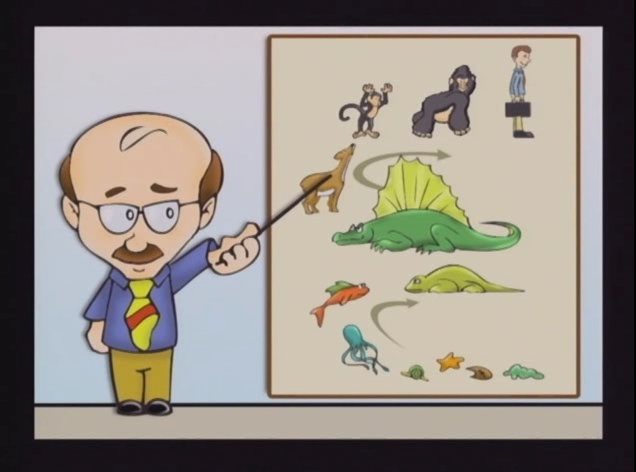
Last edited by mouse; 10-15-2009 at 02:14 AM.

It's unfortunate that mouse doesn't know what he's talking about. Again.

Wow mouse... you have too much time on your hands. If it isn't 9-11 its evolution. What else is next?
I believe I read somewhere in this debate about the beginnings of the universe.
My input on that is that I believe that there are multiple universes and two of them collided together creating our universe. Kinda like the sparks you get when you strike a piece of flint or something.
As far as evolution goes, the science geek in me says it is possible, but the spiritual side of me says Adam and Eve. I choose to combine the two. How long is a day to God? I am certain that noone knows, therefore I believe that sure we could have started as monkeys or whatever, but God was still shaping and molding us to create us in his image. Make sense to anyone? It is like watching a sculptor do their thing. The sculpture looks nothing like its intended design at first, but in time it takes shape.
On another note, science and religion go hand in hand.
Religion states things so extraordinary that science will sooner or later attempt to figure out how the it happened. The thing about that is, religion in fact further advances human intelligence and keeps curious people interested on possibilities, and the paths that we as a species have traveled.

Where did the theory of the universe being less than 10k years derive from? Originally?
Says the 14 billion year old guy who was around to have seen it all? You were there when it all started right? No??? Oh bummer....
Ah yes, I forget that for the purposes of these debates you lean heavily on others' work... If they say the Universe is 14 billion years old, then gosh darnet! it must be true. They would never lie or have a motive to do so... Yeah I get it... it's one massive circular jerk-off. Unlike some of you however, I question everything around me and don't have to rely on others to do my thinking for me... I've chosen to walk down the harder path instead of coasting along the lazy one. I've studied the topics at hand extensively instead of relying on internet/copy&paste lolapaloozas... Tactics that only seem to demonstrate that people can't defend their own position (otherwise they would pen down their arguments in manner which demonstrated they grasp the concepts at play). Sadly enough, most of these people feel they can 'win' a debate simply by 'slapping' someone else's work into the argument... as if such articles were the end-all of discussion. BTW I see that your fixation with the word 'fail' has not changed. You continue to overuse it (and yes, I say this, knowing fully well that you'll come back with some snide remark about why you feel compelled to use that word). Whatever, I don't care at this point.
Look at the facts, not those things you perceive as being fact... What do we really know? What are we really able to observe when we look out into space? Into the far reaches of the Universe? No guessing... what can we actually see?
As I said earlier, we can see that the Universe is expanding with constant acceleration, while its energy is being depleted. None of our universal models predicted that combination, why? Because most of them started off with a framework that biasly eliminated one of the potential solutions. Yeah that's right, no atheistically-biased scientist wanted to address the 'EVERYTHING from nothing' concept and so this assumption was eliminated from the very framework of their postulates. Not considered. Unfortunately for them, their theories broke-down (or failed to predict our current cosmic state) without that crucial premise. Yeah... no dilemma whatsoever, except in my eyes.... right.
Not surprisingly though, more and more people have come to accept a Universal model that establishes a finite beginning, as it has less glitches than trying to justify otherwise. What they don't realize is that the implication of that reality is far reaching from a philosophical standpoint. Since contemplation of that question, however, doesn't fall under the scope of their assessments - they leave it alone. Case in point would be to refer you to your own response earlier in which you suggested that I leave that question alone... separate in its own arena.
Explanations that incorporate the use of dark energy, and a rekindling of a half-century old cosmological constant, or even the sci-fi like 'phantom energy' concept are all in their incipient phase at this point in trying to address our current cosmic state. Dark energy, which has become very popular of late, is a catch-all term for any hypothesised field with negative pressure and variable cosmic density. Based on that 'flexible' definition its use in this matter is highly convenient given that it may produce several solutions. Unfortunately, we don't currently have the means of working with 'dark energy' much less conducting experiments with it. Not to mention, problems such as the well do ented 'Vacuum catastrophe,' become a significant hurdle toward that goal.
Aside from that pursuit, one seemingly innocuous question has lingered in the shadows, one that carries serious weight when held against the established world-view. Had the Universe expanded at its current acceleration rate for billions of years (a rate which has been verified constant over the last ten years, to the 12th decimal place no less) wouldn't all cosmic mass be moving faster than the speed of light today?? Wouldn't all matter have turned to pure energy by now.... Think about that for a second...
Since we don't observe that to be the case today, something has to give... Another question that arises, deals with the acceleration itself... How can the universe be expanding faster now than it did during the initial Big Bang??? The concept simply defies logic... For that matter, the red shift we observe today among the background radiation in the heavens simply cannot be explained by a multi-billion year Universe model, not at a constantly accelerated expansion... Oddly enough, it was an observation of the red shift around a supernovae which initially led us to the discovery that the universe was indeed expanding. But let's ignore these tidbits... everybody seems to want to do so already...
Last edited by Phenomanul; 10-16-2009 at 01:23 AM.
I read somewhere that there are galaxies that could very well be accelerating faster than the speed of light.
Noone knows what happens to matter when it exceeds the speed of light. There are only theories.

Yeah that's right, no atheistically-biased scientist wanted to address the 'EVERYTHING from nothing' concept and so this assumption was eliminated from the very framework of their postulates.
That statement is so laughable. Pretty sure the bible doesn't address creation as everything form nothing either unless you consider god nothing.
Feel free to consider 'god' whatever you so deem...
To Christians, GOD is supernatural (i.e. He exists outside of the natural realm)... He is not bound by the laws of this universe, space or time... since HE CREATED THEM. He established the rules that keep this place together...
Granted of course, that the above statement is not a scientific one.
As for whether or not the bible addresses supernatural Creation... I'm pretty sure it does... that's what all the controversy is about...
"In the beginning" --> TIME
"GOD created the heavens" --> SPACE
"and the earth" --> MATTER
All you're doing, is constructing a framework just like the one you talked about above. You're not talking creating something from nothing either. Yet you somehow either fail to see this or simply choose to ignore it.
There are currently 1 users browsing this thread. (0 members and 1 guests)
 Posting Permissions