Liechtenstein
From Wikipedia, the free encyclopedia
Jump to:
navigation,
search
"Lichtenstein" redirects here. For other uses, see
Lichtenstein (disambiguation).

This article
needs additional citations for verification.
Please help
improve this article by adding
reliable references. Unsourced material may be
challenged and
removed.
(January 2009) Principality of Liechtenstein
Fürstentum Liechtenstein
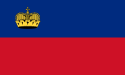
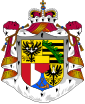 Flag Coat of arms Motto:
 Für Gott, Fürst und Vaterland
For God, Prince and Fatherland
Anthem: 
 Oben am jungen Rhein
"Up on the Young Rhine"
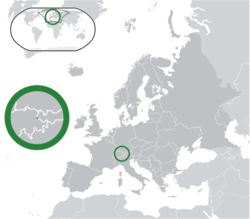
Location of
Liechtenstein (green)
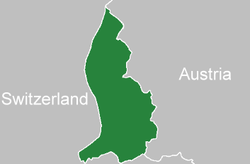
Location of Liechtenstein (green)
Capital Vaduz
 47°08.5′N 9°31.4′E / 47.1417°N 9.5233°E / 47.1417; 9.5233 Largest city Schaan Official language(s) German Demonym
 Liechtensteiner (male), Liechtensteinerin (female)
Government Parliamentary democracy under
cons utional monarchy -
Prince Hans-Adam II -
Regent Alois -
Prime Minister Klaus Tschütscher -
Landtag Speaker Arthur Brunhart Independence as
principality -
Treaty of Pressburg 1806 - Independence from the
German Confederation 1866
Area - Total
160.475 km2 (
211th)
61.960
sq mi -
Water (%) negligible
Population - 2009 estimate 35,789
[1] (
206th) - 2000 census 33,307 -
Density 221/km2 (
52nd)
572/sq mi
GDP (
PPP) 2008 estimate - Total $3.250 billion
[2][3] -
Per capita $91,697
[2][3][4] (
1st)
GDP (nominal) 2008 estimate - Total $4.929 billion
[2][3] -
Per capita $139,068
[2][3][4] (
1st)
HDI (2010)

0.891
[5] (
very high) (
6th)
Currency Swiss franc (
CHF)
Time zone CET (
UTC+1) - Summer (
DST)
CEST (
UTC+2)
Drives on the right
ISO 3166 code LI Internet TLD .li Calling code +423 The
Principality of Liechtenstein (
 i /ˈlɪktənstaɪn/ LIK-tən-styn
;
German:
Fürstentum Liechtenstein, German pronunciation:
[ˈfʏʁstn̩tuːm ˈlɪçtn̩ʃtaɪn][6]) is a
doubly landlocked alpine country in
Western Europe, bordered by
Switzerland to the west and south and by
Austria to the east. Its area is just over 160 km² (about 61.7 square miles), and it has an estimated population of 35,000. Its capital is
Vaduz; the biggest town is
Schaan. Liechtenstein has the
second highest gross domestic product per person in the world.
[7]
Liechtenstein is the smallest yet the richest
German-speaking country in the world and the only alpine country to lie entirely within the
Alps. It is the only predominantly German-speaking country not to share a common border with
Germany. It is a
cons utional monarchy divided into
11 municipalities. Much of Liechtenstein's terrain is mountainous, making it a
winter sports destination. Many cultivated fields and small farms characterize its landscape both in the south (Oberland,
upper land) and in the north (Unterland,
lower land). The country has a strong
financial sector located in the capital, Vaduz, and has been identified as a
tax haven. It is a member of the
European Free Trade Association and part of the
European Economic Area but not of the
European Union.
Contents
[
hide]
History
Main article:
History of Liechtenstein
At one time, the territory was part of the ancient
Roman province of
Raetia. For centuries this territory, geographically removed from European strategic interests, had little impact on European history. Prior to the reign of its current
dynasty, the region was
enfeoffed to a line of the counts of
Hohenems.
The
Liechtenstein dynasty, from which the principality takes its name, comes from
Castle Liechtenstein in Lower Austria, which the family possessed from at least 1140 until the 13th century, and from 1807 onward. Through the centuries, the dynasty acquired vast tracts of land, predominantly in
Moravia,
Lower Austria,
Silesia, and
Styria, though these territories were all held in
fief under other more senior feudal lords, particularly under various lines of the
Habsburg family, whom several Liechtenstein princes served as close advisers. Thus, without any territory held directly under the Imperial throne, the Liechtenstein dynasty was unable to meet a primary requirement to qualify for a seat in the Imperial diet (
parliament), the
Reichstag.


The castle of Gutenberg in
Balzers
The family yearned for the added power a seat in the Imperial government would bring and therefore sought to acquire lands that would be
unmittelbar, or held without any feudal personage other than the
Holy Roman Emperor having rights on the land. After some time, the family was able to arrange the purchase of the minuscule
Herrschaft ("Lordship") of
Sc enberg and county of
Vaduz (in 1699 and 1712 respectively) from the Hohenems. Tiny Sc enberg and Vaduz had exactly the political status required: no feudal lord other than their
comital sovereign and the
suzerain Emperor.
On 23 January 1719, after the lands had been purchased,
Charles VI, Holy Roman Emperor, decreed that Vaduz and Sc enberg were united and elevated the newly formed territory to the dignity of
Fürstentum (
principality) with the name "Liechtenstein" in honour of "[his] true servant,
Anton Florian of Liechtenstein". It was on this date that Liechtenstein became a sovereign member state of the
Holy Roman Empire. It is a testament to the pure political expediency of the purchases that the Princes of Liechtenstein did not set foot in their new principality for over 120 years.
 Vaduz Castle
, overlooking the capital, is still home to the
Prince of Liechtenstein
As a result of the
Napoleonic Wars, by 1806 the Holy Roman Empire was under the control of French emperor
Napoleon I. Napoleon dissolved the empire; this had broad consequences for Liechtenstein: imperial, legal and political mechanisms broke down. The state ceased to owe obligations to any feudal lord beyond its borders.
Modern publications generally (although incorrectly) attribute Liechtenstein's
sovereignty to these events. In reality, its prince merely became suzerain, as well as remaining sovereign lord. From 25 July 1806 when the
Confederation of the Rhine was founded, the Prince of Liechtenstein was a member, in fact a vassal of its hegemon, styled
protector, French Emperor Napoleon I, until the dissolution of the confederation on 19 October 1813.
Soon afterward, Liechtenstein joined the
German Confederation (20 June 1815 – 24 August 1866) which was presided over by the
Emperor of Austria.
 Johann I Josef, Prince of Liechtenstein
Then, in 1818,
Johann I granted the territory a limited cons ution. 1818 also saw the first visit of a member of the house of Liechtenstein, Prince Alois; however, the first visit by a sovereign prince would not occur until 1842.
Developments during the 19th century included:
- In 1836, the first factory was opened, making ceramics.
- In 1861, the Savings and Loans Bank was founded, as was the first cotton-weaving mill.
- Two bridges over the Rhine were built in 1868, and in 1872 a railway line across Liechtenstein was constructed.
20th century
Until the end of
World War I, Liechtenstein was closely tied first to the
Austrian Empire and later to
Austria-Hungary; the ruling princes continued to derive much of their wealth from estates in the Habsburg territories, and they spent much of their time at their two palaces in Vienna. The economic devastation caused by this war forced the country to conclude a customs and monetary union with its other neighbour, Switzerland. Liechtenstein's army was disbanded in 1868 for financial reasons.
At the time of the dissolution of the
Austro-Hungarian Empire, it was argued that Liechtenstein, as a feoff of the Holy Roman Empire, was no longer bound to the emerging independent state of
Austria, since the latter did not consider itself as the legal successor to the empire. This is partly contradicted by the
coeval Liechtenstein perception that the dethroned Austro-Hungarian Emperor still maintained an abstract heritage of the Holy Roman Empire.
Franz I, Prince of Liechtenstein.
In early 1938, just after the annexation of Austria into Greater
Nazi Germany, 84 year old
Prince Franz I abdicated, naming his 31-year-old third cousin,
Prince Franz Joseph, as his successor. His wife, whom he had married in 1929, was a wealthy Jewish woman from Vienna, and local Liechtenstein Nazis had already identified her as their Jewish "problem". Although Liechtenstein had no official Nazi party, a Nazi sympathy movement had been simmering for years within its National Union party.
[8]
During
World War II, Liechtenstein remained officially neutral, looking to neighboring Switzerland for assistance and guidance, while family treasures within the war zone were taken to Liechtenstein for safekeeping. At the close of the conflict,
Czechoslovakia and
Poland, acting to seize what they considered to be German possessions, expropriated the entirety of the Liechtenstein dynasty's hereditary lands and possessions in
Bohemia,
Moravia, and
Silesia — the princes of Liechtenstein lived in
Vienna until the
Anschluss of 1938. The expropriations (subject to modern legal dispute at the
International Court of Justice) included over 1,600 km2 (618 sq mi) of agricultural and forest land, and several family castles and palaces.
Citizens of Liechtenstein were forbidden to enter Czechoslovakia during the
Cold War. More recently the diplomatic conflict revolving around the controversial post-war
Beneš decrees has resulted in Liechtenstein not sharing international relations with the
Czech Republic or
Slovakia. The diplomatic relations were established between Liechtenstein and the Czech Republic on 13 July 2009,
[9][10][11] and with Slovakia on 9 December 2009.
[12]
Liechtenstein gave asylum to about 501 soldiers of the
First Russian National Army (a collaborationist Russian force within the German
Wehrmacht) at the close of World War II; this is commemorated by a
monument at the border town of
Hintersc enberg. The act of granting asylum was no small matter as the country was poor and had difficulty feeding and caring for such a large group of refugees. Eventually,
Argentina agreed to resettle the asylum seekers permanently. In contrast,
the British and Americans repatriated the Russians who had fought for Germany to the USSR, and many of them perished in the
Gulag.
In dire financial straits following the war, the Liechtenstein dynasty often resorted to selling family artistic treasures, including the priceless portrait "
Ginevra de' Benci" by
Leonardo da Vinci, which was purchased by the
National Gallery of Art of the
United States in 1967. Liechtenstein prospered, however, during the decades following, as it used its low
corporate tax rates to draw many companies to the country.
The
Prince of Liechtenstein is the world's sixth wealthiest leader with an estimated wealth of
USD $5 billion.
[13] The country's population enjoys one of the world's highest standards of living.
Government
The center of government in Vaduz.
Main article:
Politics of Liechtenstein
The
Cons ution of Liechtenstein was
adopted in March 2003, replacing the previous 1921 cons ution which had established Liechtenstein as a cons utional monarchy headed by the reigning prince of the Princely House of Liechtenstein. A parliamentary system had been established, although the reigning prince retained substantial political authority.
The reigning prince is the head of state and represents Liechtenstein in its international relations (although Switzerland has taken responsibility for much of Liechtenstein's diplomatic relations). The prince may veto laws adopted by parliament. The prince can call
referendums, propose new legislation, and dissolve parliament, although dissolution of parliament may be subject to a referendum.
[14]
Executive authority is vested in a collegiate government comprising the head of government (prime minister) and four government councilors (ministers). The head of government and the other ministers are appointed by the prince upon the proposal and concurrence of parliament, thus reflecting the partisan balance of parliament. The cons ution stipulates that at least two members of the government be chosen from each of the two regions.
[15] The members of the government are collectively and individually responsible to parliament; parliament may ask the prince to remove an individual minister or the entire government.
Legislative authority is vested in the unicameral
Landtag made up of 25 members elected for maximum four-year terms according to a proportional representation formula. Fifteen members are elected from the "Oberland" (Upper Country or region) and ten members are elected from the "Unterland" (Lower Country or region).
[16] Parties must receive at least 8% of the national vote to win seats in parliament. Parliament proposes and approves a government, which is formally appointed by the prince. Parliament may also pass votes of no confidence in the entire government or individual members.
Parliament elects from among its members a "Landesausschuss" (National Committee) made up of the president of the parliament and four additional members. The National Committee is charged with performing parliamentary oversight functions. Parliament can call for referendums on proposed legislation. Parliament shares the authority to propose new legislation with the prince and with the number of citizens required for an initiative referendum.
[17]
Judicial authority is vested in the Regional Court at Vaduz, the Princely High Court of Appeal at Vaduz, the Princely Supreme Court, the Administrative Court, and the State Court. The State Court rules on the conformity of laws with the cons ution and has five members elected by parliament.
New cons ution
In a
national referendum in March 2003, nearly two-thirds of the electorate voted in support of Hans-Adam II's proposed new cons ution to replace the 1921 one. The proposed cons ution was criticised by many, including the
Council of Europe, as expanding the powers of the monarchy (continuing the power to veto any law, and allowing the prince to dismiss the government or any minister). The prince threatened that if the cons ution failed, he would, among other things, convert some of the royal property for commercial use and move to Austria.
[18] The royal family and the prince enjoy tremendous public support inside the nation, and the resolution passed with about 64% in favour.
Geography
Main article:
Geography of Liechtenstein
The
Rhine: Border between Liechtenstein and Switzerland.
Liechtenstein is situated in the Upper
Rhine valley of the European
Alps and is bordered to the east by Austria and to the south and west by Switzerland. The entire western border of Liechtenstein is formed by the Rhine. Measured south to north and, the country is about which is 24 km (15 mi) long. Its highest point, the
Grauspitz, is 2,599 m (8,527 ft). Despite its Alpine location, prevailing southerly winds make the climate of Liechtenstein comparatively mild. In winter, the mountain slopes are well suited to
winter sports.
New
surveys using more accurate measurements of the country's borders in 2006 have set its area at 160 km2 (61.776 sq mi), with borders of 77.9 km (48.4 mi).
[19] Thus, Liechtenstein discovered in 2006 that its borders are 1.9 km (1.2 mi) longer than previously thought.
[20]
Liechtenstein is one of only two
doubly landlocked countries in the world
[21]—being a landlocked country wholly surrounded by other landlocked countries (the other is
Uzbekistan). Liechtenstein is the
sixth-smallest independent nation in the world by land area.
The principality of Liechtenstein is
divided into 11 communes called
Gemeinden (singular
Gemeinde). The Gemeinden mostly consist only of a single town or village. Five of them (
Eschen,
Gamprin,
Mauren,
Ruggell, and
Sc enberg) fall within the electoral district
Unterland (the lower county), and the remainder (
Balzers,
Planken,
Schaan,
Triesen,
Triesenberg, and
Vaduz) within
Oberland (the upper county).
Economy
Looking southward at Vaduz city-centre.
Hilti AG in New York.
Main article:
Economy of Liechtenstein
Despite (or perhaps because of) its limited natural resources, Liechtenstein is one of the few countries in the world with more registered companies than citizens; it has developed a prosperous, highly industrialized free-enterprise economy and boasts a financial service sector as well as a living standard which compares favorably with those of the urban areas of Liechtenstein's large European neighbours.
Relatively low business taxes—the maximum tax rate is 20%
[22]—as well as easy
Rules of Incorporation have induced about 73,700 holding (or so-called 'letter box') companies to establish registered offices in Liechtenstein. This provides about 30% of Liechtenstein's state revenue. Liechtenstein also generates revenue from
Stiftungen ("foundations"), which are financial en ies created to increase the privacy of nonresident foreigners' financial holdings. The foundation is registered in the name of a Liechtensteiner, often a lawyer.
Recently, Liechtenstein has shown strong determination to prosecute international money-launderers and has worked to promote the country's image as a legitimate finance center. In February 2008, the country's
LGT Bank was implicated in a
tax-fraud scandal in Germany, which strained the ruling family's relationship with the German government. Crown Prince Alois has accused the German government of trafficking in stolen goods. This refers to its $7.3 million purchase of private banking information illegally offered by a former employee of LGT Group.
[23][24] However, the
United States Senate's subcommittee on tax haven banks said that the LGT bank, which is owned by the royal family, and on whose board they serve, "is a willing partner, and an aider and abettor to clients trying to evade taxes, dodge creditors or defy court orders."
[25]
Liechtenstein participates in a
customs union with Switzerland and employs the
Swiss franc as national currency. The country imports more than 90% of its energy requirements. Liechtenstein has been a member of the
European Economic Area (an organization serving as a bridge between the
European Free Trade Association (EFTA) and the
European Union) since May 1995. The government is working to harmonize its economic policies with those of an integrated Europe. Since 2002, Liechtenstein's rate of unemployment has doubled. In 2004, it stood at 2.2% in the third quarter. Currently, there is only one hospital in Liechtenstein, the Liechtensteinisches Landesspital in Vaduz. The
gross domestic product (GDP) on a
purchasing power parity basis is $4.16 billion,
[21] or $118,000 per person.
Liechtenstein is a large producer of ceramics and is the world's largest producer of sausage casings, potassium storage units and false teeth. Other industries include electronics, textiles, precision instruments, metal manufacturing, power tools, anchor bolts, calculators, pharmaceuticals, and food products. Its most recognizable international company and largest employer is
Hilti, a manufacturer of
direct fastening systems and other high-end
power tools. Liechtenstein produces wheat, barley, corn, potatoes, dairy products, livestock, and wine. Tourism accounts for a large portion of the country's economy.
Taxation
The government of Liechtenstein taxes both personal and business income and principal (wealth). The basic rate of
personal income tax is 1.2%. When combined with the additional income tax imposed by the communes, the combined income tax rate is 17.82%.
[26] An additional income tax of 4.3% is levied on all employees under the country's
social security program. This rate is higher for the self-employed, up to a maximum of 11%, making the maximum income tax rate about 29% in total. The basic
tax rate on wealth is 0.06% per annum, and the combined total rate is 0.89%. The maximum business
income tax rate is 18–20%.
[21]
Liechtenstein's
gift and
estate taxes vary depending on the relationship the recipient has to the giver and the amount of the inheritance. The tax ranges between 0.5% and 0.75% for spouses and children and 18% to 27% for non-related recipients. The estate tax is progressive.
The
2008 Liechtenstein tax affair is a series of tax investigations in numerous countries whose governments suspect that some of their citizens may have evaded tax obligations by using banks and trusts in Liechtenstein; the affair broke open with the biggest complex of investigations ever initiated for
tax evasion in the
Federal Republic of Germany.
[27] It was also seen as an attempt to put pressure on Liechtenstein, then one of the remaining
uncooperative tax havens – along with
Andorra and
Monaco – as identified by the Paris-based
Organisation for Economic Co-operation and Development in 2007.
[28] On 27 May 2009 the OECD removed Liechtenstein from the blacklist of uncooperative countries.
[29]
In August 2009, the British Government Department, HM Revenue & Customs, agreed with the Alpine tax haven to start exchanging information. It is believed that up to 5,000 British investors have roughly £3billion stashed in accounts and trusts in the country.
[30]
Demographics
Main article:
Demographics of Liechtenstein
Administrative divisions of Liechtenstein.
Liechtenstein is the fourth smallest country of Europe, after
Vatican City,
Monaco, and
San Marino. Its population is primarily
Alemannic-speaking, although its resident population is approximately one third foreign-born, primarily
German speakers from
Germany,
Austria, and
Switzerland, other Swiss,
Italians, and
Turks. Foreign-born people make up two-thirds of the country's workforce. 209 members of the population are unemployed.[
citation needed]
The official language is German; most speak Alemannic, a
dialect of German that is highly divergent from
Standard German but closely related to those dialects spoken in neighbouring regions such as
Vorarlberg, Austria. In
Triesenberg, a dialect promoted by the municipality is spoken. According to the 2000 census, 87.9% of the population is
Christian, of whom 78.4% adhere to the
Roman Catholic faith, while about 8% are
Protestant. Compared to the 1990 census, the percentage of Christians fell, whereas
Muslims and the undeclared/no religion more than doubled in size.
[31] According to a 2009
Pew Research Center report, Muslims cons ute approximately 4.8% of the population.
[32]
Religion
[33] 2000 1990 Catholics 78.4 % 84.9 % Reformed Church 7.9% 9.4 % Christian-orthodox Churches 1.1% 0.7 % Other Christian Churches 0.4% 0.1 % Muslims 4.8% 2.4 % Jews 0.1% 0.0 % Other religions 0.3% 0.1 % Undeclared / no religion 7.0 % 2.4 %
Total: 100% 100% Liechtensteiners have an average life expectancy at birth of 79.68 years (76.1 for males; 83.28 for females). The infant mortality rate is 4.64 deaths per 1,000 live births, according to recent estimates. The literacy rate of Liechtenstein is 100%.
[21] The
Programme for International Student Assessment, coordinated by the
OECD, currently ranks Liechtenstein's education as the 10th best in the world.
[34]
Transport
There are about 250 km (155 mi) of paved roadway within Liechtenstein, with 90 km (56 mi) of marked bicycle paths.
9.5 km (5.9 mi) of railway connects Austria and Switzerland through Liechtenstein. The
country's railways are administered by the
Austrian Federal Railways as part of the route between
Feldkirch,
Austria, and
Buchs,
Switzerland. Liechtenstein is nominally within the Austrian Verkehrsverbund Vorarlberg
[35] tariff region. There are four stations in Liechtenstein, namely Schaan-Vaduz, Forst Hilti, Nendeln, and Schaanwald, served by an irregularly stopping train service that runs between Feldkirch and Buchs provided by the Austrian Federal Rail Service. While
EuroCity and other long distance international trains also travel along the route, they do not normally stop at the stations within the borders of Liechtenstein.
Liechtenstein Bus is a subsidiary of the
Swiss Postbus system, but separately run, and connects to the Swiss bus network at
Buchs and at
Sargans. Buses also run to the Austrian town of Feldkirch.
Liechtenstein has no airport; the nearest large airport is
Zürich. There is a small
heliport at
Balzers[36][37] available for charter helicopter flights.
Culture
See also:
Music of Liechtenstein
City-centre with Kunstmuseum (
Liechtenstein Art Museum).
As a result of its small size, Liechtenstein has been strongly affected by external cultural influences, most notably those originating in the southern German-speaking areas of Europe, including Austria, Bavaria, Switzerland, and specifically
Tirol and
Vorarlberg. The "Historical Society of the Principality of Liechtenstein" plays a role in preserving the culture and history of the country.
The largest museum is the
Kunstmuseum Liechtenstein, an international museum of modern and contemporary art with an important international art collection. The building by the Swiss architects Morger, Degelo and Kerez is a landmark in Vaduz. It was completed in November 2000 and forms a "black box" of tinted concrete and black basalt stone. The museum collection is also the national art collection of Liechtenstein.
The other important museum is the Liechtenstein National Museum (
Liechtensteinisches Landesmuseum) showing permanent exhibition on the cultural and natural history of Liechtenstein as well as special exhibitions. There is also a stamp museum and a ski museum.
The most famous historical sites are Vaduz Castle, Gutenberg Castle, the Red House and the ruins of Sc enberg.
Music and theatre are an important part of the culture. There are numerous music organizations such as the Liechtenstein Musical Company, the annual Guitar Days and the International Josef Gabriel Rheinberger Society, which play in two main theatres.
The Private Art Collection of the Prince of Liechtenstein, one of the world's leading private art collections, is shown at the
Liechtenstein Museum in
Vienna.
Amateur radio is a hobby of some nationals and visitors. However, unlike virtually every other sovereign nation, Liechtenstein does not have its own
ITU Prefix. It uses Switzerland's callsign prefixes (typically "HB") followed by a zero.
Sports
Marco Büchel, the first Alpine skier to compete at six Winter Olympics.
Liechtenstein
football teams play in the Swiss football leagues. The Liechtenstein Cup allows access for one Liechtenstein team each year to the
UEFA Europa League;
FC Vaduz, a team playing in the Swiss
Challenge League, the second division in Swiss football, is the most successful team in the Cup, and scored their greatest success in the European Cup Winners' Cup in 1996 when they tied and defeated the
Latvian team
FC Universitate Riga by 1–1 and 4–2, to go on to a lucrative fixture against
Paris St Germain, which they lost 0–4 and 0–3.
The
Liechtenstein national football team is regarded as an easy target for any team drawn against them; this was the basis for a book about Liechtenstein's unsuccessful qualifying campaign for the
2002 World Cup by British author,
Charlie Connelly. In one surprising week during autumn 2004, however, the team managed a 2–2 draw with
Portugal, who only a few months earlier had been the losing finalists in the
European Championships. Four days later, the Liechtenstein team traveled to Luxembourg, where they defeated
the home team 4-0 in a
2006 World Cup qualifying match. In the qualification stage of the European Championship 2008, Liechtenstein beat Latvia 1-0, a result which prompted the resignation of the Latvian coach. They went on to beat Iceland 3-0 on 17 October 2007, which is considered one of the most dramatic losses of the Icelandic national football team. On 7 September 2010, they came within seconds of a famous 1–1 draw against Scotland in Glasgow, having led 1–0 for most of the second half. They lost 2–1 thanks to a Scotland goal by Stephen McManus in the 97th minute.
As an
alpine country, the main sporting opportunity for Liechtensteiners to excel is in winter sports such as
downhill skiing: the country's single ski area is
Malbun.
Hanni Wenzel won two gold medals and one silver medal in the 1980
Winter Olympics (she won bronze in 1976), and her brother
Andreas won one silver medal in 1980 and one bronze medal in 1984 in the
giant slalom event. With nine medals overall (all in alpine skiing), Liechtenstein has won more Olympic medals per capita than any other nation.
[38] It is the smallest nation to win a medal in any Olympics, Winter or Summer, and the only nation to win a medal in the Winter Games but not in the Summer Games. Other notable skiers from Liechtenstein are
Marco Büchel,
Willi Frommelt,
Paul Frommelt and
Ursula Konzett.
Security and defense
The
Liechtenstein National Police is responsible for keeping order within the country. It consists of 85 field officers and 33 civilian staff. All officers are equipped with
small arms.
[39] The country has an extremely low crime rate, with the last murder having taken place, according to an officer who was serving in 2007, “about ten years ago.”
[39] Liechtenstein's prison holds few, if any, inmates, and those with sentences over two years are transferred to Austrian jurisdiction.
[39] The Liechtenstein National Police maintains a trilateral treaty with Austria and Switzerland that enables close cross-border cooperation among the police forces of the three countries.
[40]
Liechtenstein follows a policy of
neutrality and is
one of few countries in the world that maintains no military. The army was abolished soon after the
Austro-Prussian War in which Liechtenstein fielded an army of 80 men, although they were not involved in any fighting. The demise of the
German Confederation in that war freed Liechtenstein from its international obligation to maintain an army, and parliament seized this opportunity and refused to provide funding for an army. The prince objected, as such a move would leave the country defenseless, but relented on 12 February 1868 and disbanded the force. The last soldier to serve under the colours of Liechtenstein died in 1939 at age 95.
[41]





 Reply With Quote