Page 94 of 161 FirstFirst ... 4484909192939495969798104144 ... LastLast
Results 2,326 to 2,350 of 4001
  1. #2326
    I am that guy RandomGuy's Avatar
    My Team
    San Antonio Spurs
    Join Date
    Jun 2005
    Post Count
    51,121
    What do you think the strongest arguments of the people putting forth the AGW theory are?
    CO2 is a greenhouse gas (given).

    CO2 makes up about 0.039% of the atmosphere by volume.
    Humans contribute 3%-4% of that 0.039% by burning fossil fuels, etc.
    It has warmed 1 degree in a century -- and humans have increased CO2 emissions during the same period.
    Therefore, humans have caused the warming.


    Like I said, I don't think it's particularly strong.
    That is a little better, but still not quite a wholly accurate restatement. The first part, "CO2 makes up about 0.039% of the atmosphere by volume.
    Humans contribute 3%-4% of that 0.039% by burning fossil fuels, etc."

    http://co2now.org/Current-CO2/CO2-Tr...heric-co2.html

    Atmospheric CO2 is accelerating upward from decade to decade.

    For the past ten years, the average annual rate of increase is 2.07 parts per million (ppm). This rate of increase is more than double the increase in the 1960s.

    See the table below.
    I would also point out the mathmatically verifiable fact that half of the CO2 we have ever put out into the atmosphere has been put there in the last 16-20 years or so (assuming a 5% growth rate in emissions, 13 years for 6%, or about 10 years for 8%).

    I know you are trying not to accede any points in this discussion, but if you can't accurately restate what the other side in a complex issue discussion says that strongly implies you don't understand the issue, does it not?

    Not trying to be snarky here, just trying to point out that you may want to do some more reading.
    RandomGuy is offline

  2. #2327
    I am that guy RandomGuy's Avatar
    My Team
    San Antonio Spurs
    Join Date
    Jun 2005
    Post Count
    51,121
    But you guys frequently link skepticalscience blog
    Your blog says I frequently link to another blog?

    I am flattered about the attention, but it doesn't really say much.

    Would it be better if I linked to the serious stoners:

    http://www.jasons-indoor-guide-to-or...n-dioxide.html

    1) CO2 doesn't add much yeild if it isn't accompanied by other factors such as more nutrients in the soil and more water.

    2) CO2 being "plant food" is ing irrelevant to what the scientists are saying is dangerous about CO2 changing climate.


    It's a bit like saying "smoking isn't all that bad for you, because it keeps you from gaining a little weight" when the doctor is telling you about lung cancer.

    Lastly, it is simply ing stupid because it takes (if you bothered reading the stoner link above) insanely high concentrations of CO2 to produce any significant benefits to yields, as Wile E. Coyote's own picture shows.
    RandomGuy is offline

  3. #2328
    I am that guy RandomGuy's Avatar
    My Team
    San Antonio Spurs
    Join Date
    Jun 2005
    Post Count
    51,121
    I link actual scientific literature 90% of the time and when I don't I can provide it if asked.
    The skeptical science blog itself uses a copious amount of scientific citations, if one bothers to actually read through it.

    That is what real scientists do.

    Conspiracy theorists tend to eschew this, and instead always take the tack of nitpicking what someone else says or what they think they said. One only has to read through a few infowars.com articles, or twoofer websites to see this pattern.

    When science and facts are not on your side, then that is pretty much all you are left with, i.e. pseudoscience and innuendo.

    In this particular case the logic of risk management also goes against what the Deniers think we should do about all this information.

    I have even gone a step further and argued that the Deniers' claims that we would harm our economy by limiting CO2 emissions is arguably quite the opposite of what would actually happen. Limiting CO2 emissions would HELP the economy, by a quite a bit, over the long run.

    In real science, the data will win out, and we are getting more brainpower and more data all the time. One way or another the answer will get more and more apparent. If it is all bunk, as Darrn/Yoni/Cobra suggest, that will get easier and easier to prove. If it is as big of a conspiracy as they say it is, it will collapse under its own weight eventually, as all large conspiracies do.

    Given that, and the public policy option suggested by AGW is better for the economy anyway, it seems to me to be a no-brainer as to what the logical course is.
    RandomGuy is offline

  4. #2329
    I am that guy RandomGuy's Avatar
    My Team
    San Antonio Spurs
    Join Date
    Jun 2005
    Post Count
    51,121
    An actuary is a business professional who analyzes the financial consequences of risk. Actuaries use mathematics, statistics and financial theory to study uncertain future events, especially those of concern to insurance and pension programs. They evaluate the likelihood of those events, design creative ways to reduce the likelihood and decrease the impact of adverse events that actually do occur.

    Actuaries are an important part of the management team of the companies that employ them. Their work requires a combination of strong analytical skills, business knowledge and understanding of human behavior to design and manage programs that control risk.

    SOA members work in life insurance, retirement systems, health benefit systems, financial and investment management and other emerging areas of practice. The majority of actuaries work within the insurance industry, although a growing number of actuaries work in other fields.
    http://www.soa.org/about/about-what-is-an-actuary.aspx

    These people are paid to think about risk, and what the data say. The ones in the business that I talk to generally allude to the controversy over it, and say they are keeping an eye on it. They are careful not to make the conversation at all political.

    My intuitive sense is that they tend to trust what bodies like the IPCC are saying, and are pricing in moderately increased risk of extreme weather events into the insurance products they are responsible for.

    FWIW
    RandomGuy is offline

  5. #2330
    e^(i*pi) + 1 = 0 MannyIsGod's Avatar
    My Team
    San Antonio Spurs
    Join Date
    Mar 2003
    Post Count
    57,943
    Outside of the public policy decisions, there is no denial of what is going on. Even in the public domain, organizations that are able to make decisions without politicians (ie the military) are doing so.
    MannyIsGod is offline

  6. #2331
    Veteran DarrinS's Avatar
    My Team
    San Antonio Spurs
    Join Date
    Jun 2005
    Post Count
    42,561
    Well, how have I explained that period several times to you in the past? If you want me to enlighten you, prove that you can actually be enlightened by at least showing you have the ability to remember what I show you to begin with.

    I don't remember. Sorry.
    DarrinS is offline

  7. #2332
    Veteran DarrinS's Avatar
    My Team
    San Antonio Spurs
    Join Date
    Jun 2005
    Post Count
    42,561
    Outside of the public policy decisions, there is no denial of what is going on. Even in the public domain, organizations that are able to make decisions without politicians (ie the military) are doing so.


    Climate Change Impacts In The USA is Already [NOT] Happening


    Many government reports by NASA, NOAA, EPA, USFWS, USFS, USDA and other agencies mention that climate change impacts are already observable in the USA. This is discussed in the context of endangered species conservation, forest resource assessment, future water availability, disaster planning, agriculture policy, etc. I have read many of these reports, which often refer back to the IPCC or the US Global Change Research Program. But they are usually vague on details of what bad things are expected to happen, generally referring to increases in extreme events. Nevertheless, these vague bad things are being used to guide policy.

    The USA has some of the best data and is a large country. Are bad effects of climate change really visible already? In what follows, I address the evidence often put forward to support these claims and compare these to the literature. The true story is far from alarming.


    Ocean Acidification

    One government draft report indicated that ocean pH has increased (become more acid) by 0.1 units, and that this represents a 30% increase in acidity since 1750. Because pH is a log scale, estimating percent increases in acidity is problematic and a change of 0.1 units could not represent a 30% change in acidity as stated. A serious issue not addressed by the report is that a global time series of pH data for the oceans does not exist. Thus, the provenance of the 0.1 unit change in value is dubious, and the confidence intervals on such an estimate would no doubt be large. Furthermore, daily, seasonal, and between year pH fluctuations at any given location are on the order of ±0.3 pH units or more (Middelboe and Hansen 2007; Pelejero et al. 2005).

    Sea Level Rise

    Some reports state that sea level rise poses a threat to United States natural habitats, with other reports focusing on risks to developed areas. According to the Intergovernmental Panel on Climate Change (IPCC) temperatures due to human activity began to rise after 1980, but estimates of sea level show a rise from about 1870 (earliest records) at a nearly linear rate and with no sign of acceleration. Sea level rise from 1870 to 1980 is not likely due to human activity. One report indicates that IPCC has projected a sea level rise of 0.4 to 2 m by 2090, but the fourth IPCC report does not make such a claim, instead giving a best estimate of 0.28 to 0.43 m. Recent levels of rise (http://sealevel.colorado.edu), at 3.1 mm/year long-term trend or 0.31 m in 100 years with no indication of “acceleration,” are only consistent with the lowest IPCC projections. In fact, recent deceleration of the rate of rise (Houston and Dean 2011) has been detected. Examples of papers that projected sea level increases lower than the range discussed in the fourth IPCC report are Bouwer (2011), Chu et al. (2010), Czymzik et al. (2010), and Xie et al. (2010).

    Temperature Increases

    Governement assessment reports note that US temperatures have risen 2°F since 1961. However, conclusions about the extent of temperature increase depend heavily upon the start date for the calculation. Perhaps by coincidence, a start date of 1961 gives the most alarming rise. In contrast, there is almost no rise from 1938 to 2011 in the US. The same is true for sea surface temperature changes. This is because natural climate oscillations (e.g., Wyatt et al. 2011) produced a warm period in the mid-twentieth century with a cool period in the 1960s.

    Floods

    Reports assert that floods are increasing, but data do not bear this out. Hirsh and Ryberg (2011) showed that there is no trend toward increasing flood magnitudes in any region of the US, and a small decrease in the Southwest. Arrigoni et al. (2010) showed that climate change in the northern Rocky Mountains over 59 years has not significantly affected basin flows, although human habitat modifications have reduced the difference between minimum and maximum flows. Kundezewicz et al. (2005), in a global analysis of 195 long series of daily flow records, rejected the hypothesis of a growth in maximum daily flows. Increasing trends in flood damage can be fully accounted for by rising population and wealth.

    Regional Drought Frequency

    According to assessment reports, regional droughts are increasing in frequency and severity. However, they typically do not support this contention with any reliable data. Droughts are difficult to characterize and methods for doing so have become more sophisticated over time. The actual quantification of the “area” of a drought is also extremely subjective and no standard methods exist, nor do long-term standardized data.

    Data related to precipitation and drought activity do not appear to support the contention of increasing drought frequency and severity and suggest that drought patterns are complex. For example, there has been a 5% increase in overall precipitation in the US rather than increasing drought. Sheffield et al. (2009) found that large-scale droughts follow ENSO and northern Pacific and Atlantic SSTs. This relation to ENSO activity is confirmed in a study in the US Southwest (McCabe et al. 2010). Globally, the mid 1950s had the highest drought activity and the mid 1970s to mid 1980s had the lowest, rather than a simple increasing trend. Again, picking the mid-1970s as a start date will give a false appearance of an increasing trend.

    Extreme Storm Events

    Assessment reports allege that extreme storm events are increasing even though storm severity per se is not reported or do ented in any government archives. A “storm” is not even a well-defined object in climatology. There is an apparent increase in the number of tornados over time. However, improvements in radar quality and coverage over the past decades cause a detection bias trend, with more, smaller tornados being detected and recorded over time. Furthermore, increases in available disaster assistance aid have encouraged more frequent reporting of smaller storms in efforts to get disaster aid. Counting only category F4 and F5 events, which are relatively consistently detectable and recorded, there is no trend over the past 100 years (Balling and Cerveny 2003).

    Hurricanes

    Hurricane strength is said to be increasing. This can likely be attributed to increasing satellite coverage and resolution, which tends over time to more accurately capture the hours when a storm is at maximum strength. A study that corrects for storm detection ability over time (Vecchi and Knutson 2011) finds no trend in Atlantic hurricanes over the period of 1878 to 2008. Studies of landfall hurricanes (Balling and Cerveny 2003) also show no trend. The last landfall hurricane to hit (i.e., with the hurricane eye) the continental US was Katrina in 2005.

    Fires

    Reports suggest that warmer temperatures and changing precipitation patterns will cause more fires and affect the seasonality of fires. Indians and early European settlers both used fire extensively. Areas converted to agriculture (e.g., the Great Plains) now see almost no fire. Some western forests have higher fuel loads than 200 years ago. In the context of these and other large landscape changes, no one has do ented a change in fire regimes in the US that can be attributed to climate change. In fact, the largest historical fires were in the West around 100 years ago. Human activities (changes in fuel loads, increased ignition sources, arson) have on the other hand been clearly do ented effects on fire extent, as have “let burn” policies in the West, which have only been implemented in the past few decades..

    Algal Blooms

    Reports indicate that harmful algal blooms in aquatic ecosystems have become more frequent, intense, and widespread. Climate change is only one factor potentially causing harmful algal blooms, with increasing nutrient runoff a clearly important factor. There is no basis for ascribing trends in blooms to climate change. There is also an increasing ability to detect them as satellite imagery improves over time.

    Changes in Ecosystems

    There are studies showing responses to biota that are “consistent with” warming, but most of these are actually positive, whereas negative effects are hypothetical (e.g., phenology “might” be disrupted). For example, changes in bird migration and nesting dates indicate adaptation to changes rather than an alarming situation. The clearest data pertain to long-term trends in plant growth. These studies, with a few local exceptions, show regional to global net primary productivity (NPP) to have been increasing in the past 50 to 100 years (Alcaraz-Segura et al. 2010; Bellassen et al. 2011; Jia et al. 2009; Kohler et al. 2010; Lin et al. 2010; Nemani et al. 2003; Tian et al. 2010) due to both rising CO2 levels and increasing temperatures. If warming since the Little Ice Age is leading to increased NPP, this is difficult to construe as problematic.

    Conclusions

    Within the United States, the claim that bad climate effects can “already” be detected is a totally subjective and unsupported hypothetical.

    Literature Cited

    Aitken, S.N., Yeaman, S., Holliday, J.A., Wang, T., and Curtis-McLane, S. 2008. Adaptation, migration or extirpation: climate change outcomes for tree populations. Evolutionary Applications 1:95 111.

    Alcaraz-Segura, D., Chuvieco, E., Epstein, H.E., Kasischke, E.S., and Trishchenko, A. 2010. Debating the greening vs. browning of the North American boreal forest: differences between the satellite datasets. Global Change Biology 16:760 770.

    Anagnostopoulos, G.G., Koutsoyiannis, D., Christofides, A., Efstradiadis, A., and Mamassis, N. 2010. A comparison of local and aggregated climate model outputs with observed data. Hydrological Sciences Journal 55:1094 1110.

    Arrigoni, A.S., Greenwood, M.C., and Moore, J.N. 2010. Relative impact of anthropogenic modifications versus climate change on the natural flow regimes of rivers in the northern Rocky Mountains, United States. Water Resources Research 46:W12542; doi:10.1029/2010WRO09162.

    Balling, R.C., and Cerveny, R.S. 2003. Compilation and discussion of trends in severe storms in the United States: Popular perception v. climate reality. Natural Hazards 29(2):103 112.

    Bellassen, V., Viovy, N., Luyssaert, S., LeMarie, G., Schelhaas, M.-J., and Ciais, P. 2011. Reconstruction and attribution of the carbon sink of European forests between 1950 and 2000. Global Change Biology 17:3274 3292.

    Bouwer, L.M. 2011. Have disaster losses increased due to anthropogenic climate change? Bulletin of the American Meteorological Society 92:39 46.

    Chu, P.-S., Chen, Y.R., and Schroeder, T.A. 2010. Changes in precipitation extremes in the Hawaiian islands in a warming climate. Journal of Climate 23:4881 4900.

    Cole, K. 1985. Past rates of change, species richness and a model of vegetational inertia in the Grand Canyon, Arizona. American Naturalist 125:289 303.

    Cole, K.L. 2009. Vegetation response to early Holocene warming as an analog for current and future changes. Conservation Biology 24:29 37.

    Cwynar, L.C., and Spear, R.W. 1991. Reversion of forest to tundra in the central Yukon. Ecology 72:202 212.

    Czymzik, M., Dulski, P., Plessen, B., von Grafenstein, U., Naumann, R., and Brauer, A. 2010. A 50 year record of spring‐summer flood layers in annually laminated sediments from Lake Ammersee (southern Germany). Water Resources Research 46:W11528; doi:10.1029/2009WR008360.

    Hirsch, R.M., and Ryberg, K.R. 2011. Has the magnitude of floods across the USA changed with global CO2 levels? Hydrological Sciences Journal doi:10.1080/02626667.2011.621895.

    Houston, J.R., and Dean, R.G. 2011. Sea-level acceleration based on U.S. tide gauges and extensions of previous global-gauge analyses. Journal of Coastal Research doi:10.2112/JCOASTRES D 10 00157.1.

    Jia, G.J., Epstein, H.E., and Walker, D.A. 2009. Vegetation greening in the Canadian arctic related to decadal warming. Journal of Environmental Monitoring 11:2231 2238.

    Kohler, I.H., Poulton, P.R., Auerswald, K., and Schnyder, H. 2010. Intrinsic water-use efficiency of temperate seminatural grassland has increased since 1857: An analysis of carbon isotope discrimination of herbage from the Park Grass Experiment. Global Change Biology 16:1531 1541.

    Kundzewicz, Z.W., Graczyk, D., Maurer, T., Pinskwar, I., Radziejewski, M., Svensson, C., and Szwed, M. 2005. Trend detection in river flow series: 1. Annual maximum flow. Hydrological Sciences Journal 50(5):797 810.

    Lin, D., Xia, J., and Wan, S. 2010. Climate warming and biomass ac ulation of terrestrial plants: A meta-analysis. New Phytologist 188:187 198.

    Loehel, C. 1998. Height growth rate tradeoffs determine northern and southern range limits for trees. Journal of Biogeography 25:735 742.

    Loehle, C. 2000. Forest ecotone response to climate change: sensitivity to temperature response functional forms. Canadian Journal of Forest Research 30:1632 1645.

    Loehle, C. 2003. Compe ive displacement of trees in response to climate change or introduction of exotics. Environmental Management 32:106 115.

    Loehle, C. 2011. Criteria for assessing climate change impacts on ecosystems. Ecology and Evolution doi:10.1002/ece3.7.

    Loehle, C., and LeBlanc, D.C. 1996. Model-based assessments of climate change effects on forests: a critical review. Ecological Modelling 90:1 31.

    Masek, J.G. 2001. Stability of boreal forest stands during recent climate change: Evidence from Landsat satellite imagery. Journal of Biogeography 28:967 976.

    McCabe, G.J., Legates, D.R., and Lins, H.F. 2010. Variability and trends in dry day frequency and dry event length in the southwestern United States. Journal of Geophysical Research 11507108; doi:10.1029/2009JD012866.

    Middelboe, A.L. and Hansen, P.J. 2007. High pH in shallow-water macroalgal habitats. Marine Ecology Progress Series 338: 107-117

    Morin, X., Lechowicz, M.J., Augspurger, C., O’Keefe, J., Viner, D., and Chuine, I. 2009. Leaf phenology in 22 North American tree species during the 21st century. Global Change Biology 15:961 975.

    Nemani, R.R., Keeling, C.D., Hashimoto, H., Jolly, W.M., Piper, S.C., Tucker, C.J., Myneni, R.B., and Running, S.W. 2003. Climate-driven increases in global terrestrial net primary production from 1982 to 1999. Science 300:1560 1563.

    Noble, I.R. 1993. A model of the responses of ecotones to climate change. Ecological Applications 3:396 403.

    Payette, S. 2007. Contrasted dynamics of northern Labrador tree lines caused by climate change and migration lag. Ecology 88:770 780.

    Pelejero, C., Calvo, E., McCulloch, M.T., Marshall, J.F., Gagan, M.K., Lough, J.M. and Op , B.N. 2005. Preindustrial to modern interdecadal variability in coral reef pH. Science 309: 2204-2207

    Schliep, E. M., Cooley, D., Sain, S.R., and Hoeting, J.A. 2010. A comparison study of extreme precipitation from six different regional climate models via spatial hierarchical modeling. Extremes 13:219 239.

    Sheffield, J., Andreadis, K.M., Wood, E.F., and Lettenmaier, D.P. 2009. Global and continental drought in the second half of the twentieth century: Severity-area-duration analysis and temporal variability of large-scale events. Journal of Climate 22:1962 1981; doi:10.1175/2008JCLI2722.1.

    Stephens, G. L., L’Ecuyer, T., Forbes, R., Gettlemen, A., Golaz, J.-C., Bodas-Salcedo, A., Suzuki, K., Gabriel, P., and Haynes, J. 2010. Dreary state of precipitation in global models. Journal of Geophysical Research 11524211.

    Tian, H., Chen, G., Liu, M., Zhang, C., Sun, G., Lu, C., Xu, X., Ren, W., Pan, S. and Chappelka, A. 2010. Model estimates of net primary productivity, evapotranspiration, and water use efficiency in the terrestrial ecosystems of the southern United States during 1895-2007. Forest Ecology and Management 259:1311 1327.

    Tinner, W., Bigler, C., Gedye, S., Gregory-Eaves, I., Jones, R.T., Kaltenrieder, P., Krähenbühl, U., and Hu, F.S. 2008. A 700-year paleoecological record of boreal ecosystem responses to climatic variation from Alaska. Ecology 89:729 743.

    Vecchi, G.A. and Knutson, T.R. 2011. Estimating annual numbers of Atlantic hurricanes missing from the HURDAT database (1878-1965) using ship track density. Journal of Climate 24:1736 1746; doi:10.1175/2010JCLI3810.1.

    Wertin, T.M., McGuire, M.A., and Teskey, R.O. 2010. The influence of elevated temperature, elevated atmospheric CO2 concentration and water stress on net photosynthesis of loblolly pine (Pinus taeda L.) at northern, central and southern sites in its native range. Global Change Biology 16:2089 2103.

    Williams, J.W., Tarasov, P., Brewer, S., and Notaro, M. 2011. Late Quaternary variations in tree cover at the northern forest-tundra ecotone. Journal of Geophysical Research 116:G01017.

    Woollings, T. 2010. Dynamical influences on European climate: An uncertain future. Philosophical Transactions of the Royal Society A 368:3733 3756.

    Wyatt, M.G., Kravisov, S., and Tsonis, A.A. 2011. Atlantic Multidecadal Oscillation and Northern Hemisphere’s climate variability. Climate Dynamics doi:10.1007/s00382 011 1071 8.

    Xie, B., Zhang, Q., and Wang, Y. 2010. Observed characteristics of hail size in four regions in China during 1980–2005. Journal of Climate 23:4973 4982.

    DarrinS is offline

  8. #2333
    Veteran DarrinS's Avatar
    My Team
    San Antonio Spurs
    Join Date
    Jun 2005
    Post Count
    42,561
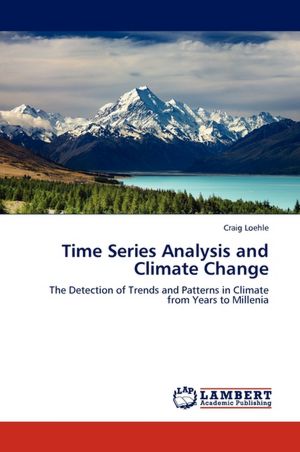
    Dr. Loehle received his Ph.D. in Natural Resource Management in 1982 from Colorado State University. His specialty is quan ative methods for analysis of ecological systems. He haspublished five books, 127 peer reviewed papers and technicalreports and is a research scientist for the National Council for Air and Stream Improvement.


    Latest book


    But, I suppose he's a PSEUDOSCIENTIST
    DarrinS is offline

  9. #2334
    e^(i*pi) + 1 = 0 MannyIsGod's Avatar
    My Team
    San Antonio Spurs
    Join Date
    Mar 2003
    Post Count
    57,943
    Its the same reason you saw a large decrease in global temp during the early 90s when Pinitubo erupted. Aerosols. The slight drop in temperature - and it was very slight - correlates almost perfectly with rising aerosol levels in the atmosphere. The IPCC themselves do ents the forcing behind aerosols and its the largest negative forcing behind cloud albedo feedback.

    If this was the case, you would still expect GHG to have an effect but you would expect that effect at night. Why? Well the main function of aerosols would be to lower incoming energy by blocking sunlight from reaching the surface. At night, there would be no effect from aerosols since there is no radiation to block. However, GHG would still be remitting IR at higher levels as their concentration went up.

    Thats exactly what research shows:

    http://www.iac.ethz.ch/people/wild/2006GL028031.pdf

    Do ents the increase in aerosols. They start skyrocketing around 1940, and they flatline at about 1970.

    http://www.pnl.gov/main/publications...PNNL-14537.pdf

    Talks about the forcing effect of aerosols:

    http://onlinelibrary.wiley.com/doi/1...91.00013.x/pdf
    MannyIsGod is offline

  10. #2335
    Veteran DarrinS's Avatar
    My Team
    San Antonio Spurs
    Join Date
    Jun 2005
    Post Count
    42,561
    One government draft report indicated that ocean pH has increased ..
    Before Manny pounces, this has since been corrected to "pH has decreased".
    DarrinS is offline

  11. #2336
    Veteran DarrinS's Avatar
    My Team
    San Antonio Spurs
    Join Date
    Jun 2005
    Post Count
    42,561
    Its the same reason you saw a large decrease in global temp during the early 90s when Pinitubo erupted. Aerosols. The slight drop in temperature - and it was very slight - correlates almost perfectly with rising aerosol levels in the atmosphere. The IPCC themselves do ents the forcing behind aerosols and its the largest negative forcing behind cloud albedo feedback.

    If this was the case, you would still expect GHG to have an effect but you would expect that effect at night. Why? Well the main function of aerosols would be to lower incoming energy by blocking sunlight from reaching the surface. At night, there would be no effect from aerosols since there is no radiation to block. However, GHG would still be remitting IR at higher levels as their concentration went up.

    Thats exactly what research shows:

    http://www.iac.ethz.ch/people/wild/2006GL028031.pdf

    Do ents the increase in aerosols. They start skyrocketing around 1940, and they flatline at about 1970.

    http://www.pnl.gov/main/publications...PNNL-14537.pdf

    Talks about the forcing effect of aerosols:

    http://onlinelibrary.wiley.com/doi/1...91.00013.x/pdf


    Amazing what the affect of blocking the sun has on temps. I wholeheartedly agree.
    DarrinS is offline

  12. #2337
    Believe.
    My Team
    San Antonio Spurs
    Join Date
    Jul 2005
    Post Count
    22,886
    In your haste to "pwn" me and discredit my source, you didn't notice that he may actually agree with you
    A smoother is not a smoother. Mann apparently used some MATLAB function that emulates the action of RC low pass filter but BEST did not and a smoother is not a smoother. They have to match the sample rates of the signals to correlate the data. While Heartland blog can say that there is no reason to do the running averages that does not make it so. BEST did so in a way that weights each data point equally in the sequence.

    So basically you grabbed a blog that you thought was on topic and it was not. Nice.

    Further as I said low pass functions are identified with decaying exponentials. A passive, proportional attenuation is not remotely the same thing as adding a signal like that guy claims. Hes just all over the place trying to dazzle people with bull because not many people can follow that type stuff .

    But really that was a red herring. BEST did directly refute your parroting of questioning the delta-T's of those decades and you do not even argue it ont hat baiss you just try and play sophist with Manny and RG instead and throw other out there and see what sticks.
    FuzzyLumpkins is offline

  13. #2338
    Veteran Wild Cobra's Avatar
    My Team
    Portland Trailblazers
    Join Date
    May 2007
    Post Count
    43,117
    I love how WC believes his stupid theory on PPM even after I showed him that its been warmer before with nowhere near the same CO2 concentrations.
    But you haven't. There are other causes that you haven't covered to make such a claim. The NOAA data for deuterium, to determine temperature was taken at shorter intervals, and each data point is under 100 years apart. The CO2 data points... damn, I forget the number but posted it in the past... are over 600 years apart average. There could easily be a few time CO2 exceeded today's levels and not be seen in the core sample.
    Why is CO2 growth after the industrial revolution not linear?
    Did you miss what I said? Our output of CO2 has had a near exponential growth. CO2 in the atmosphere is a near linear growth. Why haven't the atmospheric levels grown exponentially?
    Um, because our industrial growth isn't linear.
    That's what I said.
    Why is it slower now? Because industry is cleaner, now.
    Cleaner yes, but not less CO2. Just less sulpher, soot, etc.
    Wild Cobra is offline

  14. #2339
    Veteran Wild Cobra's Avatar
    My Team
    Portland Trailblazers
    Join Date
    May 2007
    Post Count
    43,117
    Climate Change Impacts In The USA is Already [NOT] Happening
    Some interesting things in there. One of which i recently stated.
    Wild Cobra is offline

  15. #2340
    Veteran Wild Cobra's Avatar
    My Team
    Portland Trailblazers
    Join Date
    May 2007
    Post Count
    43,117
    Dr. Loehle received his Ph.D. in Natural Resource Management in 1982 from Colorado State University. His specialty is quan ative methods for analysis of ecological systems. He haspublished five books, 127 peer reviewed papers and technicalreports and is a research scientist for the National Council for Air and Stream Improvement.


    Latest book


    But, I suppose he's a PSEUDOSCIENTIST
    He is absolutely the pseudoscientist, to those who act like Mr. Ed with blinders on.

    Wild Cobra is offline

  16. #2341
    Veteran Wild Cobra's Avatar
    My Team
    Portland Trailblazers
    Join Date
    May 2007
    Post Count
    43,117
    Its the same reason you saw a large decrease in global temp during the early 90s when Pinitubo erupted. Aerosols. The slight drop in temperature - and it was very slight - correlates almost perfectly with rising aerosol levels in the atmosphere. The IPCC themselves do ents the forcing behind aerosols and its the largest negative forcing behind cloud albedo feedback.

    If this was the case, you would still expect GHG to have an effect but you would expect that effect at night. Why? Well the main function of aerosols would be to lower incoming energy by blocking sunlight from reaching the surface. At night, there would be no effect from aerosols since there is no radiation to block. However, GHG would still be remitting IR at higher levels as their concentration went up.

    Thats exactly what research shows:

    http://www.iac.ethz.ch/people/wild/2006GL028031.pdf

    Do ents the increase in aerosols. They start skyrocketing around 1940, and they flatline at about 1970.

    http://www.pnl.gov/main/publications...PNNL-14537.pdf

    Talks about the forcing effect of aerosols:

    http://onlinelibrary.wiley.com/doi/1...91.00013.x/pdf
    I see you found the proof of a past claim of mine.
    Wild Cobra is offline

  17. #2342
    Veteran Wild Cobra's Avatar
    My Team
    Portland Trailblazers
    Join Date
    May 2007
    Post Count
    43,117
    Amazing what the affect of blocking the sun has on temps. I wholeheartedly agree.
    Absolutely.

    You guys remember how many times I claimed from the 70's to present day were not a period to claim a high level of warming, because we started cleaning up our emissions act? We previously suppressed warming with our increased aerosols. When our levels of pollution output decreased, and started going down, we saw more increases in temperature that would have occurred earlier.

    You alarmist guys all scoffed at me.

    Manny, thanks for the proof I was correct.

    Maybe next, you will find more proof of me being right.
    Wild Cobra is offline

  18. #2343
    Veteran DarrinS's Avatar
    My Team
    San Antonio Spurs
    Join Date
    Jun 2005
    Post Count
    42,561
    A smoother is not a smoother. Mann apparently used some MATLAB function that emulates the action of RC low pass filter but BEST did not and a smoother is not a smoother. They have to match the sample rates of the signals to correlate the data. While Heartland blog can say that there is no reason to do the running averages that does not make it so. BEST did so in a way that weights each data point equally in the sequence.

    So basically you grabbed a blog that you thought was on topic and it was not. Nice.

    Further as I said low pass functions are identified with decaying exponentials. A passive, proportional attenuation is not remotely the same thing as adding a signal like that guy claims. Hes just all over the place trying to dazzle people with bull because not many people can follow that type stuff .

    But really that was a red herring. BEST did directly refute your parroting of questioning the delta-T's of those decades and you do not even argue it ont hat baiss you just try and play sophist with Manny and RG instead and throw other out there and see what sticks.

    I was using low-pass filters back when you were still playing in your own diaper . But thanks for sharing.
    DarrinS is offline

  19. #2344
    Believe.
    My Team
    San Antonio Spurs
    Join Date
    Jul 2005
    Post Count
    22,886
    I was using low-pass filters back when you were still playing in your own diaper . But thanks for sharing.
    Then why did you post that blog as if it was relevant? When you make comments like this all that says is that you are willfully posting you know not to be true and/or misleading. Just like when i call WC stupid, when i call you deceptive I use specific examples.

    Thanks for sharing.
    FuzzyLumpkins is offline

  20. #2345
    e^(i*pi) + 1 = 0 MannyIsGod's Avatar
    My Team
    San Antonio Spurs
    Join Date
    Mar 2003
    Post Count
    57,943
    WC that definitely isn't proof of you being right (other than if you said aeresols having some forcing) but you're welcome to believe thats so.
    MannyIsGod is offline

  21. #2346
    I am that guy RandomGuy's Avatar
    My Team
    San Antonio Spurs
    Join Date
    Jun 2005
    Post Count
    51,121
    Climate Change Impacts In The USA is Already [NOT] Happening
    Data related to precipitation and drought activity do not appear to support the contention of increasing drought frequency and severity and suggest that drought patterns are complex. For example, there has been a 5% increase in overall precipitation in the US rather than increasing drought.
    This smacks of cherry picking.

    It isn't how much water you make, it is how much you keep.

    If you get that extra 5% during two periods of intense rain, causing massive flooding that washes all that extra water away, you can say "look at all this yearly rain we have been getting" and still have an overall drought, as the water didn't stick around to sink into an aquifer.

    Further, if you are looking at the ENTIRE U.S., and ONE part got 200% more rain, such as Florida, that still doesn't mean there isn't any drought in Texas.

    One of the main criticisms of climate change deniers is that they tend to cherry pick data.

    Do you think that happened here?
    RandomGuy is offline

  22. #2347
    I am that guy RandomGuy's Avatar
    My Team
    San Antonio Spurs
    Join Date
    Jun 2005
    Post Count
    51,121
    RandomGuy is offline

  23. #2348
    I am that guy RandomGuy's Avatar
    My Team
    San Antonio Spurs
    Join Date
    Jun 2005
    Post Count
    51,121
    Dr. Loehle received his Ph.D. in Natural Resource Management in 1982 from Colorado State University. His specialty is quan ative methods for analysis of ecological systems. He haspublished five books, 127 peer reviewed papers and technicalreports and is a research scientist for the National Council for Air and Stream Improvement.


    Latest book


    But, I suppose he's a PSEUDOSCIENTIST
    flap text of the book

    Detection and attribution of climate change dependexplicitly on proper characterization of naturalpatterns of climate over time. This book examinesmultiple types of climate data, from ocean heat content over a few years to ice core data going back 60,000 years. Multi-scale analyses are employed totest for stationarity or acceleration of warming in satellite and ground instrumental data. Problems that arise when combining instrumental data into long records are evaluated. The CO2 rise pattern is characterized and the problem of extrapolation is addressed. It is finally shown that periodic patterns can be detected at multiple time scales,from decades to millenia. These patterns are characterized and used to address the attribution problem. The human contribution to climate is shownto be separable from natural variability and is characterized. Human forcing of climate is shown to be detectable beginning in 1942. This forcing pattern is used along with patterns of natural variability to make a 100 year forecast
    Pseudoscientist, no.

    He would also likely say your skepticism is the dishonest type.
    Last edited by RandomGuy; 03-09-2012 at 09:25 AM.
    RandomGuy is offline

  24. #2349
    I am that guy RandomGuy's Avatar
    My Team
    San Antonio Spurs
    Join Date
    Jun 2005
    Post Count
    51,121
    Climate Change Impacts In The USA is Already [NOT] Happening
    One fairly minor criticism aside, the rest of it reads well, and is fairly compelling.

    A step above the usual drek, it is carefully worded, cited, and reasonable.

    He brings up some solid points and I think rightfully puts data that pokes holes to the more alarmist news reports on the subject of extreme weather events affeccting the U.S.
    Last edited by RandomGuy; 03-09-2012 at 09:30 AM.
    RandomGuy is offline

  25. #2350
    I don't really care... Yonivore's Avatar
    My Team
    San Antonio Spurs
    Join Date
    Oct 2001
    Post Count
    26,781
    Regardless of on which side of the issue you reside, Steven Hayward makes a valid point in his PowerLine post, this morning.

    80 BY 50: WHY CLIMATE SCIENCE DOESN’T MATTER ANY MORE

    So I’m away again this weekend at a conference doing my typical think-tanky stuff, and surprisingly my Internet access is strangely limited, so posts may be sporadic. But I thought it worth sharing one of my four “heterodox propositions” about energy and climate that I offered to a small audience last night.

    It is this: climate science doesn’t matter any more. While the arguments between the alarmist and skeptics camp will grind on—very likely to the detriment of the alarmists—what has really turned climate change into the biggest environmental cul de sac of all time is the brutal arithmetic of energy use. In a fit of madness, the climate campaign a few years ago put forward the conclusion that meeting the greenhouse gas stability target required an 80 percent reduction in carbon dioxide emissions by the year 2050 by the whole world, not just the United States or Europe. This is a very short time frame when you keep in mind the enormous capital cost of the world’s energy infrastructure and the fact that energy transitions are historically very slow.

    I was among the first, five years or so ago, to do the arithmetic to point out that this goal of climate policy orthodoxy would require scaling back fossil fuel use in the United States to the level last seen in the year 1910, when the U.S. had a total population of only 92 million people, and was less than 1/40th the size of today’s economy in real terms. By 2050 we’ll have a population of more than 400 million people, and the emissions reduction target of climate policy means that our per capita emissions will have to be about 2.4 tons of CO2 per person.

    Are there any nations that emit at that low a per capita level? Yes—in fact there are! Haiti, Somalia, and the other poorest and most backwards nations are all in that neighborhood.

    Keep that 80 by 50 target, as I call it, in mind. This. Ain’t. Going. To. Happen. (By the way, Al Gore says the emissions reduction needs to be closer to 90 or 95 percent, so don’t waste time saying “But won’t it be worthwhile to go some of the way down the field?” Short answer: No. Longer answer: Ask Al Gore. He’ll say “No,” too.)

    The prolonged and solemn farce of climate change policy has finally come to be understood by most responsible governments, even if not fully admitted by the climate campaign. We’re not going to go very far down the road toward a world of serious carbon constraints for the simple reason that it is economically unserious. This is why the all of the early regimes of carbon constraints are collapsing or retreating—Europe’s ETS, Australia’s emissions tax, Canada formally withdrawing from the Kyoto Protocol (which is a dead letter anyway), etc. As I’ve been saying for a long time, we’re someday going to look back on the entire Kyoto process as the climate policy equivalent of the Kellogg Briand Pact of 1928 that promised to end all war. Or maybe we’ll see it as the climate policy equivalent of wage and price controls to fight inflation in the 1970s.

    This will remain the case even if catastrophic climate change turns out to be true. But as Walter Russell Mead likes to point out, the climate campaign is probably the single most incompetently led social movement ever. So they have only themselves to blame for the dead end they’ve led us to. So they can keep stamping their feet, blaming the Heartland Ins ute for all evil in the world, and throwing up more scare stories that people long ago started to ignore, and it won’t change the fact that their remedy—the jihad against fossil fuels—is going nowhere.

    Perhaps later I’ll post up my three other heterodox propositions.
    Yonivore is offline

Thread Information

Users Browsing this Thread

There are currently 3 users browsing this thread. (0 members and 3 guests)

Posting Permissions

  • You may not post new threads
  • You may not post replies
  • You may not post attachments
  • You may not edit your posts
  •