Reply With Quote
It hasn't been named Squaw Peak for a few years because the TROGs who live in the reserves around Phoenixgot really butthurt because Squaw I guess means in the primitive language TROGs used to speak but everyone still calls it Squaw Peak.

Yeah, I recall it somehat. I lived in the most nondescript area of Tempe, tbh...fff Southern and McClintock

It hasn't been named Squaw Peak for a few years because the TROGs who live in the reserves around Phoenixgot really butthurt because Squaw I guess means in the primitive language TROGs used to speak but everyone still calls it Squaw Peak.
The success rate for climbing Everest is extremely low
I'd never do it, especially since it's more mountain climbing than it is hiking.
no...pretty sure people die there almost every year iirc. I might go just to loot off all the frozen climbers that are up there

The only reason I ever went up on the little one by the house is because there used to be an indian burial cave on it that people were trying to loot so the owners just bulldozed it shut years ago. There's rumored to be a stash of gold up there too dating back to all the train robberies in fort worth back in the day. Went up there with a metal detector and didn't find
Metal detecting is another strange hobby that I'm into. You can find all kinds of stuff.
What type of stuff u find?

I just scoped out my next camping spot this past Saturday here in the Cascades. This place has been inaccessible for the past couple of years. As you see there's still a bit of snow there. Going to give it a few weeks & check it out again. No cell reception, none of life's drama, just friends kicking it up in the woods relaxing for a few days.
The bottom pick you can see smoke. The tree was smoldering from a lightning strike during a storm that hit right before we got there.

Nah, no chance in I'd ever attempt Everest. You basically have to do quit your job and train for a year before doing it, then you pay something like a $30,000 fee to the government of Nepal for the permit, then you pay another $30,000 or so to a guiding company, you spend about a month on the mountain, including 2 weeks just sitting on your ass in base camp at about 21,000 feet just trying to get used to the elevation. Then you make a few trips up and down the ice falls for acclimation and for moving supplies. And with all that preparation and cost it's still a 2 in 3 chance that either the weather or the al ude runs you off the mountain. When doing glacier travel like that you can't do it solo either, since you're dead if you fall into a crevasse without being roped up.
I went there a couple of years ago in August and even on the warmest day I was there it was still in the mid 30s at sunrise. Summertime 20s are the norm if you go up 2000 feet or so into the Beartooths.
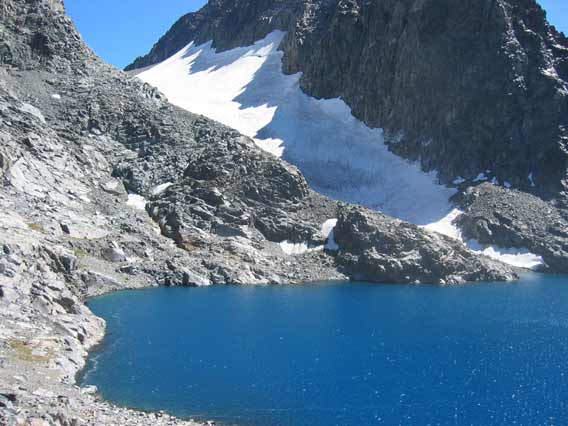
Never been to the Cascades, but it looks pretty awesome. Headed up to the Sierra next month, and can't wait to get to this lake:
Area is way too rough to setup a tent though.
I want to get down to Crater Lake in Southern OR. That's on my list of places to camp.
If you want to see some great alpine lakes, check out the Beartooths around Lower Aero Lake. Nothing that can compete with Crater Lake, but there's about a billion of them within hiking distance. Good fishing too. The weather gets pretty nasty there though.

tbh it's expensive as just to get certified to do it but I'd definitely wanna try someday if I had the money
I'd love to go to Crater Lake and do the 50 mile loop around it; if I do it, I want to do it in the winter though.
Park's closed in the winter.
I think the road around the lake is closed, which is awesome since it can then be used as a snowshoe or ski route. I could care less about the hotels, since I would want to camp there when going.

haven't been camping in 7 years, but sure would like to again. As others here said, ting in a hole sucks. Everything else like sweat, bugs, heat, you get used to that stuff after a couple days anyways.
I can't wait to go camping again. Its mentally therapeutic to get out of the city and out to nature.
As others have said to each his own, but to with camping for me. If I need mental therapy I'll rent a beach house and listen to the ocean for a week.

That's a tad more extreme, but similar to how it was where my family went camping every summer. We went and camped by the lake in Kirkwood, CA (high desert, close to South Lake Tahoe) at the same campgrounds where my dad had gone as a kid. Every summer, like clockwork. No matter how hot it was an hour or so away (around Jackson, for those familiar with California), days were on the chilly side of warm and nights required bundling up around the fire and in the sleeping bag. For me, that's just about perfect. The few times I've tried camping in super hot or super cold weather, I've been miserable.
Snowshoeing sounded more fun to me than it actually was. I've got a cousin who works in Yosemite and lives there year-round and was always going on about how the only way he could get supplies during certain parts of the off-season was on snowshoes and how awesome it was, so I finally convinced him to take me snowshoeing and it sucked. A lot.
A 35 degree morning is perfect hiking weather as long as it's not windy or raining/snowing. You're only cold for about 5 minutes even in shorts and a tshirt once you get moving.
I thought snow-shoeing was a lot more fun than it sounded tbh. Doing it there around Glacier Point or Tuolumne Meadows must be incredible.
Thought of this question when reading an article today. Here's an excerpt that explains in pretty good detail why I would never attempt it (though hiking to base camp might be cool).
--------------------------------------------------------------------------------------------
A Physicist on Everest: How Body and Mind Break Down at Elevation [Excerpt]
http://www.scientificamerican.com/ar... ude-effects
At sea level, the brain tends to have a strong grip on reality. The world presents us with a situation or an image, and our synapses fire, neurons transmit, and signals race through the internal wiring of our skull creating an understanding. When the system works smoothly, we sense things as they are: hot is hot, cold is cold, and we only see two people on a mountain when there are only two people on a mountain. We don’t hear dead people speak.
Oxygen is the lubricant that keeps the brain operating as it should; blood is the vehicle that transports the oxygen around to the various needy organs. Every organ wants a share of the blood, but the body prioritizes to make sure that the most critical needs are met first. In fact, without our even realizing it, the body operates under its own Golden Rule: keep oxygen flowing to the brain, everything else is bonus. Consequently, as a climber goes up in al ude into thinner and thinner air, the body monitors oxygen needs, reroutes blood flow, and flips system controls like a train switchman.
First, your body automatically ramps up your breathing rate as you go up in al ude. By the time a climber reaches Base Camp on Everest, at eighteen thousand feet, the respiratory rate has roughly tripled. If you were taking a breath every ten seconds at sea level, then you’ll be sucking in a breath every three seconds at Base. The impact on the metabolism is striking. If all you did all day long was sit in your tent at Base Camp doing absolutely nothing but breathe, you would still burn about three thousand calories a day. Forget about the Atkins Diet or spending hours on the elliptical machine—planting your butt at Everest Base Camp is the world’s most effective weight loss program.
Thankfully, our body carefully monitors our breathing rate, even when we don’t. If your body relaxes too much while you’re sleeping and your breathing rate slips too low to satisfy the Golden Rule, then your body will snap you awake with a sharp spasmic gasp. Base Camp echoes with the sound of sudden rasping inhales throughout the night.
As a climber goes higher, the body begins to take more drastic measures to compensate for the thinning air. To preserve as much oxygen as possible for the brain, blood flow to the extremities becomes more limited. Fingers and toes start to go numb, making them dangerously susceptible to frostbite.
As a climber goes up even higher in al ude, into the so-called death zone, the dangerously thin air above 26,000 feet, there is so little oxygen available that the body makes a desperate decision: it cuts off the digestive system. The body can no longer afford to direct oxygen to the stomach to help digest food because that would divert what precious little oxygen is available away from the brain. The body will retch back up anything the climber tries to eat, even if it’s as small as an M&M.
The consequence of shutting down the digestive system is, of course, that the body can no longer take in any calories. Lacking an external fuel source, the body has no choice but to turn on itself. It now fuels itself by burning its own muscle—the very muscle needed to climb the mountain—at a rate of about two pounds per hour.
The climber’s body is now in total collapse. The respiratory system is working way beyond its tolerance at roughly four times above normal; the circulatory system is pumping at only 30 percent capacity; the digestive system has completely shut down; and the muscular system is eating away at itself. In short, the body is dying. Rapidly.
Up to this point the body has done an admirable job of prioritizing, rerouting blood, stealing from other systems to keep blood flowing to the brain. But if a climber chooses to continue to go up in al ude, then there are no more options left; the brain starts to massively erode.
To stave off that decay, many climbers carry a tank of supplemental oxygen. Supplemental oxygen for climbers doesn’t operate like air tanks for SCUBA divers. SCUBA breathing systems are self-contained; climbing systems are not. Instead, a climber’s tank is attached to a thin hose that flows a bit of extra oxygen just below the nose, enriching the ambient air by just a touch. The rule of thumb is that every liter per minute of flow from the tank will enrich each breath with the oxygen level equivalent to the air about one thousand feet lower in al ude.
Every climber who chooses to carry supplemental oxygen now considers two questions. How many tanks should I bring? How high of a flow rate can I set on the tank? The answers require trade-offs. If a climber brings more tanks, then a higher flow rate can be set and less deterioration results. But, and there is always a but, each tank adds weight that will slow the climber down.
All the climbers on our team brought two tanks and set their flow rate to two liters per minute. At that rate, climbers at the 29,029-foothigh summit of Everest will be breathing air as if they were at 27,029 feet. That doesn’t sound like much of a difference, and for some climbers it’s not enough.
Many climbers can’t function at a low flow rate. Others set a higher flow rate in order to keep them more nimble, but they miscalculate the length of time it will take them to summit and their tanks run out. In either case, the inevitable consequence is that the brain doesn’t get enough oxygen; the grip on reality goes slack, the mind drifts.
However, the mind doesn’t stop sending signals; instead it starts inventing its own tales. Making things even worse is that the climber doesn’t even know that the deterioration is occurring. I know this, because I saw it unfold in front of me.
As I made my way down the southeast ridge of Everest, with Ang Nima and Jim Williams now a few hundred feet above me, I saw a climber from our team, Bob Clemey, on his knees, gloves at his side, with his bare hands delicately gliding over the surface of the snow.
Depleted and needing warmth, Clemey saw with absolute clarity that a rock protruding from the snow was glowing red hot. He realized that lava from the very core of the earth was lifted up to the surface of Everest and was heating that rock. So he stripped off his gloves and began warming his hands over the rock like it was a campfire.
In reality, there was no glowing red rock, no lava. There was just a climber with bare hands frozen as solid as clubs, fingers gripping snow in a twenty-below-zero blizzard.
Clemey’s oxygen tanks were drained. There was no way of knowing how long he had been there or when he had run out of oxygen.
Our second crisis had begun.
--------------------------------------------------------------------------------------
I only posted the last 2 pages, but the first three are interesting too.

camping is great and so is backpacking. lots of interesting people to meet.
last time i went camping i took solar showers lol. theres something satisfying about being ass naked in the wilderness with a woman.
There are currently 1 users browsing this thread. (0 members and 1 guests)
 Posting Permissions