Reply With Quote
It took you that long to find a 3 year old report with 5 year old data?
When you have a population increase like Texas did in this antique "analysis", govt services also grow. Guess that's news to echo chamber prisoners like you.

Texas does have a lot of things for a flaming liberal to hate, so I can understand boutons' bitterness when our state is thriving.

When you have a population increase like Texas did in this antique "analysis", govt services also grow. Guess that's news to echo chamber prisoners like you.
*Enlightened Progressive Post*
Those, dirty, dirty peasants!

No problem. Can't take credit for it, it was recommended to wife by her professors. I just thought it interesting enough to read, as education and evidence are two things I like to ac ulate.
Isn't Texas the most liberal state in the south? You can't count Florida because Florida is a piece of and a sorry excuse for a state.
San Antonio, Austin, Houston, even Dallas are all blue, only Fort Worth as a major city is still red.
the "health" of the bull Texas miracle
http://graphics.latimes.com/healthcare-disparity/
Yeah.Kalifornia is really kicking ass.
Tb!
Tx is a miracle. Because Cali sucks more
Not really. Tx faces some challenges in healthcare. Still doesnt negate the point that your asinine OP was pure bull ...per par.
But why should you care about a bunch of ing farmers and ranchers?
their welfare? I don't care.
But they are very important because they keep ( ing themselves by ) electing TX Repug assholes like Gohmert, Cruz, Abbot, RickyBobby.
Of course you don't. *Enlightened progressive post*

Boutons you should feel bad tbh
If they want to be conned into playing Repug/VRWC/tea bagger 3-card-monte of god-guns-gays while getting their pockets picked, I don't GAF for them, but they it up for us non-conned.
Boutons, nonconned, ohhhh you so funny.
That only really addresses, or attempt to address, scores on how the systems deal with immigrants. The US has a bit of an advantage, as we have more experience.
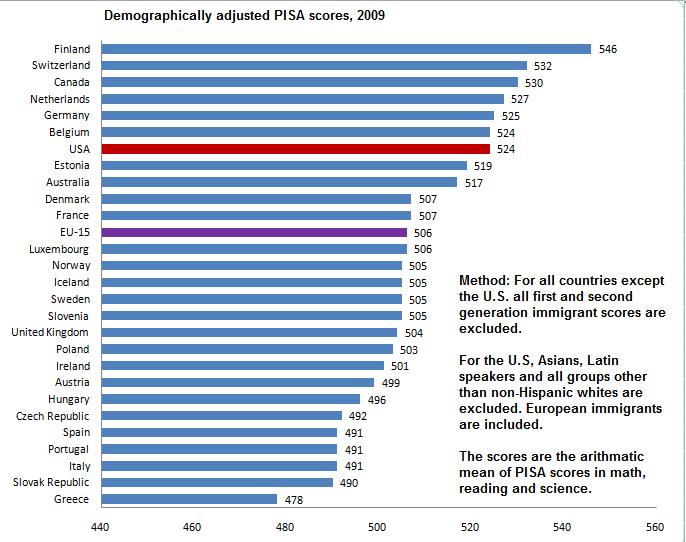
I was simply talking about how the overall average of Finland is so markedly better than anyone elses.
Honestly, I have always suspected somehow that the US educational system was a bit better than test scores seem to indicate, it was a good read.
Libertarians in the United States have often claimed that the public school system (which has more than 90% of the students) is a disaster. They blame this on government control and on teachers unions. However, it is completely unfair to demand that a public school in southern California where most of the students are recent immigrants from Mexico whose parents have no experience in higher education (only 4% of all Mexican immigrates have a college degree, compared to over 50% of Indian immigrants) should perform as well as a private school in Silicon Valley.
The libertarians have no answer why European and Asian countries that also have public school systems score higher than the United States (unadjusted for demography). Top scoring Finland has strong teacher unions, just as California.

Oops: The Texas Miracle That Isn’t
Conservatives say the Lone Star state’s recent record of growth validates their economic agenda. That record crumbles upon inspection.
http://www.washingtonmonthly.com/mag...9.php?page=allFor example, according to Census Bureau data, 441,682 native-born Americans moved to Texas from other states between 2010 and 2011. Sounds like a lot. But moving (fleeing?) in the opposite direction were 358,048 other native-born Americans leaving Texas behind. That means that the net domestic migration of native-born Americans to Texas came to just 83,634, which in a nation of 315 million isn’t even background noise. It’s the demographic equivalent of, say, the town of Lawrence, Kansas, or Germantown, Maryland, “voting with its feet” and moving to Texas while the rest of America stays put.
And despite all the gloating by Texas boosters about how the state attracts huge numbers of Americans fleeing California socialism, the numbers don’t bear out this narrative either. In 2012, 62,702 people moved from California to Texas, but 43,005 moved from Texas to California, for a net migration of just 19,697. That’s a population flow amounting to the movement of one village in a continental nation. Far from proving the merits of the so-called Texas model, it shows just how few Californians have seen fit to set out for the Lone Star State, despite California’s high cost of housing and other very real problems. The same is true for all but a handful of Americans living in other states. Net domestic migration to Texas peaked after Hurricane Katrina devastated Louisiana and Mississippi, and has been falling off ever since.
This comparatively low level of net domestic migration to Texas is consistent with another little-appreciated fact that runs counter to the conservative narrative about the Texas Miracle. It is that, for most Americans, as well as for most businesses, moving to Texas would not mean paying less in taxes, and for many it would mean paying more.
Oh yes, I know what you’ve heard. And it’s true, as the state’s boosters like to brag, that Texas does not have an income tax. But Texas has sales and property taxes that make its overall burden of taxation on low-wage families much heavier than the national average, while the state also taxes the middle class at rates as high or higher than in California. For instance, non-elderly Californians with family income in the middle 20 percent of the income distribution pay combined state and local taxes amounting to 8.2 percent of their income, according to the Ins ute on Taxation and Economic Policy; by contrast, their counterparts in Texas pay 8.6 percent.
And unlike in California, middle-class families in Texas don’t get the advantage of having rich people share equally in the cost of providing government services. The top 1 percent in Texas have an effective tax rate of just 3.2 percent. That’s roughly two-fifths the rate that’s borne by the middle class, and just a quarter the rate paid by all those low-wage “takers” at the bottom 20 percent of the family income distribution. This Robin-Hood-in-reverse system gives Texas the fifth-most-regressive tax structure in the nation.
Middle- and lower-income Texans in effect make up for the taxes the rich don’t pay in Texas by making do with fewer government services, such as by accepting a K-12 public school system that ranks behind forty-one other states, including Alabama, in spending per student.
Moving a business to Texas also turns out to have tax consequences that are inconsistent with the conservative narrative of the Texas Miracle. Yes, some businesses manage to strike lucrative tax breaks in Texas. As part of an industrial policy that dares not speak its name, the state government, for example, maintains the Texas Enterprise Fund (known to some as a slush fund and to others as a “deal-closing” fund), which the governor uses to lure favored businesses with special subsidies and incentives.
But most Texas businesses, especially small ones, don’t get such treatment. Instead, they face total effective tax rates that are, by bottom-line measures, greater than those in even the People’s Republic of California. For example, according to a joint study by the accounting firm Ernst & Young and the Council on State Taxation, in fiscal year 2012 state and local business taxes in California came to 4.5 percent of private-sector gross state product. This compares with a 4.8 percent average for all fifty states—and a rate of 5.2 percent in Texas. With the exception of New York, every major state in the country, including New Jersey, Massachusetts, Pennsylvania, Ohio, Michigan, Indiana, Illinois, Wisconsin, and Minnesota, has a lower total effective business tax rate than Texas. If you think that means Texas might not offer as much “liberty” as advertised, well, you’re right.
The same study compares how much businesses in different states pay in taxes for every dollar they get back in government-provided benefits. Using methodology developed by the Federal Reserve Bank of Chicago, the study first allocates public spending between households and businesses. Certain expenditures, such as for health care and welfare, are treated as benefiting only households; others, such as for police, fire, and highway transportation, are treated as benefiting businesses as well. The big question mark here is how to treat education spending, since businesses differ in how much education they require from their workers. But regardless of how that allocation is made, California businesses as a whole still get a far better deal on their taxes than those in Texas.
For example, under the assumption that spending on education benefits only households and not businesses, California businesses pay $2.30 in taxes for every dollar they get in benefits, while Texas businesses pay $5. By this measure, Texas is the ninth-worst state in the country in the cost/benefit ratio it offers businesses on their taxes. Assuming that 50 percent of education spending benefits business, California businesses pay $1 in taxes for every dollar they get in benefits, while Texas business pay $1.50. Either way, it’s no wonder that Texas’s economic development efforts rely so heavily on (largely false) advertising.
The business case for Texas does not speak for itself. It may be a great place to be a big oil or petrochemical company, or a politically favored large corporation able to wring out tax concessions. Its state laws are also hostile to unions, and its wage levels are generally lower than in much of the rest of the country. But for the vast majority of businesses, which are small and not politically connected, Texas doesn’t offer any tax advantages and is in many ways a harder place to do business. This is consistent with Census Bureau data showing that a smaller share of people in Texas own their own business than in all but four other states
lol nbadan fail. Thanks for reposting the the OP....you know the one you in the thread you didnt read. Good job.
RickyBobby going around bull ting other states that TX is better than them is a truly stupid way to run for President.
TX is full of bull and bull ters.

It is better in a very fortunate way that Ricky had nothing to do with.
Vast agriculture areas, huge oil and gas reserves, Top research ins utes that spawn businesses around them in Austin, Houston, Dallas. San Antonio has the Medical Center that is trying to match Houston's.
And people want to visit. Go figure...
It's not the same article idiot....
Learn to read, junior. Its the same ing link thats in the OP.
. :facepalm
From the OP:
http://www.washingtonmonthly.com/mag...t_is049289.php
From your post:
http://www.washingtonmonthly.com/mag...t_is049289.php
Now read the comments where the asinine piece was destroyed...or do you need a grownup to help you with this?
There are currently 1 users browsing this thread. (0 members and 1 guests)
 Posting Permissions