


 Reply With Quote
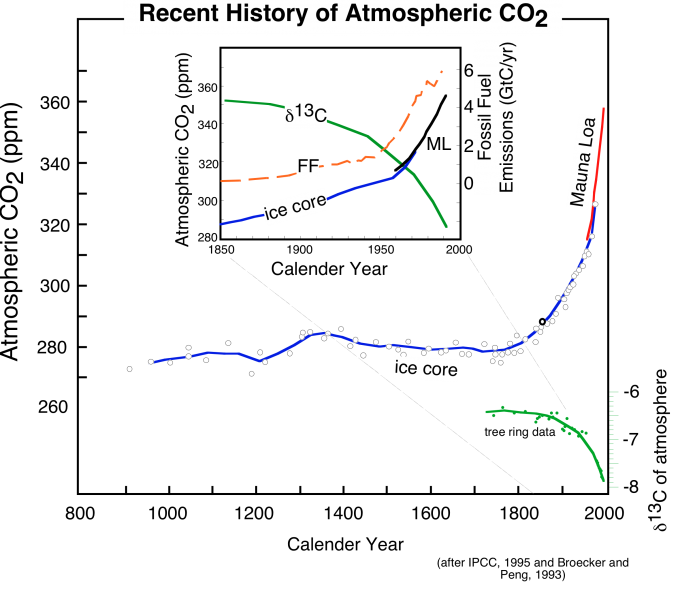
So you are saying that the very rapid uptick in average global temp is NOT in any way correlated with human activities.
Science says you are wrong at present.

I think U233 derived from thorium is a fine nuclear fuel, but you still have to store the waste for at least hundreds of years for each batch for as long as the power is produced.
So where is all the waste from tens of thousands of reactors going to go?

So you are saying that the very rapid uptick in average global temp is NOT in any way correlated with human activities.
Science says you are wrong at present.
As if facts were recognized by the anti-scientific AGW-denying religionists
No, I'm saying that I don't care. I see problem of too much use of carbon fuels and I have a plan to reverse that. Do you have a plan to stop, then reverse the use of carbon based fuels?

repealing oil and natural gas subsidies might be a good start:
BigCarbon subsidies won't stop like the AGW climate catastrophe won't stop


the left always trying too hard to be edgy. bill nye trying too hard to look like an actual scientist when he's just a ing idiot.
Smoke and mirrors is all they've got. They use comedy to hamfist their whacky agendas and sugar coat everything. They're terrified of Conservatives using memes (a comedic device) to softball their ideas in return.

Renewable energy, promote energy efficiency. A simple, slowly escalating carbon tax.
We have plenty of scientific papers, and actual experts on climate science. You are the ones relying on meme-based policy making.
Post a tweet or two now.
planet is ed and un able
The plastic industry is on track to produce as many emissions as 600 coal-fired power plants
https://grist.org/article/the-plasti...-power-plants/
Last edited by boutons_deux; 05-16-2019 at 03:56 PM.
On Islands, Tons of Plastic Trash Is Likely Buried Beneath the Sands
humans have produced more than 8.3 billion metric tons of plastic,
An Australian team of researchers traveled to the Cocos (Keeling) Islands (CKI), a remote archipelago in the Indian Ocean that’s roughly 1,700 miles off the northwest coast of Australia.
Even looking at just a fraction of beaches, the researches still managed to find over 23,000 pieces of manmade debris, weighing a total of 213 pounds.
The bulk of this debris — 95 percent — was made of plastic.
Some of those items included flip flops, plastic bags, drinking straws and lids and caps.
But 60 percent of their total haul consisted of micro-debris measuring 2-5 millimeters.
The real kicker, though, is that most of this trash isn’t even where we can see it.
Depending on the survey site,
between 10 to 70 times more debris was found below the surface — up to 10 centimeters deep
— compared to the trash they could see.
the team extrapolates that there are
approximately 414 million pieces of manmade debris on CKI, weighing in at over 200 tons.
And the researchers estimate
93 percent of those 414 million pieces are buried, likely in the form of micro debris.
http://blogs.discovermagazine.com/d-brief/2019/05/16/plastic-trash-debris-beaches-buried/?utm_source=feedburner&utm_medium=feed&utm_campaig n=Feed%3A%20DiscoverMag%20%28Discover%20Magazine%2 9#.XN3FVMhKiUk
ATMOSPHERIC METHANE LEVELS ARE GOING UP—AND NO ONE KNOWS WHY
the concentration of methane in the atmosphere had been steadily rising since 1983, before leveling off around 2000. “And then, boom, look at how it changes here,” Dlugokencky says, pointing at a graph on his computer screen. “This is really an abrupt change in the global methane budget, starting around 2007.”
The amount of methane in the atmosphere has been increasing ever since. And nobody really knows why. What’s more, no one saw it coming.
Over a 20-year time frame, methane traps 86 times as much heat in the atmosphere as carbon dioxide.
It is responsible for about a quarter of total atmospheric warming to date.
https://www.wired.com/story/atmospheric-methane-levels-are-going-up-and-no-one-knows-why/
iow, planet is ed and un able

It Was A Record 84 Degrees Near The Arctic Ocean

But al gore has a jet
Nearly 25% of West Antarctic Ice in Danger of Collapse
Glaciers and ice sheets in Antarctica have thinned and weakened dramatically over the past quarter-century,
leaving 24% of the ice in the western part of the continent seriously weakened and in danger of collapse.
In some places on Antarctica, glaciers have thinned by approximately 400 feet (122 meters).
This staggering loss has little to do with weather fluctuations;
rather, it unfolded over decades as Earth's climate warmed,
And that ice loss is accelerating.
The researchers found that West Antarctica's two biggest glaciers — Thwaites and Pine Island —
are melting away five times faster now than they were at the beginning of the survey, in 1992
https://www.livescience.com/65524-antarctica-ice-unstable.html

But it was 84 near the arctic, but snowing this week in Colorado.
did you take a thermometer across the street though?
Darrin so glib.
Thing is, he's not wrong. On a cultural level, his bull anecdotes are stronger than the truth of climate change.
You'd think an engineer would understand the geometric growth of pollutants and the startling rate of warming worldwide over the last 150 years occurs in a context of terrestrial feedback that can't be ignored and will be very costly in our lifetimes. Geographical process is overtaking historical time.

all yer sciencey facts. Its gettin hotter cus the gays and libruls are bringing the on earth!
Again and louder:
Al Gore has a jet
There are currently 16 users browsing this thread. (0 members and 16 guests)
 Posting Permissions

