Reply With Quote
My point is that isn't that they arent burning off gas, it's that it's not the amount to be the primary source of light pollution as the picture alludes to.

My point is that isn't that they arent burning off gas, it's that it's not the amount to be the primary source of light pollution as the picture alludes to.

Absolutely. And you're dead on. Avante has to be bouton's sock puppet....or the other way around.
I grew up playing by the light of gas flares in West Texas tho. Sun Oil used to flare off gas at the refinery at the edge of town now and again. When they did, we could play till midnight.
you certainly don't bother with responding to my -slapping points
"the article claims 30% of the gas is flared, do you dispute that?"
more"
"It is not as if no one is doing anything about excessive flaring. Since 2002, the World Bank has had a Global Gas Flaring Reduction Partnership, which has attacked the problem on several fronts. By promoting best practices and encouraging the development of markets for associated gas, the partnership has made some headway. Gas flaring worldwide dropped from 172 billion cubic meters in 2005 to 140 billion in 2011, equivalent to taking 52 million cars off the road. The World Bank’s partnership is happy to take at least partial credit for that. However, it appears that flaring is again on the increase, especially in North Dakota.
North Dakota has been making efforts to cut flaring, as well. In principle, state regulations allow a well to flare for no more than a year before it is connected to some kind of gathering system, although permits are sometimes extended. Last year some 1,000 wells were connected, but more than that were drilled, so the amount of flaring increased. In addition to encouraging producers to hook up to the pipeline network, North Dakota uses tax incentives and other carrots to encourage the use of associated gas as a fuel for the generators that power equipment at drilling sites."
- See more at: http://www.economonitor.com/dolaneco....Ooj06Nxs.dpuf"
lol @ " -slapping points"...
30% is flared, what about the other 70%? When is this flared, in unison as the picture suggests? That " -slapping point" raises more questions than it answers.

Fracking is very promising in my opinion. It is our chance for energy independence.
your question, you answer it, you seem to be an expert on passing gas
^
You post one reference saying all the gas is burned because it's so isolated that it's not worth building pipelines.... then another saying 30% is burned. So the other 70% is sold? And the 30% is burned at once in every well plot in the entire basin like overpressured wellbores producing a blowtorch show??? And a satellite happened to catch this spectacle and snap a picture. All those lights, those are flares....
Last edited by Halberto; 07-30-2013 at 05:05 PM.
Your problem is you can't comprehend my argument because you haven't seen what I've seen (giant flare stacks producing giant flares) in person and you don't understand how it all works. You just hunt down another article and pretend like it doesn't matter what I say, what I KNOW, and continue your zealous agenda like a liberal god warrior.

You two appear to be talking past each other. As a layman, what are the effects to the environment of the 30% that are admittedly being flared off? That's a negative externality for which the oil and gas companies are not paying when determining in the cost of production.
who cares if it can be seen from space.

Well, I'd be lying if I said I knew the true consequences of what burning 30% (is the amount known in BCF?) does for the environment. Clearly it's not helpful, but the magnitude is debatable. What I can tell you is that the oil companies don't enjoy burning it off like wild hooligans, it's lost money. Even at $2.50 /mcf (which is rising in value) that adds up to thousands of dollars a day. This fishy number of 30% is likely a necessary evil. While drilling gas is stuck in the drilling mud and must be circulated out before the mud goes back into the borehole (the mud is continually circulating through the drilling process). The gas at that point is not able to be captured and stored due to it's expansion and the immediate need to get it out for safety reasons. 30% of a well's gas is not burned during the drilling phase, less than 5% probably, so there probably is some issues with pipeline expansion creating an issue. Flares exceeding 40 ft for a wellsite are a cause for concern, it indicates overpressuring and risks the well blowing out and the safety of those around it. When it starts to get that bad they stop drilling, increase the mudweight and the flare lowers.... saving people and also saving money. It should also be noted that the flares pulse, it peaks maybe once every 4 seconds.
That being said, the article sure seems false in claiming it's lighting up the sky over the Bakken... and the sketchy and very unspecific figures they provide lose more merit with the picture.
The article is completely false in portraying the light as flares. As you stated earlier, the lights were from the rigs.....not that the moonbat blogs would ever admit that up.

http://thinkprogress.org/climate/201...-gag-for-kids/When drilling company Range Resources offered the Hallowich family a $750,000 settlement to relocate from their fracking-polluted home in Washington County, Pennsylvania, it came with a common restriction. Chris and Stephanie Hallowich would be forbidden from ever speaking about fracking or the Marcellus Shale. But one element of the gag order was all new. The Hallowichs’ two young children, ages 7 and 10, would be subject to the same restrictions, banned from speaking about their family’s experience for the rest of their lives.
It’s not the only time gas exploration companies have gone to great lengths to keep the health problems caused by fracking under wraps. A 2012 Pennsylvania law requires companies to tell doctors the chemical contents of fracking fluids, so long as doctors don’t reveal that information, even to patients they are treating for fracking-related illness.
Sharon Wilson, and organizer with Earthworks, said that was the point. “These gag orders are the reason can give testimony to Congress and say there are no do ented cases of contamination. And then elected officials can repeat that.” She makes it clear she doesn’t blame the families who take the settlements. “They do what they have to do to protect themselves and their children.”
Wary of the bad press for putting a lifetime gag order on two minors, Pizzarella told the Pittsburgh Post-Gazette that “we don’t believe the settlement applies to children.” This, despite ready availability of the settlement transcript, in which the company’s lawyer states “I guess our position is it does apply to the whole family. We would certainly enforce it.”
"Today in a statement given to the Post-Gazette, we learn that Range may be issuing an affidavit releasing the gag on the Hallowich children."
The question I ask... Would they be backing down if this extortion had not become public...?
This common practice by the gasholes when they eff up peoples water IS extortion.
carbon tax? a fantastic solution, as in pure fantasy!
Carbon pollution taxation has a very good chance of getting imposed by the federal and red state legislatures dominated and/or blocked by legislatures with $100Ms from BigCarbon in their pockets, with the promise of $100Ms more to come.
New Study Finds High Levels of Arsenic in Groundwater Near Fracking Sites
A recently published study by researchers at the University of Texas at Arlington found elevated levels of arsenic and other heavy metals in groundwater near natural gas fracking sites in Texas’ Barnett Shale.
While the findings are far from conclusive, the study provides further evidence tying fracking to arsenic contamination. An internal Environmental Protection Agency PowerPoint presentation recently obtained by the Los Angeles Times warned that wells near Dimock, Pa., showed elevated levels of arsenic in the groundwater. The EPA alsofound arsenic in groundwater near fracking sites in Pavillion, Wyo., in 2009 — a study the agency later abandoned.
http://www.propublica.org/article/ne...fracking-sites
inorganic arsenic! It's What's For Dinner
Wisconsin’s Surprising Involvement In The Fracking Boom
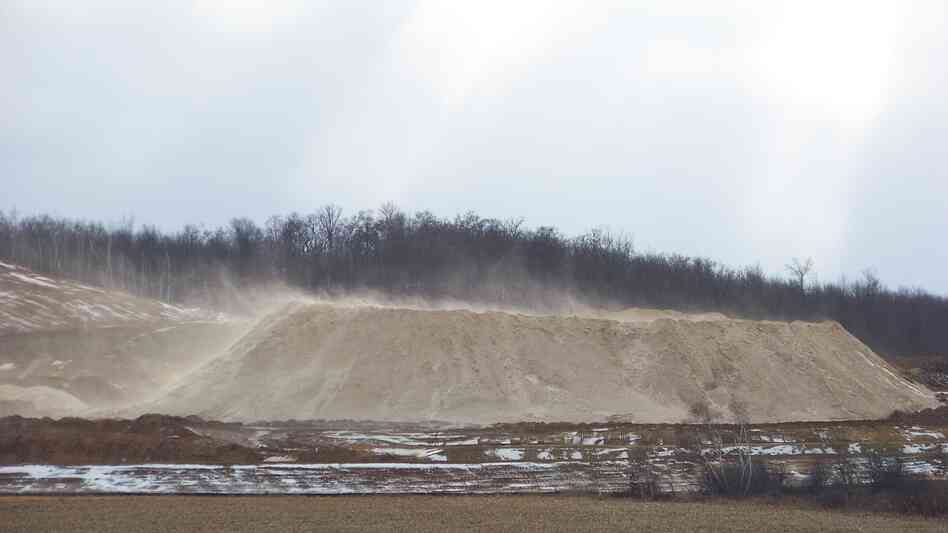
Sand is used as a ‘proppant’ — during fracking, the granuals hold open fractures in the rock formations, so that the natural gas can be released.
Sand mines have been a part of the Wisconsin landscape for hundreds of years, or about as long as dairy cows. Used to make pavement and for water filtration, silica sand has long been a small, but steady industry. Over the last couple of years, however, the demand for sand, and particularly, Wisconsin’s special blend, has sky-rocketed. According to the Wisconsin Department of Natural Resources, in 2010 there were about five frac sand mines and processing plants.
Now there are somewhere on the order of 115 throughout dozens of counties in central and western Wisconsin.
The rising demand has come almost exclusively from fracking operations. The sand of the Dairy State is so sought after because it is almost pure quartz — every grain is nearly spherical and it has a high compressive strength. Minnesota, northern Illinois, and Iowa all have similar sand composition.
The rapid pace of sand mine development in Wisconsin has many environmentally-minded Midwesterners alarmed. While sand mining might seem relatively benign as these things go — like a child on the beach with a bucket — there is growing concern over the human health and environmental impacts of the industry.
As Sarah Williams, staff attorney at Midwest Environmental Advocates based in Madison, Wisconsin, explained, the fine silica from mining sites is something of a nightmare in the human lung.
“These are tiny, jagged crystals that get lodged in people’s lungs,” said Williams. “Over time, they cause a degenerative lung disease called silicosis, that has no cure and ultimately leads to death.”
The explosion in sand mining for fracking is already having adverse impacts on the region’s water supply. Since November 2011, the DNR has issued 20 notices of violation to 19 different mining companies. There have been numerous accidents in recent years, where storm water has washed massive quan ies of sand into local waterways. In April 2012, sediment from a Interstate Energy Partners of Plymouth, Minnesota mine ended up in a wetland, eventually flowing into the St. Croix River, a federally protected waterway. Sand can change river pH, water flow patterns and the health of the fish and other animals that call the river, wetland or lake home.
The DNR has been quoted by multiple sources as saying that these problems are just “growing pains.”
As Wisconsin and other states struggle with the fallout from increased sand mining for fracking, it adds to the mounting evidence that the impacts of the natural gas boom will be felt far beyond the drill sites.
http://thinkprogress.org/climate/201...fracking-boom/
and there's more:
Sand From Fracking Could Pose Lung Disease Risk To Workers
http://www.npr.org/blogs/health/2013...Silicosis-Risk
Poor little, persecuted BigCarbon just can't catch a break for all the the dump on the planet. snif snif
Frackonomics: The Science and Economics of the Gas Boom
Fracknapping
You might wonder why the EPA has not limited or regulated fracking operations, in light of the combustible water, cancer-causing chemicals, and earthquake clusters.
The EPA might well have adopted significant national policies on fracking by now, had the practice not been made exempt from the main national environmental laws in the Energy Policy Act of 2005, an offspring of Cheney’s secretive energy committee.
The exemptions from the
Clean Water Act,
the Safe Drinking Water Act,
the Clean Air Act, and
the Superfund law
drastically limit the agency’s authority to act on fracking.
The drive to limit even EPA research into fracking is decades old. An extensive New York Times report, based on interviews with scientists and reviews of confidential files, found that “more than a quarter-century of efforts by some lawmakers and regulators to force the federal government to police the industry better have been thwarted, as EPA studies have been repeatedly narrowed in scope and important findings have been removed.” When Congress first directed the EPA to investigate fracking in the 1980s, the Times reported, EPA scientists found that some fracking waste was “hazardous and should be tightly controlled.” But the final report sent to Congress eliminated these conclusions. An agency scientist relates, “It was like science didn’t matter. ... The industry was going to get what it wanted, and we were not supposed to stand in the way.”
Similarly, when an EPA public-advisory letter to the state of New York called for a moratorium on drilling, the advice was stripped from the released version. A staff scientist said the redaction was due to “politics,” but could as well have said “business power.” More importantly, the first major EPA review of fracking found “little or no threat to drinking water.” This was an eyebrow-raising claim, given that five of seven members of the peer review panel had current or former energy industry affiliations, a detail noted by agency whistle-blower Weston Wilson. Other studies have been narrowed in scope or colored by similar conflicts of interest. More recently, the agency announced that its study finding contamination of Wyoming groundwater will not be subjected to outside peer review, and that further work instead will be funded directly by industry. As the EPA is presently drafting a brand-new report on the subject, these past embarrassments should be kept in mind.
This brings up the problem of regulatory capture, where an industry to be monitored gains major influence over regulators’ policies. As mentioned above, fracking is very loosely regulated by the states, which is always a favorite outcome for corporate America since the regulatory resources of state governments are far smaller and the regulators are even more easily dominated than those of the federal government. The industry-sponsored FracFocus website is the state-sanctioned chemical-information clearing house, and a masterpiece of smooth PR design, suggesting clear water and full transparency. But Bloomberg News reports that “more than 40 percent of wells fracked in eight major drilling states last year had been omitted from the voluntary site.”
Other state reactions have varied. In 2010, the New York State legislature voted to ban fracking, but then-Governor Paterson vetoed the bill and instead issued a temporary moratorium on the practice, though fracking remains illegal in the New York City watershed. Finally, while the EPA’s main study is still pending, the agency has taken some steps, as in 2012 when it required well operators to reduce methane gas emissions from wells and storage pits to limit air pollution. But even here the regulation wears kid gloves: The new moves do not cut into industry profits. In fact, capturing the “fugitive” methane, the agency estimates, will save the industry $11 to $19 million annually. Also, the regulation won’t take effect until 2015.
http://www.truth-out.org/news/item/1...f-the-gas-boom
A Texan tragedy: ample oil, no water
Fracking boom sucks away precious water from beneath the ground, leaving cattle dead, farms bone-dry and people thirsty
Three years of drought, decades of overuse and now the oil industry's outsize demands on water for fracking are running down reservoirs and underground aquifers. And climate change is making things worse.
In Texas alone, about 30 communities could run out of water by the end of the year, according to the Texas Commission on Environmental Quality.
Nearly 15 million people are living under some form of water rationing, barred from freely sprinkling their lawns or refilling their swimming pools. In Barnhart's case, the well appears to have run dry because the water was being extracted for shale gas fracking.
Ranchers dumped most of their herds. Cotton farmers lost up to half their crops. The extra draw down, coupled with drought, made it impossible for local ranchers to feed and water their herds, said Buck Owens. In a good year, Owens used to run 500 cattle and up to 8,000 goats on his 7,689 leased hectares (19,000 acres). Now he's down to a few hundred goats.
The drought undoubtedly took its toll but Owens reserved his anger for the contractors who drilled 104 water wells on his leased land, to supply the oil companies.
Water levels were dropping in his wells because of the vast amounts of water being pumped out of the Edwards-Trinity-Plateau Aquifer, a 34,000 sq mile water bearing formation.
"They are sucking all of the water out of the ground, and there are just hundreds and hundreds of water trucks here every day bringing fresh water out of the wells," Owens said.
"If you're going to develop the oil, you've got to have the water," said Larry Baxter, a contractor from the nearby town of Mertzon, who installed two frack tanks on his land earlier this year, hoping to make a business out of his well selling water to oil industry.
By his own estimate, his well could produce enough to fill up 20 or 30 water trucks for the oil industry each day. At $60 (£39.58) a truck, that was $36,000 a month, easily. "I could sell 100 truckloads a day if I was open to it," Baxter said.
He rejected the idea there should be any curbs on selling water during the drought. "People use their water for food and fibre. I choose to use my water to sell to the oil field," he said. "Who's taking advantage? I don't see any difference."
San Angelo, a city of 100,000, dug a pipeline to an underground water source more than 60 miles away, and sunk half a dozen new wells.
Las Cruces, just across the border from the Texas panhandle in New Mexico, is drilling down 1,000ft in search of water.
"We've got to get floods. We've got to get a hurricane to move up in our country and just saturate everything to replenish the aquifer," he said. "Because when the water is gone. That's it. We're gone."
http://www.theguardian.com/environme...e-oil-no-water

Top MIT Professors refuse to do a live debate on this subject.
Texan drought sets residents against fracking
http://www.theguardian.com/environme...fracking-video
Keep preaching guys, you're doing great. One day people will remember all the good you've done here.
"Las Cruces, just across the border from the Texas panhandle in New Mexico, is drilling down 1,000ft in search of water."
when fracking victims start drilling down for "fossil water" at 1000 ft+, they will get the toxic fracking waste water that nobody's ever supposed to see again.
There are currently 1 users browsing this thread. (0 members and 1 guests)
 Posting Permissions