Reply With Quote
fast food workers are producing products, selling .

or just give those cooks all of your money!
fast food workers are producing products, selling .

So you cannot even boycott a fast food restaurant to show them you mean business?I thought canceling was right up your alley.
You really aren't that committed outside of talking.
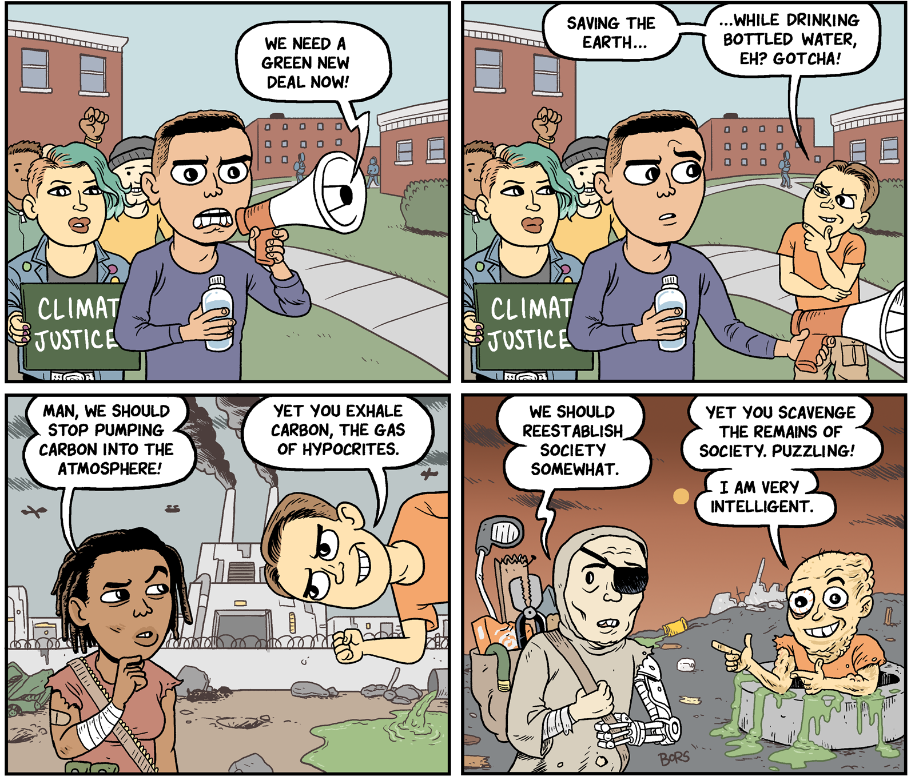
You walking past an empty soft drink bottle on the ground..
"Someone should do something about this"
nah. i'll pick it up and toss it. but if there's a nationwide epidemic of bottles on the ground, i realize that the odds of millions of people nationwide making a spontaneous yet coordinated effort to solve the problem is naive, and would advocate for government policy to address it.
Do you think boycotting a business would put pressure on them to examine their pay scales? I mean, the left cancels things all the time without government intervention. Whatever happened to the concept of voting with your dollar? If you continue using something you claim to disagree with, you're condoning it. Why can't you boycott it and still pressure your rep to do something about it? If the federal government doesn't do it, maybe the business itself will.
i didnt actually say one shouldnt boycott the business. my sarcastic alternative to give the underpaid cooks all your money was a parody of your take that charity can/should take care of the things i think the government should take lead on

Nobel Prize to Card and Imbens
tl;dr
-- minimum wage hikes don't reduce hiring
-- immigrants don't replace native workers or lower their pay.
https://apnews.com/article/nobel-pri...86a68b52c2bb32A U.S.-based economist won the Nobel prize in economics Monday for pioneering research that transformed widely held ideas about the labor force, showing how an increase in the minimum wage doesn’t hinder hiring and immigrants don’t lower pay for native-born workers. Two others shared the award for developing ways to study these types of societal issues.
Canadian-born David Card of the University of California, Berkeley, was awarded half of the prize for his research on how the minimum wage, immigration and education affect the labor market.

Nobel Prize lost all credibility when they gave Obama the Nobel Peace Prize before he did a ing think to promote peace, then added more troops to Afghanistan.. Just a bunch of liberals jacking each other off.
Uhhh long before Obama Yassir Arafat got the award. I will leave it up to you to decide who was a worse candidate.
And the entire Nobel prize structure is a jacking off joke because of the Nobel Peace Prize? History has been VERY tough on Nobel Peace Prize winners.
What do you have against Linus Pauling?
"Organized thieves are running us out of business"
https://topclassactions.com/lawsuit-...5m-settlement/
https://www.sfchronicle.com/sf/artic...n-16536960.phpFour years ago, Walgreens told shareholders it planned to close 600 stores nationwide. It wound up closing 769. In 2019, the Illinois company said in a U.S. Security and Exchange Commission filing that it would shutter 200 stores, or fewer than 3% of its 10,000 locations in the U.S. — one of several cost-saving measures projected to save $1.5 billion in annual expenses by 2022, according to the filings.
Gandhi never receiving it is more damning than any stupid ones given out.
Seed money for the prize came from Nobel's invention of TNT.
lol not noticing the liberal bias until black president got one
I am aware of that.
Another of the many faulty assumptions made by whinehole.
$15 isn't enough...Putin's price hike I guess

be interesting to see if these results get replicated
https://nymag.com/intelligencer/2023...ates-jobs.htmlIn “High Minimum Wages and the Monopsony Puzzle,” a team of economists at the University of California, Berkeley examined 47 large U.S. counties where the minimum wage had reached $15 an hour by the first quarter of 2021, and compared their wage levels and employment figures to those of similar counties that hadn’t raised the minimum wage since 2009. They focused specifically on fast-food workers, so as to avoid the complexities introduced by the tipped-wages common among servers at more upscale restaurants.
Their results will shock Saltsman and his ideological sympathizers. First, raising the minimum wage successfully increased hourly pay for workers in the bottom 10 percent of the income distribution without reducing wages for those in the middle. Had New York and California failed to pass minimum wage increases, this narrowing of the gap between the bottom and middle rungs of the income ladder would not have occurred. Second, the implications for employment were very slightly positive: Counties that enacted minimum wages saw more job growth, not less.
Now, a conservative economist might counter that one reason why these minimum wage hikes didn’t increase unemployment is that New York City, San Francisco, and Los Angeles already had fairly high market wages, and saw considerable “natural” wage growth over this period. If researchers had focused narrowly on the impact of state-level minimum-wage hikes on relatively low-wage counties in upstate New York or inland California, they probably would have discovered substantial employment effects.
Happily, the Berkeley economists thought of this. To correct for the possibilities 1) that high-wage cities are disproportionately likely to enact large minimum wage increases and 2) that high market wages attenuate the employment implications of high minimum wages, they isolated the impact of state-level minimum wages on counties that had neither enacted local minimum wage increases nor enjoyed above-average market wages.
When they narrowed their lens, the researchers did in fact find that the employment impacts of minimum wage hikes became more profound: Rather than producing a slight increase in job growth, high minimum wages were associated with substantial increases in employment.
In truth, this finding is not all that surprising. Economists have long recognized that, under conditions of “monopsony” — which is to say, when there are just a small number of employers in a given labor market — modest increases in the minimum wage will not kill jobs and might even create them. And liberal analysts had been arguing for decades that monopsony was far more common than generally appreciated.
Under conditions of monopsony, businesses do not need to offer compe ive wages, since workers have few other employers they can turn to. Therefore, the market wage may substantially underprice the value that a given hour of labor actually provides to a firm. When the government steps in and forces wage rates up, businesses can afford to weather the increase in labor costs without slowing hiring, automating roles, or raising prices. Rather, they’re simply forced to divert a bit of their earnings away from ownership and towards staff.
That redistribution of income away from business owners to workers can, in turn, have a stimulative effect. Low-wage workers often live paycheck to paycheck and spend a high percentage of their earnings. Affluent business owners, by contrast, can often afford to stow away excess earnings. Thus, when you move dollars from the latter to the former, that money becomes more likely to circulate in the local economy. Which translates to higher demand for goods and services, such as fast food, which gives fast food restaurants an incentive to add more staff.

"..... Five years after Amazon.com Inc. raised wages to $15 an hour, half of warehouse workers surveyed by researchers say they struggle to afford enough food or a place to live.
The national study, published Wednesday by the University of Illinois Chicago’s Center for Urban Economic Development, asked US employees about their economic wellbeing, including whether they’d skipped meals, went hungry, or were worried about being able to make rent or mortgage payments....."
https://fortune.com/2024/05/16/amazo...ord-food-rent/
inflation and unemployment Cassandras were wrong
https://x.com/BrandonRichards/status/1844413276488450328
Lee Ohanian at Hoover published bunk research and had to retract six articles.
Almost like he worked backward from the ideological result they wanted
In September 2023, California passed a law to bring fast food workers’ minimum wage up from $16 to $20 an hour. A flurry of reports predictably followed from the likes of The Wall Street Journal, Employment Policies Ins ute, and the Hoover Ins ution claiming that restaurants and other businesses were already laying off workers based on the new law.
https://www.dropsitenews.com/p/71518...e-72d7e1f09a3cThe Hoover Ins ution, a think tank with $879.8 million in total assets, continued to dig in against AB 1228, publishing multiple articles over the past year attempting to pin “lost jobs” on rising wages. At the heart of the research are three major claims made by Lee Ohanian, an economist at UCLA and senior fellow at The Hoover Ins ution:
- Government jobs account for 96.5% of job growth in California over 2.5 years,
- California lost 410,000 jobs from February 2020-February 2024, and,
- California lost 10,000 jobs in the fast food sector since the minimum wage law was signed in September 2023.
All three claims are false, and the Hoover Ins ution has now had to retract six articles based on faulty research by Ohanian. The claims were first debunked by Invictus, an anonymous poster—using the same publicly available data that Ohanian used as source for his analysis. In reality,
- Between January 2022 and June 2024, private-sector jobs accounted for the majority of job growth in California, at 77.8%
- California did not lose any jobs between February 2020 and Feburary 2024; it actually gained 290,000 jobs
- California’s fast food sector has seen consistent growth, both in terms of jobs and the total number of establishments, outpacing national averages.
There are currently 1 users browsing this thread. (0 members and 1 guests)
 Posting Permissions