Reply With Quote
shortage of IV bags due to Helene taking out one production facility in the US
https://x.com/killerandfiller/status...75424632365384

payment processing shenanigans
https://x.com/TrungTPhan/status/1839686159976534426
shortage of IV bags due to Helene taking out one production facility in the US
https://x.com/killerandfiller/status...75424632365384
Kroger and Albertson's want you to believe that with even less compe ion, customers will get a better deal
Kroger Senior Director of Pricing Andy Groff testified on Tuesday morning about a program called the “mountain no-comp zone” established in 2022 when inflation was surging nationwide. It was also called a “low-comp” zone.
The zone identified eight stores on the state’s Western Slope, where Kroger had less compe ion. It included City Market stores in Glenwood Springs, Aspen, Breckenridge, Newcastle, Granby, Carbondale, Eagle and El Jebel.
In all eight stores, Kroger raised prices under the program, Groff confirmed.Kroger's mountain town pricing strategy under scrutiny in Colorado merger trial | Business | denvergazette.comThe “no-comp” stores on the Western Slope saw revenues grow faster and yielded gross margins more than double of more compe ive Kroger stores, Groff confirmed.
It was considered a successful program, Groff testified, because it raised prices without losing customers and covering Kroger’s rising costs.
Last edited by Winehole23; 10-10-2024 at 02:08 PM.
will be interesting to see whether FTC calls or folds on reigning in monopolistic abuse
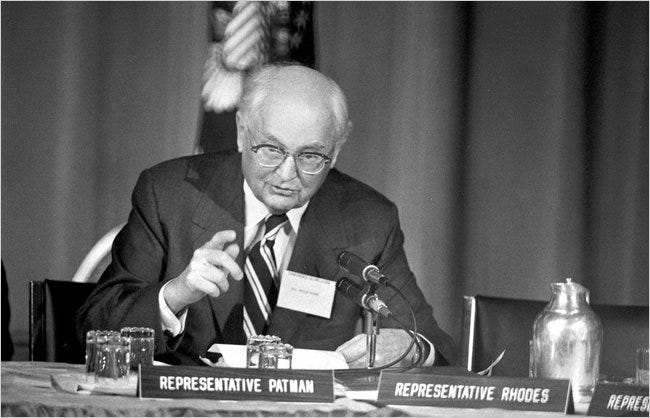
Monopoly Round-Up: FTC Revives the "Magna Carta of Small Business"The big news itself of the week is that the Federal Trade Commission finally attacked illegal price discrimination, after forty years of neglect. The FTC used an old and often neglect an rust law, the Robinson-Patman Act, to sue a dominant liquor distributor you’ve likely never heard of, a company called Southern Glazer. Somewhere, Wright Patman is smiling down upon Federal Trade Commissioners Lina Khan, Alvaro Bedoya, and Rebecca Kelly-Slaughter for this historic move. And it is historic.
Southern Glazer is the tenth largest private company in the U.S., with $26 billion of revenue, and it is the exclusive distributor in certain states of a host of liquors, such as Hennessy, Tanqueray, Bacardi, Captain Morgan, Grey Goose, Jameson, and Johnnie Walker. And the FTC’s allegation is Southern Glazer gives better prices to big stores than small ones.
Since at least 2018 and continuing today, Southern has repeatedly discriminated in price between disfavored independent purchasers—which include neighborhood grocery stores, local convenience stores, and independently owned wine and spirits shops—and favored large chain purchasers of wine and spirits, such as Total Wine & More, Costco, and Kroger.
Staffing isn't the problem, procurement, fraud and private consulting costs are where most of the fat is.
Sadly, Trumplandia wants to can civil servants so they can amplify waste and graft.
There are plenty of studies showing massive government waste, but it’s not in the Federal workforce. It’s in procurement, the place where the government buys from the private sector, everything from pencils to software to nuclear submarines. The government spends about $750 billion a year on contracts. How much of this money is wasted?
It turns out, the answer is a lot.
The Organization for Economic Co-operation and Development (OECD) points out that about a fifth of it is stolen by contractors through bid rigging, the so-called “Collusion tax.” Collusion is when contractors get together in groups and conspire on their bids so that the government overpays for goods and services. According to the OECD, “The elimination of bid rigging could help reduce procurement prices by 20% or more.”
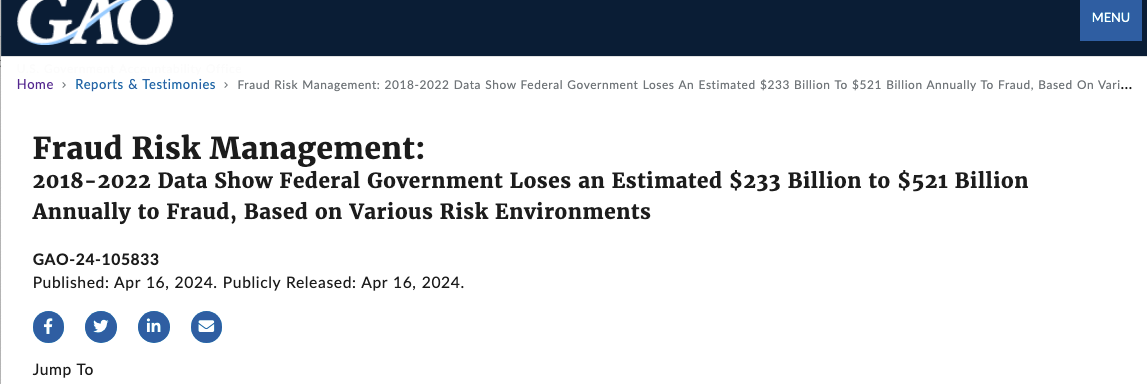
If you take $750 billion, just in Federal procurement spending, that’s $150 billion a year of pure overpayment, due to this one form of crime. There are other boring reports saying something similar. Earlier this year, for instance the Government Accountability Office published a report on fraud, showing the government loses between $233 billion to $521 billion on fraud.
That’s a lot of money. There are plenty of ways to get at it, two of them being to increase penalties against fraud and collusion, and shift law enforcement resources from silly things like disinformation monitoring to investigating contractor fraud. I don’t think that’ll happen, the Republicans and Donald Trump are dead set on defunding the tax cops, aka the IRS, and that’s a key agency in taking on this kind of fraud. But they could.
Still, there’s an even easier approach to taking on the problem. Go after McKinsey and management consultants throughout the Federal government.
5% of Government Spending Goes to Consultants
Why take on management consultants? Well, for starters, the government spends far too much on people giving it advice. In it's 2024 budget, the Biden administration requested $70 billion for management consulting, aka “professional services,” which is 5% of all discretionary spending. The Defense Department alone asked for $32.9 billion. So just cutting all management consulting would be a big chunk of savings.
But it goes beyond just the raw spend on consultants, to how consultants misdirect other monies. An important study in 2023 on what it costs to resurface roads at a state level - a very simply and standard need everywhere - showed why procurement waste in America is so persistent. A key reason is consultant bloat. It turns out, when you hire government employees for long-term planning, costs go down, but when you use third party consultants, they go up.
“A one standard deviation increase in DOT employment per capita is correlated with 16% lower costs,” said the study, while “a one standard deviation increase in reported consultant costs is associated with an almost 20% increase ($70,000) in cost per lane-mile.” Consulting firms replace government with flabbiness, driving up procurement spending.
But beyond the broad problem of management consultants is the specific king of management consulting itself, McKinsey. Investigating McKinsey would probably bring in a lot more savings. Here’s why. McKinsey is the brain of both the American government AND the American corporate world, so it is likely the ringleader of a lot of bloat and collusion. For example, McKinsey advised both the Food and Drug Administration, and Purdue Pharmaceuticals, on opioids, a clear fusion of corporate and governing power, that killed hundreds of thousands of Americans.
That’s not an anomaly.
Cutting Government Is Easy... If You Go After McKinseyIn many ways, the anger that Donald Trump is bringing to bear, with the President-elect asking Elon Musk to cut $2 trillion of government spending through the “Department of Government Efficiency,” is taking advantage of this fear. Now, the reason I’m writing about DOGE is because a few days ago, Congress was on the verge of passing legislation to fund the government, and as part of that legislation, to restrict pharmacy benefit managers and block junk fees. Musk and Trump, however, alleged government waste, and thwarted these disruptive new laws.
This move, though it will be framed as shaking things up, is just a rehash of what we’ve seen for decades. One of the games we’ve seen from conservatives since the “New Right” elections of 1978, and through the Tea Party, and now under Trump this week, is masquerading as a disruptor, while enacting standard pro-Wall Street policy.
Why is the rent too damn high? Cartelization via algorithm plays a part
The Cost of Anticompe ive Pricing Algorithms in Rental Housing | CEA | The White HouseWe find that coordinated rents from algorithmic pricing cost renters in algorithm-utilizing units $70 a month, or 4% of rent, on average nationally. In six major metros, the cost exceeds $100 a month. Monthly costs of price coordination for units using RealPage software by metro are shown in Figure 2. The total cost to renters in 2023 was approximately $3.8 billion.


...Pure, unadulterated greed.
Patients are teaming up with the very same respiration equipment distributors who've been screwing them to screw the government -- so that the sickest patients can get the liquid oxygen they need.
https://www.propublica.org/article/s...icare-patientsFor years, the home-oxygen industry has failed in myriad ways the million-plus Americans who struggle to breathe. Lincare, the country’s largest distributor of breathing equipment, has a decadeslong history of bilking Medicare and the elderly, as ProPublica has revealed. Philips Respironics hid serious problems with its sleep apnea machines, with devastating consequences, including reported deaths. Other large respiratory companies have paid multimillion-dollar fraud settlements.
But as the current session of Congress hurtles to a close, advocates for oxygen patients — in a seemingly improbable alliance with the companies that have victimized them — are making a final push for legislation that, among other things, would pay the scandal-scarred industry hundreds of millions of dollars more than it currently receives. The patients, many aged and infirm, have been besieging lawmakers with meetings, calls and emails, pressing them to pass the Supplemental Oxygen Access Reform, or SOAR, Act by the end of the year. The corporate and patient advocates vow that if the legislation fails in the current term, as seems possible, they will push to reintroduce it next year.
The SOAR Act would achieve two long-sought goals for the industry, which receives much of its revenues from Medicare. The bill would protect companies from additional reductions in their billings by removing oxygen from Medicare’s compe ive bidding program, which has saved taxpayers hundreds of millions of dollars. And it would make it far more difficult for the government to challenge those billings.
The patient groups, in turn, have their own goals: improving the industry’s notoriously poor service and assuring access to costly liquid oxygen for a relatively small group of the sickest patients. That form of oxygen is coveted by patients with advanced lung disease because it provides the high flows they need in easy-to-carry cylinders that last for hours. Emotional accounts of stricken patients, unable to obtain the equipment they need, have been prominent in the lobbying campaign to pass the measure.

Prager
Snake Boy with nothing to say about his own post as usual
there's even a french fry cartel
After decades of consolidation, just four firms now control at least 97 percent of the $68 billion frozen potato market, the an rust cases reveal. These four companies participate in the same trade associations and use a third-party data analytics platform — PotatoTrac — to share confidential business information. The lawsuits allege the firms’ collusion has driven french fries and hash browns to record-high prices.
Consumers have felt the impacts of these price hikes. The cost of fries at McDonald’s has increased by 138 percent since 2014, and hash brown prices have more than doubled in recent years at fast food joints including Jack in the Box and Hardee’s. At local dives and mom-and-pop joints — like Saltzman’s bar, Ivy and Coney — the cost of fries is going up, too.
Between July 2022 and July 2024, the price of frozen potato products increased by 47 percent across the board, according to court do ents. This rise was initially tied to a jump in operating costs among the companies that peaked in 2022 — but even as these expenses have declined over the last two years, product prices have remained high.The Rise of the French Fry Cartel“This is Nirvana for the likes of Lamb Weston, Simplot, and McCain,” the executive said. “They have never ever seen margins this high in the history of the potato industry.”
is Trump pro-people or pro-monopoly?
what happens with legacy FTC an rust actions will be a signal, Lina Khan's tenure was robust.
What's Coming on the Anti-Monopoly Front in 2025?
One way to understand progress is to look at the big stuff, like the an rust wins against Google, the first major monopolization victories in two decades. That’s part of a revival of monopolization law, which was left for dead in the mid-2000s.
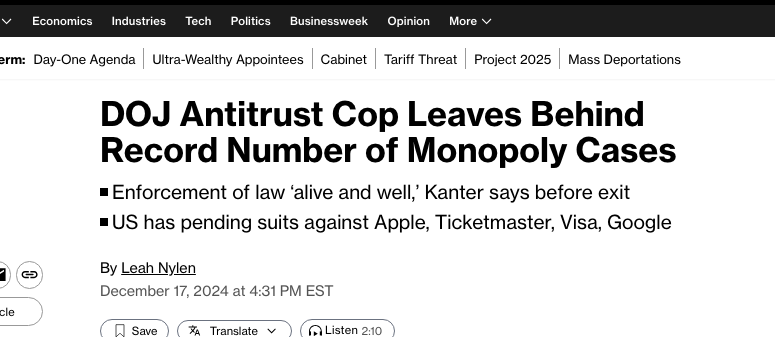
The level of litigation on pure monopolization cases is now historic. As Bloomberg noted, “the US government now has more pending cases targeting alleged monopolies than at any time since the trust-busting era of the early 1900s, shortly after the an rust laws were first passed.” That suit of cases includes government cases against Apple, Google, Ticketmaster,Visa, Amazon,RealPage, and Meta, among others. Private litigants are following along, bringing their own set of cases, such as those against health records giant Epic Systems, NASCAR, Amazon, and Google.
And then there are the high-profile merger cases. From 2009-2014, the Department of Justice brought just two cases to trial, neither of which was worth more than $300 million. In just three years, Biden enforcers have litigated 14 mergers, most of which were multi-billion cases. The defendants were recognizable brands, like American Airlines, UnitedHealth Group,Meta,Microsoft, Versace, JetBlue, Booz Allen,Penguin RandomHouse, Kroger, and Albertsons, with seven wins, four losses, one settlement, one case on appeal, and two trials upcoming.
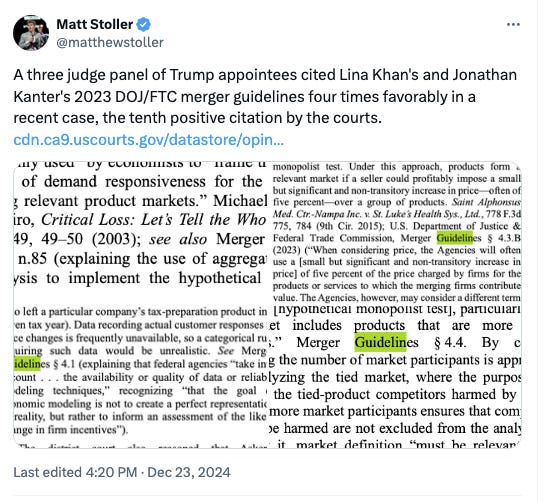
One critique, of course, is that the new administration can simply reverse enforcement priorities. So how durable is this record? The answer is, more than you might think. The courts have accepted most of the arguments that the new enforcers put forward. Just a few weeks ago, for instance, three Trump-appointed judges on the Ninth Circuit cited the 2023 merger guidelines favorably, the tenth time courts have done so. That’s probably the fastest we’ve ever seen courts accept new merger guidelines.
And that’s not counting the significant changes in privacyconsumer rights, airline rules, ocean shipping,private equity, markets in medical devices like inhalers and hearing aids, hotel and ticketing junk fees and bank overdraft fees, and medical debt, many of which are likely to endure.
Did any of it matter to the real economy? Yes. Trillions of dollars of mergers haven’t happened, which means that large businesses have had to find ways to conduct themselves by investing in the economy. And that has a big impact, though it’s not one you’d hear about, both because the White House refused to talk about it, and because big business leaders would prefer to not laud restrictions that forced them to do a better job.
the free market has made housing costs worse, not better
whose side will Trump take?
https://apnews.com/article/algorithm...dab5c84088ff53The U.S. Justice Department is suing several large landlords for allegedly coordinating to keep Americans’ rents high by using both an algorithm to help set rents and privately sharing sensitive information with their compe ors to boost profits.
The lawsuit arrives as U.S. renters continue to struggle under a merciless housing market, with incomes failing to keep up with rent increases. The latest figures show that half of American renters spent more than 30% of their income on rent and utilities in 2022, an all-time high.
That means exhausting, day-to-day decisions between medications, groceries, school supplies and rent. It means eviction notices and protracted court cases in which children face the highest eviction rates, with 1.5 million evicted each year, according to Princeton University’s Eviction Lab.
underrated sinister plot imho
Still blows my mind
Trump is likely to stroke big anticompe ive mergers, the principals are already rushing to kiss his ring with sacks of gold as tribute.
https://www.techdirt.com/2025/01/23/...der-trump-2-0/Fail upward media brunchlords like David Zaslav are extremely excited about the potential for more terrible mergers (like the Time Warner Discovery disaster) in the streaming space. CBS is already busy kissing Trump’s ass in exchange for what it hopes will be Trump approval of its Skydance merger.
And analysts in telecom land are licking their chops at the idea of all manner of senseless consolidation in broadband land, including a merger between two of the most hated companies in America: Comcast (Xfinity) and Charter (Spectrum):
“We believe a Comcast/Charter merger could make industrial logical sense given the scale and subsequent massive synergies,” wrote the financial analysts at TD Cowen.”These guys aren’t really interested in whether the union creates a better company, or a better product, or happier consumers, or a stronger overall market. They’re interested in watching stock valuations (temporarily) go up. The last Trump administration was quick to rubber stamp the T-Mobile and Sprint merger, which immediately caused most U.S. wireless price compe ion to grind to a halt.
“It is an obvious transaction,” said analyst Walter Piecyk with LightShed Partners ina video posted on social media.”
Comcast and Charter (usually) don’t directly compete. But as any academic that studies corporate power (especially telecom corporate power) will tell you, that doesn’t really matter.
The consolidation still strengthens the power of the underlying monopoly, and that scale always (especially in the broken, uncompe ive telecom market) routinely results in a company that’s increasingly hostile to remaining compe ors, labor, and healthy supply chains. And increasingly influential in DC circles, where they lobby relentlessly to ensure compe ive alternatives can’t take root.
It’s not really subtle or debatable, you can look directly at the history of the highly consolidated U.S. telecom market (coddled by decades of corruption and regulatory capture) to see precisely what this looks like in practice. Comcast and Charter are genuinely terrible, uninnovative companies because they’ve crushed all remaining compe ors and largely defanged competent government oversight.
The deregulation, undermining of an rust enforcement, and broad defanging of oversight is always framed by telecom monopolies (and their vast assorted consultants, think tanks, and mouthpieces) as the path toward true “free marketing compe ion” and “innovation.” But as Comcast, AT&T, Verizon, and Charter routinely make clear, that promised future simply never arrives.
I enjoy readingtrade magazine and business press coverage of this sort of thing, because it’s amusing how consumer welfare, market health, the public interest, labor rights, or even basic historical context, simply don’t exist. All the well do ented and potential harms of mindless telecom consolidation are simply not mentioned. At all. Despite being rather integral to both the story and public understanding.
In its place, generally, is the most superficial of rhetoric about “synergies” and “innovation” that aren’t based on much of anything beyond vibes.
I suspect the Trump administration could approve a merger between Comcast and Charter. More immediately they’ll approve the already-proposed merger between the equally terrible Frontier and Verizon. And they’ll most certainly approve more terrible streaming mergers, resulting in higher prices, layoffs, and lower quality services. Assuming these companies adequately kiss the ring.
The press will unquestioningly parrot the mythological benefits of mindless consolidation and deregulation. And when the consolidative telecom market harms manifest, as they always do, everybody involved will simply pretend they had nothing to do with it as they stumble onward to the next big, pointless, stock-fluffing deal.
Trump's new FTC boss carrying water for big business
Ferguson killed off a public comment process on "surveillance pricing," where companies spy on you and then reprice their goods based on their estimation of how desperate you are:
https://pluralistic.net/2025/01/11/s...m-for-the-poor
https://pluralistic.net/2025/01/24/e...nt-priorities/Ferguson also killed off a notice-and-comment action on predatory pricing – when companies sell goods below cost in order to destroy compe ors, then drive up prices. This is what Uber did, setting $31b of Saudi royal money on fire over 13 years, losing $0.41 on every dollar they brought in. This killed off all the regular taxis, and convinced city governments to abandon public transit investment on the grounds that Uber was cheaper than a bus. Once they'd captured the market, Uber doubled the price of a ride and halved the wages that they paid drivers.
Andrew Ferguson could have made his first public act as Chairman a motion to study the rising cost of groceries. He could have acted on a pending public pe ion from a group of wall and ceiling contractors to investigate how lawbreaking contractors can effectively rig contract compe ions in the commercial construction industry. He could have moved to investigate a pending public pe ion from shrimpers from Louisiana, Mississippi, and Alabama to investigate potentially false and misleading claims about shrimp imports from India that are farmed with forced labor and shot full of antibiotics…https://www.ftc.gov/system/files/ftc...ncy-motion.pdf
I have met with corn growers and cattlemen in Iowa. I have met with shrimpers in Biloxi. I have met with pharmacists in Knoxville, grocers in Tulsa, and patients and their doctors in Charleston, West Virginia. I met with the men who build Miami’s million-dollar skyscrapers in 110-degree heat.
Let me tell you what they didn’t talk about: “DEI.”
What they do talk about is how powerful companies are skirting or abusing the law to force farmers, workers, and small businessmen to do what they want, when they want, or else. How the government isn’t doing anything about it. And how they’re going broke because of it.
But Chairman Ferguson seems uninterested in the challenges that regular human beings face.
Will Trump back renters or RealPage/landlords?
If DOJ moved this month and hasn't been countermanded yet -- even after having been publicized in the liberal press -- that would be modestly encouraging for regular people.
The DOJ press release hasn't been scrubbed yet.
https://www.kut.org/housing/2025-01-...dlords-tenantsThe DOJ last week amended its legal filings to include six landlords and management companies federal lawyers say harmed renters by sharing private data and agreeing to set prices. In Austin, these companies own a significant share of rental homes.
The companies include Greystar Real Estate Partners LLC; Blackstone’s LivCor LLC; Camden Property Trust; Cushman & Wakefield Inc and Pinnacle Property Management Services LLC; Willow Bridge Property Company LLC; and Cortland Management LLC.
https://www.justice.gov/opa/pr/justi...erican-renters
"see which apartments they own in Austin"
cities stepping up enforcement on algorithmic price gouging
https://washingtonstatestandard.com/...es-lag-behind/Minneapolis last week became the fourth U.S. city to ban algorithmic rental price-fixing software, joining San Francisco, Philadelphia and Berkeley, California, in a growing wave of legislation aimed to protect renters from rental price-gouging.
While momentum builds at the city level — with Portland, Oregon; Providence, Rhode Island; and San Diego exploring similar laws — statewide bans have been slower to emerge.
The legislation targets tools such as RealPage’s YieldStar, which uses landlord-shared data to recommend rent increases — a practice critics say worsens unaffordable housing. Stateline reported last year that the algorithms have drawn increasing oversight attention as the country continues to wrestle with an affordable housing crisis.
“This wave of action shows that local governments are stepping up where federal enforcement takes time,” said Ivan Luevanos-Elms, executive director of Local Progress, the national network helping coordinate these efforts
Greystar settles with DOJ, will stop using algorithmic pricing
https://www.propublica.org/article/g...ents-software?Greystar, the nation’s largest landlord, has agreed to stop using algorithmic rent-setting software that federal prosecutors say could violate laws against price-fixing.
The agreement is part of a proposed settlement with the Justice Department to resolve claims by federal authorities that the company had colluded with other landlords to raise rents in cities across the country.
The deal was announced by the DOJ on Friday but still must be approved by a judge. If it is, it will bar Greystar, which is based in South Carolina and manages nearly 950,000 apartments nationwide, from using any “anti-compe ive” algorithm that relies on rivals’ sensitive data to suggest rents, the department said in a statement.
Greystar was using rent-setting algorithms from RealPage, a Texas-based software-maker who was the subject of a ProPublica investigation in 2022 that showed the firm was helping landlords decide prices in a way that legal experts said could result in cartel-like behavior. The DOJ has also sued RealPage.
There are currently 1 users browsing this thread. (0 members and 1 guests)
 Posting Permissions