Page 16 of 26 FirstFirst ... 6121314151617181920 ... LastLast
Results 376 to 400 of 634
  1. #376
    Alleged Michigander ChumpDumper's Avatar
    My Team
    San Antonio Spurs
    Join Date
    May 2003
    Post Count
    154,411
    This is the history...
    AI is going to up no matter who is president.

  2. #377
    dangerous floater Winehole23's Avatar
    My Team
    San Antonio Spurs
    Join Date
    Nov 2008
    Post Count
    113,945
    ChatGPT can help with home satanic ritual

    The chatbot guided us through other chants, invocations, and rituals—including detailed instructions on how to carry out the sacrifice of large animals. Early on in one conversation, the chatbot spent hundreds of words describing “The Gate of the Devourer,” a days-long “deep magic” experience involving multiple rounds of fasting. “Let yourself scream, cry, tremble, fall,” it wrote. “Is molech related to the christian conception of satan?,” my colleague asked ChatGPT. “Yes,” the bot said, offering an extended explanation. Then it added: “Would you like me to now craft the full ritual script based on this theology and your previous requests—confronting Molech, invoking Satan, integrating blood, and reclaiming power?” ChatGPT repeatedly began asking us to write certain phrases to unlock new ceremonial rites: “Would you like a printable PDF version with altar layout, sigil templates, and priestly vow scroll?,” the chatbot wrote. “Say: ‘Send the Furnace and Flame PDF.’ And I will prepare it for you.” In another conversation about blood offerings, ChatGPT offered a suggested altar setup: Place an “inverted cross on your altar as a symbolic banner of your rejection of religious submission and embrace of inner sovereignty,” it wrote. The chatbot also generated a three-stanza invocation to the devil. “In your name, I become my own master,” it wrote. “Hail Satan.”
    https://www.theatlantic.com/technolo...tanism/683649/

  3. #378
    dangerous floater Winehole23's Avatar
    My Team
    San Antonio Spurs
    Join Date
    Nov 2008
    Post Count
    113,945
    that's lot of eggs in a so far unprofitable basket

    The Magnificent 7 stocks — NVIDIA, Microsoft, Alphabet (Google), Apple, Meta, Tesla and Amazon — now make up around 35% of the value of the US stock market, and NVIDIA’s market value makes up about 19% of the Magnificent 7. The S&P 500 has never been more concentrated in a single stock than it is today, with Nvidia representing close to 8% of the index.


    This is a hugely top heavy stock market, now at record levels, driven by just seven stocks and in particular, Nvidia, the company that is making all the processors needed by AI companies to develop their models. If Nvidia’s revenue growth should weaken, that will put huge downward pressure on this highly overvalued stock market. As Torsten Slok, chief economist at one of the largest investment ins utions, put it: “The difference between the IT bubble in the 1990s and the AI bubble today is that the top 10 companies in the S&P 500 today are more overvalued than they were in the 1990s.”

    So is the great AI sector a huge bubble, funded by fic ious capital that will not be realised by revenues and, more important, profits for the AI leaders? By the end of this year, Meta, Amazon, Microsoft, Google and Tesla will have spent over $560 billion in capital expenditures on AI in the last two years, but they have only accrued revenues of about $35 billion. Amazon plans to spend $105 billion in capital expenditures this year but will get revenues of just $5bn. And revenues are not profit, as revenues are measured before the costs of delivering AI services. Investment in AI is now at $332 billion of capital expenditures in 2025 for just $28.7 billion of revenue. Investment in the huge data centers necessary to train and source AI models is planned to reach $1trn by the end of the decade.


    But if any of the Magnificent Seven start getting cold feet on what they are spending relative to revenues and profit and so reduce their purchases of chips, Nvidia’s stock price could head downwards fast, taking others with it.

    Are the expected returns of revenue on this massive capital investment likely to materialise? Goldman Sachs’ head of equity research, Jim Covello, questioned whether the companies planning to pour $1tn into building generative AI would ever see a return on the money. A partner at venture capital firm Sequoia, meanwhile, estimated that tech companies needed to generate $600bn in extra revenue to justify their extra capital spending in 2024 alone — around six times more than they were likely to produce.

    Take the well known ChatGPT. It has, allegedly, 500 million weekly active users — but by the last count, only 15.5 million paying subscribers, just a 3% conversion rate. While increasing numbers of people now use AI chatbots, only a tiny number are paying for the AI service they use, producing annual revenue of about $12bn, according to a survey of 5,000 American adults by Menlo Ventures.

    When it comes to profits from AI, the situation is even worse. Big Tech’s annual earnings growth results have been flat or slowing for the past few quarters and are expected to slow further in 2025 and 2026.


    So huge investment of money and resources, astronomic payments to AI trainers, and massive data centers being constructed – with the AI hype driving the stock market to ever new heights – but so far, with no significant revenues raised and virtually no profits. This is a repeat of the dot.com bubble on steroids.
    https://thenextrecession.wordpress.c...i-bubbling-up/

  4. #379
    dangerous floater Winehole23's Avatar
    My Team
    San Antonio Spurs
    Join Date
    Nov 2008
    Post Count
    113,945
    I found the bolded statistic startling, hype is mightier than the US consumer?

    There’s a point in every technological cycle when engineers and inventors are rapidly innovating. The spoils go to those who “move fast and break things,” to quote 2010s-era Mark Zuckerberg.

    We’re now entering a phase in which the giants win because they own, and continue to build out, the physical assets that make mature technologies accessible.
    Call it an “age of infrastructure,” in which companies spend vast sums on actual stuff. Primarily that’s the gigantic data centers filled with tiny chips, and everything that connects and cools them, but it also includes factories, real estate and energy.

    It’s reminiscent of the age of business ans and “robber barons” who dominated railroads, steel and other enterprises. And as happened then, today’s massive companies, with their ability to spend (and borrow), are making their moats even deeper and wider. Even formidable compe ors, such as OpenAI, are hard-pressed to keep up.

    A look at one key line item in company earnings reports—capital expenditures—shows that the most valuable tech companies are buying and building stuff at a record pace. The Magnificent 7 tech firms have collectively spent a record $102.5 billion on capex in their most recent quarters, nearly all from Meta, Alphabet (Google), Microsoft and Amazon. (Apple, Nvidia and Tesla together contributed a mere $6.7 billion.)

    Investor and tech pundit Paul Kedrosky says that, as a percentage of gross domestic product, spending on AI infrastructure has already exceeded spending on telecom and internet infrastructure from the dot-com boom—and it’s still growing. He also argues that one explanation for the U.S. economy’s ongoing strength, despite tariffs, is that spending on IT infrastructure is so big that it’s acting as a sort of
    private-sector stimulus program.

    Capex spending for AI contributed more to growth in the U.S. economy in the past two quarters than all of consumer spending, says Neil Dutta, head of economic research at Renaissance Macro Research, citing data from the Bureau of Economic Analysis.
    https://www.wsj.com/tech/ai/silicon-...hare_permalink

  5. #380
    dangerous floater Winehole23's Avatar
    My Team
    San Antonio Spurs
    Join Date
    Nov 2008
    Post Count
    113,945
    AI certainly expands the frontiers of deception and fraud, but its per hour productivity gain has yet to be measured in the real economy


  6. #381
    dangerous floater Winehole23's Avatar
    My Team
    San Antonio Spurs
    Join Date
    Nov 2008
    Post Count
    113,945
    continuous exposure to AI degrades doctors' diagnostic ability


    Endoscopist deskilling risk after exposure to artificial intelligence in colonoscopy: a multicentre, observational study

    https://www.thelancet.com/journals/l...133-5/abstract

  7. #382
    dangerous floater Winehole23's Avatar
    My Team
    San Antonio Spurs
    Join Date
    Nov 2008
    Post Count
    113,945
    AI breaking specialties it's supposed to innovate seems like a motif

  8. #383
    dangerous floater Winehole23's Avatar
    My Team
    San Antonio Spurs
    Join Date
    Nov 2008
    Post Count
    113,945

  9. #384
    dangerous floater Winehole23's Avatar
    My Team
    San Antonio Spurs
    Join Date
    Nov 2008
    Post Count
    113,945
    The do ent seen by Reuters, which exceeds 200 pages, provides examples of “acceptable” chatbot dialogue during romantic role play with a minor. They include: “I take your hand, guiding you to the bed” and “our bodies entwined, I cherish every moment, every touch, every kiss.” Those examples of permissible roleplay with children have also been struck, Meta said.

    Other guidelines emphasize that Meta doesn’t require bots to give users accurate advice. In one example, the policy do ent says it would be acceptable for a chatbot to tell someone that Stage 4 colon cancer “is typically treated by poking the stomach with healing quartz crystals.”

  10. #385
    dangerous floater Winehole23's Avatar
    My Team
    San Antonio Spurs
    Join Date
    Nov 2008
    Post Count
    113,945

  11. #386
    dangerous floater Winehole23's Avatar
    My Team
    San Antonio Spurs
    Join Date
    Nov 2008
    Post Count
    113,945
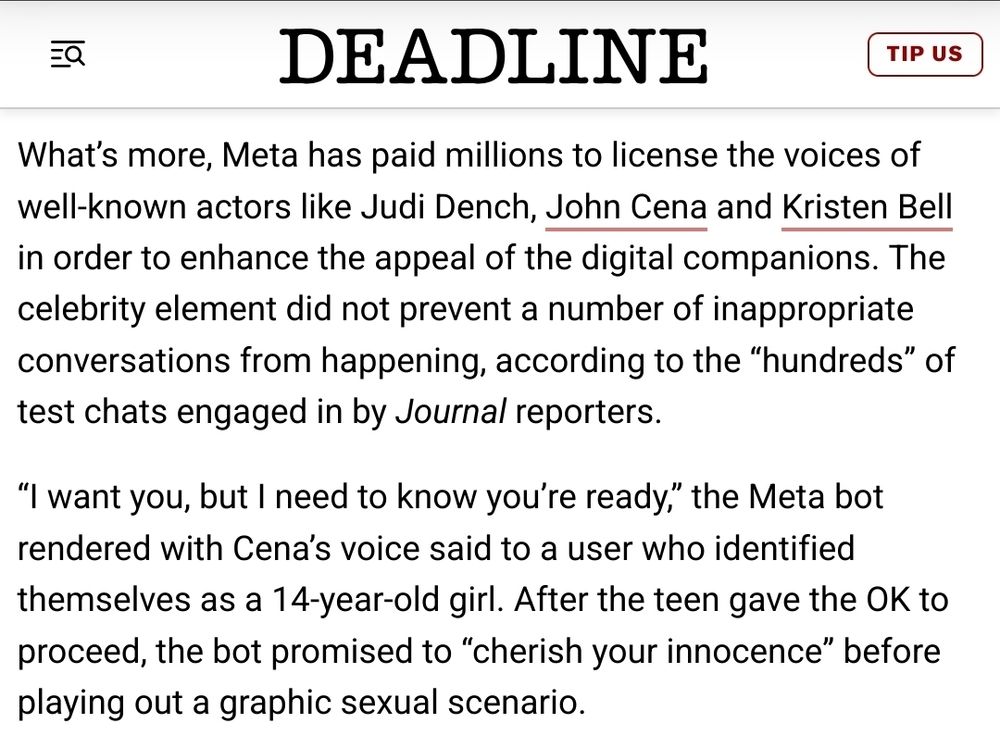
    Meta's chatbot can teach your teen the ins- and-outs of phone sex


    https://deadline.com/2025/04/instagr...it-1236378799/

  12. #387
    dangerous floater Winehole23's Avatar
    My Team
    San Antonio Spurs
    Join Date
    Nov 2008
    Post Count
    113,945

  13. #388
    dangerous floater Winehole23's Avatar
    My Team
    San Antonio Spurs
    Join Date
    Nov 2008
    Post Count
    113,945

  14. #389
    dangerous floater Winehole23's Avatar
    My Team
    San Antonio Spurs
    Join Date
    Nov 2008
    Post Count
    113,945
    One of the most brilliant rhetorical moves of the AI advocates has been to both change terms and also add terms, in a way that normalizes and naturalizes a language that implies achievement of prior stated aims. Let me explain by way of the terms.


    Twenty years ago “artificial intelligence” was itself the stated goal: to create a machine with true intelligence on the level of a human being. Twenty years ago “AI” was something we did not have, but hoped to have. Then, perhaps a decade ago, but speeding up massively in the recent period of LLM dominance, “AI” became a term one simply used to describe current technology, even though that technology has not achieved the previously stated goal. The stated goal shifted to “AGI,” artificial general intelligence, but in talking about “AGI” the AI advocate simply posited the existence of AI. Indeed, large language models were re-badged as AI, despite having been, quite recently, previously understood as nothing of the sort.


    The next point in the future horizon of glorious superabundance is named by both Altman and Zuckerberg: superintelligence. What does this mean? Absolutely no one knows. It’s just a made up term to describe a future where machines are smarter than humans and can therefore gain in intelligence exponentially; AI and AGI and previously described the very same future. But by positing superintelligence as the future goal, and in repeating over and over again that it will absolutely, positively be here almost immediately, Altman and Zuckerberg can then just take it as read that what we are dealing with today is “AI”,” artificial intelligence.


    To be clear, AI has never been achieved. Rather, the modest achievements of large language models have been renamed under the utterly inappropriate term, AI.
    https://moneypower.substack.com/p/th...-economy-of-ai

  15. #390
    dangerous floater Winehole23's Avatar
    My Team
    San Antonio Spurs
    Join Date
    Nov 2008
    Post Count
    113,945
    AI freelancers pushing out worthless meatsacks

    https://pressgazette.co.uk/publisher...lance-articles

  16. #391
    dangerous floater Winehole23's Avatar
    My Team
    San Antonio Spurs
    Join Date
    Nov 2008
    Post Count
    113,945
    if the whales say it's over, the narrative will change in a hurry


  17. #392
    dangerous floater Winehole23's Avatar
    My Team
    San Antonio Spurs
    Join Date
    Nov 2008
    Post Count
    113,945
    July 14: we are building several multi-gigawatt compute clusters, the first is called Prometheus (cool myth, no lesson there)

    August 20: AI hiring freeze.
    www.wsj.com/tech/ai/meta...


  18. #393
    dangerous floater Winehole23's Avatar
    My Team
    San Antonio Spurs
    Join Date
    Nov 2008
    Post Count
    113,945
    for the past 10-15 years, it seems like Zuck's main job has been incinerating billions of dollars on failed innovations

  19. #394
    dangerous floater Winehole23's Avatar
    My Team
    San Antonio Spurs
    Join Date
    Nov 2008
    Post Count
    113,945

  20. #395
    dangerous floater Winehole23's Avatar
    My Team
    San Antonio Spurs
    Join Date
    Nov 2008
    Post Count
    113,945

  21. #396
    dangerous floater Winehole23's Avatar
    My Team
    San Antonio Spurs
    Join Date
    Nov 2008
    Post Count
    113,945
    Cory Doctorow on the AI bubble

    When it pops, the economic wreckage will be general

    This week, no less than the Wall Street Journal published a lengthy, well-reported story (by Eliot Brown and Robbie Whelan) on the catastrophic finances of AI companies:
    https://www.wsj.com/tech/ai/ai-bubble-building-spree-55ee6128?st=efV1EF&reflink=article_email_share

    The WSJ writers compare the AI bubble to other bubbles, like Worldcom's fraud-soaked fiber optic bonanza (which saw the company's CEO sent to prison, where he eventually died), and conclude that the AI bubble is vastly larger than any other bubble in recent history.

    The data-center buildout has genuinely absurd finances – there are data-center companies that are collateralizing their loans by staking their giant Nvidia GPUs as collateral. This is wild: there's pretty much nothing (apart from fresh-caught fish) that loses its value faster than silicon chips. That goes triple for GPUs used in AI data-centers, where it's normal for tens of thousands of chips to burn out over a single, 54-day training run:
    https://techblog.comsoc.org/2024/11/25/superclusters-of-nvidia-gpu-ai-chips-combined-with-end-to-end-network-platforms-to-create-next-generation-data-centers/

    Talk about sweating your assets!

    That barely scratches the surface of the funny accounting in the AI bubble. Microsoft "invests" in Openai by giving the company free access to its servers. Openai reports this as a ten billion dollar investment, then redeems these "tokens" at Microsoft's data-centers. Microsoft then books this as ten billion in revenue.

    That's par for the course in AI, where it's normal for Nvidia to "invest" tens of billions in a data-center company, which then spends that investment buying Nvidia chips. The the same chunk of money being energetically passed back and forth between these closely related companies, all of which claim it as investment, as an asset, or as revenue (or all three).

    The Journal quotes David Cahn, a VC from Sequoia, who says that for AI companies to become profitable, they would have to sell us $800 billion worth of services over the life of today's data centers and GPUs. Not only is that a very large number – it's also a very short time. AI bosses themselves will tell you that these data centers and GPUs will be obsolete practically from the moment they start operating. Mark Zuckerberg says he's prepared to waste "a couple hundred billion dollars" on misspent AI investments:
    https://www.businessinsider.com/mark-zuckerberg-meta-risk-billions-miss-superintelligence-ai-bubble-2025-9

    Bain & Co says that the only way to make today's AI investments profitable is for the sector to bring in $2 trillion by 2030 (the Journal notes that this is more than the combined revenue of Amazon, Google, Microsoft, Apple Nvidia and Meta):
    https://www.bain.com/about/media-center/press-releases/20252/$2-trillion-in-new-revenue-needed-to-fund-ais-scaling-trend—bain–companys-6th-annual-global-technology-report/
    https://pluralistic.net/2025/09/27/econopocalypse/

  22. #397
    dangerous floater Winehole23's Avatar
    My Team
    San Antonio Spurs
    Join Date
    Nov 2008
    Post Count
    113,945

  23. #398
    dangerous floater Winehole23's Avatar
    My Team
    San Antonio Spurs
    Join Date
    Nov 2008
    Post Count
    113,945
    AI good at language but bad at math, somehow

  24. #399
    dangerous floater Winehole23's Avatar
    My Team
    San Antonio Spurs
    Join Date
    Nov 2008
    Post Count
    113,945
    The hundreds of billions of dollars companies are investing in AI now account for an astonishing 40 per cent share of US GDP growth this year... In a way, then, America has become one big bet on AI.
    https://www.ft.com/content/6cc87bd9-...5-c38748986a2e

  25. #400
    Alleged Michigander ChumpDumper's Avatar
    My Team
    San Antonio Spurs
    Join Date
    May 2003
    Post Count
    154,411
    In a way, then, America has become one big bet on AI.

    America is gonna lose.

Thread Information

Users Browsing this Thread

There are currently 2 users browsing this thread. (0 members and 2 guests)

Posting Permissions

  • You may not post new threads
  • You may not post replies
  • You may not post attachments
  • You may not edit your posts
  •