Reply With Quote
Nbadan and Galileo like to gargle each other's balls. There is not a conspiracy too wacky for them to fall for.
Truth of the matter is, Lee Harvey Oswald killed JFK.

Funny that the powers say he fired three shots from an old WWII rifle, then fired two shots from a handgun......but when given a chemical test to check his hands for gun powder residue, none was found indicating he had not fired a gun. And his prints were not found on the rifle after the FBI tested it, but a palm print of Oswald's mysteriously turned up o the rifle after the rifle returned to Dallas.
Nbadan and Galileo like to gargle each other's balls. There is not a conspiracy too wacky for them to fall for.
Truth of the matter is, Lee Harvey Oswald killed JFK.

The US House Select Committee on Assassinations said in 1979 that Oswald was probably involved in a conspiracy to kill the president, but that it didn't involve any foreign government or US intelligence agency.
Now here is G. Robert Blakey, the chief council on that committee, in 2003:
http://www.pbs.org/wgbh/pages/frontl....html#addendumI am no longer confident that the Central Intelligence Agency co-operated with the committee. My reasons follow:
The committee focused, among other things, on (1) Oswald, (2) in New Orleans, (3) in the months before he went to Dallas, and, in particular, (4) his attempt to infiltrate an anti-Castro group, the Directorio Revolucionario Estudiantil or DRE.
These were crucial issues in the Warren Commission's investigation; they were crucial issues in the committee's investigation. The Agency knew it full well in 1964; the Agency knew it full well in 1976-79. Outrageously, the Agency did not tell the Warren Commission or our committee that it had financial and other connections with the DRE, a group that Oswald had direct dealings with!
What contemporaneous reporting is or was in the Agency's DRE files? We will never know, for the Agency now says that no reporting is in the existing files. Are we to believe that its files were silent in 1964 or during our investigation?
I don't believe it for a minute. Money was involved; it had to be do ented. Period. End of story. The files and the Agency agents connected to the DRE should have been made available to the commission and the committee. That the information in the files and the agents who could have supplemented it were not made available to the commission and the committee amounts to willful obstruction of justice.
Obviously, too, it did not identify the agent who was its contact with the DRE at the crucial time that Oswald was in contact with it: George Joannides.
During the relevant period, the committee's chief contact with the Agency on a day-to-day basis was Scott Breckinridge. (I put aside our point of contact with the office of chief counsel, Lyle Miller) We sent researchers to the Agency to request and read do ents. The relationship between our young researchers, law students who came with me from Cornell, was anything but "happy." Nevertheless, we were getting and reviewing do ents. Breckinridge, however, suggested that he create a new point of contact person who might "facilitate" the process of obtaining and reviewing materials. He introduced me to Joannides, who, he said, he had arranged to bring out of retirement to help us. He told me that he had experience in finding do ents; he thought he would be of help to us.
I was not told of Joannides' background with the DRE, a focal point of the investigation. Had I known who he was, he would have been a witness who would have been interrogated under oath by the staff or by the committee. He would never have been acceptable as a point of contact with us to retrieve do ents. In fact, I have now learned, as I note above, that Joannides was the point of contact between the Agency and DRE during the period Oswald was in contact with DRE.
That the Agency would put a "material witness" in as a "filter" between the committee and its quests for do ents was a flat out breach of the understanding the committee had with the Agency that it would co-operate with the investigation.
The committee's researchers immediately complained to me that Joannides was, in fact, not facilitating but obstructing our obtaining of do ents. I contacted Breckinridge and Joannides. Their side of the story wrote off the complaints to the young age and at ude of the people.
They were certainly right about one question: the committee's researchers did not trust the Agency. Indeed, that is precisely why they were in their positions. We wanted to test the Agency's integrity. I wrote off the complaints. I was wrong; the researchers were right. I now believe the process lacked integrity precisely because of Joannides.
For these reasons, I no longer believe that we were able to conduct an appropriate investigation of the Agency and its relationship to Oswald. Anything that the Agency told us that incriminated, in some fashion, the Agency may well be reliable as far as it goes, but the truth could well be that it materially understates the matter.
What the Agency did not give us none but those involved in the Agency can know for sure. I do not believe any denial offered by the Agency on any point. The law has long followed the rule that if a person lies to you on one point, you may reject all of his testimony.
I now no longer believe anything the Agency told the committee any further than I can obtain substantial corroboration for it from outside the Agency for its veracity. We now know that the Agency withheld from the Warren Commission the CIA-Mafia plots to kill Castro. Had the commission known of the plots, it would have followed a different path in its investigation. The Agency unilaterally deprived the commission of a chance to obtain the full truth, which will now never be known.
Significantly, the Warren Commission's conclusion that the agencies of the government co-operated with it is, in retrospect, not the truth.
We also now know that the Agency set up a process that could only have been designed to frustrate the ability of the committee in 1976-79 to obtain any information that might adversely affect the Agency.
Many have told me that the culture of the Agency is one of prevarication and dissimulation and that you cannot trust it or its people. Period. End of story.
I am now in that camp.
I wonder why the CIA just so happened to choose George Joannides to be that "facilitator" - the same guy who was the CIA's point of contact with the same anti-castro group that Oswald was involved with. They even brought Joannides out of retirement for this job. It's probably just a coincidence; a coincidence that Scott Breckinridge, the committee's main daily contact person in the CIA during these investigations, somehow forgot to mention to Blakey. What are the odds?
The CIA is one amazingly untrustworthy organization.
David Atlee Phillips, a former CIA handler who was thought to be Oswald's handler, was quoted years after the assassination that he thought "a roque element of American intelligience (CIA?)" shot Kennedy.
Then E. Howard Hunt on his deathbed intimated there was a conspiracy to kill Kennedy.
When two former high ranking CIA employees basically tell you Kennedy was murdered as part of a conspiracy, most likely from the intelligence community, isn't that enough proof?
you people would do yourself a big favor by watching this video
I did it. I work for the government. Isn't that enough proof?
I didn't hear anything in the video about the US House Select Committee on Assassinations; it does talk about Oswald being the lone gunman, that the mob had nothing to do with it, and the findings of the Warren Commission. In 2003 the chief council of the HSCA said, "Significantly, the Warren Commission's conclusion that the agencies of the government co-operated with it is, in retrospect, not the truth...We also now know that the Agency set up a process that could only have been designed to frustrate the ability of the committee in 1976-79 to obtain any information that might adversely affect the Agency."
Why did the CIA bring out of retirement George Joannides, the agent who had had contact with the same anti-Castro group as Oswald, and at the same time as Oswald, and put him in charge of "fascilitating" the research of the HSCA, and without telling anybody in the HSCA about Joannides's background? As Blakey said, Joannides should have been testifying, not working in the investigation. The HSCA's reserachers complained that Joannides was acting as a "filter", not a "fascilitator". What was he filtering? We'll never know, thanks to the CIA's obstructions. Did they go to all of this trouble just to make sure that nobody in the agency would look bad? Is it not natural to wonder just what the CIA was ultimately trying to hide?
Whatever the exact truth is, the CIA didn't look very interested in finding it. That agency has lied to the citizens of this country many times and it has engaged in terrible activities from the beginning. I don't know why anyone would trust anything that they are involved in, which very much includes these investigations into Oswald's activities before he assassinated JFK.

Yep, it has been proven that he was able to do so. No question in my mind.
Just because most people cannot fire the rifle that good, doesn't mean it cannot be done!
Oswald never got a chance to cross-examine adverse witnesses against him during his trial by a jury of his peers. Oops, the jurors weren't his peers either.

Well, Darrin did say he was guilty, and Darrin does have a track record here....
Who Was Lee Harvey Oswald?
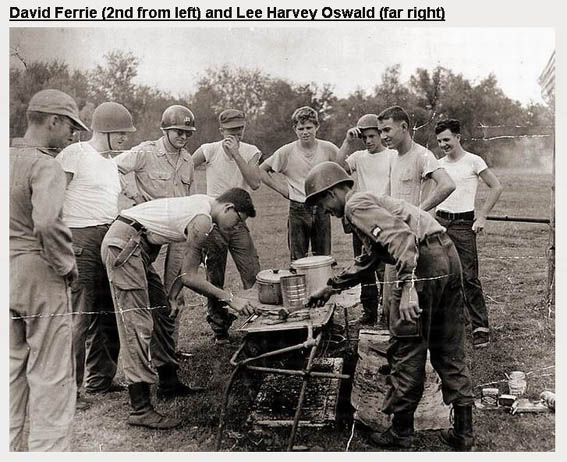
After the Kennedy assassination, David Ferrie told investigators he never knew Lee Oswald. "I never heard David Ferrie mention Lee Harvey Oswald," said Layton Martens, a former C.A.P. Cadet and a close friend to Ferrie until Ferrie's death in 1967
by Joan Mellen
Copyright 2008 Joan Mellen. All Rights Reserved.
(ed note: this essay first appeared on www.joanmellen.com )
Mary FerrellThis talk was delivered on October 5, 2008 at the Wecht Ins ute's Symposium: Making Sense of the Sixties
EXCERPT...
Drawing on what we know as certain, the Oswald who is recognizable to us was born in New Orleans, and seems rarely to have been deprived of the company of others. Certainly, he was not a loner in Dallas where he was offered the friendship of CIA asset and so-called oil geologist (he had no degree in the subject) George de Mohrenschildt. De Mohrenschildt reported to the Domestic Contact Service (00) in Dallas on Haitian matters, the existing record shows. The quintessential unreliable narrator, a year before his death, de Mohrenschildt targeted Haroldson Lafayette Hunt as the sponsor of the Kennedy assassination. Coincidentally, H. L. Hunt was unique among Texas oil men in being a lifelong antagonist of the CIA, as has been his son, Nelson Bunker Hunt. It was, perhaps, de Mohrenschildt’s final Agency assignment.
Nor was Oswald particularly solitary in New Orleans during the summer of 1963 where his presence was noted at anti-Castro training camps north of Lake Pontchartrain.
Almost from the moment of his arrival in New Orleans from Texas in April 1963, Oswald sought the acquaintance of CIA and FBI assets. He attempted to infiltrate anti-Castro groups. By the time he was arrested on Canal Street in August, he was so well acquainted with the FBI field office that he told the officer interviewing him, Lieutenant Francis Martello of New Orleans police intelligence, “Call the FBI. Tell them you have Lee Oswald in custody.” It was a moment that Martello neglected to describe to the Warren Commission which he held in utter contempt until the end of his life, as former police intelligence officer Robert Buras, working for the House Select Committee, and a long-time Martello acquaintance, told me.
Supporting the conclusion that the CIA was behind the Kennedy assassination is the fact that in New Orleans Oswald associated only with people with intelligence connections, beginning with Arnesto Rodriguez, an FBI informant with family members rooted in the CIA’s clandestine services. Rodriguez was one of FBI Special Agent Warren de Brueys’ informants. One day Oswald appeared at Rodriguez’s office at the International Trade Mart building at 124 Camp Street. He wanted to help the Cubans, Oswald said. He wanted to be part of the training camps. Rodriguez was su ious. Who had sent Oswald to him? he wondered. How did Oswald know that there was “a training camp across the lake from us, north of Lake Pontchartrain?” It was top secret at the time, yet Oswald knew about it.
Pilot David Ferrie was a CIA asset whom Oswald knew from his youth in the Civil Air Patrol and with whom he renewed his acquaintance that summer. They were joined in their travels by Clay Shaw, a CIA operative whose activities were charted by at least five CIA components. The sources who observed Oswald with Shaw and Ferrie in those hamlets north of Baton Rouge are unimpeachable, and include Dr. Frank Silva, the medical director of the East Louisiana State Hospital at Jackson where Oswald applied for a job.
Last edited by Nbadan; 11-25-2008 at 03:43 PM.
JAMES WILCOTT'S TESTIMONY
James B. Wilcott, a former CIA accountant, swore in a secret session of the House Select Committee on Assassinations that he was told by other CIA employees that Lee Harvey Oswald was paid by the CIA, and that money he himself had disbursed was for "Oswald or the Oswald project." The HSCA report indicated that other CIA employees discounted Wilcott's testimony, but none of their statements were included in the report. The do ent excerpted below was acquired by John Armstrong after his JFK Lancer NID97 presentation. Selected pages from the National Archives are presented graphically; the remainder, to preserve bandwidth, are excerpted typographically. A link to the complete text of Wilcott's testimony is provided near the bottom of this page.
EXECUTIVE SESSION
ASSASSINATION OF PRESIDENT JOHN F. KENNEDY
WEDNESDAY, MARCH 22, 1978
House of Representatives,
John F. Kennedy Subcommittee
of the Select Committee on
Assassinations,
Washington, D.C.
<. . . . >
TESTIMONY OF JAMES B. WILCOTT, A FORMER EMPLOYEE
OF THE CENTRAL INTELLIGENCE AGENCY:
Mr. Goldsmith. For the record, would you please state your name and address and occupation?
Mr. Wilcott. My name is James B. Wilcott. My address is 2761 Atlantic Street, in Concord, and my occupation is electronic technician.
< . . . . >
Mr. Goldsmith. And, Mr. Wilcott, is it true that you are a former employee with the CIA and that you are here today testifying voluntarily without a subpoena?
Mr. Wilcott. Yes.
Mr. Goldsmith. During what years did you work for the CIA?
Mr. Wilcott. I worked from the years, May, of 1957 to, April, of 1966.
Mr. Goldsmith. And in what general capacity did you work with the CIA?
Mr. Wilcott. All in the finance--in accounting all of the time.
<. . . .>
Mr. Goldsmith. Drawing your attention to the period immediately after the assassination of President Kennedy, at that time, did you come across any information concerning Lee Harvey Oswald's relationship with the CIA?
Mr. Wilcott. Yes, I did.
Mr. Goldsmith. And will you tell the Committee what that relationship was?
Mr. Wilcott. Well, it was my understanding that Lee Harvey Oswald was an employee of the agency and was an agent of the agency.
Mr. Goldsmith. What do you mean by the term "agent?"
Mr. Wilcott. That he was a regular employee, receiving a full-time salary for agent work for doing CIA operational work.
Mr. Goldsmith. How did this information concerning Oswald first come to your attention?
Mr. Wilcott. The first time I heard about Oswald being connected in any way with CIA was the day after the Kennedy assassination.
Mr. Goldsmith. And how did that come to your attention?
Mr. Wilcott. Well, I was on day duty for the station. It was a guard-type function at the station, which I worked for overtime. There was a lot of excitement going on at the station after the Kennedy assassination.
Towards the end of my tour of duty, I heard certain things about Oswald somehow being connected with the agency, and I didn't really believe this when I heard it, and I thought it was absurd. Then, as time went on, I began to hear more things in that line.
Mr. Goldsmith. I think we had better go over that one more time. When, exactly, was the very first time that you heard or came across information that Oswald was an agent?
Mr. Wilcott. I heard references to it the day after the assassination.
Mr. Goldsmith. And who made these references to Oswald being an agent of the CIA?
Mr. Wilcott. I can't remember the exact persons. There was talk about it going on at the station, and several months following at the station.
Mr. Goldsmith. How many people made this reference to Oswald being an agent of the CIA?
Mr. Wilcott. At least--there was at least six or seven people, specifically, who said that they either knew or believed Oswald to be an agent of the CIA.
Mr. Goldsmith. Was Jerry Fox one of the people that made this allegation?
Mr. Wilcott. To the best of my recollection, yes.
Mr. Goldsmith. And who is Jerry Fox?
Mr. Wilcott. Jerry Fox was a Case Officer for his branch, the Soviet Russia Branch, Station, who purchased information from the Soviets.
Mr. Goldsmith. Mr. Wilcott, did I ask you to prepare a list of CIA Case Officers working at the Station in 1963?
Mr. Wilcott. Yes, you did.
<. . . .>
Mr. Goldsmith. At the time that this allegation first came to your attention, did you discuss it with anyone?
Mr. Wilcott. Oh, yes. I discussed it with my friends and the people that I was associating with socially.
Mr. Goldsmith. Who were your friends that you discussed this with?
Mr. Wilcott. George Breen, Ed Luck, and .
Mr. Goldsmith. Who was George Breen?
Mr. Wilcott. George Breen was a person in Registry, who was my closest friend while I was in .
Mr. Goldsmith. Was he a CIA employee?
Mr. Wilcott. Yes, he was.
Mr. Goldsmith. And would he corroborate your observation that Oswald was an agent?
Mr. Wilcott. I don't know.
Mr. Goldsmith. At the time that this allegation first came to your attention, did you learn the name of Oswald's Case Officer at the CIA?
Mr. Wilcott. No.
Mr. Goldsmith. Were there any other times during your stay with the CIA at Station that you came across information that Oswald had been a CIA agent?
Mr. Wilcott. Yes.
Mr. Goldsmith. When was that?
Mr. Wilcott. The specific incident was soon after the Kennedy assassination, where an agent, a Case Officer--I am sure it was a Case Officer--came up to my window to draw money, and he specifically said in the conversation that ensued, he specifically said, "Well, Jim, the money that I drew the last couple of weeks ago or so was money" either for the Oswald project or for Oswald.
Mr. Goldsmith. Do you remember the name of this Case Officer?
Mr. Wilcott. No, I don't.
Mr Goldsmith. Do you remember when specifically this conversation took place?
Mr. Wilcott. Not specifically, only generally.
Mr. Goldsmith. How many months after the assassination was this?
Mr. Wilcott. I think it must have been two or three months after the assassination.
Mr. Goldsmith. And do you remember were this conversation took place?
Mr. Wilcott. It was right at my window, my disbursing cage window.
Mr. Goldsmith. Did you discuss this information with anyone?
Mr. Wilcott. Oh, yes.
Mr. Goldsmith. With whom?
Mr. Wilcott. Certainly with George Breen, the circle of social friends that we had.
Mr. Goldsmith. How do you spell last name?
Mr. Wilcott. (spelling).
<. . . .>
Mr. Goldsmith. Did this Case Officer tell you what Oswald's cryptonym was?
Mr. Wilcott. Yes, he mentioned the cryptonym specifically under which the money was drawn.
Mr. Goldsmith. And what did he tell you the cryptonym was?
Mr. Wilcott. I cannot remember.
Mr. Goldsmith. What was your response to this revelation as to what Oswald's cryptonym was? Did you write it down or do anything?
Mr. Wilcott. No; I think that I looked through my advance book--and I had a book where the advances on project were run, and I leafed through them, and I must have at least leafed through them to see if what he said was true.
Link
The House Select Committee found evidence for conspiracy in the assassination of President Kennedy and recommended to the Justice Department that they re-open the investigation. The incoming Reagan Department of Justice didn't bother.
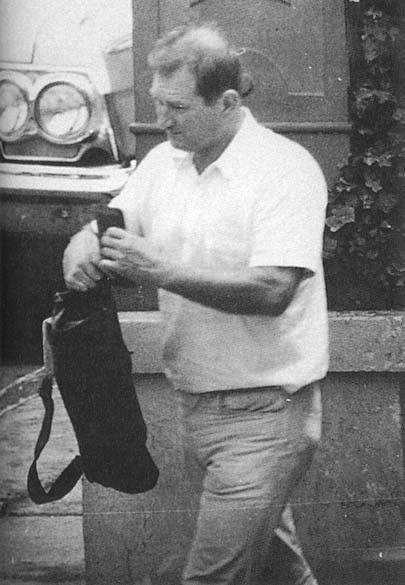
Buell Frazier drove Oswald to work on the day of the assassination....his testimony was central to the case against Oswald...
Oswald co-worker no longer silent about JFK assassination role
Dallas News...Officials assumed that the package Oswald carried to work that morning was the Italian-made rifle he used to kill Kennedy.
Mr. Frazier still doesn't believe it.
When Oswald got in his car that morning, Mr. Frazier hardly noticed the bundle Oswald laid on the back seat.
"He told me he was taking some curtain rods for his room," Mr. Frazier said. "I didn't think much about it."
Mr. Frazier parked his car behind the depository building and revved his engine for a few moments, charging his low battery, and watched Oswald walk about 200 yards into the building with the package under his arm.
In his testimony before the Warren Commission, Mr. Frazier said the brown paper package Oswald carried that morning was too short to contain a rifle. Oswald cupped the package in his hand, he said, and it fit under his armpit.
In Washington, Mr. Frazier said, he was "pressured" to change his recollection. In the days afterward, he was badgered by the media, harassed by people who didn't understand his relationship to Oswald and even became fearful for his life.
His testimony was important because investigators had proved that Oswald bought the rifle used in the JFK slaying and had found a matching palm print on the stock, but they had no proof that he had it with him that day.
Ms. Randle, who was also a leading witness, said recently that when she and Mr. Frazier testified before the Warren Commission, "they tried to get us to say that package was much longer than we recalled, but that wasn't true."
The commission kept pushing, Mr. Frazier said. Could it be that he was traumatized by the horror of what happened or embarrassed that he hadn't been more observant?
"I know what I saw," he said, "and I've never changed one bit."
Size dispute
Hundreds of conspiracy theories have spawned thousands of books and articles since the tragedy, but the official investigation concluded that Oswald shot Kennedy from the Texas School Book Depository and acted alone.
The Warren Commission cited eyewitnesses to the president's shooting and the later assault of Officer J.D. Tippit and knew that Oswald had bought the Mannlicher-Carcano rifle for $12.95 from a Chicago mail-order house.
A brown paper sack with an Oswald palm and fingerprint on it was found close to the sixth-floor window where Oswald sat perched in wait that day.
Oswald's claim that he was carrying curtain rods for his room carried little weight with investigators because no curtain rods were ever found in the depository, and Oswald's room on Beckley Street in Oak Cliff already had curtains.
In a book he's writing, Mr. Frazier describes how he and his sister assembled packages with wrapping paper for hours, trying to show Warren Commission lawyers the size of the package Oswald carried that day.
In its report, released in the fall of 1964, the commission said:
"The Warren Commission has weighed the visual recollection of Frazier and Mrs. Randle against the evidence here presented ... and has concluded that Frazier and Randle are mistaken as to the length of the bag."
The FBI lab reported that the disassembled rifle stock measured just under 35 inches long, and the homemade bag measured 38 inches.
"I wasn't surprised," Mr. Frazier said. "They seemed to have a prearranged agenda when they questioned Linnie and me. Our refusal to agree with their agenda simply caused them to state that we were mistaken."
Their testimony fostered early public doubt about the commission's investigation.
President Gerald Ford, who in 1963-64 was a Michigan congressman and a Warren Commission member, told reporters in Dallas in early 1964 that he thought Mr. Frazier had been mistaken.
"I don't believe for a moment that he was consciously lying," Mr. Ford said then. "This is a fine young man – I've talked to him – who recalls seeing an object a certain size. But if Oswald was carrying curtain rods, as Mr. Frazier claimed he told him, I am a bit confused as to what happened to them."
Mr. Ford told a Dallas Morning News reporter that day: "I have never believed Mr. Frazier was involved in anything more than being a good neighbor, a good friend. I don't think he even knew Oswald very well."
Actually, Mr. Frazier said, "I didn't know his last name until that day. We all just knew him as Lee. I thought that was his last name."
The CIA told the Warren Commission that they had photos of Lee Harvey Oswald at the Cuban embassy.
This is the fellow in their photos, a guy who apparently caused a commotion about his intentions to head to the Soviet Union:
Oswald, the CIA and Mexico City
By John Newman, Ph.D.
Copyright ©1999 by John Newman.
All Rights Reserved.
I. The Rosetta Stone
CONTINUED...The Assassination Records Review Board finished its search more than a year ago—a search for records relating to the murder of a president thirty-six years ago. Surprisingly, the passage of time has not managed to erode or cover over all of the important evidence. On the contrary, the work of the Review Board has uncovered important new leads in the case. I will leave medical and ballistic forensics to others. I will confine myself to do ent forensics, an area for which the work of the board had been nothing less than spectacular. More specifically, I will confine myself to the do entary record concerning Lee Harvey Oswald’s 1963 visit to Mexico City.
In 1978, the House Select Committee on Assassinations (HSCA) completed its work, including a report on Oswald’s activities in Mexico written by Eddie Lopez and Dan Hardway. Our first glimpses of their report began shortly after the 1993 passage of the JFK Records Act. Not even all the redactions of those early versions could hide the seminal discoveries in that work. While Lopez couched his words in careful language, he suggested that Oswald might have been impersonated while he was in Mexico City just weeks before the assassination. Lopez was more forthright when I interviewed him about this in 1995. Armed with more CIA do ents and the first Russian commentary (Nechiporenko’s book, Passport to Assassination), I went further in my own Oswald and the CIA (Carroll & Graf: 1995) in advancing the argument that Oswald was impersonated in the Mexican capitol. Specifically, someone pretending to be Oswald made a series of telephone calls between 28 September and 1 October, allegedly to and from the Cuban and Soviet consulates in Mexico City.
I concluded then, that, based on the content of the CIA Mexico City telephone transcripts alone, the speaker purporting to be Oswald was probably an impostor. I will not repeat my lengthy discussion here, other than to summarize it in this way: the speaker’s words were incongruous with the experiences we can be reasonably certain Oswald underwent. For reasons still obscure, the CIA has lied consistently for these past several decades about the tapes from which those transcripts were made. The Agency concocted the story that the tapes were routinely destroyed before the assassination. It is perhaps true that some tapes were destroyed before the assassination. But Lopez uncovered FBI do ents containing detailed accounts of how two of the tapes were listened to after the assassination by FBI agents familiar with Oswald’s voice.
More evidence would come in time. Shortly after the passage of the JFK Records Act, the public gained access to a telephone transcript the day after the assassination in which FBI Director Hoover informs President Johnson that it is not Oswald’s voice on the tapes. The Review Board diligently followed these leads and settled the matter when they found CIA do ents in which the Agency itself explicitly states that some of the tapes were reviewed after the assassination. The CIA’s continued silence on the matter of the tapes stands, like a giant beacon, pointing the way forward to the investigator. The impersonation of Oswald in Mexico by someone who drew attention to an Oswald connection to a KGB assassination officer may prove to be the Rosetta stone of this case.
Before going further, I once again pay tribute to Peter Dale Scott, who wrote of these matters as early as 1995, advancing his "Phase I-Phase II hypothesis" on largely deaf ears. I will not repeat his lengthy discussion here, other than to summarize it in this way: In Phase I, immediately after the assassination, previously planted evidence of a Cuban/Kremlin plot surfaced in Oswald’s files; this, in turn, precipitated Phase II, in which a lone-nut cover-up was erected to prevent a nuclear war.
In Oswald and the CIA, I deliberately steered clear of the conspiracy-anti-conspiracy vortex in order to set out some of the facts concerning Oswald’s pre-assassination files. Since then, the ulative weight of the evidence uncovered by the Review Board has led me to the conclusion that the Oswald impersonation can best be explained in terms of a plot to murder the president. I remain open to other interpretations and fresh analyses by fellow researchers, and I understand that new evidence could corroborate or undermine this hypothesis. What follows is a first stab at explaining, in a short and simple way, how those plotting the president’s murder may have left their fingerprints in the files.

Just tell us who did it.
Who benefited most from the assassination?
The publisher of this, Ford's final book and who helped author the text, does believe there was a conspiracy and that Ford knew even more than he told his publisher and the world. Ford admits here for the first time that the CIA "did" destroy pertinent do ents, covering up the investigation of the assassination. Ford shares many other breath-taking admissions with the reader in this, his final book, written three years prior to his own death.
I seem to remember a clip of the author on cable news stating that Ford told him, while on his deathbed, that LBJ was involved in the conspiracy. Personally, I think Ford might have said this to draw attention away from Nixon.
Another interesting excerpt from the book:
Link"I completely replaced cabinet and staff. You may recognize some of my appointees:
George H.W. Bush - Director, CIA
Richard Cheney - Chief of Staff
Donald Rumsfeld - Secretary of Defense
Alan Greenspan - Chairman, Council of Economic Advisors"
It's like what Lenin said . . .
(I am the Walrus)
So Ford's publisher killed JFK.
The DEATH of DOROTHY KILGALLEN
A Key Chapter from "Justice For JFK"
by Robert D. Morningstar
LinkOn November 8, 1965, Dorothy Kilgallen, was found dead in her apartment shortly after returning from Dallas where she had interviewed Jack Ruby and had conducted her own investigation of the JFK murder during several trips to cover the Ruby trial.
She had revealed secret transcripts of Ruby's testimony in her column. Kilgallen had met with Ruby. She had learned of a meeting three weeks before the assassination at Ruby's "Carousel", the Dallas underworld's merry-go-round where the "Big D" mobsters wheeled around.
(snip)
Lee Israel, author of "Kilgallen", reports that that Ruby, himself a TV fan of Dorothy Kilgallen, had taken a liking to her during the trial. According to Israel, he respected her more than any other reporter. She had gained his confidence and had several conversations with him in the courtroom. She was given a five minute session alone with Ruby. Some writers have stretched this to a half-hour, others deny it.
Regardless, it is a fact that when Dorothy returned to New York, she told friends that she had discovered that Ruby and the slain Officer J.D. Tippit had been friends. They had been seen together in Ruby's Carousel Club at a meeting 2 weeks before the assassination in the company of Bernard Weissman, who had placed the "JFK-Wanted for Treason" newspaper ad in Dallas newspapers on November 22nd, 1963. Studying the Warren Commission Report, Killgallen deduced that the meeting had also been reported to Chief Justice Warren AND that the iden y of "the fourth man",which she had been unable to ascertain, had been reported to Warren as "a rich Texas oil man", as Earl Warren described him in the official transcript.
She told Israel that she had discovered something that was going to break the whole JFK assassination mystery wide open. She told the same story to her next door neighbor, her hairdresser, her agent, her publisher, and the producer and host of "Nightlife".
(snip)
On Sunday November 8, Dorothy Kilgallen was found dead, sitting fully dressed, upright in bed, early in the morning. The New York City Police investigated and the coroner found that Dorothy Kilgallen had died from ingestion of a lethal combination of alchohol and barbituates. All her notes and the article on which she had been working to "blow the JFK assassination wide open" also disappeared.
Here's video of two shooters, one of whom fired the fatal shot:
Evidence of Revision (1 of 5) : The Assassinations of Kennedy and Oswald
http://video.google.com/videoplay?do...rt+1+jfk&hl=en
One shooter is shown at the 18 minute mark, the other after the 19 minute mark.
I have a question for Galileo and Dan,
Has anything involving the United States Government ever just been the truth? Have they ever once told us the truth about a single monumental event in United States History?
If so, which one(s)?
James Madison told the truth about the War of 1812. Grover Cleveland told the truth when he issued his veto statements. Congressman Ron Paul tells the truth about everything.
Madison greatly exaggerated the severity in which the British Navy was capturing American vessels.
Cleveland was drunk and his advisors issued those statements.
See, anyone can just come up with by making up stories.
There are currently 1 users browsing this thread. (0 members and 1 guests)
 Posting Permissions