Think the Job Market Still Stinks? You’re Right
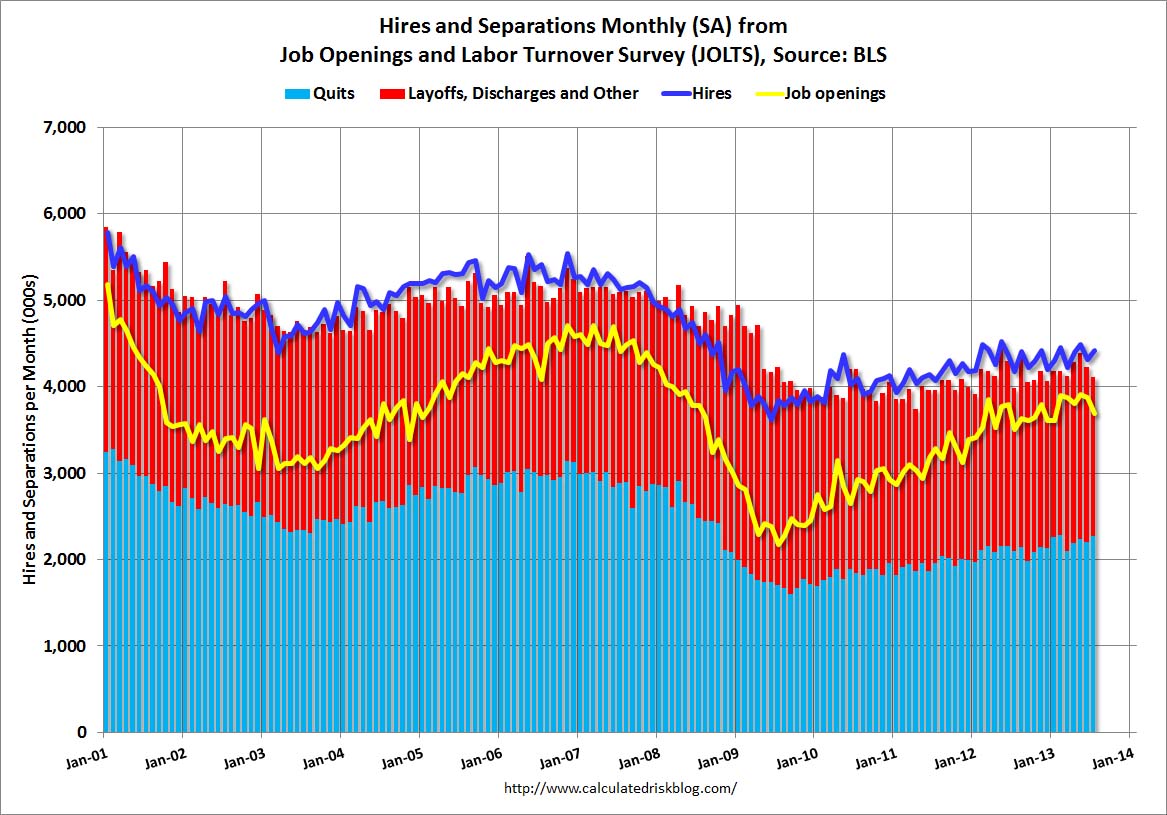
The JOLTS data are a regular reminder that there is always a great deal of “churn” in the labor market.… Over the last year, an average of 4.3 million workers were hired every month and an average of 4.2 million workers either left their jobs voluntarily or were laid off every month. These hires and separations numbers, however, are currently very low; when the labor market is stronger, there is much more churn. For example, in 2006 and 2007, there were 5.3 million people being hired and 5.1 million people separating from their jobs (i.e., leaving their jobs or being fired) each month on average.The reason the rate is so low? People are afraid to quit their jobs, and employed people looking for greener pastures are having trouble finding them. So the churn stalls.
In 2006 and 2007, nearly 3 million workers voluntarily quit their jobs each month. That dropped to a low of 1.6 million in September 2009. It has since increased somewhat, but is still extremely low. In June, 2.2 million workers voluntarily quit their jobs, a decline of 73,000 from May. Because leaving a job for a better opportunity can be an important way for workers to advance, this persistent depressed rate of voluntary quits represents millions of lost opportunities.
The new number for July: 2.3 million quit their jobs, a slight uptick but still well below the pre-recession rates. According to EPI, another section of the JOLTS report reveals a frustrating truth. “In today’s economy, unemployed workers far outnumber job openings in every major sector. … This demonstrates that the main problem in the labor market is a broad-based lack of demand for workers—not, as is often claimed, available workers lacking the skills needed for the sectors with job openings.”
http://www.truthdig.com/eartothegrou...s_youre_right/
... but the Repugs say the Welfare Queens mooching of public assistance, living high, are lazy, even criminal, and won't go get one of those Ms of jobs widely available for the asking, so the Repugs plan to cut public assistance.


Good trend

how do you know the real rate when people cant even get benefits?
then there are clowns who cant qualify cause they have excess savings till its nil, then they can qualify for benefits..
how about those with plenty of investments making them money when they are unemployed, they cant access the benefits...

so in Feb the unemployment rate was 4.9%. Libs will credit Obama and right wingers will say that the it false because one only has to work 15 hours a week to be considered employed vs 30 hours a week when Bush was in office. Did the full time hours change?
30hrs is full time in america? wtf
thought it was 38hrs-40hrs...
https://krueger.princeton.edu/sites/...h_29_20165.pdfA striking implication of these estimates is that all of the net employment growth in the U.S. economy from 2005 to 2015 appears to have occurred in alternative work arrangements. Total employment according to the CPS increased by 9.1 million (6.5 percent) over the decade, from 140.4 million in February 2005 to 149.4 in November 2015. The increase in the share of workers in alternative work arrangements from 10.1 percent in 2005 to 15.8 percent in 2015 implies that the number of workers employed in alternative arrangement increased by 9.4 million (66.5 percent), from 14.2 million in February 2005 to 23.6 million in November 2015. Thus, these figures imply that employment in traditional jobs (standard employment arrangements) slightly declined by 0.4 million (0.3 percent) from 126.2 million in February 2005 to 125.8 million in November 2015.

It was historically 40 until the ACA redefined it as anyone over 30. The actual effect was some employees that had been"part time" getting 30+ hours a week got cut back to 28 hours a week to keep the part time classification. This was especially prevalent in retail jobs.
class war commies at Commentary:
https://www.commentarymagazine.com/a...-21st-century/For an apples-to-apples look at America’s 21st-century jobs problem, we can focus on the 25–54 population—known to labor economists for self-evident reasons as the “prime working age” group. For this key labor-force cohort, work rates in late 2016 were down almost 4 percentage points from their year-2000 highs. That is a jobs gap approaching 5 million for this group alone.
It is not only that work rates for prime-age males have fallen since the year 2000—they have, but the collapse of work for American men is a tale that goes back at least half a century. (I wrote a short book last year about this sad saga.2) What is perhaps more startling is the unexpected and largely unnoticed fall-off in work rates for prime-age women. In the U.S. and all other Western societies, postwar labor markets underwent an epochal transformation. After World War II, work rates for prime women surged, and continued to rise—until the year 2000. Since then, they too have declined. Current work rates for prime-age women are back to where they were a generation ago, in the late 1980s. The 21st-century U.S. economy has been brutal for male and female laborers alike—and the wreckage in the labor market has been sufficiently powerful to cancel, and even reverse, one of our society’s most distinctive postwar trends: the rise of paid work for women outside the household.
In our era of no more than indifferent economic growth, 21st–century America has somehow managed to produce markedly more wealth for its wealthholders even as it provided markedly less work for its workers. And trends for paid hours of work look even worse than the work rates themselves. Between 2000 and 2015, according to the BEA, total paid hours of work in America increased by just 4 percent (as against a 35 percent increase for 1985–2000, the 15-year period immediately preceding this one). Over the 2000–2015 period, however, the adult civilian population rose by almost 18 percent—meaning that paid hours of work per adult civilian have plummeted by a shocking 12 percent thus far in our new American century.
link?
In Dreamland, his harrowing and magisterial account of modern America’s opioid explosion, the journalist Sam Quinones notes in passing that “in one three-month period” just a few years ago, according to the Ohio Department of Health, “fully 11 percent of all Ohioans were prescribed opiates.” And of course many Americans self-medicate with licit or illicit painkillers without doctors’ orders.
In the fall of 2016, Alan Krueger, former chairman of the President’s Council of Economic Advisers, released a study that further refined the picture of the real existing opioid epidemic in America: According to his work, nearly half of all prime working-age male labor-force dropouts—an army now totaling roughly 7 million men—currently take pain medication on a daily basis.
It's much more difficult to legally abuse hydrocodone than it used to be. They have pretty much fixed Dr. shopping with cross check data bases.

Welcome back from rehab
Seriously, I go to a pain specialist and we were just discussing last week how the state data base now prevents doctor shopping.
Did you tell him you like to wash them down with a 6 pack?
Not really a problem with only one or two but thanks for asking.
I know, was just joking.

I always pictured you as a hookers and blow kind of guy CC.
There are currently 1 users browsing this thread. (0 members and 1 guests)
 Posting Permissions


 Reply With Quote