Page 2 of 2 FirstFirst 12
Results 26 to 38 of 38
  1. #26
    NB:lol Luck_The_Fakers_Luck_The_ Fakers_Luck_The_Fakers_Lu ck_The_Fakers_Luck_The_Fa kers_ 21_Blessings's Avatar
    My Team
    Los Angeles Lakers
    Post Count
    6,765
    Someone post the Lakers forcast

  2. #27
    Banned
    My Team
    Los Angeles Lakers
    Post Count
    7,194
    Originally Published: September 28, 2009
    2009-10 Forecast: Los Angeles Lakers

    As the Lakers go for another ring, will Ron Artest seal the deal or seal their fate?


    Comment Email Print Share

    By John Hollinger
    ESPN.com
    Archive


    Jesse D. Garrabrant/NBAE/Getty ImagesNo. 24 ended 2008-09 on top of the basketball world once again, having won ring No. 4. Next: No. 5.
    GO TO: 2008-09 Recap Offseason Moves Biggest Strength/Weakness Outlook


    2008-09 Recap

    Is there an opposite of "team of destiny"? The Los Angeles Lakers won 65 regular-season games and needed five games in the NBA Finals to cruise to the championship, but at no time did it feel preordained. In fact, for much of their playoff run the focus was more on the Lakers' problems -- the struggles of Andrew Bynum and Derek Fisher, the lack of toughness that derailed them a year earlier against the Boston Celtics, and a couple of woeful efforts in the second round against Houston.
    And despite the white-hot spotlight that glared on the league's most popular team, Boston and the Cleveland Cavaliers stole a lot of the Lakers' limelight during the regular season. For their part, the Lakers didn't really look like champions until the fifth game of the conference finals … at which point they won six out of their next seven to storm to the crown.
    The Lakers also threw us off their championship scent with an embarrassing showing in Games 4 and 6 of the Houston Rockets series. Despite playing without Yao Ming, Houston exposed every L.A. weakness -- complacency, softness, lack of quickness at the point guard spot, and shot selection in the backcourt -- en route to a pair of lopsided wins.
    In a way, perhaps the Lakers should thank the Rockets. Seeing such a harsh light shone on those weaknesses seemed to compel L.A. to address them, and the sloppy play magically cleaned itself up over the final month. Shannon Brown cemented the guard rotation, Kobe Bryant and Derek Fisher stopped forcing the action, and the Lakers benefited from not having to face a point guard with Aaron Brooks' quickness the rest of the postseason.
    HOLLINGER'S '08-09 STATS

    W-L: 65-17 (Pythagorean W-L: 63-19)
    Offensive Efficiency: 109.8 (3rd)
    Defensive Efficiency: 101.9 (5th)
    Pace Factor: 96.7 (7th)
    Highest PER: Kobe Bryant (24.46)


    Additionally, history should have taught us that second-round struggles are a common problem for eventual champions. As I noted at the time, the Lakers are the seventh straight champion to hit a major speed bump in the second round, and surviving those scrapes seemed to propel them toward the championship rather than slow their progress.
    That was certainly the case for L.A. But before it could reach that point, a number of events needed to happen to push them to 65 wins and a top seed in the Western Conference. For starters, Lamar Odom accepted a bench role, moving from small forward to power forward in the process. That move netted two huge, positive effects for the Lakers. First, it allowed L.A. to use a devastating three-man frontcourt rotation of Gasol, Bynum and Odom that few opponents could battle. Second, it permitted Trevor Ariza -- filched from Orlando in a trade the previous season -- to move into the starting lineup and solidify the small forward spot.
    Less well do ented is perhaps the greatest salary dump in franchise history. The Lakers are more renowned for ac ulating payroll than shedding it, but it was their divestment of the Vladimir Radmanovic mistake that reaped rewards this time. Guard Shannon Brown, included as a throw-in from Charlotte, provided much-needed stability as a backcourt reserve and hit some huge shots in the playoffs -- most notably when he turned the tide in the crucial Game 5 of the conference finals with an earth-shattering third-quarter dunk.
    Brown's addition helped the Lakers overcome two major disappointments -- the off year from Jordan Farmar and the inability of Bynum to come back at full strength from a midseason injury.
    Slated as the heir apparent to Fisher at the point, Farmar suffered a nightmare season and was largely out of the rotation by the playoffs. As for Bynum, he played extremely well early in the season, a performance that made L.A. notably stronger at the defensive end over the first half of the season. But for the second year in a row a midseason knee injury threw him off stride. While he returned in the postseason, Bynum proved ineffective until the Finals and never regained the All-Star caliber form he'd shown earlier in the season.
    The fact L.A. won the le despite huge setbacks from its two most prominent young players is a testament to the depth and quality of the Lakers' talent. With Bryant and Gasol, the Lakers were a fearsome offensive team even when others struggled, as evidenced by their third-place finish in offensive efficiency.
    Unusually for a dominant offensive team, L.A. wasn't particularly good at long-range shooting. The Lakers nailed only 36.1 percent of their 3-pointers, a bit below the league average, and didn't attempt the shot with great frequency.
    Instead, L.A. overwhelmed its opposition two points at a time. L.A. claimed the league's fifth-lowest turnover rate and, thanks to the size advantage in the frontcourt, it's third-best offensive rebound rate. As a result, only two teams averaged more shot attempts per possession. Additionally, they were potent shooters inside the arc -- L.A. converted 50.5 percent of its two-point shots, again finishing third in the league. While primarily an offensive team, the Lakers demonstrated an improved defense as well. They ranked fifth in defensive efficiency, with exquisite 3-point defense being their primary calling card.
    The Lakers held opponents to only 34.5 percent shooting from the arc, which was the third-best mark in the NBA. They further amplified the impact by convincing opponents to fire from distance -- only three teams allowed a higher rate of 3-pointers per field-goal attempt. While normally that's a bad sign, because L.A. defended the 3 so well, it turned into a positive. In fact, their opposition had a better true shooting percentage inside the arc, which is unusual.
    This appeared to be part of a larger defensive strategy by L.A. -- they'd let opponents fire 3s off the dribble on pick-and-rolls, and keep their big men back to protect the basket. Some quick guards were able to take advantage, but many opponents shot themselves out of the game trying. Like most of Phil Jackson's gambits, it worked, and as a result he won a record-setting 10th championship. That wouldn't have shocked anybody if you'd told them before the season, but for much of the spring it seemed they were on a very different path.


    Offseason Moves

    It's a bit much to call the Lakers fiscally "conservative" -- they're probably going to have the league's highest payroll this season, and their willingness to s out $15 million more in luxury tax was what made the 2008 heist of Pau Gasol possible.
    But for a world champion team that is pulling in revenue by the fistful, L.A. definitely shows caution with marginal payroll increases. In addition to last winter's salary dumps of Radmanovic and Chris Mihm, the Lakers held the line in contract negotiations with three rotation players this summer and avoided trades that would take on additional salary.
    Let Trevor Ariza go, signed Ron Artest for five years, $34 million. This was the biggest roll of the dice in the Lakers' summer. They didn't want to pay Ariza more than the midlevel exception and turned to Artest when they couldn't agree on a deal with Ariza. While the risk of paying Artest for five years is huge -- nobody knows what he'll do five minutes from now, let alone five years -- L.A.'s willingness to venture into the tax makes it better able to withstand the risk than most.
    The Lakers also benefit in a couple of other ways from this deal. First, Artest is capable of playing the 4, which adds to the Lakers' lineup options. Second, he's a much better spot-up shooter than Ariza -- Artest hit 39.9 percent on 3s last season, while Ariza is at 29.9 percent for his career. Ariza's hot shooting from the corners in the playoffs last season convinced some people that he's a good long-range threat, but history says he's not.
    Obviously, this comes with some risks, too. Artest is half a decade older than Ariza, isn't nearly as good a finisher, and may submarine the offense if he isn't willing to become L.A's fourth option. And of course, he's Ron Artest. But the Lakers weren't likely to repeat if they stood pat given the arms race going on in the East, and Artest is unquestionably the league's most qualified player to defend LeBron James one-on-one -- a salient point given the likelihood of facing Cleveland in the Finals.
    Re-signed Shannon Brown for two years, $4 million. This was a fair value deal for a great bench energizer in last season's playoff run. Brown had never played well before so he couldn't command the salary he might have as a more proven quan y, but he's a solid insurance policy against flameouts by Fisher and/or Farmar.
    Re-signed Lamar Odom for four years, $33 million. This was unquestionably the biggest story of the summer in L.A., as the two sides briefly walked away from the negotiating table when the Lakers wouldn't meet Odom's number. This would have proven hugely costly if Odom had been willing to relocate, because L.A. had no way to replace his spot under the salary cap rules. Fortunately, it turned out to be a great poker move by the Lakers. Odom loves Southern California and desperately wanted to return, so he ended up agreeing to a very favorable deal for L.A. The fourth year is a team option at a lower number than the first three, giving the Lakers a great deal of salary flexibility as they move into the future.
    Drafted Chinemelu Elonu. The late second-round choice was a stow-away pick and is almost certainly headed for Europe. His name is better than his game -- he's a project forward who may be heard from in a couple years, if ever.


    Biggest Strength: Frontcourt

    Sure, they have Kobe Bryant, and that's enough of an advantage on many nights. But the advantage that doesn't get enough attention is the Lakers' size and quality up front. A lot of teams just can't deal with L.A. because of the size of Bynum and Gasol up front. Bynum is the big bruiser who occupies the opponent's biggest post defender, with the Lakers frequently using him to register first-quarter body blows in the post before turning things over to Bryant and Gasol.
    Although Bynum's presence often forces Gasol to play away from the basket, it also allows the 7-footer to feast on size mismatches against smaller 4s. Additionally, it spares Gasol the physical pounding of being a full-time center and instead lets him indulge in the finesse game that he plays so well.
    And then there's the change of pace with Odom. The few opponents who have the size to deal with Gasol and Bynum rarely have a big man who can match up against Odom farther from the hoop. His ability to take bigger players off the dribble provides an offensive staple for the second unit, and on some nights creates even more mismatches than the Gasol-Bynum starting combo.


    Biggest Weakness: Point Guard

    The Lakers are rock solid at four of the five positions, but point guard remains a major question mark. While Fisher righted his ship enough to hit some big shots in the conference finals and NBA Finals, he was brutal for the first half of the playoffs and wouldn't start for most of the league's teams. L.A. was fortunate to avoid quick point guards in the final two rounds last season, but playing in a conference with the likes of Chris Paul and Tony Parker means they may not be spared such a fate in this go-round.
    Brown was the best of the Lakers' three point guards in the postseason, but he's also the least accomplished, careerwise, and is more of a 2 than a 1. He's a nice stopgap to have off the bench, but he's nobody's idea of a long-term starter at the spot.
    That leaves Farmar, who's undeniably the most talented of the three despite a horrid campaign last season. He's the one Laker with the quickness to defend the speedy guards that give L.A. problems, but he'll have to improve his focus and technique and, above all, he has to make more shots.


    Outlook

    Despite the fact that Orlando and Cleveland spent the summer arming up while L.A. largely stood pat, the Lakers have an excellent chance to repeat as champions. They won 65 games and a le a year ago despite Bynum's and Farmar's struggles; if those two recover and the others hold steady, the Lakers could be phenomenal. Bynum, in particular, presents the prospect of a big performance jump if he can just stay on the court for the whole season.
    Of course, while other teams would kill to have the Lakers' problems, it's worth noting that they do have some warts. For instance, Bryant is 31 and his free-throw rate dropped precipitously last season, Fisher is 35 and his two backups don't inspire waves of confidence, Bynum has missed nearly as many games as he's played the past two campaigns and Artest is on another planet.
    That said, the Lakers are an overwhelming favorite to win the West, especially since the other perennial contenders have fallen off the past two years. I'm projecting them to prevail by a whopping 10 games, so even if some players fall well short of my estimates, they should still finish as the conference's top playoff seed.
    For a second year in a row, the Lakers also may benefit from their Finals opponent. Last season they got a break with a Jameer Nelson being hampered for Orlando, after he was one of many quick point guards who riddled the Lakers' defense in the regular season. This time around they may benefit again -- Nelson is back, but I'm projecting Cleveland to meet L.A. in the Finals. With Artest in tow, the Lakers couldn't possibly match up better against the Cavs, which means Phil Jackson may be able to break out his "XI" hat next June.


    Prediction: 65-17, first in Pacific Division, first in Western Conference

  3. #28
    Banned
    My Team
    Los Angeles Lakers
    Post Count
    7,194
    Originally Published: September 28, 2009
    2009-10 Forecast: Golden State Warriors

    The Warriors could contend for a playoff spot … as long as no one's traded first


    Comment Email Print Share

    By John Hollinger
    ESPN.com
    Archive


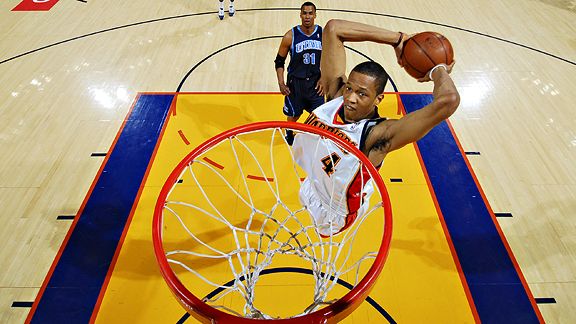
    Rocky Widner/Getty ImagesAnthony Randolph showed tremendous promise when Don Nelson actually gave him a chance to play.
    GO TO: 2008-09 Recap Offseason Moves Biggest Strength/Weakness Outlook


    2008-09 Recap

    There's nothing golden about this state of affairs. Ambushed by injuries and bleeding internally from divisions in the front office, the Warriors limped home to a disappointing 29-win season that continued the NBA's most miserable playoff streak -- the Warriors have qualified just once in the past 15 seasons. Even the sad-sack Clippers have managed twice as many playoff appearances in that time span.
    Certainly last season's Warriors would have won more if not for the injuries. The projected perimeter trio of Monta Ellis, Stephen Jackson and Corey Maggette missed a combined 111 games, while center Andris Biedrins missed another 20. Thanks to assorted other nicks and scrapes, only three Warriors played more than 67 games.
    That said, much of the damage in Golden State was self-inflicted. Divisions between general manager Chris Mullin and team president Robert Rowell spread into the open, with Rowell -- who previously had never made the basketball decisions -- negotiating a pointless, cap-killing extension for Jackson on his own while excluding Mullin from important decisions.
    Head coach Don Nelson, meanwhile, played his own games. He inactivated Al Harrington at the start of the season, essentially sidelining one of his most productive players over a personality conflict (not the first time this has happened with Nelson and a talented Golden State power forward). Eventually Golden State sent Harrington to New York for Jamal Crawford, who impressed Nelson so much that he publicly implored Crawford to opt out of his contract and sign someplace else.
    HOLLINGER'S '08-09 STATS

    W-L: 29-53 (Pythagorean W-L: 30-52)
    Offensive Efficiency: 106.6 (T-11th)
    Defensive Efficiency: 110.1 (28th)
    Pace Factor: 101.0 (1st)
    Highest PER: Andris Biedrins (19.16)


    Nelson seemed determined to avoid using Mullin's draft picks as well. He kept Brandan Wright locked away at the end of the bench despite his undeniable production when he played and engaged in similar tactics with rookie Anthony Randolph for half the season. Instead of playing those two power forwards, Nelson remained wedded to an odd-ball, small lineup strategy that often saw 6-6 wings Maggette and Kelenna Azubuike masquerading as power forwards. Nearly everyone on the roster saw his playing time yo-yo back and forth with little rhyme or reason, even on the rare occasions when injuries didn't reset the rotation.
    Pace factor leaders, 2008-09

    Team Pace Golden State 100.9 New York 98.9 Indiana 98.9 Phoenix 98.2 Sacramento 96.8 League average 94.1

    In sum, it was a wild mess. Golden State ran at every opportunity and permitted opponents to do the same, resulting in far and away the league's fastest pace (see chart). That pace also led the Warriors to overrate their own players. Jackson, for instance, is a 20-point scorer if he's playing 39 minutes a game at this frenetic pace, but let the air out and he's a pretty ordinary performer. The Warriors failed to do that, and instead gave a three-year, $28 million extension to a player who will be 36 by the time the deal ends. Similarly, they were so taken with Ellis' 20.2 scoring average a season earlier that they inked him to a $66 million deal.
    The Warriors' frequent small-ball experiments enabled them to push the pace to such extremes, but they also left them badly undersized. The size issue largely explains their pathetic work on the defensive glass. Golden State retrieved only 68.1 percent of opponent missed shots, easily the league's worst percentage. Before a shot went up the Warriors were close to being a league-average defense, as they didn't allow an overwhelming shooting percentage and defended the 3-point line well. But the second shots were killers, dragging them to 28th in defensive efficiency.
    Worst defensive rebound pct., 2008-09

    Team Def. Rebound % Golden State 68.1 Sacramento 69.9 Chicago 70.9 L.A. Clippers 71.2 Washington 71.4 League average 73.3

    If you looked hard enough, there were some encouraging signs along the way. Randolph showed tremendous promise when he got more late-season minutes, undrafted rookie Anthony Morrow left an impression as a sharpshooter off the bench, second-year pro C.J. Watson established his career with a strong season, and Ellis came back from a mo-ped wreck to play 25 late-season games. Golden State managed an encouraging 12-13 mark with Ellis in the lineup, albeit against a fairly tame stretch of schedule with 16 home games.
    But the story on the court took a backseat to the palace intrigue. Nelson received a two-year extension for so ably leading his team back to the lottery, while confidante Larry Riley was installed as the team's new general manager. It remains to be seen whether Rowell will move back to the business office or whether he now fancies himself a talent evaluator, or if the infamously cantankerous Nelson will move on to battle Rowell after the two of them teamed up to dispatch Mullin.
    Looming in the background, meanwhile, are rumors that secretive owner Chris Cohan might finally sell the team and put it under more capable management. Warriors fans -- a bunch that remains shockingly abundant despite the team's numerous failures -- can only dream.


    Offseason Moves

    With a young team and some luxury tax concerns going forward, the Warriors sat out the free-agent market, with their only major deals involving dumping salaries. This being Golden State, we still had drama. Jackson publicly demanded a trade (thanks for the extension, suckas), which subsequently led to a fine by the league's fun police. Entering the season the Warriors appeared in no hurry to deal him and Nelson said he'd remain a captain.
    Drafted Stephen Curry. The sharpshooter from Davidson will fit into Nelson's basic philosophy of shooting lots of 3s and worrying about defense later, and therein lies the concern. If Golden States plans to pair him in the backcourt with Ellis, one or the other will pose a major defensive liability against opposing shooting guards. Curry is a combo guard who should thrive offensively in this system and almost certainly offered the best value on the board when the Warriors chose, but much of what he provides already exists on the roster.
    Traded Jamal Crawford to Atlanta for Speedy Claxton and Acie Law. Golden State dumped nearly $19 million in salary over the next two years on the Hawks in return for two players who are unlikely to play much, if at all. Should Law develop as a shooter, the Warriors could use him as a third point guard, but there's little reason to believe that will happen based on his first two seasons.
    Traded Marco Belinelli to Toronto for Devean George and cash. Here's what has to worry you if you're Anthony Randolph or Stephen Curry -- the Warriors have run five of the preceding seven first-round draft choices out of town. Belinelli joins Patrick O'Bryant, Ike Diogu, Mickael Pietrus and Jiri Welsch as Warriors who didn't make it to their second contract, with all but Pietrus traded prior to their expiration. Only Andris Biedrins and Brandan Wright have stuck around, and in Wright's case it may not be for long.
    Belinelli was another salary dump despite a fairly encouraging second season, as the Raptors included enough money to pay George's contract. George himself is likely to be of little value, even with Nelson's love of small-ball power forwards, as his play declined precipitously last season.
    Re-signed C.J. Watson for one year, $1 million. Watson reluctantly took the Warrior's qualifying offer after failing to find an acceptable deal on the open market as a restricted free agent. It's great value for a productive backup point guard and provides a good fallback plan should Curry prove unready, but Watson has basically signaled that he's outta here after this one season.
    Signed Mikki Moore for one year for the veteran's minimum. This one is a head scratcher. Moore turns 34 the first week of the season, he was brutally awful last season, and the Warriors already have a surplus of string-bean power forwards. How does this move fit in with a rebuilding team?
    Traded two second-round picks to New Jersey. The Warriors sent the picks to the Nets to delay having to give New Jersey a first-rounder from the 2008 Marcus Williams trade until at least 2012. The deal gives Golden State trade flexibility to include their 2010 first-round pick in a trade -- the league prohibits trading draft picks in consecutive years. Also, if you're keeping track, they've now traded two seconds and a first to New Jersey for a player Nelson wanted to cut within 30 seconds of his arrival.


    Biggest Strength: One-on-One Scoring

    The Warriors are very difficult for opposing defenses to match up against because they have so many capable one-on-one scorers. It starts at the point: If Ellis bounces back at full strength from his injuries, he'll be a handful due to his outstanding quickness and capable midrange shooting. On the wings, Maggette is one of the most effective drivers in basketball, earning a steady stream of free throws when he's not putting it in the basket, while Jackson is a dangerous scorer who can shoot from long range or attack the basket off the dribble.
    Coming behind them is a second wave of scorers who are nearly as capable. Azubuike is a good outside shooter who can physically overwhelm smaller wings down low, Curry is a deadly long-range marksman, Watson is a competent outside shooter off the dribble, and Morrow not only spots up but can hit shots off the dribble in pick-and-rolls.
    Up front, Biedrins is a proven expert at taking slower centers off the dribble in one-on-one situations, and Randolph is an emerging talent developing similar capabilities. Deeper on the bench, Wright also has scored effectively throughout his career.


    Biggest Weakness: Passing

    It's tempting to say "defense," except that the Warriors are set up to be a bad defensive team. Sure, they'll give up a ton of points, but their plan is to score more. The problem is that the system doesn't work unless they move the ball around and set up all those devastating offensive players they've acquired.
    Last season Golden State assisted on only 53 percent of its made baskets, the second-lowest rate in the league. While one of the main offenders of the me-ball attack, Jamal Crawford, was exiled to Atlanta, there are plenty of other single-minded scorers ready to take his place. Ellis played only 25 games a season ago, but he's a shoot-first point guard who needs a lot of work finding the open man. He'll often team with Curry, another guard far more accomplished at shooting and scoring than at seeing the floor.
    Here's a shocking stat: Only three Warriors in this season's likely rotation finished in the top two-thirds at their position in assist ratio last season. Two of them were centers who moved the ball a bit better than their peers but had little impact on the team's overall assist rate. Only Jackson, who ranked fourth among small forwards, is a legitimately good passer. Wright, Ellis, Morrow, Watson, Maggette and Azubuike all finished in the bottom 15 at their positions in assist ratio, while Randolph didn't fare much better.
    If that doesn't change, the result will be similar to last season's -- too many quick, contested shots by gunners unaccustomed to involving others and an offense that fails to achieve its potential as a result.


    Outlook


    Golden State will almost certainly be better. It's highly unlikely the Warriors will suffer as many injuries as a season ago and most of their players are young, which means they're likely to improve. There was a bit of a talent drain in the offseason with the losses of Crawford and Belinelli, but the Warriors were so deep on the wings that it's unlikely they'll feel it.
    That said, they still have many of the same problems, and those problems likely will keep them out of the playoffs. The Warriors were a terrible defensive team last season and did nothing in the offseason to get better. In particular, they struggle against physical frontcourts, but their perimeter defenders leave much to be desired as well. Chances are good that they'll once again finish in the bottom five in defensive efficiency.
    Offensively, they'll need to be a top-five team to offset their defensive shortcomings, but the inability to pass and the lack of a go-to star make that scenario unlikely. The Warriors ranked 11th a season ago and can improve on that standing with better health this time around, but it's unlikely they'll score enough to fully offset the Swiss cheese defense.
    Bigger picture, the organizational dysfunction remains a concern. Although the principals are no longer in open disagreement now that Mullin is gone, having Nelson as the de facto personnel boss is a dangerous game given his history of feuding with players. Already it seems Golden State will end up hocking Wright for pennies on the dollar, which would be a shame given how well he's played in his all-too-scarce opportunities.
    Nelson also is likely to continue going small come or high water, limiting minutes for the frontcourt players so he can use the likes of Maggette or Azubuike as his power forward. That can confuse opponents at times, but over the long haul the size disparity leaves his squad overwhelmed physically.
    Overall, the Warriors have a fairly bright future in spite of themselves, with talented young players like Ellis, Curry, Randolph, Morrow, Wright and Biedrins. But that future still seems to be a year or two away & just like it's been for the past decade and a half.


    Prediction: 37-45, 4th in Pacific Division, 11th in Western Conference

  4. #29
    Banned
    My Team
    Los Angeles Lakers
    Post Count
    7,194
    Originally Published: September 28, 2009
    2009-10 Forecast: Los Angeles Clippers

    Can Blake Griffin make an impact on the woeful Clips in his first season in L.A.?


    Comment Email Print Share

    By John Hollinger
    ESPN.com
    Archive


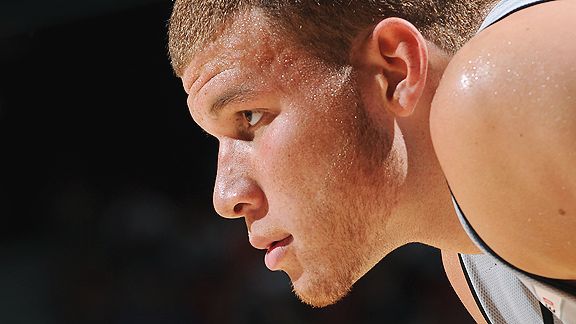
    Garrett W. Ellwood/NBAE/Getty ImagesBlake Griffin: No. 1 pick in the draft; Most Outstanding Player of Summer League; Rookie of the Year?
    GO TO: 2008-09 Recap Offseason Moves Biggest Strength/Weakness Outlook


    2008-09 Recap

    Even by the low standards of this franchise's cursed history, 2008-09 was an especially forgettable campaign. Expected to challenge for a playoff spot in the West, the Clippers were plagued by injuries and in-fighting and won only 19 games; amazingly this was only their seventh-worst record in 25 seasons in Los Angeles.
    The focal point for much of the disappointment was free-agent pickup Baron Davis. Inked to a five-year, $65 million deal and expected to be the catalyst for the offense, he showed up out of shape, feuded with head coach Mike Dunleavy and stubbornly hoisted ill-chosen jumpers despite converting just 37.0 percent from the floor.
    Worst offensive efficiency, 2008-09

    Team FG% TS% Off. Eff. L.A. Clippers 44.1 52.0 99.53 Okla. City 44.7 52.1 99.93 Memphis 45.4 53.3 100.89 Charlotte 45.5 53.6 101.59 Washington 45.0 52.4 102.27 NBA avg. 45.9 54.4 104.78

    Other moves to shore up the backcourt didn't work out any better. Although swingman Ricky Davis was supposed to provide scoring as a sixth man, he performed abominably thanks to a knee injury and spent most of the year on the sidelines. At least he showed up -- the Clippers signed Jason Williams to be their backup point guard, only to have him retire before the season. And Dunleavy, in his role as general manager, further diminished his wings by trading Cuttino Mobley and Tim Thomas to New York for Zach Randolph.
    As a result, the perimeter rotation was a shambles. The Clippers relied on castoffs like Mardy Collins, Fred Jones, Alex Acker, Jason Hart and Mike Taylor for 3,572 minutes, or more than 40 a game. Only rookie guard Eric Gordon provided a bandage, as well as one of the few positive stories from the Clippers' season, by averaging 16.1 points per game.
    Up front the Clippers were ravaged by injuries, as the theoretically potent trio of Randolph, Chris Kaman and Marcus Camby combined to play only 132 games. The reserves here didn't fare quite as poorly, as DeAndre Jordan had a solid rookie season and Steve Novak established himself as a rotation player, but the injuries still left the Clips devoid of star talent.
    HOLLINGER'S '08-09 STATS

    W-L: 19-63 (Pythagorean W-L: 16-66)
    Offensive Efficiency: 99.5 (30th)
    Defensive Efficiency: 108.8 (26th)
    Pace Factor: 94.6 (12th)
    Highest PER: Zach Randolph (19.72)


    Between the injuries and the off year by Baron Davis, the Clips had little to work with at the offensive end, a fact reinforced by their league-worst ratio of free throw attempts to turnovers. The two stats are normally strongly correlated at the team level, so generally it takes a bad offense to generate lots of turnovers without getting to the line much. The Clippers were one such offense -- they posted the league's fifth-lowest free throw rate, but it's ninth-highest turnover rate. No other team could claim membership in the bottom 10 in the former and the top 10 in the latter.
    It's no surprise, then, that the Clippers were the worst offensive team in captivity (see chart). L.A. also captured the le of worst in field goal percentage and true shooting percentage, while also falling well below the league average in every offensive category except one: 3-point attempts per field goal attempt. Thanks to Baron Davis, they attempted slightly more than the league average … and thanks to Davis again, they finished 23rd in accuracy.
    Defensively the Clippers were a bit better, although this is damning with faint praise -- they were run-of-the-mill awful rather than exceptionally horrid, so it doesn't merit as much comment. Even with the injuries, however, the Clippers had the talent to do much better. Alas, it appeared some of the vets -- notably the Davises -- tuned out Dunleavy early on, and things deteriorated from there.
    In Dunleavy's defense, it's hard to overstate just how harshly injuries decimated the roster. Some of this was inevitable -- if a team invests in Marcus Camby, Baron Davis and Zach Randolph, it can't expect to get 82 games of health from the starters. On the other hand, they couldn't possibly have expected things to get this bad. Ricky Davis, for instance, averaged 80 games a year the previous seven seasons but was damaged goods from opening day, while Kaman's 31 games played were a crushing blow after he'd averaged a double-double the year before.


    Offseason Moves

    Fortunately for the Clippers, the NBA takes pity on its weakest citizens. Their offseason became a success before it even started, as they won the draft lottery and the rights to select Oklahoma stud Blake Griffin. That, in turn, set into motion a few other moves that suddenly pointed the Clippers' ship toward much brighter horizons. It was without question the strongest offseason in Dunleavy's tenure.
    Drafted Blake Griffin. Well that was a no-brainer. Griffin should give them an All-Star-caliber performer at the power forward spot for the next decade or so, providing a major building block if the Clippers don't screw it up. Somehow, pretty much everyone thinks they'll find a way, but for now L.A. can celebrate a tremendous coup.
    Traded Zach Randolph for Quentin Richardson. This was the best trade of the offseason, as the Clippers cleared a starting job for Griffin and opened up $10 million more in cap space to pursue free agents next summer. Despite their sad-sack reputation, the Clippers are a hot free-agent destination because of the attractions of L.A. -- that's how they got Baron Davis a year ago, for instance -- so the fact they'll have about $16 million in cap space next summer is a major positive.
    But wait, it gets better …
    Traded Richardson for Craig Smith, Sebastian Telfair and Mark Madsen; waived Madsen. The Clippers took on a few million in salary with this move, but the big positive was the addition of Smith, a beastly power forward who was vastly underrated for his play in Minnesota. He'll provide a capable backup for Griffin and a very strong replacement in the middle on the nights when Kaman or Camby (or both) are on the bench with injuries.
    Telfair pencils in as the backup point guard for the moment, though it's possible the Clips could pick up another veteran in training camp and push him down to third on the depth chart. That seems advisable given Baron Davis' injury history, as the Clippers need a strong backup to soak up the extra minutes and Telfair is merely a stopgap.
    Traded a conditional second-rounder to the Hornets for Rasual Butler and cash. Talk about a win-win -- the Clippers essentially gave up nothing and were paid by the Hornets to take Butler. This was another solid move by the Clips, who found themselves under the cap after the Randolph trade and slotted in the final year of Butler's contract at $3.9 million. It was a pure salary dump from the Hornets, and gives the Clips a solid defender and 3-point shooter off the bench. Plus, since Butler had only one year left on his deal, it doesn't cut into the cap space next summer.
    Waived Mike Taylor. Taylor displayed some potential at the defensive end but really struggled offensively, so he became expendable when the Clips needed to cut a bit more salary to add Butler.
    Re-signed Steve Novak for one year, $1.03 million. Novak re-signed with the Clips on their qualifying offer after emerging as a 3-point ace a year ago. He has no other skills whatsoever and will likely play far less than he did a year ago, but he's a nice weapon to have in late-game situations that require a 3-pointer.
    Re-signed Brian Skinner for one year for the minimum. Skinner provides another reliable big man for the frontcourt rotation. The Clips were already overloaded in this department, but given the injury histories of Camby and Kaman, you can't blame them for wanting additional insurance.


    Biggest Strength: Frontcourt depth

    The Clippers suddenly find themselves with an embarrassment of riches up front -- Dunleavy has seven players to choose from in the frontcourt, and he could extend it to eight when they play small by moving small forward Al Thornton to the 4.
    At the center spot, Dunleavy can turn to Kaman or Camby as his starter and the other as his primary backup. One suspects Camby will get the nod since his skills mesh better with those of Griffin -- he can play the high post and stay out of Griffin's way offensively, and his length complements Griffin's power on D. If so, Kaman -- who averaged 15 points and 12 rebounds two years ago -- provides a potent reserve. After those two, don't sleep on Jordan, who showed promise as a rookie a year ago. He may be needed, as he backs up two of the league's most injury-prone players.
    At power forward even more options abound, though they may not be needed often considering Griffin's might. Behind the rookie is another potent powerhouse in Smith, who averaged better than a point every two minutes in Minnesota last season while shooting 56.2 percent. If it's shooting Dunleavy wants, there's always Novak, a 41.9 percent career 3-point shooter. And as a deep reserve, Skinner is far more qualified than most players of his type.
    The possibilities are endless for mixing and matching in late-game situations, too -- Camby and Kaman or Skinner for defense, or Griffin and Novak for offense, or Griffin and Smith if they want to raise the physicality a notch, or Thornton and Griffin if they want to go small … the list goes on and on.


    Biggest Weakness: Small forward

    With Baron Davis, Gordon, Griffin and Camby, the Clippers have four-fifths of a superb starting lineup, but it remains to be seen what they'll get from the 3 spot this season. Last year's starter, Thornton, was second on the team in scoring at 16.8 points per game, but it was an empty 16.8 -- his PER of 12.7 was basically identical to his rookie mark, and he made the same frustrating mistakes in his defense and shot selection.
    Unfortunately, the Clippers don't have a lot of great alternatives. Ricky Davis should be in better shape than he was a year ago, but it seems folly to play him starter's minutes when he's 30 years old and shot 33.9 percent last season. The next alternative, Butler, is a fine role player but not somebody you'd be excited to have playing 40 minutes a night -- just ask the Hornets, who did that exact thing last season and were so impressed they gave him away for nothing. After that, the only option is Novak, who can shoot the lights out but can't guard a snail.
    The best option for the Clippers would be to trade some of their surplus in the frontcourt for a better solution at the starting 3, and push Thornton into a sixth-man role where his shoot-first tendencies don't interfere as much with the rest of the offense. Of course, the trick is to do it without taking on salary for 2010-11 and messing up the Clips' free-agent push, which is why it's more likely they'll ride it out with Thornton this year and cross their fingers that it works out.


    Outlook

    Occasionally even the worst-run team hits the jackpot, and this year it was the Clippers' turn. Winning the Griffin lottery was a glorious stroke of good fortune for a franchise that has had precious few over the years, and it's one of several positive indicators for the Clips heading into this season. Baron Davis seemed embarrassed by his 2008-09 campaign and has vowed there won't be a repeat, Gordon should perform better in his second pro season and Ricky Davis and Kaman should be in much better physical condition this time around.
    As a result, the Clippers may find themselves back in familiar territory -- albeit one year later than they expected -- as one of several contenders in the West for the conference's final playoff spot. L.A. won only 19 games a year ago, but if one replaces all the minutes they gave to castoffs and ne'er-do-wells to newly healthy players and additions like Griffin, Smith and Butler, then the prognosis improves considerably.
    Ultimately, however, too many question marks remain to comfortably place the Clippers in the conference's top eight. From the health issues with the two Davises, Camby and Kaman, to the conflicts between Baron Davis and Dunleavy, to the shaky, unpredictable ownership of Donald Sterling that could rear its ugly head at any moment, the odds of something coming along to trip up the Clippers are strong.
    That said, they're in a far better spot than they were a year ago thanks to drafting Griffin and unloading Randolph. The Clips may not be a playoff team yet, but with a rising star in the frontcourt and a wad of cap space to build around him, they're finally headed in the right direction.


    34-48, 4th place in Pacific Division, 11th in Western Conference

  5. #30
    Banned
    My Team
    Los Angeles Lakers
    Post Count
    7,194
    Originally Published: September 28, 2009
    2009-10 Forecast: Sacramento Kings

    Tyreke Evans brings some hope to Sac-Town, but the Kings are still a long ways away


    Comment Email Print Share

    By John Hollinger
    ESPN.com
    Archive


    Jesse D. Garrabrant/NBAE/Getty ImagesPoint guard or not, Tyreke Evans has a bright future and could contend for Rookie of the Year honors.
    GO TO: 2008-09 Recap Offseason Moves Biggest Strength/Weakness Outlook


    2008-09 Recap

    Bad cap moves always come back to bite you. It may take a while, but make enough of them and it will inevitably drag a franchise to its knees. Sacramento offers a perfect example. For several years, the Kings slowly painted themselves into a corner with a series of questionable salary decisions while losing their grip on a spot in the West's elite. They managed to stay in the playoff hunt for a few years, but 2008-09 was the year all those bad decisions came back to hammer them.
    Already laden with several dead-weight contracts, the Kings needlessly piled on two more before the season started. Sacramento signed Beno Udrih to a five-year deal for the full midlevel exception and gave Francisco Garcia an extension for similar money, committing nearly $70 million over half a decade to two bench players.
    The result was a demoralizing 17-win season that left once-raucous Arco Arena quieter than a retirement home and raised questions about the Kings' long-term future in the city. The Kings struggled out of the gate and never recovered, with injuries exacerbating a lack of depth. Star guard Kevin Martin missed 31 games with a bad ankle, mostly early in the season, and by the time he came back, the season was already in the toilet. Small forward John Salmons delivered a career year before his trade to Chicago and Brad Miller made something of a comeback from a disappointing 2007-08 campaign, but with glaring weaknesses at both point guard and power forward, neither of those developments could keep the Kings afloat.
    Meanwhile, coach Reggie Theus proved overmatched, again making a series of bizarre decisions. His baffling use of rookie big man Jason Thompson as a starting small forward took the cake, but other moves -- from his almost slavish loyalty to unproductive journeyman Mikki Moore to his head-scratching endgame choices -- led to his ouster in mid-December. Replacement Kenny Natt didn't prove much wiser, ignoring high-scoring reserve Ike Diogu at the end of his bench until the season's final two games to virtually ensure that he wouldn't return to Sacramento.
    HOLLINGER'S '08-09 STATS

    W-L: 17-65 (Pythagorean W-L: 17-65)
    Offensive Efficiency: 102.6 (T-24th)
    Defensive Efficiency: 111.9 (30th)
    Pace Factor: 96.8 (7th)
    Highest PER: Kevin Martin (19.25)


    Of course, nobody was going to win big with this roster. The Kings committed roughly midlevel exception money to six players (Moore, Udrih, Garcia, Kenny Thomas, Bobby Jackson, and Shelden Williams) who contributed virtually nothing, while dropping another $11 million on a marginally effective year from Miller. It could have been worse -- remember, Bonzi Wells turned down a five-year, $36 million offer from the Kings two years ago. He's out of the league now. It got worse. Sacramento hoped it would have a helpful rookie in Donte' Greene as a result of the trade of Ron Artest, but he was terrible -- finishing last in the NBA in PER. Lottery pick Spencer Hawes scuffled through another mediocre year, and re-import Bobby Brown -- signed from Germany as a free agent -- was also found wanting.
    With the Kings absorbing nightly beatings, they also started bleeding red ink due to sparse crowds and an outdated (bordering on anachronistic) home arena. Sacramento went into survival mode at the trade deadline, shedding contracts to get the payroll down any way they could. Miller and Salmons went to Chicago for Andres Nocioni and Drew Gooden in a deal made solely to cut Miller's $12 million obligation for the coming season, Brown and Williams went to Minnesota for Diogu and Rashad McCants to save another $1 million, and the Kings saved further money by buying out Moore and Gooden.
    Meanwhile, with little progress being made on a replacement arena in Sacramento, rumors swirled that the Kings would have a new home soon. Certainly there are buildings available -- San Jose, Anaheim and Kansas City have all expressed interest. For now, however, the Kings remain committed to a vague process with the city in which a site has been selected but no investors or financing have been identified. Good luck with that.


    Offseason Moves

    Money, money, money. The Kings don't have any, and don't appear to have much coming down the pipeline until the arena issue gets settled with either a new building or a relocation. As a result, they were reluctant to spend much this offseason, and we could easily see more salary dumping if things turn out as badly as they did a year ago.
    Sacramento made some interesting moves in the draft, but their lone free-agent signing was a minimum-salaried player. At least they didn't take on any more bad contracts to mess up their future. As things stand now, Sacramento will be well under the salary cap a year from now, so if they get a stomach for spending again next summer, they can take a run at importing some high-price talent.
    Drafted Tyreke Evans, Omri Casspi and Jon Brockman. The Kings drafted Evans as a point guard, hoping he'd replace the ineffective Udrih, but on paper he looks a lot more like a shooting guard. He's a slasher who had low assist rates in college and stands 6-5; historically players of that ilk migrate to shooting guard within two years of entering the league. At any position, however, his quickness with the ball makes him a threat to become a big-time scorer, and as such he was one of the top prospects in the draft.
    Casspi is an Israeli import who posted decent translated stats from Europe the past two seasons. He'll play right away as a combo forward off the bench. Along with tough, undersized second-round battler Brockman and renowned wildman Nocioni, it's hoped Casspi will improve Sacramento's toughness. The Kings were among the league's most lily-livered squads a year ago, a big reason they were so vulnerable in the paint.
    Traded for Sergio Rodriguez. Sacramento moved down eight spots in the draft to acquire Rodriguez from Portland, a deft move that gives the Kings a backup plan should Evans be found wanting at the point. Rodriguez struggled in Portland, but on an up-tempo team like Sacramento could bloom. He's had some of the highest assist ratios in basketball the past two years, but shooting, defense and turnovers have held him back.
    Signed Sean May for the minimum. Sacramento signed one free agent and it was to a minimum contact, but at least it was a fairly good gamble. May has been productive when he's played, but fell badly out of shape after undergoing knee surgery and has never been able to stay healthy for a full season. The Kings will give him a test drive and see if his knees can cope with the rigors of an NBA schedule; if not, they haven't lost much, but if he can knock down 18-footers and rebound the way he did in leading North Carolina to a national le, he'll provide a huge return on a minimal investment.
    Signed Desmond Mason for the minimum. Mason's deal isn't guaranteed and the Kings have 14 players under contract, meaning that Sacramento can wash their hands at any point before Jan. 15. It's highly likely they'll do so -- Mason is 32, performed horribly last year and hasn't played well since 2004-05, and it's not clear how he fits in on a rebuilding team.
    Hired Paul Westphal. Westphal isn't chock full of admirers around the league, but this was absolutely the right decision. Through his career, he's done one thing really well: develop young talent. Under his watch, Cedric Ceballos, Wesley Person, Richard Dumas, Luck_The_Fakers_Luck_The_Fakers_Luck_The_Fakers_Lu ck_The_Fakers_Luck_The_Fakers_Luck_The_Fakers_ Perry, Michael Finley, Rashard Lewis, Ruben Patterson, and Shammond Williams all became full-time regulars, even though he was coaching veteran teams at the time.
    Coaching a young team in the Kings, his ability to develop the kids should really shine. He's one of the few coaches willing to let young players play through their mistakes, which should prove especially beneficial for high-mistake pups like Rodriguez, Evans and Casspi.


    Biggest strength: Wing scoring

    The Kings have a lot of shortcomings, but one thing they don't lack for are skilled wing players at the offensive end. The best of the bunch is Martin, obviously, one of the most highly efficient scorers in league annals. Last year was his fourth consecutive campaign with a TS percent above 60, and he did it on a bad wheel while pumping in nearly 25 points a game. Now that he's back at full strength, he could be capable of even more this season. As awful as the Kings were last season, they were even worse (5-26) in the 31 games he missed.
    Surrounding him are a few others capable of filling up the bucket. Evans has tremendous potential as a slashing scorer and could make immediate contributions, whether at the point or at shooting guard. Nocioni averaged a point every two minutes two years ago for the Bulls, and could put up similar numbers if placed in the same bench scoring role (he may start). Outside sniper Garcia is another Kings winger who makes shots and stretches defenses, while Casspi should also contribute based on his translated European numbers.
    Additionally, the potential of a passing point guard to get these players the rock could add to the fun. Rodriguez floundered with a half-court team in Portland but could break out in a more up-tempo environment with the Kings, and if he does, the result will be more easy shots for their legions of wings.
    All of this might not make the Kings a good team, or even a decent one. But watching their wing players fill it up may make the losing a little more palatable.


    Biggest weakness: Defense

    The Kings were the worst defensive team in the league last season and did virtually nothing to change that in the offseason. Look up and down the roster and you'll see virtually every player is a below-average defender. At the point, Udrih and Rodriguez struggle to contain dribble penetration. On the wings, nobody even remotely qualifies as a wing stopper who can play the Bryants and Wades of the league. The best offensive player, Martin, has been horrendous defensively, while of the others, only green rookie Evans has the physical skills that might eventually make him a decent stopper.
    Up front it's a similar story. Thompson has trouble defending big 5s while Hawes and May are softer than a pod of lilies. That leaves the Kings doubling and scrambling against good post players, and since the perimeter players can barely guard their own man even without worrying about secondary help assignments, it blows open the whole defense.
    The Kings at least tried to change the at ude on D by importing some skull-busters. Nocioni, Casspi and Brockman all are tough-as-nails, take-no-prisoner types who have never backed away from taking a hard foul. Unfortunately, none of them are equipped with the dexterity or leaping ability to contain quality scorers, and so they may do little to plug all the leaks in the Kings' defensive .


    Outlook


    The Kings probably won't be quite as bad as they were a year ago. Up front, Thompson and Hawes should be a year bigger and stronger, plus we won't have any more foolishness with Thompson chasing small forwards through screens on the perimeter. Martin should be healthier than he was a year ago, and along with Evans gives the Kings a pair of go-to scorers -- two more than they had on many nights a year ago. Udrih and Garcia can produce satisfactory results in bench roles that are more in line with their skills, making the second unit stronger than it was a year ago.
    Westphal should be worth a few wins as well, as he'll let the kids work through their mistakes and develop through game experience. Rodriguez and May are added wild cards who may give the Kings added production at two spots where they got little last season.
    Nonetheless, it's a long way back from where the Kings are right now. It took several years of mismanagement to reach this lowly point, and they aren't gong to climb out overnight. As the season begins, they're the odds-on favorite to finish with the league's worst record.


    Prediction: 22-60, 5th in Pacific Division, 15th in Western Conference

  6. #31
    Banned
    My Team
    Los Angeles Lakers
    Post Count
    7,194
    Originally Published: September 28, 2009
    2009-10 Forecast: New York Knicks

    After a nine-game leap last season, should we expect more of the same? Maybe not


    Comment Email Print Share

    By John Hollinger
    ESPN.com
    Archive


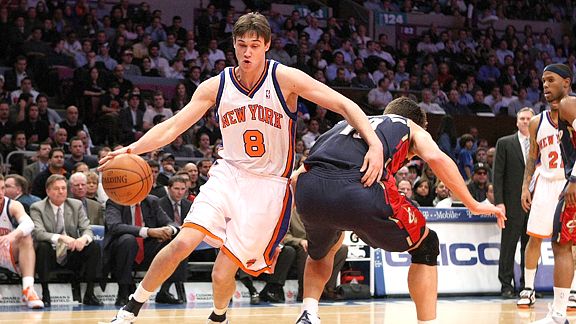
    Nick Laham/Getty ImagesThe development of Danilo Gallinari is essential to the Knicks' aspirations -- this season and beyond.
    GO TO: 2008-09 Recap Offseason Moves Biggest Strength/Weakness Outlook


    2008-09 Recap

    Let's sum up this season in one word: hope.
    The 2008-09 Knicks weren't really much better than they'd been under the disastrous tenure of Isiah Thomas. They won 32 games with many of the same players who had won 23, 33, 23, and 33 the previous four seasons, so the product on the court wasn't necessarily improved.
    What changed was that big fat light at the end of the tunnel. With Thomas's reign of error behind them, the Knicks set about repairing all the damage -- a construction project on par with building Hoover Dam -- and bringing some order to a locker room in which the inmates had been running the asylum.
    On those fronts the season was a huge success, and that was all anyone could ask. Thomas had left the Knicks with an impossible situation, capped out for several years with a bad team full of me-first wannabe superstars, and it's going to take a long time for the Bockers to dig themselves out.
    In Year 1, coach Mike D'Antoni and general manager Donnie Walsh made a nice start. Early in the season they dumped two big contracts, belonging to forward Zach Randolph and guard Jamal Crawford, for the more cap-friendly ones of Al Harrington, Tim Thomas and Cuttino Mobley. These moves didn't do much for the team's on-court prospects, especially since Mobley had to retire when it was revealed that he had a serious heart problem, but they put them in position to dip well under the salary cap in 2010. They also bought out Stephon Marbury, relieving the franchise's biggest headache.
    HOLLINGER'S '08-09 STATS

    W-L: 32-50 (Pythagorean W-L: 33-49)
    Offensive Efficiency: 105.3 (17th)
    Defensive Efficiency: 108.4 (24th)
    Pace Factor: 99.0 (2nd)
    Highest PER: David Lee (19.07)


    Meanwhile, D'Antoni energized the fans with his open-court, attacking style and a surprising start that saw the Knicks in playoff contention at 21-25 in late February. They ran out of gas soon afterward, but stylistically his methods were a breath of fresh air after watching Thomas spend two years methodically pounding the ball into Randolph and Eddy Curry.
    Curry was still on the team, but you'd have had a hard time proving it. He showed up out of shape and played only three games, hurting the Knicks' attempts to trade his onerous contract and create more salary-cap space. They unsuccessfully shopped another cap-killing deal, that of Jared Jeffries, even though Jeffries was healthy and stayed in the rotation all year.
    Fortunately, New York's thin roster was a good fit for D'Antoni's short rotation. Much like he did in Phoenix, he typically used only seven or eight players. With rookie Danilo Gallinari missing most of the season with a back injury, and Curry and Jerome James joining him on the sidelines, D'Antoni went small. David Lee played as an undersized center nearly all year, often surrounded by three or even four guards.
    Fewest blocked shots, 2008-09

    Team % opp. FGA blocked New York 2.90 Milwaukee 4.91 Minnesota 4.94 San Antonio 5.01 Sacramento 5.14 League average 5.94

    Those strategies explain the Knicks' defensive numbers. New York blocked only 2.9 percent of opponents' shots on the season, and I must emphasize the shocking awfulness of those results. It was not only less than half the league average; it was nearly half the average of every other team in the league (see chart). Not surprisingly, the Knicks also claimed the league's worst defense against 2-point shots, surrendering 51.8 percent accuracy from inside the arc.
    New York rebounded decently despite its lack of size and didn't foul much, so it wasn't the worst defensive team overall. The Knicks finished 24th in defensive efficiency, in fact, which wasn't a bad showing considering the lack of size and depth. But without a serious upgrade in the frontcourt defense, it's hard to see that state of affairs improving much.
    Worst 2-point field-goal defense, 2008-09

    Team Opp. 2-Pt. FG% New York 51.8 Washington 51.6 Memphis 51.0 Oklahoma City 50.5 Sacramento 50.4 League average 48.5

    Offensively, the Knicks were notable mainly for their tempo -- only Golden State played at a faster pace than their 98.9 possessions per 48 minutes. As with D'Antoni's teams in Phoenix, they took a ton of 3s and largely eschewed the foul line. New York attempted .322 3-point attempts per field goal attempt, the second highest rate in the league and nearly one-and-a-half times the league average. Unfortunately, they landed only 21st in accuracy at 36 percent.
    Additionally, all those 3s came at the expense of free throws. New York's .268 free-throw attempts per field goal attempt ranked 28th out of the league's 30 teams. Fortunately, they generated a low turnover rate and a strong 2-point field goal percentage (thanks to Lee's 54.9 percent shooting), leading to a respectable 17th-place finish in offensive efficiency.


    Offseason Moves

    New York's offseason was a little bit like "Seinfeld" -- it was a show about nothing. There were a lot of meetings, discussions and rumors, but in the end the Knicks made no deals after draft day except to bring back their own free agents.
    That said, it was a bit bizarre to see them offer Jason Kidd and Grant Hill multiyear deals -- not exactly the types of players you'd expect a rebuilding team to pursue. Fortunately for the Knicks, both players rebuffed their advances, leaving the Knicks on a pace to have enough cap room to pursue a major free agent a year from now and still fill in with other talent around the edges.
    If they can somehow find another taker for the contracts of Jeffries and/or Curry, they could add two major free agents at once in 2010. Given the magnet that is the Big Apple, that might allow them to turn things around overnight; unfortunately, dealing either contract is a major long shot.
    Incidentally, Thomas left the Knicks with another major liability in 2010 -- he traded their first-round draft pick, unprotected, to acquire Marbury when he first took over the team. That deal not only may cost the Knicks a high lottery pick in the 2010 draft, but by rule also precludes them from trading their first-rounder in 2011 -- something that could have helped sweeten a deal involving Jeffries or Curry.
    Drafted Jordan Hill and Toney Douglas. I'm not a huge fan of Hill, but the Knicks sorely needed some athleticism in the frontcourt, and he can certainly provide it. He's unlikely to star, but if he can rebound and block some shots, he'll be a decent value with the eighth overall pick in a weak draft. Douglas has a rep as an ace defender but is undersized for a shooting guard and didn't shoot particularly well in college. He'll need to play right away, however, as the Knicks are badly lacking in wing depth.
    Traded Quentin Richardson and cash to Memphis for Darko Milicic. This was a fantastic swap for the Knicks. They acquired a quality defensive center in return for one of their least productive wing players, and they accomplished it without harming their cap situation in 2010. Milicic's offensive potential was largely a figment of scouts' imaginations, but his length and timing at the defensive end make him a strong performer when he's motivated. Look for the Knicks to make heavy use of him to take some of the strain off Lee in the middle.
    Re-signed David Lee for one year, $8 million. As a restricted free agent, Lee had trouble getting decent offers and settled on returning to the Knicks. He'll try again as an unrestricted free agent a year from now. In the meantime, it's a low-risk deal for the Knicks to keep their best young player around. By keeping him in the fold, they maintain a fall-back position should the top free agents spurn them next summer, and by limiting the contract to one year, they don't cut into their 2010 cap space.
    Re-signed Nate Robinson for one year, $4 million. As with Lee, Robinson was a restricted free agent who had trouble getting decent nibbles. As with Lee, he ended up returning for less than market value, allowing the Knicks to keep him around for a year and see what happens.


    Biggest Strength: Offensive Versatility

    The Knicks lack a go-to star scorer, but they make up for it with the ability to attack in several different ways. Chris Duhon and Lee are a deadly pick-and-roll combo, with Lee among the best in the league at taking a pass on the move in the lane and flying in for the finish, making that play a staple of the Knicks' offense. It also opens up some action on the perimeter, particularly for Harrington. While he's a little too enthusiastic about shooting off the catch, Harrington's ability to space the floor and attack bigger players off the dribble makes him a tough matchup for opposing 4s.
    Off the bench, the Knicks have human TNT in the form of Robinson, the diminutive but explosive guard. He's out of control at times, but he can also get on crazy hot streaks. Last season he reined in his play just enough to provide a potent sixth man, and they'll ask him to do it again. The two young small forwards, Gallinari and Wilson Chandler, also offer offensive weapons. Gallinari shot extremely well in his limited minutes a year ago and has a rep as a skilled passer as well. As for Chandler, his numbers overstate his effectiveness (more on that below), but he can finish in transition and attack the basket off the dribble.
    Finally, there's Curry. It's not clear what to expect from him this season, but he can be a deadly low-post scorer when he's in shape and motivated. Should that happen, he can give the Knicks' offense a completely different dimension that it lacked a year ago.

    Biggest Weakness: Wings

    I'm tempted to say frontcourt defense, but the Knicks should be better off on that front. Milicic gives them a true defensive center for the first time in ages, Hill should contribute energy and athleticism, and anything they get from Curry would be gravy. Based on the above, I suspect they'll block a lot more than 2.9 percent of opponent shots this season.
    But they look awfully shaky on the wings. Larry Hughes and Chandler project as the starters, and while each makes for a decent rotation player, they're stretched to the limit in a 40-minute role. Hughes washed out as a starter in his past two stops thanks to his wayward outside shooting and iffy shot selection, while Chandler's gaudy per-game averages from a year ago are largely a by-product of the Knicks' fast pace and his own heavy minutes. On a per-minute basis, he's a mediocre offensive player and, like Hughes, an iffy shooter who doesn't create much for the others.
    Those two must start, though, because there's little available in reserve. Late first-round pick Toney Douglas is the primary backup at shooting guard, while at small forward the Knicks will have to hope for a return to health from Gallinari -- not to mention pray that he can stay in front of the same 3s who blazed by him a year ago. The only other alternative is Jeffries, a truly rotten offensive player who has marginal utility as a defender in traps and presses.


    Outlook

    This is the last year of low expectations for the Knicks, and they may very well take full advantage of that fact. New York lacks an All-Star performer and is unlikely to make any moves to upgrade the roster during the season, as it needs to protect its precious cap-space trove for 2010 and hope that LeBron James, Chris Bosh or somebody else will step up to take it. If anything, the Knicks will spend the season shedding assets as they look to find new homes for Jeffries and Curry. Don't be surprised if the Knicks showcase those two, which would further diminish the team's prospects.
    While New York has some nice pieces in Lee, Robinson, Chandler, Hill and Gallinari, the lack of star power and defensive grit could mean it takes a step back even from a year ago. While the frontcourt defense should be stronger than it was a year ago, New York is unlikely to be a strong defensive team overall. Additionally, the team has very little firepower on the wings and may experience a dip from last season's offensive numbers, particularly if Robinson and Lee regress from their career years. Another potentially aggravating factor is that five of the Knicks' top six players are free agents after the season -- meaning personal agendas could easily supplant team goals.
    As a result of all those problems, New York is more likely to finish near the bottom of the Eastern Conference heap than challenge for a playoff spot. Fortunately, they can still sell their fans hope … just not immediate hope. Between the limited roster and the impending cap space, New York's next summer is likely to be a lot more exciting than its upcoming season.


    Prediction: 26-56, 4th in Atlantic Division, 13th in Eastern Conference

  7. #32
    Long, Dark Blues redzero's Avatar
    My Team
    New Orleans Hornets
    Post Count
    14,531
    Originally Published: September 28, 2009
    2009-10 Forecast: New Orleans Hornets

    Despite a relatively quiet offseason, New Orleans can still think big with CP3 in tow


    Comment Email Print Share

    By John Hollinger
    ESPN.com
    Archive
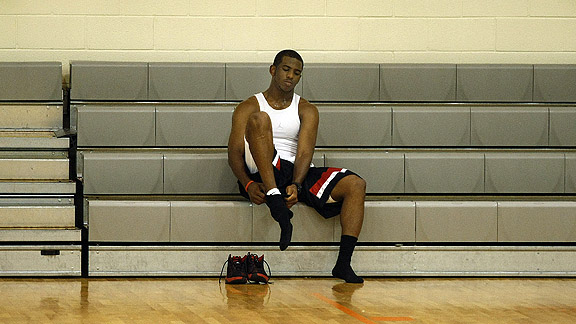

    Layne Murdoch/NBAE/Getty ImagesAfter a quick exit in the playoffs last season, Chris Paul is ready to lace 'em up for a new season.
    GO TO: 2008-09 Recap Offseason Moves Biggest Strength/Weakness Outlook


    2008-09 Recap

    The Hornets made one of the worst mistakes possible prior to the 2008-09 season -- they believed their press clippings. After a seven-game, second-round defeat to San Antonio, much was written about how San Antonio's experience proved the telling difference and how the Hornets needed to add some to get over the hump.
    Closer analysis could have offered more tangible reasons -- like the lack of a quality backup center. This forced the Hornets to double-team Tim Duncan every first half since they were terrified of Tyson Chandler picking up fouls, and it directly led to the barrage of 3-pointers that tripped them in Game 7. Unfortunately, the Hornets placed their faith in the intangible rather than the tangible, and it set the stage for a disappointing 2008-09 campaign.
    New Orleans invested its money in a full midlevel offer to James Posey, hoping his magic playoff beans would lead them to the promised land. They did this in lieu of moves that would have made them a better basketball team, such as using their cap exceptions to fill the gaping holes at backup center and backup point guard.
    It was no fault of Posey's, who put up his usual numbers, but he provided little difference from the legions of other small forwards already on the Hornets' roster. The lack of a backup big man, on the other hand, killed them when Chandler hurt his ankle and missed 37 games. New Orleans' backup fives were Hilton Armstrong (PER 10.49), Sean Marks (8.64) and Melvin Ely (5.67); between them they gave the Hornets 2,303 minutes of sub-replacement-level production and essentially neutralized the team's two All-Stars.
    HOLLINGER'S '08-09 STATS

    W-L: 49-33 (Pythagorean W-L: 46-36)
    Offensive Efficiency: 106.2 (T-18th)
    Defensive Efficiency: 104.1 (9th)
    Pace Factor: 90.0 (28th)
    Highest PER: Chris Paul (30.04)


    The backup point guard spot was an even greater calamity until the team engineered a deal for Washington's Antonio Daniels, relieving the wholly incapable Mike James of the gig. Daniels wasn't anything great, either, but he at least patched an open sore for the 10 minutes or so Chris Paul wasn't out there. On the wings, Morris Peterson's play fell off and Peja Stojakovic's back woes returned, leading to the worst season of Stojakovic's pro career. New Orleans also made the puzzling decision to keep second-year wing Julian Wright sequestered at the end of the bench despite his productive play in limited cameos, instead relying on Rasual Butler, Posey and Stojakovic for the bulk of its wing minutes.
    The one thing that kept them afloat was Paul. He was even better than his MVP runner-up season from the prior year, joining the tiny fraternity of players to post a 30-plus PER and leading the league in assists and steals. But it was basically a two-man team: Paul and David West were the only Hornets to finish with a PER above the league average, and most of their teammates weren't even close.
    Hornets coach Byron Scott rode the starters hard down the stretch in order to get them into the playoffs, but they had nothing left by then. Chandler and Stojakovic played but were clearly hurt, and the others looked out of gas and somewhat dejected by the entire state of affairs. Denver humiliated New Orleans in five games, including an embarrassing 121-63 home defeat in Game 4.
    Statistically, the one defining characteristic of the Hornets' season was the snail's pace at which they played. With an all-world point guard, you would think they would be a terrifying transition team, but Paul rarely had anybody in position to run with him. The Hornets finished 28th in pace factor, often requiring the entire shot clock to get a clean look. Despite the excellence of Paul and West, the Hornets finished just 13th in offensive efficiency, as the supporting cast couldn't cut the mus .
    New Orleans did excel in one area -- not getting shots blocked. Only 4.5 percent of Hornet attempts were sent back, the lowest percentage in the league. However, a big part of this can be attributed to how often the Hornets settled for jumpers and how rarely they attacked in the post. The Hornets finished 22nd in free throw rate and 25th in offensive rebound rate, an indication of how rarely they had the ball in scoring position in the paint. That, in turn, is yet another reflection of how the 2008 offseason failed to address the roster's shortcomings.


    Offseason Moves

    A history of previous missteps tied the Hornets' hands as they entered the offseason several million dollars above the 2009-10 luxury-tax level and even farther above the shrunken 2010-11 threshold. As a small-market team with a limited revenue base, New Orleans had little choice but to spend the offseason furiously working its way back under the tax line.
    Traded Tyson Chandler to Charlotte for Emeka Okafor. This was a spectacular deal for the Hornets, cutting more than $1 million from their luxury-tax payment while upgrading at the center position with Okafor. Though Okafor isn't the alley-oop finisher that Chandler is, he's a useful post scorer who can hit short bank shots and the occasional jumper -- making him vastly more versatile than Chandler. On a team that had only two primary scoring options a year ago, this is huge. The drawback is the longer obligation to Okafor, who has five years left at an overvalued $12 million a pop, but it makes their short term considerably brighter.
    As a side note, Okafor's arrival virtually guarantees that the Hornets will not claim the league's lowest blocked-shot rate this time around. Okafor gets his shot rejected so often -- 12 percent of his shots were sent back last season, according to 82games.com -- that you half expect to see the word "Spalding" imprinted backward on his forehead.
    Traded Rasual Butler and cash to the Clippers for a future second-round pick. This was a straight salary dump by New Orleans to lower their luxury-tax assessment, ditching the $3.9 million owed to Butler in return for essentially nothing -- the draft pick is in 2016 and is top 55 protected. The Hornets also get a trade exception worth $3.9 million, but it seems inconceivable that they'd use it. The main benefit was offloading one of their legions of fungible wings to reduce the tax payment, which was so valuable to the Hornets that they threw in cash to pay a big chunk of Butler's salary.
    After this move and the Antonio Daniels trade below, the Hornets are $3.2 million over the tax. They can eliminate the remaining amount at the trade deadline by trading Hilton Armstrong (who makes $2.8 million) to a team under the cap, paying them the maximum allowable $3 million for their trouble, and then shuttling a minimum-sized contract (such as the redundant Devin Brown) to another squad in a similar move. The mechanics are less important than the big picture -- it appears they'll be able to dodge the luxury-tax bullet for this year with limited pain thanks to these moves.
    Drafted Darren Collison. The Hornets filled a roster hole on draft day by tabbing Collison, and in that sense it was a success -- he should be an adequate backup point guard who hits open shots, and he solved a clear problem. The issue is that the Hornets set such a low ceiling for potential success, given that Collison is going to play 10 minutes a game at the absolute most because he plays the same position as Chris Paul. That will be as true five years from now as it is today, regardless of how well Collison plays. Perhaps they might have been better off targeting a frontcourt player with the draft pick and then using their minimum salary exception on a generic backup point guard.
    Traded two future second-rounders to Miami for a second-rounder; drafted Marcus Thornton. I'm sure they liked Thornton, but trading two future picks for one pick of the same ilk makes little sense -- it's the basketball equivalent of a payday loan with 50 percent interest. He'll get some chances to play because of the paucity of true shooting guards on the roster, but he wasn't a highly ranked prospect.
    Signed Ike Diogu for the minimum salary. I'm not a big fan of some of the Hornets' other moves, but I loved this one. Diogu can flat-out score, and that's vitally important on a second unit that had massive trouble generating offense. He'll give the bench group a post-up threat and create doubling situations that open up the 3-point line, plus he's a decent rebounder. Diogu has his weaknesses -- he's turnover-prone and he doesn't defend well -- but at this price he was a spectacular bargain.
    Traded Antonio Daniels to Minnesota for Darius Songaila and Bobby Brown. This trade essentially made the Hornets' jobs a little easier this year but much harder next year. Songaila is a useful frontcourt reserve who can bang and shoot from outside, and Scott has familiarity with him from his Sacramento days. As such, he's a welcome addition to a frontcourt that was looking paper-thin.
    However, Daniels had an expiring contract while Songaila makes $4.8 million in 2010-11, which puts the Hornets about $10 million into the tax a year from now depending on where the new cap number comes in. It will be difficult to shed that much salary next summer and seemingly untenable to pay the tax in this market, so it's not clear how the Hornets plan to wriggle out of it. The we'll-deal-with-it-later mindset toward the cap has been a running theme in New Orleans in the past few years, and they keep digging the hole deeper.


    Biggest Strength: Frontcourt Scoring

    One huge difference between this year's Hornets and last year's is the mul ude of scoring options New Orleans has in the frontcourt. West was the only reliable frontcourt weapon a year ago, and when he and Paul were out of the game, it produced some rather undesirable play calls -- Posey posting up, for instance, or Armstrong trying to attack from the high post. Now there's legitimate offense waiting in the wings. Okafor might not be the most fluid post scorer in the world, but he's strong, can get free for shots in the paint and earns plenty of putbacks. All told he averages over five points more per 40 minutes than Chandler, which is a huge improvement.
    Diogu should also be a major factor. He's averaged about a point every two minutes during his pro career, and despite sporadic playing time, he's performed well everywhere he's landed. As a go-to scorer for the second unit, he should engender a major improvement from last year's toothless bunch.
    Additionally, Songaila is another frontcourt player who can put the ball in the hoop, and his ability to space the floor from the perimeter makes him a nice complement to the Hornets' pick-and-roll game with Paul.


    Biggest Weakness: Shooting Guard

    The Hornets have six wing players on the roster, but out of the group only Thornton, a rookie second-round pick, is naturally a 2. Posey, Wright, Stojakovic, Brown and Peterson are pure 3s, forcing at least one of them to play as a fish out of water at the shooting guard spot. It's less of an issue on this team compared to some others because Paul does nearly all the ballhandling, but it still leaves them a step slow on D and minus some creativity on offense.
    The bigger problem is not the lack of a natural 2, however -- it's that none of their wings are good enough to start. Somehow, two of them have to step up. The best bet at small forward is Stojakovic, who was miserable a year ago but should produce if he can shrug off the back problems that limited him so much. Posey is more comfortable coming off the bench but could end up playing the bulk of the minutes at this spot if Stojakovic continues to struggle.
    That takes care of one position, but the 2 is an even bigger issue. Wright is the most logical candidate, even though he's 6-foot-8 and can't shoot, because he's the best ball handler of the bunch and has been the most productive. If not, Peterson may retake the starting gig he lost last season after a year-plus of rather unimpressive play.
    Big picture, the Hornets need to get more from these players than they did a year ago, or they'll surrender the advantage they have in the frontcourt.


    Outlook



    The Hornets have nothing but question marks at the wing positions, and despite adding Diogu, Songaila and Collison, the bench isn't exactly rock-solid, either. Additionally, their difficult salary situation makes it unlikely they can make moves to upgrade the roster during the course of the season. If anything, they'll be shedding talent, with Armstrong the most likely player to depart since offloading his contract would help put the Hornets under the luxury-tax line.
    Fortunately, the Hornets have two huge positives in their favor. First, the frontcourt will be much more potent than a year ago thanks to the additions of Okafor, Songaila and Diogu. On a per-minute scoring basis, the newcomers should nearly double what the Hornets got from Chandler and the assorted flotsam backing him up a year ago.
    But the biggest reason the Hornets will stay afloat is Paul. He's the best point guard in the league, and if anything, he's still underrated because of New Orleans' small market and the team's slow-paced, half-court style. They may step up the pace a bit this year if Wright starts, but this still won't be a track team.
    Instead, Paul will carve up opponents on pick-and-rolls enough for the Hornets' defense to do the rest. That D should remain robust, as Okafor is Chandler's equal on that end. As a result, the Hornets will be back in the playoffs and may even win a round once they get there.


    Prediction: 51-31, 2nd in Southwest Division, 5th in Western Conference

    Thank you, Culburn. I knew you were good for something.

    Hollinger got everything right with the Hornets. Our front court was pitiful last season, and Okafor, Songaila and Diogu will bring much more to the table than a hobbled Chandler, Melvin Ely, and Hilton Armstrong.

  8. #33
    Banned
    My Team
    Los Angeles Lakers
    Post Count
    7,194
    Thank you, Culburn. I knew you were good for something.
    I can be an asshole, but, never a stingy one.

  9. #34
    NB:lol Luck_The_Fakers_Luck_The_ Fakers_Luck_The_Fakers_Lu ck_The_Fakers_Luck_The_Fa kers_ 21_Blessings's Avatar
    My Team
    Los Angeles Lakers
    Post Count
    6,765
    Thanks Cul

  10. #35
    I'm The Future GOAT carrao45's Avatar
    My Team
    Los Angeles Lakers
    Post Count
    1,099
    Thank you very much Culburn

  11. #36
    Banned
    My Team
    Los Angeles Lakers
    Post Count
    7,194
    You're all most welcome.

  12. #37
    Banned
    My Team
    Los Angeles Lakers
    Post Count
    3,977
    You're all most welcome.
    te hee

  13. #38
    Believe.
    My Team
    San Antonio Spurs
    Post Count
    320
    Awesome, ty for posting this, exactly what I was looking for.

Thread Information

Users Browsing this Thread

There are currently 1 users browsing this thread. (0 members and 1 guests)

Posting Permissions

  • You may not post new threads
  • You may not post replies
  • You may not post attachments
  • You may not edit your posts
  •