Reply With Quote
Lavabit loses its appeal on technical groundsL http://www.wired.com/2014/04/lavabit-ruling/
N.S.A. Dragnet Included Allies, Aid Groups and Business Elite
Secret do ents reveal more than 1,000 targets of American and British surveillance in recent years, including the office of an Israeli prime minister, heads of international aid organizations, foreign energy companies and a European Union official involved in an rust battles with American technology businesses.
While the names of some political and diplomatic leaders have previously emerged as targets, the newly disclosed intelligence do ents provide a much fuller portrait of the spies’ sweeping interests in more than 60 countries.
Britain’s General Communications Headquarters, working closely with the National Security Agency, monitored the communications of senior European Union officials, foreign leaders including African heads of state and sometimes their family members, directors of United Nations and other relief programs, and officials overseeing oil and finance ministries, according to the do ents. In addition to Israel, some targets involved close allies like France and Germany, where tensions have already erupted over recent revelations about spying by the N.S.A.
Details of the surveillance are described in do ents from the N.S.A. and Britain’s eavesdropping agency, known as GCHQ, dating from 2008 to 2011. The target lists appear in a set of GCHQ reports that sometimes identify which agency requested the surveillance, but more often do not. The do ents were leaked by the former N.S.A. contractor Edward J. Snowden and shared by The New York Times,The Guardian and Der Spiegel.
Also appearing on the surveillance lists is Joaquín Almunia, vice president of the European Commission, which, among other powers, has oversight of an rust issues in Europe. The commission has broad authority over local and foreign companies, and has punished a number of American companies, including Microsoft and Intel, with heavy fines for hampering fair compe ion. The reports say that spies intercepted Mr. Almunia’s communications in 2008 and 2009.
In a statement, the N.S.A. denied that it had ever carried out espionage to benefit American businesses.
“We do not use our foreign intelligence capabilities to steal the trade secrets of foreign companies on behalf of — or give intelligence we collect to — U.S. companies to enhance their international compe iveness or increase their bottom line,” said Vanee Vines, an N.S.A. spokeswoman.
But she added that some economic spying was justified by national security needs. “The intelligence community’s efforts to understand economic systems and policies, and monitor anomalous economic activities, are critical to providing policy makers with the information they need to make informed decisions that are in the best interest of our national security,” Ms. Vines said.yeah sure.
http://www.nytimes.com/2013/12/21/wo...-elite.html?hp

Lavabit loses its appeal on technical groundsL http://www.wired.com/2014/04/lavabit-ruling/
https://www.schneier.com/blog/archiv...es_not_ca.htmlAT&T's CEO believes that the company should not offer robust security to its customers:
But tech company leaders aren't all joining the fight against the deliberate weakening of encryption. AT&T CEO Randall Stephenson said this week that AT&T, Apple, and other tech companies shouldn't have any say in the debate.His position is extreme in its disregard for the privacy of his customers. If he doesn't believe that companies should have any say in what levels of privacy they offer their customers, you can be sure that AT&T won't offer any robust privacy or security to you.
"I don't think it is Silicon Valley's decision to make about whether encryption is the right thing to do," Stephenson said in an interview with The Wall Street Journal. "I understand [Apple CEO] Tim Cook's decision, but I don't think it's his decision to make."
Does he have any clue what an anti-market position this is? He says that it is not the business of Silicon Valley companies to offer product features that might annoy the government. The "debate" about what features commercial products should have should happen elsewhere -- presumably within the government. I thought we all agreed that state-controlled economies just don't work.
My guess is that he doesn't realize what an extreme position he's taking by saying that product design isn't the decision of companies to make. My guess is that AT&T is so deep in bed with the NSA and FBI that he's just saying things he believes justifies his position.
Here's the original, behind a paywall.
Court Says 10 Weeks Of Warrantless Surveillance Is Perfectly Cons utional
How long can the government surveill your property without a warrant? According to the Sixth Circuit Court of Appeals, pretty much indefinitely.
Rocky Houston appeals his conviction of being a felon in possession of a firearm in violation of 18 U.S.C. § 922(g)(1). At trial, the primary evidence against Houston was video footage of his possessing firearms at his and his brother’s rural Tennessee farm. The footage was recorded over the course of ten weeks by a camera installed on top of a public utility pole approximately 200 yards away. Although this ten-week surveillance was conducted without a warrant, the use of the pole camera did not violate Houston’s reasonable expectations of privacy because the camera recorded the same view of the farm as that enjoyed by passersby on public roads.
It's hard to fault the logic of this conclusion, even if it does seem the ATF's surveillance bumped up against the edges of the Fourth Amendment. What happened in aggregate was not a violation because no individual aspect of it crosses over the "expectation of privacy" line. An ATF agent with a camera filming from across the road wouldn't have violated Houston's privacy, even if the agent could only do so for a single 8-hour shift.
Ten weeks of surveillance is nothing more than 10 weeks of back-to-back, round-the-clock 8-hour shifts. US courts have often stated that rights violations cannot spring into existence on their own.
The aggregate is a sum of smaller parts and if none of the "smaller parts" are a violation of Fourth Amendment rights, then 1,680 hours of surveillance by camera is no different than 8 hours of surveillance by an agent.
https://www.techdirt.com/articles/20...tutional.shtml

IoT will be a dream come true for the gov't.
already is
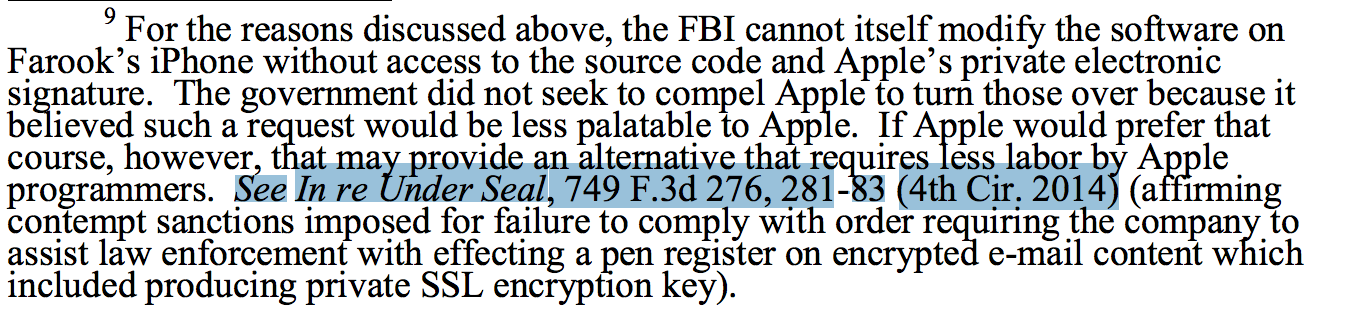
DOJ references Lavabit in its court battle with Apple:
https://www.emptywheel.net/2016/03/1...bit-treatment/DOJ has submitted its response to Apple in the Syed Farook case. Amid invocations of a bunch of ominous precedents — including Cheney’s successful effort to hide his energy task force, Alberto Gonzales effort to use kiddie porn as an excuse to get a subset of all of Google’s web searches, and Aaron Burr’s use of encryption — it included this footnote explaining why it hadn’t just asked for Apple’s source code.
That’s a reference to the Lavabit appeal, in which Ladar Levison was forced to turn over its encryption keys.
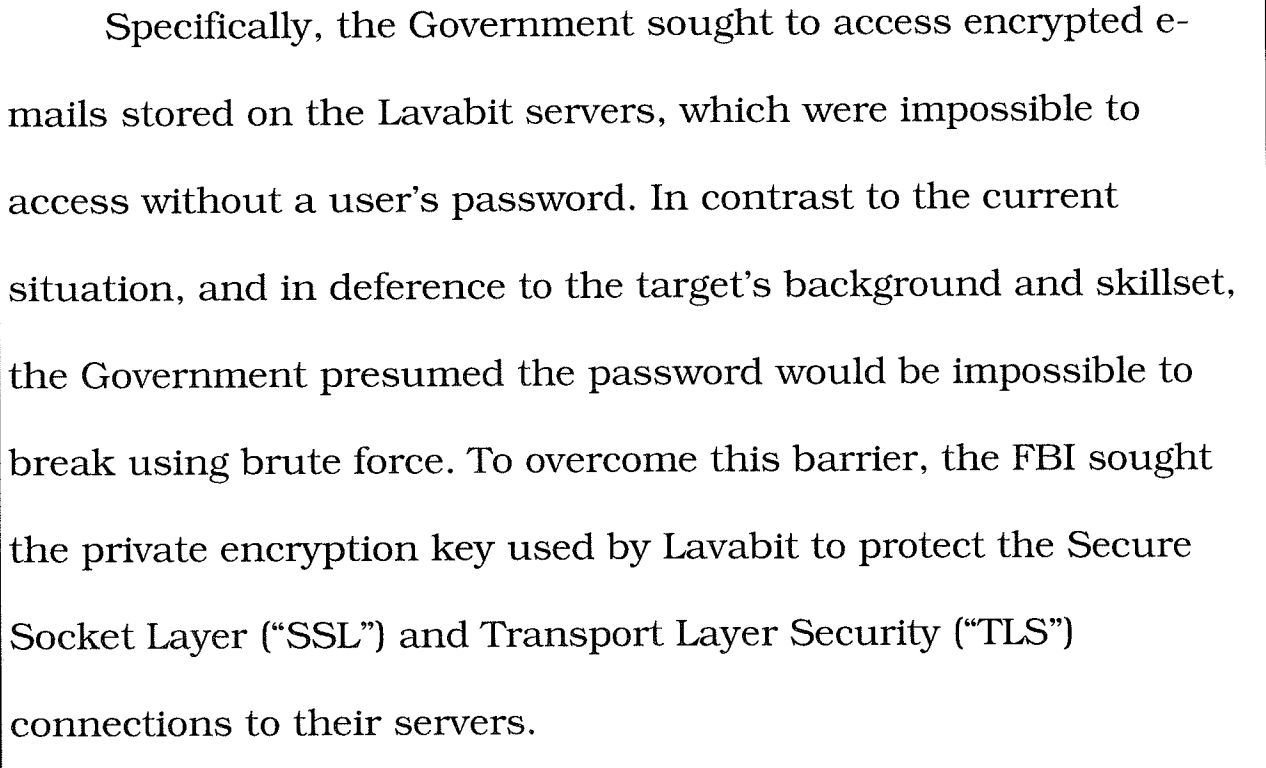
As it happens, Lavabit submitted an amicus in this case (largely arguing against involuntary servitude). But as part of it, they revealed that the reason the government demanded Lavabit’s key is because “in deference to [Edward Snowden’s] background and skillset, the Government presumed the password would be impossible to break using brute force.”
But that says that for phones that — unlike Farook’s which had a simple 4-digit passcode — the government maintains the right to demand more, up to and including their source code.
The government spends a lot of time in this brief arguing it is just about this one phone. But that footnote, along with the detail explaining why they felt the need to obtain Lavabit’s key, suggests it’s about far more than even Apple has claimed thus far.
NSA sneak and peek, officially no longer just for investigating terrorism:
A while back, we noted a report showing that the “sneak-and-peek” provision of the Patriot Act that was alleged to be used only in national security and terrorism investigations has overwhelmingly been used in narcotics cases. Now the New York Times reports that National Security Agency data will be shared with other intelligence agencies like the FBI without first applying any screens for privacy. The ACLU of Massachusetts blog Privacy SOS explains why this is important:
What does this rule change mean for you? In short, domestic law enforcement officials now have access to huge troves of American communications, obtained without warrants, that they can use to put people in cages. FBI agents don’t need to have any “national security” related reason to plug your name, email address, phone number, or other “selector” into the NSA’s gargantuan data trove. They can simply poke around in your private information in the course of totally routine investigations. And if they find something that suggests, say, involvement in illegal drug activity, they can send that information to local or state police. That means information the NSA collects for purposes of so-called “national security” will be used by police to lock up ordinary Americans for routine crimes. And we don’t have to guess who’s going to suffer this uncons utional indignity the most brutally. It’ll be Black, Brown, poor, immigrant, Muslim, and dissident Americans: the same people who are always targeted by law enforcement for extra “special” attention.This basically formalizes what was already happening under the radar. We’ve known for a couple of years now that the Drug Enforcement Administration and the IRS were getting information from the NSA. Because that information was obtained without a warrant, the agencieswere instructed to engage in “parallel construction” when explaining to courts and defense attorneys how the information had been obtained. If you think parallel construction just sounds like a bureaucratically sterilized way of saying big stinking lie, well, you wouldn’t be alone. And it certainly isn’t the only time that that national security apparatus has let law enforcement agencies benefit from policies that are supposed to be reserved for terrorism investigations in order to get around the Fourth Amendment, then instructed those law enforcement agencies to misdirect, fudge and outright lie about how they obtained incriminating information — see the Stingray debacle. This isn’t just a few rogue agents. The lying has been a matter of policy. We’re now learning that the feds had these agreements with police agenciesallover the country, affecting thousandsof cases.
EFF wins suit against DEA, curtains peeled back on Hemisphere:
https://www.techdirt.com/articles/20181223/09123641283/eff-wins-foia-lawsuit-against-dea-forces-release-more-info-about-hemisphere-program.shtmlAT&T has always considered itself to be an integral part of federal government surveillance programs, often going beyond what's required to comply with demands for info. In the case of Hemisphere, it appeared to be operating as an unofficial arm of the government by "embedding" personnel in the DEA to expedite its surveillance efforts.
More do ents obtained by other FOIA requesters have peeled back a little bit of the secrecy. Even with redactions in place, the astonishing breadth of Hemisphere's surveillance capabilities was evident. Communications contained in the do ents showed both the DEA and AT&T encouraged hiding the program from criminal defendants and the courts overseeing their cases. Parallel construction was the de facto policy, preventing anyone outside of US law enforcement from attacking the origin of evidence used against them.
The EFF's lawsuit victory has revealed even more of the program's inner workings [PDF], including the forms used by the DEA to initiate phone record searches. The searches hardly appear to be targeted, as agents were able to capture an unlimited amount of call data using a single subpoena.
To sum up: the DEA doesn't want to talk about a program it claims it doesn't control. The DEA redacted tons of info about a program that's completely legal and it shouldn't have to justify to the American public, while simultaneously hiding the use of the program from criminal defendants and judges. It is not the NSA, the DEA claims, while engaging in many of the NSA's tactics, like parallel construction and Glomar-esque non-denial denials of the program's existence.
!!!
Over in the private sector, AT&T decided it was more DEA than telco to engage in the program, turning a decent profit on unchecked surveillance and benefiting from the legal immunity extended to private sector participants in government surveillance programs.
There are currently 1 users browsing this thread. (0 members and 1 guests)
 Posting Permissions