10 Things the GOP Doesn't Want You to Know About the Debt
Just two weeks after he seconded Treasury Secretary Tim Geithner's dire warnings about the August 2 deadline to raise the U.S debt ceiling, House Majority Leader Eric Cantor walked out of the budget talks aimed at reaching a bipartisan compromise over deficit reduction. Like Arizona GOP Senator Jon Kyl, Cantor shifted the burden to Speaker John Boehner, Senate Minority Mitch McConnell and President Obama to "get over this impasse on taxes."
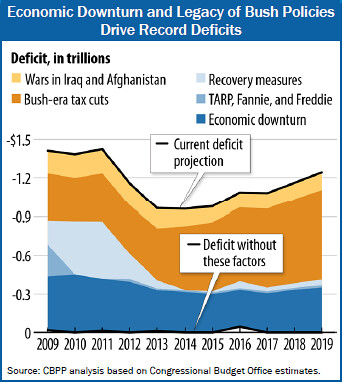
For his part, McConnell promised that no deal to end the GOP's hostage taking of the U.S. economy will include tax hikes. But while McConnell boasted that "If they couldn't raise taxes when they owned the government, you know they can't get it done now," left unsaid was the inconvenient truth that the nation's mounting debt is largely attributable to wars, a recession and tax policies put in place under his party's watch.
Here, then, are 10 things the GOP doesn't want you to know about the debt:
- Republican Leaders Agree U.S. Default Would Be a "Financial Disaster"
- Ronald Reagan Tripled the National Debt
- George W. Bush Doubled the National Debt
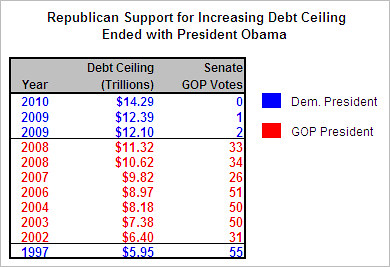
- Republicans Voted Seven Times to Raise Debt Ceiling for President Bush
- Federal Taxes Are Now at a 60 Year Low
- Bush Tax Cuts Didn't Pay for Themselves or Spur "Job Creators"
- Ryan Budget Delivers Another Tax Cut Windfall for Wealthy
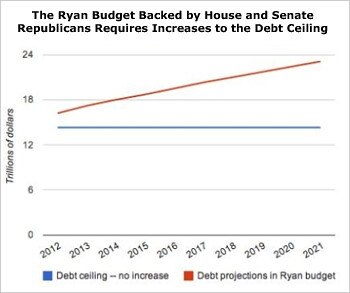
- Ryan Budget Will Require Raising Debt Ceiling - Repeatedly
- Tax Cuts Drive the Next Decade of Debt
- $3 Trillion Tab for Unfunded Wars Remains Unpaid
1. Republican Leaders Agree U.S. Default Would Be a "Financial Disaster"
Senator Pat Toomey (R-PA), Rep. Michele Bachmann (R-MN) and White House hopeful Tim Pawlenty are among the GOP luminaries who have joined the ranks of what Dana Milbank called the "default deniers." But you don't have to take Treasury Secretary Timothy Geithner's word for it "that if Congress doesn't agree to an increase in the debt limit by August 2, the United States will be forced to default on its debt, potentially spreading panic and collapse across the globe." As it turns out, Republican leaders (and their big business backers) have said the same thing.
In their few moments of candor, Republican leaders expressed agreement with Tim Geithner's assessment that default by the U.S. "would have a catastrophic economic impact that would be felt by every American." The specter of a global financial cataclysm has been described as resulting in "severe harm" (McCain economic adviser Mark Zandi), "financial collapse and calamity throughout the world" (Senator Lindsey Graham) and "you can't not raise the debt ceiling" (House Budget Committee Chairman Paul Ryan). In January, even Speaker John Boehner acknowledged as much:
"That would be a financial disaster, not only for our country but for the worldwide economy. Remember, the American people on election day said, 'we want to cut spending and we want to create jobs.' And you can't create jobs if you default on the federal debt."
2. Ronald Reagan Tripled the National Debt
Among the Republicans who prophesied the default doomsday scenario was none other than conservative patron saint, Ronald Reagan. As he warned Congress in November 1983:
"The full consequences of a default -- or even the serious prospect of default -- by the United States are impossible to predict and awesome to contemplate. Denigration of the full faith and credit of the United States would have substantial effects on the domestic financial markets and the value of the dollar."
Reagan knew what he was talking about. After all, the hemorrhage of red ink at the U.S. Treasury was his doing.
As most analysts predicted, Reagan's massive $749 billion supply-side tax cuts in 1981 quickly produced even more massive annual budget deficits. Combined with his rapid increase in defense spending, Reagan delivered not the balanced budgets he promised, but record-setting debt. Even his OMB alchemist David Stockman could not obscure the disaster with his famous "rosy scenarios."
Forced to raise taxes eleven times to avert financial catastrophe, the Gipper nonetheless presided over a tripling of the American national debt to nearly $3 trillion. By the time he left office in 1989, Ronald Reagan more than equaled the entire debt burden produced by the previous 200 years of American history. It's no wonder Stockman lamented last year:
"[The] debt explosion has resulted not from big spending by the Democrats, but instead the Republican Party's embrace, about three decades ago, of the insidious doctrine that deficits don't matter if they result from tax cuts."
It's no wonder the Gipper cited the skyrocketing deficits he bequeathed to America as his greatest regret.
3. George W. Bush Doubled the National Debt
Following in Reagan's footsteps, George W. Bush buried the myth of Republican fiscal discipline.
Inheriting a federal budget in the black and CBO forecast for a $5.6 trillion surplus over 10 years, President George W. Bush quickly set about dismantling the progress made under Bill Clinton. Bush's $1.4 trillion tax cut in 2001, followed by a $550 billion second round in 2003, accounted for the bulk of the yawning budget deficits he produced. (It is more than a little ironic that Paul Ryan ten years ago called the tax cuts "too small" because he believed the estimated surplus Bush eviscerated would be even larger.)
Like Reagan and Stockman before him, Bush resorted to the rosy scenario to claim he would halve the budget deficit by 2009. Before the financial system meltdown last fall, Bush's deficit already reached $490 billion. (And even before the passage of the Wall Street bailout, Bush had presided over a $4 trillion increase in the national debt, a staggering 71% jump.) By January 2009, the mind-numbing deficit figure reached $1.2 trillion, forcing President Bush to raise the debt ceiling to $11.3 trillion.
4. Republicans Voted Seven Times to Raise Debt Ceiling for President Bush
"Reagan," Vice President Cheney famously declared in 2002, "proved deficits don't matter." Not, that is, unless a Democrat is in the White House.
As Donny Shaw do ented in January 2010, Republican intransigence on the debt ceiling only began in earnest when Bush left the White House for good.
The Republicans haven't always been against increasing the federal debt ceiling. This is the first time in recent history (the past decade or so) that no Republican has voted for the increase. In fact, on most of the ten other votes to increase the federal debt limit that the Senate has taken since 1997, the Republicans provided the majority of the votes in favor.
As it turns out, Republican majorities voted to raise the U.S. debt ceiling seven times while George W. Bush sat in the Oval Office. (It should be noted, as Ezra Klein did, that party-line votes on debt ceiling increases tied to other legislation is not solely the province of the GOP.) As ThinkProgress pointed out, during the Bush presidency, the current GOP leadership team voted 19 times to increase debt limit. During his tenure, the U.S. national debt doubled, fueled by the Bush tax cuts of 2001 and 2003, the Medicare prescription drug plan and the unfunded wars in Iraq and Afghanistan. And Mitch McConnell and John Boehner voted for all of it and the debt which ensued because, as Orrin Hatch later explained:
"It was standard practice not to pay for things."
5. Federal Taxes Now at a 60 Year Low
Even as Vice President Biden leads bipartisan negotiations to trim at least $1 trillion from the national debt, Republican leaders faithfully regurgitate the refrain that tax increases are "off the table." In one form or another, Mitch McConnell, Eric Cantor and just about every other conservative mouthpiece parroted Speaker John Boehner's line that:
"Medicare, Medicaid - everything should be on the table, except raising taxes."
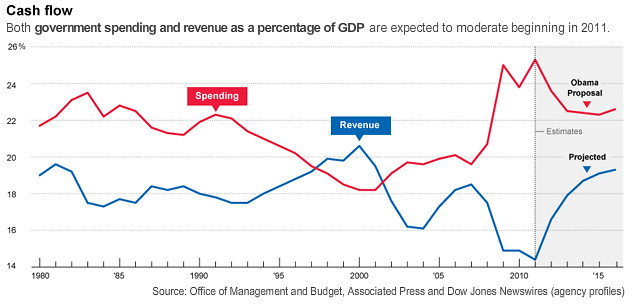
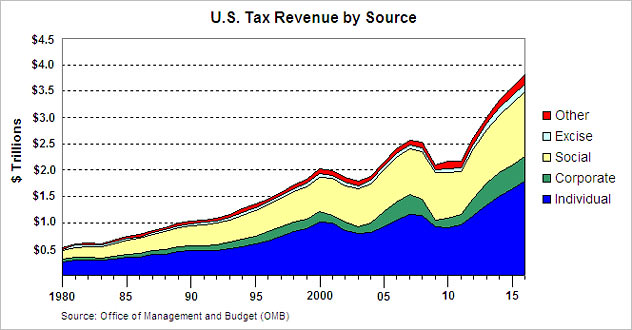
Which purely by the numbers (if not ideology) is an odd position to take. After all, as a percentage of the U.S. economy, the total federal tax bite hasn't been this low in 60 years.
As the chart representing President Obama's 2012 budget proposal above reflects, the American tax burden hasn't been this low in generations. Thanks to the combination of the Bush Recession and the latest Obama tax cuts, the AP reported, "as a share of the nation's economy, Uncle Sam's take this year will be the lowest since 1950, when the Korean War was just getting under way." In January, the Congressional Budget Office (CBO) explained that "revenues would be just under 15 percent of GDP; levels that low have not been seen since 1950." That finding echoed an earlier analysis from the Bureau of Economic Analysis. Last April, the Center on Budget and Policy Priorities concluded, "Middle-income Americans are now paying federal taxes at or near historically low levels, according to the latest available data." As USA Today reported last May, the BEA data debunked yet another right-wing myth:
Federal, state and local taxes -- including income, property, sales and other taxes -- consumed 9.2% of all personal income in 2009, the lowest rate since 1950, the Bureau of Economic Analysis reports. That rate is far below the historic average of 12% for the last half-century. The overall tax burden hit bottom in December at 8.8% of income before rising slightly in the first three months of 2010."The idea that taxes are high right now is pretty much nuts," says Michael Ettlinger, head of economic policy at the liberal Center for American Progress.
Or as former Reagan Treasury official Bruce Bartlett explained it this week the New York Times:
In short, by the broadest measure of the tax rate, the current level is unusually low and has been for some time. Revenues were 14.9 percent of G.D.P. in both 2009 and 2010. Yet if one listens to Republicans, one would think that taxes have never been higher, that an excessive tax burden is the most important constraint holding back economic growth and that a big tax cut is exactly what the economy needs to get growing again.



 Reply With Quote

 you guys are SO DELUDED! Govt spending has always been a huge part of GDP, even more during/after WWII.