Page 2 of 2 FirstFirst 12
Results 26 to 32 of 32
  1. #26
    Veteran scott's Avatar
    My Team
    San Antonio Spurs
    Join Date
    Apr 2003
    Post Count
    20,555

    Something is wrong with the combined 1st pick probability %. It should just be the two numbers from the first table added together. So 7th + 8th should be 8.2% + 6.0% = 14.2% instead of 13.7%. I think what you computed subtracted out the probability of both picks being the #1 pick, which can't happen.

    As for the other column, I think the percentages there should be a bit higher than what you listed as well, for a similar reason. I think you subtracted out the probability of both picks being in the 1-4 range, but there are cases that can't happen (both picks being #1, both being #2, etc) which should be added back in. However, the correct percentage is difficult to compute because you need to know the exact odds of getting each of the four picks.
    If you look at the Tankathon odds table, here: https://tankathon.com/pick_odds you can sum up the probabilities horizontally or vertically, but you cannot sum up both vertically and horizontally. So for example, if you had the #1 and #2 lotto seeds, adding up the Top-4 odds for each of those would give you a 104.2% chance at a Top 4 pick which is obviously incorrect (and in fact you'd have less than a 100% chance - you'd actually have around a 77% chance).

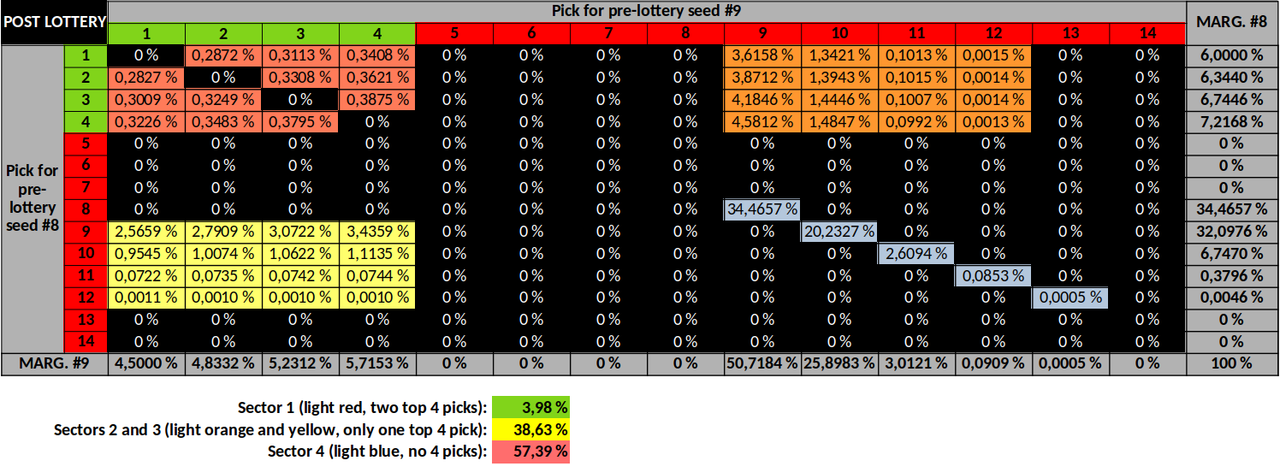
    We discussed this in a thread over the summer and Ariel made this nice table which calculates all the various possibilities if you end up with the 8th and 9th pre-lotto seeding in this post: https://www.spurstalk.com/forums/sho...1#post11093167


    Ariel actually calculated slightly better odds of at least one Top-4 pick in this scenario (42.6% versus the 41.6% chance that OP calculated).

    So yeah, OP's table is a little off... but it's close enough to give us an idea. You can calculate joint probability distributions for any combination of picks, which I'm sure we'll all be starting at for weeks between the time the regular season ends and the lottery draw takes place
    Last edited by scott; 03-03-2025 at 09:14 PM.

  2. #27
    Veteran scott's Avatar
    My Team
    San Antonio Spurs
    Join Date
    Apr 2003
    Post Count
    20,555
    ChatGPT has gotten better at these sorts of things... I got it to spit out this joint probability distribution model for where things currently sit (9th and 11th seed)


    Odds of at least one top-4 pick with 9 and 11 are 27.7%

    Here are the prompts I fed into ChatGPT to get the answers (which is a of a lot faster than calculating stuff yourself these days )

    1. "Consider the following table for NBA Lottery Odds"
    2. Feed in Tankathon table (literally just paste it in)
    3. "Calculate a joint probability distribution if you have the #9 and #11 seed" (you can replace 9 and 11 with whatever you want)
    4. Tell it to produce the full matrix when it asks you
    5. Tell it to produce the heatmap visualization when prompted
    6. After that you can just directly ask it "what are the odds that you get at least one top-4 pick"
    Last edited by scott; 03-03-2025 at 09:12 PM.

  3. #28
    Veteran scott's Avatar
    My Team
    San Antonio Spurs
    Join Date
    Apr 2003
    Post Count
    20,555
    The other way to quickly do this for calculating your joint probability for at least one top for pick is just this simple formula:

    P(At least one in Top 4) = 1 − P(Neither in Top 4)
    P(Neither in Top 4) = P(#x not in top 4) × P(#y not in top 4)

    So for picks #9 and #10 (the tankathon table updated as I was writing this as POR beat PHI... so now 9 and 10 are the current seedings), it would just be:

    P(Neither in Top 4) = (.797) x (.861) = 0.686

    P(At least one in Top 4) = 1 - 0.686 = .314 = 31.4% chance at a Top 4.

    Slightly different than OP's table, but close enough.

    Last edited by scott; 03-03-2025 at 09:32 PM.

  4. #29
    Veteran Spursfanfromafar's Avatar
    My Team
    San Antonio Spurs
    Join Date
    Jan 2009
    Post Count
    3,110

    Something is wrong with the combined 1st pick probability %. It should just be the two numbers from the first table added together. So 7th + 8th should be 8.2% + 6.0% = 14.2% instead of 13.7%. I think what you computed subtracted out the probability of both picks being the #1 pick, which can't happen.

    As for the other column, I think the percentages there should be a bit higher than what you listed as well, for a similar reason. I think you subtracted out the probability of both picks being in the 1-4 range, but there are cases that can't happen (both picks being #1, both being #2, etc) which should be added back in. However, the correct percentage is difficult to compute because you need to know the exact odds of getting each of the four picks.
    No, the probabilities aren't just an addition of the two.

    The reason we don’t simply add the probabilities of two picks to calculate the combined probability is due to the principle of independent events in probability theory. Instead, we use the formula:


    P(At least one wins 1st pick)=1−P(Neither pick wins 1st pick)Why Not Just Add the Probabilities?

    If we simply added the probabilities, we'd get an overestimated value. This is because there's a small chance that both picks could win at the same time, which isn't possible in the lottery (since only one team can get the 1st pick).

    Correct Method: Using the "At Least One" Formula

    Since each pick has an independent chance of winning, the correct way to calculate the combined probability is:


    P(\text{Neither pick wins}) = (1 - P_1) \times (1 - P_2)P(Neither pick wins)=(1−P1​)×(1−P2​)Then:

    P(\text{At least one wins}) = 1 - P(\text{Neither pick wins})P(At least one wins)=1−P(Neither pick wins)For example, for 7th & 8th picks:

    • 7th pick chance of 1st pick = 8.2% (0.082)
    • 8th pick chance of 1st pick = 6.0% (0.060)
    • Neither pick wins 1st pick:
      (1−0.082)×(1−0.060)=0.918×0.940=0.863(1 - 0.082) \times (1 - 0.060) = 0.918 \times 0.940 = 0.863(1−0.082)×(1−0.060)=0.918×0.940=0.863
    • At least one wins:
      1−0.863=0.137=13.7%1 - 0.863 = 0.137 = 13.7\%1−0.863=0.137=13.7%


    Key Takeaway

    If we incorrectly added the probabilities:
    8.2%+6.0%=14.2%(Overestimated)8.2\% + 6.0\% = 14.2\% \quad (\text{Overestimated})8.2%+6.0%=14.2%(Overestimate d)But the correct method gives 13.7%, which is slightly lower.
    This ensures that we're not double-counting cases where both picks would win simultaneously (which isn’t possible in the lottery system).

  5. #30
    Believe.
    My Team
    San Antonio Spurs
    Join Date
    May 2013
    Post Count
    82
    No, the probabilities aren't just an addition of the two.

    The reason we don’t simply add the probabilities of two picks to calculate the combined probability is due to the principle of independent events in probability theory. Instead, we use the formula:
    The problem is that the chances of the two teams winning the #1 pick are dependent events, not independent. It's dependent because if one team wins the #1 pick, the other teams' chances go to 0%. Dependent is like rolling one six-sided dice, and there are 6 teams, and the winner is the team whose number comes up. Each team has 1/6 chance, but if you have two teams' chances, you just added up the chances and get 1/6+1/6 = 1/3. Independent would be like rolling one dice per team, and if they got their number on their roll, they'd get the pick. But with this model, it would be possible for multiple teams to get the same pick, so this isn't the correct model for the lottery.

    Consider if there were only 2 teams in the league, and the chances of them winning the lottery were 60% and 40%. If you had both teams' picks, you would simply add 60+40 = 100%. With the "at least one" formula, you'd get .6 + (.4*.6) = .84 = 84% which is clearly wrong.

  6. #31
    Veteran scott's Avatar
    My Team
    San Antonio Spurs
    Join Date
    Apr 2003
    Post Count
    20,555
    The problem is that the chances of the two teams winning the #1 pick are dependent events, not independent. It's dependent because if one team wins the #1 pick, the other teams' chances go to 0%. Dependent is like rolling one six-sided dice, and there are 6 teams, and the winner is the team whose number comes up. Each team has 1/6 chance, but if you have two teams' chances, you just added up the chances and get 1/6+1/6 = 1/3. Independent would be like rolling one dice per team, and if they got their number on their roll, they'd get the pick. But with this model, it would be possible for multiple teams to get the same pick, so this isn't the correct model for the lottery.

    Consider if there were only 2 teams in the league, and the chances of them winning the lottery were 60% and 40%. If you had both teams' picks, you would simply add 60+40 = 100%. With the "at least one" formula, you'd get .6 + (.4*.6) = .84 = 84% which is clearly wrong.
    I agree with this, and is what I alluded to earlier where you can add up horizontally or vertically on the table, but you can't do both. If you look at all the odds for pick #1 of the various seedings (the vertical reading), they all equal 100%, and the odds for each seed add up to 100% (the horizontal reading). If you hold multiple seedings, you can just add them together for any one pick. You don't have to worry about accounting for the possibility that both end up at #1, because this is a one-shot game... there is only one roll of the dice and therefor there is no possibility of more than one outcome for a given pick.

    Likewise, that's the reason you can sum up odds both vertically and horizontally simultaneously (and by that, I mean you can add the "Top 4 Odds" of one seed and the "Top 4 Odds" of another seed and get the right answer). That's because in determining multiple picks it ceases to be a one-shot game, and becomes a multiple-shot game (in this case, 4 shots). If one of the seeds lands #1, it automatically excludes it from winning #2, 3 or 4 (though supposedly the Spurs also "won" the #2 pick in the Wemby draft even though they had already got #1... that winning pull had to be thrown out). So by winning in the #1 game, you reduce your odds of winning the #2, 3, or 4 game because one of your seeds is now eliminated.

    TLDR version: to get the odds of landing a specific pick, you just add the Spurs and Hawks seeds together. To get the joint odds of "at least one better than", you have to use the probability formula provided above.

  7. #32
    Veteran Spursfanfromafar's Avatar
    My Team
    San Antonio Spurs
    Join Date
    Jan 2009
    Post Count
    3,110
    Tankathon lists the probability for each team's picks based on their current NBA standings. Here are the odds for each team in the lottery (assuming none of the picks are traded and all picks are owned) -


    Now the Spurs are currently picking 10th and 11th (from the Atlanta Hawks). What is the probability of the Spurs picking 1st or within the top 4 considering they have both picks? While we want to find that answer, lets also calculate the probability of picking 1st or within the top 4 if the land earlier in the lottery. Here are some possible scenarios (the most likely ones. The Spurs and Hawks will find it difficult to drop all the way down to the 6th position based on how current rankings are).


    In other words, the Spurs will have nearly the same probability of picking the 1st pick and within the top 4 if they land up in the 7th position and the Hawks in the 8th position, as what the teams in the worst 3 have. As things stand, they are getting the 10th & 11th picks .. which gives them a 4.9% chance to win the NBA lottery and a 22.3% chance of getting a pick in the top 4. Thats the equivalent of having the same odds as the 9th worst team.

    Here's hoping that the Hawks and/or the Spurs get into a situation that they lose games enough to finish higher in the lottery if the idea is to get one of the top 4 picks in the lottery.
    Updated odds with other pick possibilities as well -


    As of now the Hawks are picking after 14. But there is a good chance that they might land up between 10 and 14 still.

Thread Information

Users Browsing this Thread

There are currently 1 users browsing this thread. (0 members and 1 guests)

Posting Permissions

  • You may not post new threads
  • You may not post replies
  • You may not post attachments
  • You may not edit your posts
  •