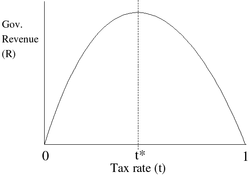
In fairness to Mr. Laffer, there's nothing wrong with this theory. It's almost certainly very true in countries with very high rates of taxation. If you consider the extreme, say a 99 percent marginal tax rate, then the government will probably not be collecting a lot of revenue. To begin with, citizens are going to hide as much income as possible. (The more honest ones will turn to barter and avoid the tax system entirely.) And no one is going to rush out and take a second job or build a factory if they get to keep only $1 of every $100 that they earn.
So it's entirely likely that slashing tax rates from 99 percent to 30 percent could increase government tax revenues. It would deflate the black market and provide a huge new incentives to get back to work and invest - the honest way....
But here's the problem when we take Laffer's theory and try to apply it in the U.S. We don't have a 99 percent marginal tax rate. Or 70 percent. Or even 50 percent. We start with low marginal tax rates relative to the rest of the developed world. (Yes, I understand that it may not feel that way after the check you wrote last month.)
So cutting the tax rate from 36 percent to 33 percent is not going to give you the same kind of economic expansion as slashing a tax rate from 90 percent to 50 percent. There's no huge black market to be shut down, no big supply of skilled workers to be lured back into the labor market, and so on....
Will it generate new economic activity? Probably. And that will generate some incremental tax revenue for the government. But remember, it also means that the government will be taking a smaller cut of all the economic activity than they already were...
Think about a simple numerical example: Assume you've got a $10 trillion economy and an average tax rate of 30 percent. So the government takes $3 trillion.
Let's cut the average tax rate to 25 percent and, for the sake of example, assume that it generates $1 trillion in new economic growth (a Herculean assumption, by the way). So now, what does Uncle Sam get? One quarter of $11 trillion is only $2.75 trillion. The economy grows, government revenues shrink.
That's basically what happened with the large Reagan and George W. Bush tax cuts, both of which were followed by large budget deficits. Yes, spending has a lot to do with that, but the bottom line is unequivocal - In both cases, government revenue was lower than it would have been without the tax cuts.



 Reply With Quote