Reply With Quote
You can't live off vitamin supplements and eating steak and eggs three times a day will just give you scurvy and heart disease by age 14.
Soylent Green is people, good eats.We can always have some Soylent Green. I heard it goes good with margarine.

We can always have some Soylent Green. I heard it goes good with margarine.

You can't live off vitamin supplements and eating steak and eggs three times a day will just give you scurvy and heart disease by age 14.
Soylent Green is people, good eats.We can always have some Soylent Green. I heard it goes good with margarine.

YahooTAIPEI (Reuters) - Taiwan's bee farmers are feeling the sting of lost business and possible crop danger after millions of the honey-making, plant-pollinating insects vanished during volatile weather, media and experts said on Thursday.
Over the past two months, farmers in three parts of Taiwan have reported most of their bees gone, the Chinese-language United Daily News reported. Taiwan's TVBS television station said about 10 million bees had vanished in Taiwan.
A beekeeper on Taiwan's northeastern coast reported 6 million insects missing "for no reason," and one in the south said 80 of his 200 bee boxes had been emptied, the paper said.
LinkyMark Brady, president of the American Honey Producers Association Inc., told the committee that "honey bees pollinate more than 90 food, fiber and seed crops. In particular, the fruits, vegetables and nuts that are cornerstones of a balanced and healthy diet are especially dependent on continued access to honey bee pollination."
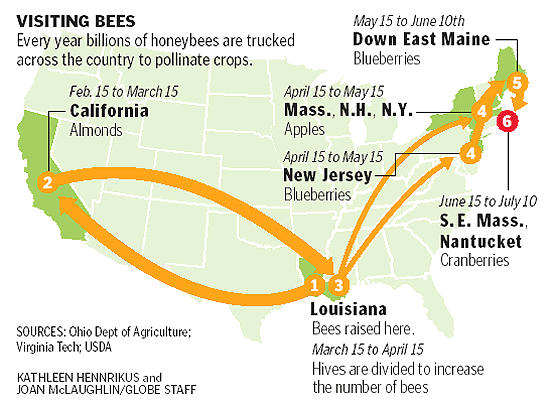
Brady went on: "The importance of this pollination to contemporary agriculture cannot be understated. The value of pollinated crops is vastly greater than the total value of honey and wax produced by honey bees. The scale of commercial pollination is also vast. Each year more than 140 billion honey bees representing 2 million colonies are employed by U.S. beekeepers across and around the country to pollinate a wide range of important crops."
He asked Congress to "work closely with beekeepers, agricultural producers, researchers and others on an urgent basis to find the causes of CCD and to develop effective measures to address this new and serious threat."
The strange malady became apparent when beekeepers realized that worker bees were vanishing from their hives. The queen bees and the younger bees were all in place, but the ones that do the work for the highly structured society had disappeared and their bodies were nowhere to be found. "This is what makes the phenomenon so hard. There are no actual dead bees to study," said May Berenbaum, head of the entomology department at the University of Illinois.
Why is it green?

Because they ran out of red and yellow dye, and besides that the
green ones are owned by Hailburton.
"you can take a vitamin supplements?"
Please show any scientific research that vitamins have any positive effect.
Please show any scientific research that vitamins from industrial products are better or even equal to vitamins from natural food.
Can Bees pollinate wheat? I dont' know, so I'm asking.

Voices Green and Purple.
Isn't that some 1960's pyschedelic song?
This growing crisis is sailing past the M$M...
Yahoo NewsBELTSVILLE, Md. - Unless someone or something stops it soon, the mysterious killer that is wiping out many of the nation's honeybees could have a devastating effect on America's dinner plate, perhaps even reducing us to a glorified bread-and-water diet.
Honeybees don't just make honey; they pollinate more than 90 of the tastiest flowering crops we have. Among them: apples, nuts, avocados, soybeans, asparagus, broccoli, celery, squash and cu bers. And lots of the really sweet and tart stuff, too, including citrus fruit, peaches, kiwi, cherries, blueberries, cranberries, strawberries, cantaloupe and other melons.
In fact, about one-third of the human diet comes from insect-pollinated plants, and the honeybee is responsible for 80 percent of that pollination, according to the U.S. Department of Agriculture.
Even cattle, which feed on alfalfa, depend on bees. So if the collapse worsens, we could end up being "stuck with grains and water," said Kevin Hackett, the national program leader for USDA's bee and pollination program.

We'll be cloning them in no time.
Colony Collapse and Honeycomb Size
Tue, 24 Apr 2007 00:00:00 -0700
By Sharon Labchuk
Linky"Natural" beehives appear less affected by the strange new plague dubbed colony collapse disorder. Colony Collapse Disorder in domestic honey bees is all the buzz lately, mostly because honey bees pollinate food crops for humans.
However, we would not be so dependent on commercial non-native factory farmed honey bees if we were not killing off native pollinators. Organic agriculture does not use chemicals or crops toxic to bees and, done properly, preserves wildlife habitat in the vicinity, recognizing the intimate relationship between cultivated fields and natural areas.
While no one is certain why honey bee colonies are collapsing, factory farmed honey bees are more susceptible to stress from environmental sources than organic or feral honey bees. Most people think beekeeping is all natural but in commercial operations the bees are treated much like livestock on factory farms.
I’m on an organic beekeeping email list of about 1,000 people, mostly Americans, and no one in the organic beekeeping world, including commercial beekeepers, is reporting colony collapse on this list. The problem with commercial operations is pesticides used in hives to fumigate for varroa mites and antibiotics are fed to the bees to prevent disease. Hives are hauled long distances by truck, often several times during the growing season, to provide pollination services to industrial agriculture crops, which further stresses the colonies and exposes them to agricultural pesticides and GMOs.
Bees have been bred for the past 100 years to be much larger than they would be if left to their own devices. If you find a feral honeybee colony in a tree, for example, the cells bees use for egg-laying will be about 4.9 mm wide. This is the size they want to build – the natural size.
Natural pollinators like Bumble bees don't seem to be as effected by colony collapse as the agri-grown bees naturally cloned to pollinate and produce honey, leading some to believe that the problem may lie in some type of naturally occuring disorder rather than a genetically-induced plague.

If bee dies, bee dies.
^^^^ Rowflmaoflao!!!!!
Jim Hightower has this all figured out...
The Hightower ReportAnother little-known fact is that bee pollination is increasingly a highly concentrated industry. Rather than a dispersed system of local hives, a few commercial operators now haul tens of billions of bees from coast to coast, trucking their hives in 18-wheelers.
Colony Collapse Disorder, as it's now called, could be the result of this industrialized model of pollination. First, the bees themselves have been bred into single-purpose superpollinators, rather than bees with multiple functions (make honey, feed the queen, maintain the hives, and extend the species). The industrial bees have lost the diversity and natural traits of wild bees.
Second, constant trucking puts stress on the bees, suppressing their immune systems and making them vulnerable to viruses, mites, and diseases. Also as part of their forced migration, the bees are fed a limited diet of high fructose corn syrup – about as healthy as humans trying to live on Cokes. Other research is indicating certain pesticides and genetically altered organisms that have been artificially spliced into many field crops.
Once again, we have the heavy hand of mankind messing with Mother Nature in ways that come back to mess with us – big time. It's not just bees these food industrialists are messing with – it's our food supply.

Well, the Einstein quote might be an Urban Legend. I tried to find it, but couldn't find an actual source.
Still....
It is a serious concern. I am one to believe it is the digital cell phone systems in the 1.8 GHZ to 1.9 GHZ range. Just the right wavelength to screw with a bees navagation system if magnetic based. It seems the bee numbers have been falling with increased building of cell towers, in line with the locations.
Let's assume the Einstein quote is correct. The Myan (or is it Inca?) calender ends 12/21/2012!
From: "HSI - Jenny Thompson" <[email protected]>
http://www.hsibaltimore.com
"Dear Reader,
The mystery of the missing honeybees may have a simple solution. But will anyone pay attention?
--------------------------------------------
Antibiotic bees
--------------------------------------------
Over the past few months I've been following a stream of daily updates about colony collapse disorder (CCD), the phenomenon in which bees abandon their hives and disappear. CCD continues to be reported throughout the U.S. and Canada - a potential disaster for food crops that require pollination.
Most of the updates I've seen come from newspapers that detail local incidences of CCD. And most of them read the same: a description of the overall problem followed by interviews with local beekeepers. Each of these accounts notes the various theories about what causes CCD (all speculation at this point): fungi, bacteria, pesticides, parasitic mites, weakened immune systems, and even interference from cell phone towers.
But this week I came across an entirely different CCD article. The le: "No ORGANIC Bee Losses."
This article is described as a "widely circulated email" from Sharon Labchuk, an environmental activist and part-time beekeeper. Ms. Labchuk states that she's on an organic beekeeping list of about 1,000 beekeepers - mostly American - and "no one in the organic beekeeping world, including commercial beekeepers, is reporting colony collapse on this list.
"The problem with the big commercial guys is that they put pesticides in their hives to fumigate for varroa mites, and they feed antibiotics to the bees. They also haul the hives by truck all over the place to make more money with pollination services, which stresses the colonies."
--------------------------------------------
Forget me not
--------------------------------------------
Ms. Labchuk goes on to quote a message from a web site maintained by beekeeper Michael Bush. Mr. Bush explains that he has no problems with varroa mites because he uses natural sized cells. Larger commercial beekeepers tend to use larger hive foundations, which result in larger cells and larger bees than those in natural hives.
Mr. Bush: "By letting the bees build natural sized cells, I have virtually eliminated my Varroa and Tracheal mite problems."
Ms. Labchuk's response: "Who should be surprised that the major media reports forget to tell us that the dying bees are actually hyper-bred varieties that we coax into a larger than normal body size? It sounds just like the beef industry."
And who should be surprised that media reports also tend to gloss over any potential connection between genetically modified (GM) crops and CCD? We're told there's no evidence of such a link and the subject is dropped, as if evidence would be impossible to produce. Okay - no evidence - then how about the next best thing?
In October 2000, Joe Rowland (a beekeeper and the secretary/treasurer of the Empire State Honey Producers Association) testified before the New York Assembly regarding the way GM organisms might affect honeybees. He drew his testimony from available research and his own knowledge of honeybee biology.
After noting that pollen is the honeybee's protein source and that the gene structure of pollen is modified in GM crops, he offered this comment: "Findings indicate that none of the tested pollens kill adult bees outright, but that they may shorten their lifespan and cause some behavioral changes, particularly in a loss of their ability to learn and to smell. This may cause foraging bees to 'forget' where flowers or even their own hive is located."
Note that this comment was made a full seven years before the phrase "colony collapse disorder" was coined. Those seven years may have taken a heavy toll."
I think bee's should be respected.

It is interesting that it is the industrialized bee=keeping industry that is having the problem; I wasn't aware of that angle, nor am I surprised. The problem could be self-correcting when that industry collapses.

well they still have t hem boxes, put it too good use, meth lab biatches

I definitely think this is an important issue, however Earth is much more resilient to overcome this obstacle
and
Mankind has already come up with ways to pollinate gardens w/o insect life. A pretty ty Plan B, but not all humans would die.
No big deal. No bees means there is food sitting there. Where there is food, something else will move in to feed on it. All the wasps in Texas that pollinate these nasty sour orange trees are a good example.
Nature wont let everything collapse from one thing going away.
Your missing the point. The bees aren't going away. "Domesticated" bees are vanishing, natural bees aren't. And the domesticated ones aren't dieing, they're just dissapearing. No dead bodies.
Probably the domesticated ones are hooking up with africanized honey bees when they are out cruisin for pollen. You know the old saying, once you go african you never go back.
Most americans would do well to pass up every third bite."Every third bite we consume in our diet is dependent on a honeybee to pollinate that food," said Zac Browning, vice president of the American Beekeeping Federation.

There are currently 1 users browsing this thread. (0 members and 1 guests)
 Posting Permissions