Reply With Quote
By the way, RG, no one has explained to me why temperatures cooled between 1940 and 1975, a 35-year period when there was substantial CO2 emmissions.

According to numerous sources including the IPCC, natural sources emit 150 million tons of CO2 and human sources are almost 30 times less than that. 1/30 is roughly 3% according to my calculator.
When I stated this exact thing earlier, you said I was "distorting the science".
I thought it was completely understood and a "settled" science.
By the way, RG, no one has explained to me why temperatures cooled between 1940 and 1975, a 35-year period when there was substantial CO2 emmissions.

Originally Posted by RandomGuy
Please cite a source for this cost [of $300bn annual cost]
Thank you for taking the time to get this. I really do appreciate it. I was really wanting to get to the basis for this claim for some time, but have been unable to find it.
GDP in 1992 dollars in 2020, base case (no Kyoto) $11,478
GDP in 1992 dollars in 2020, Kyoto implemented: $11,245
Long-term, even this incomplete economic look gives a grand total of 2% difference in GDP after 20 years.
What was lacking in this do ent was any consideration of NET jobs lost/gained.
Nowhere in the do ent did it weigh in ANY potential benefits to the economy, such as increases in employment in the renewables sector. It did show an increase in renewable output of electricity, but didn't mention anything about their starting assumptions.
Funny that these numbers were based on (gasp) computer modeling of complex systems, in this case the economy.
How do we know that the ideological bent of the economic study's authors didn't color THEIR starting assumptions?
, this study was from 1998, and gas price increases have already exceeded what they thought would happen under the Kyoto treaty restrictions, so it can be pretty easily shown that their starting assumptions for how the economy would work out were wrong, simply from the benefit of hindsight.
Sorry, but that do ent not only doesn't prove the costs, it actively proves that there is absolutely no basis whatsoever to the claim that we would hurt our economy by limiting our CO2 emissions in some manner.
Last edited by RandomGuy; 02-11-2009 at 01:56 PM.
You didn't pick up on my sarcasm? I don't understand why you're quoting me here.
'cause I accidentally hit the post button in the middle of putting together somethign kind of complicated. I fixed it in an edit though. Sorry.
Lunch hour is up, but I will try to get back to you at some point.
Adios.

The values of man made CO2 in the atmosphere can be determined by the ratio of isotopes. Natural CO2 has carbon-14 in it's makeup and fossil fuels have none. Fossil fuels only have carbon-12 and carbon-13 in them since they are so old, the radioactive carbon-14 has dissipated.
I completely forgot about this aspect. I know this has been attempted to be quantified, but there is much disagreement on the results. This method shows that man-made CO2 is smaller than the subtraction of present from past levels.
I have done some searches and so far found little useful. Salmon scales seem to be one of the better proxies by how much of each isotope they contain for ocean sinking.
Last edited by Wild Cobra; 02-11-2009 at 06:15 PM.
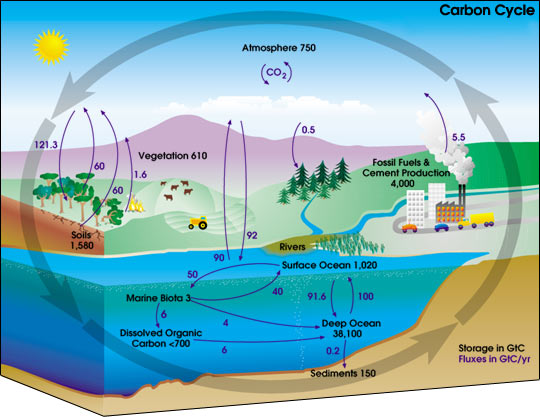
This is very true Random. Go to any Carbon Cycle model, and look for yourself. The first one has a total of 6.3 GTons from fossil fuels and concrete sources and 201.6 from natural sources. The second one has 5.5 vs. 221.6. That means that less than 3% of the increased atmospheric CO2 is man made. If we take 380 - 280 for a 100 ppm difference, man is responsible for only a 3 ppm increase! Even if you include land use because we change the landscape, the numbers don't rise very much.
This is why I say you can often find good data in the IPCC report, just that they they ignore certain facts that don't fit their agenda.
Remember that the carbon cycle and everything involved is dynamic. Not static. Theo things immediately come to mind to account for increased CO2 levels:
1) As the ocean temperature rises, they are not capable of holding as much CO2. Consider the idea that the majority of the warming could be solar and soot driven. Just like a cold beer retains its CO2, and a warm one is flat, the same thing happens here. The warmer the water, the less CO2 it reatains, increasing the atmospheric CO2 levels.
2) The oceans are acidifying. The alarmist like to blame it on CO2, but the known equations show that higher acidity reduces CO2 absorption.
Both the two items reduce how much CO2 the oceans can sink as a ratio.
All of which is highly irrelevant, because doing something along the lines of the Kyoto treaty would end up helping our economy, Global Warming or not.
Checkmate.
Since you're such a stickler for sources, can you provide a source to back up your assertion?
I wouldn't expect anything persuasive if I were you.
WTF...
What have you been smoking. May I have some please?
Good paper by a a left-leaning scientist
http://carbon-sense.com/wp-content/u.../hertzberg.pdf
My favorite quote from the paper:
"In comparison to water in all of its forms, the effect of the
carbon dioxide increase over the last century on the
temperature of the earth is about as significant as a few farts in
a hurricane!”
There's also a very good graph that shows the potential warming effect of CO2 as a function of CO2 concentration. It's a decaying exponential, essentially the same logrithmic graph that WC presented, but flipped about the horiztonal axis.
That deserves its own thread.
Thanks for the idea, and yes, I can provide sources. Bit of a research project, but I think I can make a pretty decent case.
Give me a bit of time, and remind me in case my absent-mindedness gets the better of me.
The alarmists here like to cite RealClimate dot ORG. Suggest you read this:
GAVIN SCHMIDT'S RESPONSE TO THE ACQUITTAL OF CO2
SHOULD SOUND THE DEATH KNELL FOR AGW
by Jeffrey A. Glassman, PhD
"That is a distortion of science my good sir."
I like that, I'll have to put it to use in the future.

The Southwest proves AGW is happening; the Northeast is natural fluctuations and prove nothing.
whoot.
Because as we all know, one' years data proves/disproves everything.
How about 10 years?
50-500 years would be better. What are the trends over that period of time?
One would want to focus mostly on the industrial revolution, as that is one very obvious variable introduced into the rather complex system of our climate.
Besides lowering CO2 emissions would create a lot of jobs and improve the economy.
Why do the deniers hate the US and want to see us in economic ruin?
If one looks even further back and sees a period that is as warm as today, wouldn't our current "warming" seem unremarkable?
because we seem to want to have this debate, yet again.
There are currently 1 users browsing this thread. (0 members and 1 guests)
 Posting Permissions