Reply With Quote
something structurally similar is true of the auto market. a lot of bad debt is going to be exposed when interest rates rise.

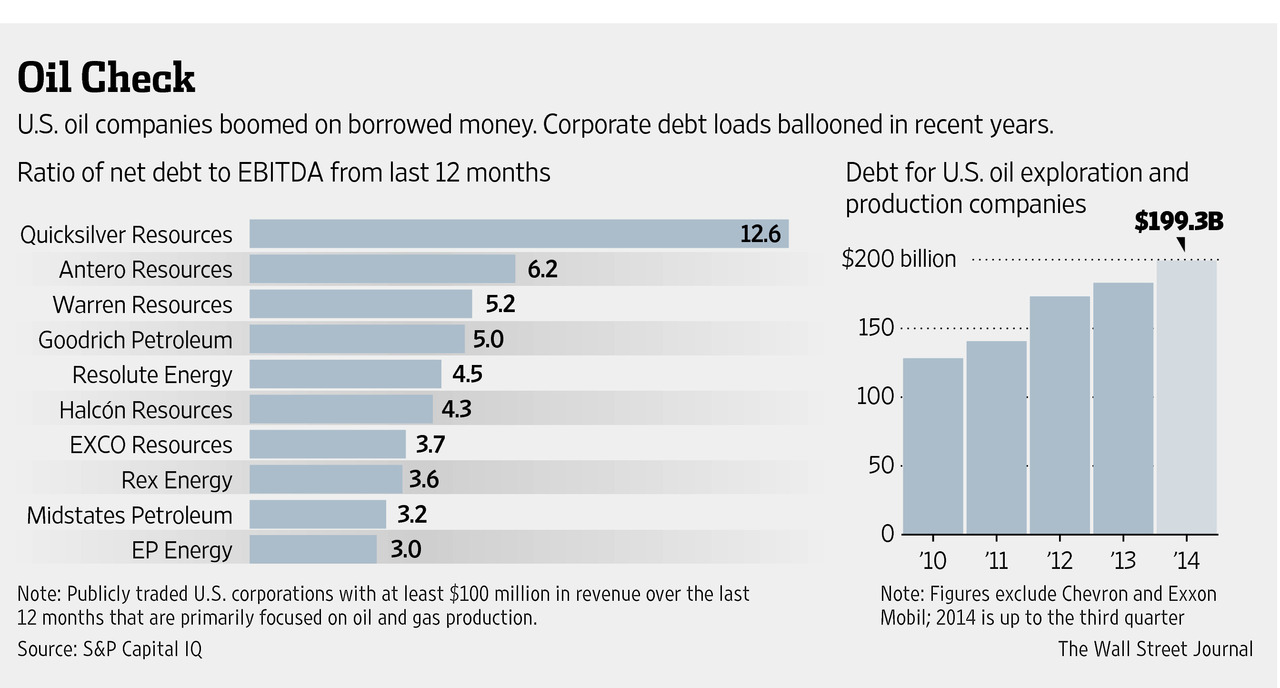
with the end of zero bound interest financing and dropping prices, energy markets -- and the wider economy -- could be in for a reckoning. fracking is financed largely by junk bonds:
http://www.nakedcapitalism.com/2014/...-insanity.html
something structurally similar is true of the auto market. a lot of bad debt is going to be exposed when interest rates rise.
Saudi Arabia well head price: about $30/barrel
USA fracking well head price: about $60/barrel
Canadian tar sands price? about ?? / barrel

Just reading this thread is depressing. They've got a million of those damn things around here I'm probably screwed.
"While production growth is very strong [in North America], remember if you look at the debt situation for a lot of these companies, there is a lot of distressed debt," said Beveridge.
"$68 a barrel is not economical for a lot of these shale oil wells. CDS [credit default swap] spreads and yields on some of the debt are rising very quickly, because at these kinds of oil prices you are going to see producers go bankrupt," he added.
Since 2011, U.S. energy firms have ploughed some $1.5 trillion into ramping up their operations, taking on a large share of debt to do so, according to AllianceBernstein. Debt issued by energy companies now accounts for more than 15 percent of the U.S. junk bond market, compared with less than 5 percent a decade ago.
Small companies that have levered up to fund exploration and production will see their margins squeezed with bankruptcy "a distinct possibility,"
http://www.cnbc.com/id/102222911
Stupidity of Pink Fracking Fully Exposed on The Daily Show
Even Susan G. Komen’s own website shares the chemicals from fracking that are linked to breast cancer, but it didn’t stop them from partnering with oil and gas giant Baker Hughes, which donated $100,000 to Komen in October for the “Doing Our Bit for the Cure” campaign where 1,000 fracking drill bits were painted pink.
The viral post on EcoWatch, written by breast cancer survivor and fracking activist Sandra Steingraber, exposed the hypocrisy of this campaign.
Now, The Daily Show with Jon Stewart takes this outrageous partnership to new heights.
Watch this hilarious segment where The Daily Show‘s Samantha Bee meets Karuna Jaggar, executive director of Breast Cancer Action, to fully uncover the stupidity of pink fracking.
http://ecowatch.com/2014/12/04/pink-...d1ece-85879165
Studies Raise Red Flags About Hazardous Compounds in Fracking Fluid
this month federal officials announced they will allow some fracking in George Washington National Forest - the largest national forest in the eastern United States.
At the same time, scientists are finally getting to the bottom of what's in fracking fluids - with some troubling results. Truthout takes a detailed look at two of these studies, which raise some red flags.
Perhaps the most comprehensive look to date at fracking chemicals was presented in August at the National Meeting & Exposition of the American Chemical Society (ACS).
William Stringfellow, a professor in environmental engineering at the University of the Pacific, lead author of the report, said he conducted the review of fracking contents to help resolve the public debate over the controversial drilling practice.
Fracking involves injecting water with a mix of chemical additives into rock formations deep underground to promote the release of oil and gas. It has led to a natural gas boom in the United States, but it has also stimulated major opposition and troubling reports of contaminated well water, as well as increased air pollution near drill sites.
The team of scientists presenting this work said that out of nearly 200 commonly used compounds, there's very little known about the potential health risks of about one-third. However, they concluded eight of the known compounds are toxic to mammals. Chemicals such as corrosion inhibitors and biocides are being used in "reasonably high concentrations that potentially could have adverse effects," said Stringfellow.
"Biocides are inherently toxic by design," he told Truthout. "They need to be evaluated even if used in small amounts because of their toxicity."
"Produced water can have benzene, which can get into groundwater or volatilize into air. . . . It's not good to either drink or inhale it."
A second study released in October by the Environmental Integrity Project (EIP) found that despite a federal ban on the use of diesel fuel in hydraulic fracturing without a permit, several oil and gas companies are exploiting a Safe Drinking Water Act loophole pushed through by Halliburton to frack with petroleum-based products containing even more dangerous toxic chemicals than diesel. For example, a drilling company in West Texas injected up to 48,000 gallons of benzene into the ground in September.
Over about two months, Eric Schaeffer, Executive Director of the EIP and former Director of Civil Enforcement at the Environmental Protection Agency, studied more than 150 records in the industry-sponsored database of chemicals used in hydraulic fracturing, called FracFocus.
"Five gallons of ethylbenzene can pollute a billion gallons of water."
Fracking with fluids containing benzene (a carcinogen), ethylbenzene (a probable carcinogen) and other highly toxic chemicals is a potential threat to drinking-water supplies and public health, but, it appears to be common practice, according to the EIP's review of product descriptions available online and company disclosures in FracFocus, an online chemical disclosure registry. "Produced water can have benzene, which can get into groundwater or volatilize into air," Schaeffer told Truthout. "It's not good to either drink or inhale it."
High Concentrations of Ethylbenzene
During an interview earlier in November, Schaeffer and a Truthout reporter went over the most recent, complete entries in the FracFocus database. In one of the first disclosure reports, a well operated by Citation Oil and Gas Corp. in Carter County, Oklahoma, had more than 90 gallons of ethylbenzene present in "hydraulic fracturing fluid product."
"Texas is in a record-breaking drought where private water wells and even wells for entire towns are going dry. Every drop is precious so we cannot risk polluting any water with toxic fracking chemicals."
"That's a lot," Schaeffer said. "Five gallons of ethylbenzene can pollute a billion gallons of water."
According to EPI, even the limited data available on FracFocus shows at least 153 wells in 11 states were fracked with fluids containing ethylbenzene between January 2011 and September 2014, with the largest numbers of wells in Oklahoma (77 wells), North Dakota (23), Texas (20), Wyoming (11), Colorado (9), California (5), Ohio (3), Louisiana (2), New Mexico (1), Montana (1) and Michigan (1).
In some cases, the amount of toxic fracking fluids injected into the ground is large. The BlackBush Dimmit well, in San Antonio, Texas, was not the only case EIP found of extensive levels of benzene.
For example, between May 2013 and February 2014, another firm, Discovery Operating Services, reported injecting solvents containing nearly 1,000 gallons of benzene into 11 wells in Midland and Upland counties in Texas.
Sharon Wilson, Texas organizer for Earthworks' Oil & Gas Accountability Project, said: "Texas is in a record-breaking drought where private water wells and even wells for entire towns are going dry. Every drop is precious so we cannot risk polluting any water with toxic fracking chemicals."
http://www.truth-out.org/news/item/2...nown-chemicals
BigCarbon destroying the planet, pure 100% insanity.
Health worries pervade North Texas fracking zone
Propped up on a hospital bed, Taylor Ishee listened as his mother shared a conviction that choked her up. His rare cancer had a cause, she believes, and it wasn’t genetics.
Others in Texas have drawn the same conclusions about their confounding illnesses. Jana DeGrand, who suffered a heart attack and needed both her gallbladder and her appendix removed. Rebecca Williams, fighting off unexplained rashes, sharp headaches and repeated bouts of pneumonia. Maile Bush, who needed surgery for a sinus infection four rounds of antibiotics couldn’t heal. Annette Wilkes, whose own severe sinus infections were followed by two autoimmune diseases.
They all lived for years atop the gas-richBarnett Shale in North Texas, birthplace ofmodern hydraulic fracturing. And they all believe exposure to natural gas development triggered their health problems.
“I’ve been trying to sell my house,” said Williams, a registered nurse, “because I’ve got to get out of here or I’m going to die.”
Texas regulators and politicians have shrugged off such complaints for years.
The leap from suspected environmental exposure to definitive proof of harm is a difficult one, and they insist they’ve found no cause for concern.
Officials in other states have said the same thing as hydraulic fracturing — known as fracking — moved beyond Texas and opened up lucrative oil and gas deposits across the country.
http://www.publicintegrity.org/2014/...est+Stories%29
Fired: Texas regulators say they tried to enforce rules, lost jobs
During their careers as oil and gas inspectors for the Texas Railroad Commission, Fred Wright and Morris Kocurek earned merit raises, promotions and praise from their supervisors.
They went about their jobs — keeping tabs on the conduct of the state’s most important industry — with gusto.
But they may have done their jobs too well for the industry’s taste — and for their own agency’s.
Kocurek and Wright, who worked in different Railroad Commission districts, were fired within months of each other in 2013. Both say their careers were upended by their insistence that oil and gas operators follow rules intended to protect the public and the environment.
The incidents Kocurek and Wright describe offer an inside look at how Texas regulates the oil and gas industry, a subject InsideClimate News and the Center for Public Integrity have been investigating for more than a year and a half.
The investigation has found that the Railroad Commission and its sister agency, the Texas Commission on Environmental Quality, focus more on protecting the industry than the public, an approach tacitly endorsed by the state’s political leaders.
The Railroad Commission is controlled by three elected commissioners who, combined, accepted nearly $3 million in campaign contributions from the industry during the 2012 and 2014 election cycles, according to data from the National Ins ute on Money in State Politics.
Gov. Rick Perry collected a little less than $11.5 million in campaign contributions from those in the industry since the 2000 election cycle. The governor-elect, Attorney General Greg Abbott, accepted more than $6.8 million.
http://www.publicintegrity.org/2014/...est+Stories%29
TX govt is 100% corrupt.
The Alarming Research Behind New York's Fracking Ban
The research incorporates findings from multiple studies conducted across the country and highlights the following seven concerns:
- Respiratory health: The report cites the dangers of methane emissions from natural gas drilling in Texas and Pennsylvania, which have been linked to asthma and other breathing issues. Another study found that 39 percent of residents in southern Pennsylvania who lived within one kilometer of a fracking site developed upper-respiratory problems compared with 18 percent of those who lived more than two kilometers away.
- Drinking water: Shallow methane-migration underground could seep into drinking water, one study found, contaminating wells. Another found brine from deep shale formations in groundwater aquifers. The report also refers to a study of fracking communities in the Appalachian Plateau where they found methane in 82 percent of drinking water samples, and that concentrations of the chemical were six times higher in homes close to natural gas wells. Ethane was 23 times higher in homes close to fracking sites as well.
- ?Seismic activity: The report cites studies from Ohio and Oklahoma that explain how fracking can trigger earthquakes. Another found that fracking near Preese Hall in the United Kingdom resulted in a 2.3 magnitude earthquake as well as 1.5 magnitude earthquake.
- Climate change: Excess methane can be released into the atmosphere, which contributes to global warming. One study predicts that fracking in New York State would contribute between 7 percent and 28 percent of the volatile organic compound emissions, and between 6 percent and 18 percent of nitrogen oxide emissions in the region by 2020.
- Soil contamination: One analysis of a natural gas site found elevated levels of radioactive waste in the soil, potentially the result of surface spills.
- The community: The report refers to problems such as noise and odor pollution, citing a case in Pennsylvania where gas harvesting was linked to huge increases in automobile accidents and heavy truck crashes.
- Health complaints: Residents near active fracking sites reported having symptoms such as nausea, abdominal pain, nosebleeds, and headachesaccording to studies. A study in rural Colorado which examined 124,842 births between 1996 and 2009 found that those who lived closest to natural gas development sites had a 30 percent increase in congenital heart conditions. The group of births closest to development sites also had a 100-percent increased chance of developing neural tube defects.
http://news.yahoo.com/alarming-resea...190028034.html
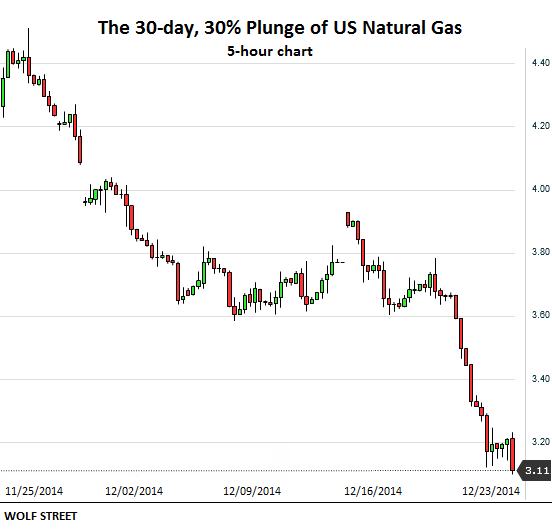
First Oil, Now US Natural Gas Plunges, “Negative Igniter” for New Debt Crisis
Wolf has been keeping a sharp eye out on how shale gas players were junk bond junkies, and how that is going to lead to a painful withdrawal. Here, he focuses on one of the big drivers of the heavy borrowings: the deep involvement of private equity firms, who make money whether or not the companies they invest in do well, by virtue of all the fees they extract. The precipitous drop in natural gas prices is exposing how bad the downside of a dubious can be, at least for the chump fund investors.
It’s hard to imagine an industry that is a worse candidate for private equity than oil and gas exploration and production. The prototypical private equity purchase is a mature company with steady cash flow.
Oil and gas development is capital intensive and the cash flows are unpredictable and volatile, because the commodity prices are unpredictable and volatile.
A less obvious issue is that it actually takes a lot of expertise to run these businesses. This is not like buying a retailer or a metal-bender. Now private equity kingpins flatter themselves into believing that experts are just people they hire, but here, the level of expertise required, and the fact that the majors are way bigger than private equity firms means that the private equity buyers don’t know enough to vet whether the guy they hire is really as good as he says he is. Like all outsiders, they are way too likely to be swayed by the sales pitch and personality rather than competence.* And even with all the money that private equity has thrown at energy plays, it’s not clear that New York commands much respect in Houston.
As one private equity insider wrote in June, ironically just before oil priced peaked:
I have been digging underneath the surface (pun was not originally intended) of these let us call them fracking E&P companies and I was pretty surprised. Many of the bigger ones have not made money the last few years. Sitting in a bar over dinner I got to talking to a petroleum landman and he basically told me they have to keep drilling or if they stop they will not get started again (Red Queen effect). The reason is these wells deplete so quickly that the economics have been hidden by artificially high reserve reports. This whole process got started by someone telling me they had reserves worth $600 million but after long discussions I saw there financials and they were losing there ass even with full cost accounting which is the most aggressive.
One minor quibble: I agree that the sudden fall in oil and now natural gas prices has the potential to have very nasty blowback to the financial system. But I don’t see shale gas plays alone as having the potential to do as much damage as the housing bust did. The big reason that what were ultimately 40% losses in a $1.3 trillion subprime market did so much damage is that credit default swaps created exposures on the worst subprime bonds, and on the weakest rated tranches, that were 4-6 times the real economy exposures, and too many of those toxic bets wound up on the balance sheets of over-levered, systemically important financial ins utions. We don’t have that kind of leverage and concentration in shale-related debt.
However, the sudden fall in energy prices creates additional dislocations, such as among financial speculators who sold price protection, investors in emerging market equity and debt. So the ulative impact of the oil price reset could well be greater than you’d think based on the sum of its parts.
http://www.nakedcapitalism.com/2014/...+capitalism%29
Saudis Tell Shale Industry It Will Break Them, Plans to Keep Pumping Even at $20 a Barrel
Posted on December 23, 2014 by Yves SmithWhen the Saudis announced their intention not to support oil prices when they were sliding towards $90 and plunged quickly through that level, we deemed the move to be a masterstroke. It served to damage both economic and political enemies. On the economic front, the casualties would include renewables, Canadian tar sands, and the US shale gas industry. On the geopolitical front, the casualties would include Iran, Syria, Russia…. and the US.
Even though Riyadh is nominally still an ally, relations with the US are fraught. The Saudis are mighty unhappy with America over its failure to get rid of Assad, its refusal to indulge Saudi demands of attacking Iran (our leaders may be drunk on power, but they haven’t quite gone over the deep end) and or indirectly working with Iran against ISIS (which started out as Prince Bandar’s private army and may still have the kingdom as a stealth patron).
So the Saudis are not at all unhappy if the US suffers as a result of the whackage of its energy industry. First, that’s an inevitable outcome if the Saudis are to succeed in maximizing the value of their oil assets, which is a survival issue for the royal family. Second, since relations between the US and Riyadh are frayed right now, it is an opportune time to show that the kingdom is not to be treated casually.
Yesterday, the Saudis made it even more clear that they are not pulling out of their game of chicken with other energy producing nations. The Saudis will keep pumping and by implication, will force production cuts on others. But in its clever formulation, which has the advantage of being true but misleading, the Saudis insist that all they are doing is preserving market share. Key sections of the Financial Times report:
Opec will not cut production even if the price of oil falls to $20 a barrel, the cartel’s de facto leader said, spelling out a dramatic policy shift that will have far-reaching implications for the global energy industry.
In an unusually frank interview, Ali al-Naimi, the Saudi oil minister, tore up Opec’s traditional strategy of keeping prices high by limiting oil output and replaced it with a new policy of defending the cartel’s market share at all costs.
“It is not in the interest of Opec producers to cut their production, whatever the price is,” he told the Middle East Economic Survey. “Whether it goes down to $20, $40, $50, $60, it is irrelevant.”
He said the world may never see $100 a barrel oil again….
In the MEES interview, Mr Naimi said Saudi Arabia and other Gulf oil producers would be able to withstand a long period of low crude prices, largely because their production costs were so low — at only about $4-$5 a barrel.
But he said the pain will be much greater for other oil regions, such as offshore Brazil, west Africa and the Arctic, whose costs are much higher.
“So sooner or later, however much they hold out, in the end, their financial affairs will limit their production,” he said.
“We want to tell the world that high efficiency producing countries are the ones that deserve market share,” said Mr Naimi added. “If the price falls, it falls . . . Others will be harmed greatly before we feel any pain.”
http://www.nakedcapitalism.com/2014/...+capitalism%29
I don't see how low oil price hurts "renewables" that, since renewables are mostly in production of electricity, not fuel which is 70% of US consumption.
yes, NG is used for electricity, but dead-end, dying coal will be hurt worse, sooner than renewable energy, coal getting pinched by NG and by EPA emission rules. Coal is dying, has no future, while solar/wind have nothing but promising future, no matter what the price of oil.
I expect BigOil will be pushing EVEN HARDER for LNG exports to the world market where NG is 3,4x more expensive than US domestic price.

This is likely going to disappear on its own without help from the Saudis....
Study Confirms Earthquakes In Ohio Were Triggered By Fracking
http://www.iflscience.com/environmen...gered-frackingA new study, released by the Seismological Society of America on Monday, has confirmed that a series of small earthquakes experienced in Ohio were triggered by fracking activity. This seismic sequence, which took place in March 2014, comprised five recorded earthquakes, ranging from magnitude 2.1 to 3.0.
One of these events was a rare “felt” earthquake, meaning it was large enough to be felt by people in nearby towns, although it didn’t pose any risk and didn’t cause damage. Given the fact that the events took place within one kilometer (0.6 miles) of a group of oil and gas wells, state officials decided to halt operations two days after the 3.0 quake hit. Since then, scientists have been scouring through seismic data to determine whether the fracking activity was to blame, and the results have now been published in the Bulletin of the Seismological Society of America.

Reports of up to 6 earthquakes today alone near Irving TX, felt in many places around DFW.

lol why are they continue to frack,
when global prices has drop significantly due to sanctions on russia and Saudis continue to pump more oil when demand is low keeping prices down due to oversupply...
why doesnt america just go liberate and turn saudi arabia into a 53rd state...
Energy Crash - 97% of Fracking Now Operating at a Loss at Current Oil Prices
West Texas Intermediate reached a 2014 peak of $107.73 in June before dropping as low as $49.77 today on the New York Mercantile Exchange.
The grade settled at $50.04 a barrel.
That’s below the break-even price for 37 of 38 U.S. shale oilfields, according to Bloomberg New Energy Finance.
http://www.alternet.org/economy/97-fracking-now-operating-loss-current-oil-prices
Remember head saying Iraq was a "sweet spot" (his BigOil target) where oil was sweet and cheap to produce, cheap only for him and his co-criminals, since 5000+ dead US military and $3T wasted are off his accounting books.
this is from 3 months ago
Toxic Mix Blows up: Oil Price Collapse & Junk Bond Insanity
Whatever the reasons for the market chaos, we already know what it has accomplished in the US: Investors who were long when they sleepwalked into this new era that started in late June have had their heads handed to them. WTI gave up 21% in less than four months. Over the same period, the SPDR Oil & Gas Equipment & Services Fund (XES), a basket of the largest oil- and gas-related stocks, plummeted 33%. Shares of smaller oil and gas companies have gotten demolished.
Reason for this mayhem: the toxic mix of high debt and plunging oil price.
The oil and gas sector is capital intensive. Drillers have borrowed phenomenal amounts of money, which was nearly free and grew on trees, to acquire leases and drill wells and install processing equipment and infrastructure. Even as debt was piling up, the terrific decline rates of fracked wells forced drillers to drill new wells just to keep up with dropping production from old wells, and drill even more wells to show some kind of growth. One heck of a treadmill. Funded in part by junk bonds [read… Where Money Goes to Die: How Fracking Blows Up Balance Sheets of Oil and Gas Companies].
Junk bond issuance has been soaring as the Fed repressed interest rates and caused yield hungry investors to close their eyes and take on risks, any risks, just to get a teeny-weeny bit of extra yield. Demand for junk debt soared and pushed down yields further. And even within this rip-roaring market for junk bonds, according toBloomberg, the proportion issued by oil and gas companies jumped from 9.7% at the end of 2007 to 15% now, an all-time record.
While the overall high-yield market is down 2.3% since the end of August, oil and gas junk debt has dropped 4.6%. But it hides the bloodletting beneath the surface.
Samson Investment, an oil and gas explorer headquartered in Tulsa, OK, owned by private equity firm KKR, extracted $2.25 billion of new money from gullible investors in July. In early August, these junk bonds still traded at 103.5 cents on the dollar. Then reality sank in, and that formerly low-risk paper plunged to 77.5 cents on the dollar.
Not just in fracking la-la land. Paragon Offshore, an offshore driller, completed its spinoff from Noble in early August. Its stock started trading at $17.50 a share and immediately plunged and is now down a cool 68% in the first 10 weeks as an independently traded company. In July, it also sold $580 million in 10-year junk bonds to your conservative-sounding bond fund at 100 cents on the dollar. Now they trade for 77.3 cents on the dollar.
Hercules Offshore, a Houston-based drilling company with the appropriate ticker HERO, saw its shares plunge 81% since July last year to $1.47 on Tuesday. In March, it had the temerity to sell – or rather investors had the Fed-induced idiocy to buy – for 100 cents on the dollar $300 million in junk bonds that now trade at 66 cents.
This is what happens at the tail end of a credit bubble. Investors still lust for high-risk debt because it offers a little more yield in the era of ZIRP, but that yield did not compensate investors for the risks they were taking on. Companies and Wall Street did what the Fed had wanted them to do: issue junk and push it into retirement portfolios where it can quietly decompose. And bamboozled investors – thinking that the Fed was the greatest thing since sliced bread – took this debt with a desperate grin.
Now that the bottom is falling out, it is getting more expensive for these companies to borrow. Newly awakened investors are demanding to be compensated at least a little for the risk, and that risk has now been exacerbated by the collapse of the price of oil. That’s the toxic mix.
If the money stops growing on trees, the jig is up for many of these over-indebted companies, and the American fracking boom may well do what other oil booms have done before, and what OPEC would like it to do: grind to a halt. And investors who’ve done what the Fed had wanted them to do – take on risks with their eyes closed – would lose their oil-stained shirts.
The broader market has, let’s say, some issues: “Too many poorly understood structural changes have created unstable markets. Now comes the dismount.” Read… Why the Market Swoon May Become “Disorderly on a scale not seen since the crash of 1987”
http://wolfstreet.com/2014/10/15/tox...llapse-junk-bond-insanity/
=============
from July:
How Fracking Is Blowing Up Balance Sheets of Oil and Gas Companies
http://www.nakedcapitalism.com/2014/...companies.html
And surely all these junk bonds are in play in the Wall St derivatives, collateralized debt obligations, etc, etc. Will we have Sep 2008 all over again?
Crude price slump exposing oil field risk takers
Dangerous and difficult oil fields that looked like goldmines when crude fetched more than $100 a barrel have turned into money pits as oil crashes to multiyear lows.
Collapsing oil prices not only shrink profits for producers and imperil dividend payouts prized by investors, they can cripple a company’s future growth by starving it of cash needed to find, drill, assess and equip discoveries. A spending halt in deep-water fields and Canada’s oil sands could disrupt the chain of new projects needed to keep the world supplied as older wells dry up.
For the biggest explorers, the impacts of slumping prices are dramatic. Every $10 price drop erases $2.8 billion in annual cash flow for Exxon Mobil Corp., according to analysts at Barclays Plc. For Chevron Corp., which is more crude-dependent than its bigger rival, a $10 change translates to $3.85 billion in cash flow.
“Because of their long lead times, once canceled or postponed, oil sands and deep-water projects cannot be brought online at short notice in response to rising prices,” Chief Executive Officer Andrew Hall said in a Jan. 2 communique to investors in his Astenbeck Capital Management commodity funds. “This sets up the potential — if not the inevitability — for supply shortfalls in the future.”
Budget Cuts
Energy explorers who committed to hundreds of billions of dollars in oil projects from Brazil to Scotland to Oklahoma during the past five years now are working to trim costs and delay contracts. Crude’s tumble to less than $50 a barrel, the lowest prices since 2009, is prompting budget cuts and layoffs from the rig floor to the steel mills that make piping for wells.
Explorers are expected to cut spending by 17 percent this year to $571 billion, James Crandell, a Cowen and Co. analyst, said in a note today to clients. Crandell, who has been tracking oil-industry capital spending since 1982, said the estimate assumes an average crude price of $70 a barrel. If prices turn out to be lower, spending will decline more, he said.
An oil-market rebound that would bail out the most ambitious and expensive ventures seems increasingly unlikely. Worldwide demand growth is faltering, worsening a U.S. supply glut that hasn’t been this big at this time of year in three decades. The excess — a result of the unprecedented production boom in U.S. shale rock formations — may take “months or years” to be absorbed, said United Arab Emirates Energy Minister Suhail Al Mazrouei.
http://fuelfix.com/blog/2015/01/08/crude-price-slump-exposing-oil-field-risk-takers/
Also has slide show of the history of oil booms/busts, with of course TX included
Last edited by boutons_deux; 01-08-2015 at 02:34 PM.
the purpose of fracking was to drive down price
lol opec can also play that game...
the purpose of fracking is to obtain product and sell it at the highest possible price
Last edited by boutons_deux; 01-12-2015 at 11:45 AM.

Not really true. The purpose of fracking was to be able to produce O&G from shale that couldn't be exploited in the past. It's not cheap or easy.

Fracking is as much abut natural gas it is oil. Don't want to argue for or against, but just talking about oil doesn't encompass the whole discussion.
The only thing that kept the eagle ford going was the wet wells on the northern section. Natural gas prices have been so low they were capping dry (gas) wells because it wasn't worth building pipelines.
There are currently 1 users browsing this thread. (0 members and 1 guests)
 Posting Permissions