


 Reply With Quote
I'll bet Algore doesn't make that mistake again. Funny how the microphone got killed, eh?

No kidding.
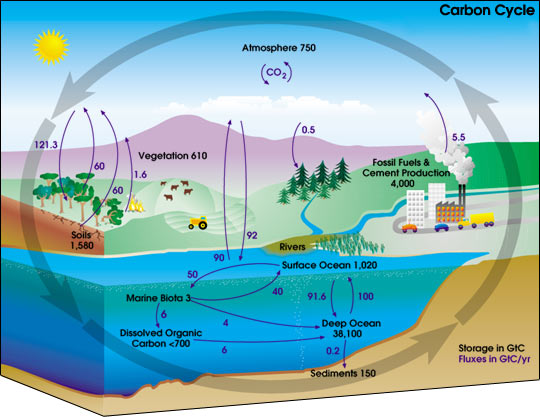
I'd like to remind people of the amount of carbon we introduce into the atmosphere. Wiki: Carbon Cycle:
Please note that the forests, earth, etc produce 120 GtC annually. The oceans 90 GtC. Mankind, only 7.1 GtC through industry and land use. This is a total of 217.1 GtC of sourced carbon emission with man contributing to 3.3% of it. Now add a volcano every now and then...
The problem isn't the added CO2 we are responsible for. The problem is that nature is being natural. Things change. Even if we didn't contribute any carbon to the carbon cycle, with the oceans warming, their equilibrium has changed to the point we would have almost as much CO2 in the atmosphere anyway.
Last edited by Wild Cobra; 10-12-2009 at 03:09 PM.

I'll bet Algore doesn't make that mistake again. Funny how the microphone got killed, eh?
Well, I agree that one person shouldn't be able to monopolize the time, but Gore should have given a proper answer also.
Just proves Gore couldn't. I say the guy should have said something like "OK, I see you cannot answer that one without lying or flip-flopping." Put him on the spot that way.

Attacking someone's education level is low-brow and ad hominem fallacy.
You need no degree to be a scientist or to perform research. You will find that a 9 year old child is more than capable of performing tests on a set of samples with a control group and drawing a statistically significant conclusion. A scientist is one who uses the scientific method, not one that earn degrees.
Speaking of which, this is the problem with "climate change" (indeed usage of this term is rising these days over global warming). Specifically, that people are attempting to draw conclusions on geological timescales based on a few decades of data. Some extend this to a few centuries, but of course the instrumentation that measures the temperature or whatever is not the same in each test. Anything past that uses more fuzzy data such as ice core samples.
Combine this with the fact that we have no real idea how the sun and earth cycle over millenia and you have a political "science" in which millions of dollars are at stake for each party involved. Yeah, we have an idea on SOME cycles, but nothing so sure that we could predict the temperature at some given point in time based on things like eccentricity, solar output, cloud cover, water vapor, and so forth. We can only guess and we are extrapolating into the future on a half-baked scheme of how everything works.
You don't see this with other sciences. Computer scientists have no problems agreeing on theory and meteorologists can predict hurricane movement and air mass movement with little variation. Physicists all agree on the path a body will take if launched out of Earth and under the effects of many other bodies. Yet in climatology we have many models disagreeing in how the temperature will increase with time. Simplistic models that only account the components of air can see the effects of increasing some component, but what model can take into effect carbon sinks and solar variation and so forth? Few, which is why there is so much discrepancy and why you have scientists that speak out against global warming.
In my opinion you can take a "better safe than sorry" approach or an economical one. No one has any clue as to how much man-made global warming exists without hundreds of more years of data. It has been proven right here many times where two people with graphs and science debate both sides without reaching any conclusion because of contradicting models on something we don't quite understand yet.
Yes, but when there is confidence to a range of information, one clearly outweighs the other.
I disagree, but that depends on what level you wish to quantify it. If you want absolutes, then you are right. It is scientifically clear than man's impact is far less than at first thought.
That's the problem with using models based on what you believe to start with. Such models give you the results you already believe.
I think you agree with me that Global Warming is far more complex than what the discipline of Climatology alone can explain. Climatology is only one of several disciplines of the geosciences. Solar is a clear aspect. The sun is the source of nearly all the Earths heat, and mankind can only have a small effect on the feedbacks of different systems. The energy the earth receives from the sun is an aspect that can be clearly identified. The alarmists dismiss solar changes, and only focus on the "radiative forcing" in the atmosphere for it's changes. What you never read of their calculations, because they flat out ignore them, is that the oceans are about 70% of the earth and they absorb about 92% of the solar power they receive. They absorb it deep, so you don't have the type of energy redirected skyward like the land does, which absorbs a global average of about 70% and reflects about 30%. It's that 70% that is re-emitted as IR skyward. Regardless how you make the calculations from there, the oceans are a long term storage of radiant heat, and minor changes in the suns output make notable difference.
Show me an alarmists research that takes that actually takes the ocean heat into account. I will gladly be open to their work. The others are a joke.

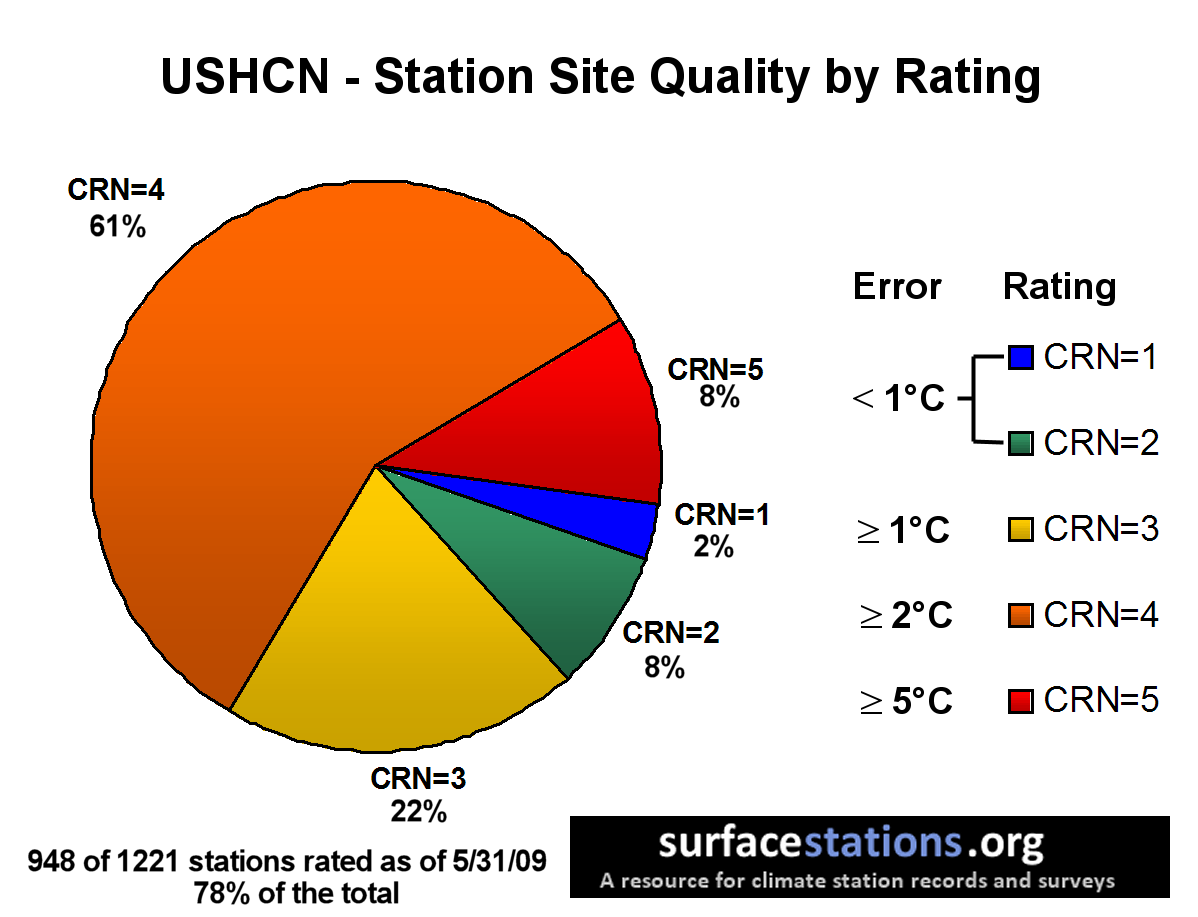
From http://www.surfacestations.org/
This pie chart shows that the surface temperature measurements in the US aren't very reliable. A majority are reading too high because of urban heat island effects.
61% of surface stations are reading >= 3.6 degrees too high (Fahrenheit)
8% are reading >= 9 degrees too high(Fahrenheit)
These guys have surveyed about 80% of all surface stations in the US
Whatever happened to global warming? How freezing temperatures are starting to shatter climate change theory
In the freezing foothills of Montana, a distinctly bitter blast of revolution hangs in the air.
And while the residents of the icy city of Missoula can stave off the -10C chill with thermals and fires, there may be no easy remedy for the wintry snap's repercussions.
The temperature has shattered a 36-year record. Further into the heartlands of America, the city of Billings registered -12C on Sunday, breaking the 1959 barrier of -5C.
Closer to home, Austria is today seeing its earliest snowfall in history with 30 to 40 centimetres already predicted in the mountains. Such dramatic falls in temperatures provide superficial evidence for those who doubt that the world is threatened by climate change.
But most pertinent of all, of course, are the growing volume of statistics.
According to the National Climatic Data Centre, Earth's hottest recorded year was 1998.
If you put the same question to NASA, scientists will say it was 1934, followed by 1998. The next three runner-ups are 1921, 2006 and 1931.
Which all blows a rather large hole in the argument that the earth is hurtling towards an inescapable heat death prompted by man's abuse of the environment.
Indeed, some experts believe we should forget global warming and turn our attention to an entirely differently phenomenon - global cooling.
The evidence for both remains inconclusive, which is unlikely to help the legions of world leaders meeting in Copenhagen in December to negotiate a new climate change deal.
There is no doubt the amount of man-made carbon dioxide, the gas believed to be responsible for heating up the planet, has increased phenomenally over the last 100 years.
For the final few decades of the 20th century and as the atmosphere's composition changed, scientists recorded the planet was warming rapidly and made a positive correlation between the two.
But then something went wrong. Rather then continuing to soar, the Earth's temperature appeared to stabilise, smashing all conventional predictions.
The development seemed to support the view of climate change cynics who claimed global warming was simply a natural cycle and not caused by man.
Some doubters believe that the increase was actually down to the amount of energy from the Sun, which provides 98 per cent of the Earth's warmth.
Previously, the fluctuating amount of radiation given out by the sun was thought to play a large role in the climate.
But Dr Piers Forster from Leeds University, who was part of the team to win the 2007 Nobel Peace Prize for his work on climate change, studied solar output - the heat leaving the sun's surface - and cosmic ray intensity over the last 40 years, and compared those figures with global average surface temperature.
He told the BBC: 'Warming in the last 20 to 40 years can't have been caused by solar activity.'
Scientists have intensified the search for alternative explanations
Professor Don Easterbrook from Western Washington University believes the key to the connumdrum may be the temperature of the world's seas.
Figures show the Pacific Ocean has been cooling over the last few years, and Easterbrook's research shows a correlation between this and global temperatures.
He says the oceans have a cycle in which they warm and cool cyclically, known as Pacific decadal oscillation (PDO).
And after a 30-year heating cycle in the 1980s and 1990s, pushing temperatures above average, we are now moving into a cooler period.
Professor Easterbrook said: 'In the last few years [the Pacific Ocean] has been losing its warmth and has recently started to cool down.
'The PDO cool mode has replaced the warm mode in the Pacific Ocean, virtually assuring us of about 30 years of global cooling.'
His figures show that the global cooling from 1945 to 1977 coincided with one of these cold Pacific cycles.
Mojib Latif, a member of the IPCC (Intergovernmental Panel on Climate Change), stressed the impact of the ocean currents in the North Atlantic - a phenomenon called the North Atlantic Oscillation (NAO) and the Atlantic Meridional Oscillation.
He believes we may be in a period of cooling - but that it will be temporary before global warming reasserts itself.
He said the NAO may have been responsible for some of the rapid rise in temperatures of the last three decades.
'But how much? The jury is still out,' he said.
So is the sun really going down on global warming?
The Met Office is not convinced.
They incorporate solar and oceanic cycles into their models, and they say that - even if there are periods of slower warming, or temporary cooling, the long-term trend in global temperatures is still on the up.

Quite frankly, I would be VERY happy if all the CO2 we were producing had little to no effect on our climate. Fossil fuels are easy to get, and if you can control the nastier side-effects of their production/refining/usage I am all for them.
They are making and improving the predictive models that grow ever more complex as time goes by with more data. Hopefully we can get to better answers as we go forward, and I am sure that we will, one way or another.
Until we know for certain one way or the other, mitigating our usage of something so potentially harmful should be a no-brainer. You don't have to know for 100% certain that smoking will kill you to cut back and raise your odds.
The problem with so many people is that this stuff has to be black or white, on/off, 100%/0%. It is possible to mitigate potential risks without knowing exact data.

What ever happen to rough-n-read. Our resident Aussie Scientist in waiting......who
could tell you how much he saved the earth by cutting off his laptop...or whatever.
I think he realized he is unable to counter my points very well.
Where have you been?

Maybe he went totally native and is living in the outback on recycled urine and dingo testicles.

weather happens...

"If the number of polar bears increased, surely they're not endangered."
Genius.

He's saving it right now... by not having his laptop on and posting he has allowed us to have this cooling trend.
If there's some logic to this post, I'm missing it.
Do you know what defines a species as being endangered?
http://en.wikipedia.org/wiki/Endangered_species
An endangered species is a population of organisms which is at risk of becoming extinct because it is either few in numbers, or threatened by changing environmental or predation parameters.
So, are the polar bear few in numbers? Is their changing environment threatening their population? The data suggests otherwise.
What data?
In one region:
A larger estimate:There was an estimated 0.3 percent annual decline in the polar bear population in the southern Beaufort Sea between 2001 and 2007, with the total numbers likely hovering between 1,397 and 1,526 animals, according to the draft assessments.
http://www.reuters.com/article/envir...55I06C20090619The worldwide polar bear population is generally believed to be about 20,000 to 25,000, according to the International Union for Conservation of Nature, which lists the species as "vulnerable".
So they've possibly been declining. Thanks.
Polar bear expert barred by global warmists
Over the coming days a curiously revealing event will be taking place in Copenhagen. Top of the agenda at a meeting of the Polar Bear Specialist Group (set up under the International Union for the Conservation of Nature/Species Survival Commission) will be the need to produce a suitably scary report on how polar bears are being threatened with extinction by man-made global warming.
This is one of a steady drizzle of events planned to stoke up alarm in the run-up to the UN's major conference on climate change in Copenhagen next December. But one of the world's leading experts on polar bears has been told to stay away from this week's meeting, specifically because his views on global warming do not accord with those of the rest of the group.
Dr Mitc Taylor has been researching the status and management of polar bears in Canada and around the Arctic Circle for 30 years, as both an academic and a government employee. More than once since 2006 he has made headlines by insisting that polar bear numbers, far from decreasing, are much higher than they were 30 years ago. Of the 19 different bear populations, almost all are increasing or at optimum levels, only two have for local reasons modestly declined.
Dr Taylor agrees that the Arctic has been warming over the last 30 years. But he ascribes this not to rising levels of CO2 – as is dictated by the computer models of the UN's Intergovernmental Panel on Climate Change and believed by his PBSG colleagues – but to currents bringing warm water into the Arctic from the Pacific and the effect of winds blowing in from the Bering Sea.
He has also observed, however, how the melting of Arctic ice, supposedly threatening the survival of the bears, has rocketed to the top of the warmists' agenda as their most iconic single cause. The famous photograph of two bears standing forlornly on a melting iceberg was produced thousands of times by Al Gore, the WWF and others as an emblem of how the bears faced extinction – until last year the photographer, Amanda Byrd, revealed that the bears, just off the Alaska coast, were in no danger. Her picture had nothing to do with global warming and was only taken because the wind-sculpted ice they were standing on made such a striking image.
Dr Taylor had obtained funding to attend this week's meeting of the PBSG, but this was voted down by its members because of his views on global warming. The chairman, Dr Andy Derocher, a former university pupil of Dr Taylor's, frankly explained in an email (which I was not sent by Dr Taylor) that his rejection had nothing to do with his undoubted expertise on polar bears: "it was the position you've taken on global warming that brought opposition".
Dr Taylor was told that his views running "counter to human-induced climate change are extremely unhelpful". His signing of the Manhattan Declaration – a statement by 500 scientists that the causes of climate change are not CO2 but natural, such as changes in the radiation of the sun and ocean currents – was "inconsistent with the position taken by the PBSG".
So, as the great Copenhagen bandwagon rolls on, stand by this week for reports along the lines of "scientists say polar bears are threatened with extinction by vanishing Arctic ice". But also check out Anthony Watt's Watts Up With That website for the latest news of what is actually happening in the Arctic. The average temperature at midsummer is still below zero, the latest date that this has happened in 50 years of record-keeping. After last year's recovery from its September 2007 low, this year's ice melt is likely to be substantially less than for some time. The bears are doing fine.
There are currently 1 users browsing this thread. (0 members and 1 guests)
 Posting Permissions
