Reply With Quote
American tax debate in a nuts : the wealthy tell the poor that the upper middle class are wealthy and the poor believe them.
wealth does not equal income.
If you want a wealth tax then come out and just say it.

Fair enough. I can see the logic behind that conclusion. Poverty does not a happy populace make, obviously.
American tax debate in a nuts : the wealthy tell the poor that the upper middle class are wealthy and the poor believe them.
wealth does not equal income.
If you want a wealth tax then come out and just say it.

The problem is that when you're talking about issues that affect a society using personal responsibility as a reasoning completely ignores the obvious evidence of systematic problems.
When you talk to individual A and you try to ascertain his situation and why he's there you can point to decision X or decision Y and say if you had made a better choice here you could have avoided this and I think that is a fine approach because you're looking at things on the very specific micro level.
The problem is that when you look at an entire society and you see that 72% of your population is in a bad situation you cannot simply write things off as bad decision making because even if it is bad decision making you should wonder why that situation is so rampant and wide spread. What cir stances have allowed this problem to manifest itself on a wide basis and what is the cause of those cir stances? Those are the questions you ask on a macro level because you're not trying to save individuals but you're trying to fix the problem in an entire society.
For the individual, you could give him specific advice to correct his situation work with him on a personal basis to fix his problem
But on the macro level you have to devise programs that are far reaching and address the underlying causes. Chalking things up to personal responsibility and righteous indignation have no place if you think there is an actual problem here.

PROFOUNDLY accurate.
I agree completely. There's a reason why I've mentioned wealth over and over in this thread and didn't mention an income tax but a true progressive tax code.
Of course Darrinbot and all his knowledge of nuance led him to call me a dumb over this.
But also, don't think the wealthy don't try to turn the middle class against the poor either. All of the chest thumping over the percentage of Americans who don't pay an income tax is just that.
That's precisely the reason why forced wealth redistribution wouldn't work. You're not talking about a solution to the cir stances that created the problem to begin with. You're talking about a temporary fix to appease the unhappy poor. Personally, I don't think America's problem lies in lack of taxation.
I should add that I'm no economist, nor do I claim to have my finger on the pulse of America's problems right now. I just don't think that's the solution, is all.
Thats a fair point, MM. Wealth redistribution is such a bad term to be honest. I don't think that you should take money directly from Bill Gates and send a check to Joe the Plumber because its unfair that he's broke.
I want them to fund the programs that will fix the problem - primarily our education and healthcare systems.

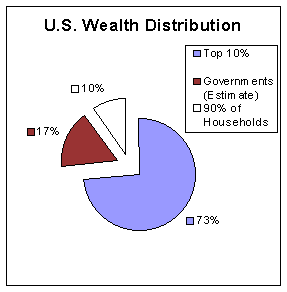
The wealth gap in America is insurmountable.
Dont know what year that is from, and it doesnt matter, it didnt get better.
There is no solution beyond very longterm programs (like MiG mentioned) education and healthcare.
But that gap will never narrow, ever. And that is sort of the point, isnt it?
Now that's something we can agree on
In terms of household income the 72nd percentile is around $75k. What systematic problem is forcing a household making $75k into living paycheck to paycheck? Seems to me that the only systematic problem here is an unwillingness of non-poor Americans to live beneath their means. I'm not saying the percentage of Americans living paycheck to paycheck should be zero. But it should be a of a lot less than 72%.
Repugs and conservatives HATE wealth distribution when applied downward, but they have fought like for 35 years for and LOVE wealth distribution and concentration upward, and they've won that war and there's no way to reverse it. GAMEOVER.
Blaming and criminalizing the poor and unemployed is standard Repug/conservative race war and class war.
America's infrastructure (oil/gas/electrical/transport/etc) is old and rotting and would be extremely expensive to repair and maintain correclty. Ain't gonna happen. The decline of America is irreversible.
Why do so many Americans choose to not live beneath their means? As someone who does live beneath my means, and as a direct result is not living paycheck to paycheck, I have no idea.
Don't you think thats an important piece of information? This is exactly what I mean - you just want to write it off without understanding or caring about the repercussion of doing so because of your righteous indignation. YOU manage to live financially responsible so why can't THEY?
Thats fine and your prerogative, but thats not going to solve a damn thing.
BTW, ManuManiac, an interesting thing I just read about is called the Gini Coefficient which is a measurement of economic inequality in a country. The US and Argentina have very similar numbers.

A lot of variables within that $75K HH income... number in HH, geography, employee-provided HC...
I generally agree that a married couple in TX with no children making $75K annually should be able to put some of it into savings but depending on cost of living and other factors, it may not be that easy for all in that percentile. And there's still 51% under $50K HH earnings.

what size of a family are we talking about here ? a family of 6 or 7 with day care, groceries, insurance, clothing, mortgage, cars, gasoline, utilities and medical expenses could easily have to live paycheck to paycheck. and that is in no ways living beyond one's means. that is just the bare bones.
Those are all expenses over which that family has some level of control. Are there some families who have already exercised all the control available to them and still end up having to live paycheck to paycheck? Obviously yes. I wholeheartedly disagree that those families comprise 72% of the American population though.
To be honest, I'd also argue that people with large families are extremely guilty of making bad decisions. Having that many kids and not being able to afford it is worse than running up your debt on a CC, IMO.

And all you're doing is wanting to write it all off over some "systematic problem" that you can't seem to define. Couldn't possibly be that there is anyone in that 72% who's living paycheck to paycheck because they bought more than they really need. Nope, it's all due to "systematic problems".
I have already said on multiple occasions that there are people who legitimately can't avoid living paycheck to paycheck. All I've said is that percentage is a of a lot less than 72%. Do you agree or disagree with that statement?
As I have already stated, the "they" I am referring to are the non-poor Americans who are living paycheck to paycheck. So yes, why can't THEY live financially responsible? Care to provide an answer?YOU manage to live financially responsible so why can't THEY?
If you've got a solution for your "systematic problem" I'd be more than happy to hear it.Thats fine and your prerogative, but thats not going to solve a damn thing.
The 10% is static, but how about who makes up the 10%?
I know people that were in it, but now aren't, and many people who were not in it, but now are. There is no convention of the top 10% (that's 30,000,000 people, folks) where they get together and figure how to keep the other 90% down.
Off the top of my head; serious expenses people don't NEED, but almost all HAVE:
1. Cable TV.
2. Cell Phone(s)
3. Car payments (because they buy new, and trade it in too often)
another killer many poor are guilty of:
Cigarettes!
If they have any of those; I have little sympathy.
There are currently 1 users browsing this thread. (0 members and 1 guests)
 Posting Permissions