


 Reply With Quote
Taiwan

But where else would we buy $600Bn worth of cheap crap per year if we did that?

Taiwan
WalMart?

New intraday record yesterday... getting close to $60.
Any guesses as to what happened today?

Look at the dumbasses at wall street. They want it at $100...
General Motors plan to make Chinese Quote "fall in love" the the America Auto is working! Brilliant!
ps... all time high close on Friday

Producers and refiners strain to meet world demand...
Bloomberg NewsJune 27 (Bloomberg) -- Crude oil rose to a record in New York on concern that oil producers and refiners will strain to boost output to meet surging demand for fuel.
Iran and other OPEC members are pumping oil at ``the highest possible level'' and can't increase production to meet rising global consumption, Iranian Central Bank Governor Ebrahim Sheibany said yesterday.
....
Crude oil for August delivery rose as much as 63 cents, or 1.1 percent, to $60.47 a barrel in after-hours electronic trading on the New York Mercantile Exchange. It traded at $60.40 a barrel at 11:41 a.m. Sydney time.
.....
Oil prices could rise to $100 a barrel in New York if instability continues in producing countries such as Iraq and Nigeria, Algerian Oil Minister Chakib Khelil said, according to the Arabic-language Saudi newspaper Okaz on June 25. Political instability will have an impact on oil output even if OPEC boosts its capacity in the next two to three years, Khelil said.
<</SNIP>>
Some sobering thoughts by Jan Lundberg, author of the Lundberg letter, regarding the Culture Change that is needed in the U.S. to meet the coming world energy crisis...
more...am a petroleum-industry analyst, although I last saw any money from the oil industry back in 1988 when I told Exxon and Mobil I was terminating my market research business. My office then became an environmental ins ute, and I proceeded to get a much clearer picture of oil's place in the world than from my previous sixteen years known for publishing "the bible of the oil industry," the Lundberg Letter. My understanding of oil and energy in the economy and culture has brought me to my present analysis about the end of the United States of America.
Here are my limits on my objectivity: I have no investments other than wanting to see family and friends do especially well in terms of health and happiness in the extremely turbulent phase ahead. I am further biased in wanting the Earth to have maximum biodiversity, but either the web of life holds or it will not. I will shed no tears over the disappearance of General Motors, for example, which is teetering already. Such a corporation -- found guilty for destroying dozens of cities' electric rail trolley service -- is an enemy of the planet and of the people.
The fall of the U.S. may be the swiftest empire collapse in world history. It is obvious that the U.S. population and the nation's infrastructure is heavily petroleum dependent. The U.S. peaked in oil production (extraction) in 1971. The world may be peaking now, as some evidence indicates, or in a few short years. As a severe energy shortage is on tap as soon as the gap between supply and demand is felt by the market, and the Earth gives noticeably less oil than just recently, there will be a cascade of impacts on the economy and people's lives.
So it will not matter how much oil is still in the ground, or if other ways of obtaining and using energy are more renewable and greener: A massive shut down of petroleum supply brought about by market panic and economic collapse will terminate corporate globalism and the political landscape as well. [As discussed in this essay and in links at the end, production of other forms of energy cannot subs ute for petroleum and will not be maximized for readiness anyway.] Many aspects of modern society are at a breaking point already, whether one looks at the Iraq war over oil, the housing market bubble, U.S. debt and deficits, or the prospects of damaging weather from the fast distorting of the planet's climate.
Not only will the sudden oil shortage ahead mean the Final Energy Crisis, the present economy only works on growth: so even a plateau of global petroleum extraction -- what seems to be happening now, although it is being called "insufficient refining capacity for poor quality crude oil" -- would mean the house of economic cards collapses on its own. Recovery from such an event, even if not from oil shortage, would appear impossible because supplies of oil would be among the commodities suddenly scarce, and this would have a terminal effect on much economic activity and people's lives.
With so much local business and self-sufficiency destroyed by Walmartization, costs of urban sprawl, medical costs and the drain of militarism, impacts from oil collapse will be brutally thorough in the U.S. and almost as thorough in all other industrialized societies. Security, leadership and individual self-responsibility we have almost none: "We have met the terrorist and the terrorist is us," to paraphrase Walt Kelly's Pogo.
I decided to outline my scenario of the end of the United States after co-hosting a talk show on San Francisco radio with Martin Matthews. We got a call in on the air from a lady wanting to know if there were any relevant politicians to deal with peak oil. I came close to suggesting Congressman Roscoe Bartlett, who quoted me on the effects of peak oil before Congress on C-SPAN television. But the Congressman's office had told me he would not be seeking higher office. Martin and I continued our conversation over some Arab food and I outlined my end-of-the-USA outlook. Later that same day, June 16, 2005, I conferred with Lonnie Maxfield of Jivan Ins ute in Olympia, Washington by telephone. He asked me if I thought the U.S.A. would survive long beyond this time in history. We agree the U.S. will not last.
The social fabric has been unraveling for several decades, and the lack of solidarity or social cohesion is one of the reasons there must be a collapse in the U.S. -- after all, do you see community-spirit on the rise and an actual transition underway to a sustainable and ecologocial society? As this series of essays has explored, people are driven apart by materialism and trying to separate themselves from nature.
Susan Meeker-Lowry, author and editorial contributor to Culture Change, points out that people are noticing climate change and the prospect of tighter energy supplies, and are seriously worried about the implications such as heating their homes and paying their taxes. "But we need to be dealing with these issues as a community, not as individual family units. We need to be creating safety nets for ourselves, preparing for the day when the bills won't get paid because there's no more money and we need to defend our homes from the wealthy who will try and take them away for nonpayment of mortgage or taxes," she says.
Culture ChangeThe problem with renewable energy is that it's not so renewable. The energy production ratio of non-oil energy extraction is comparatively poor. Additionally, the present infrastructure is entirely geared toward petroleum which allows for our vast, consuming population size. Renewable energy will have its niche in local applications, but it will never power a global economy. Renewable energy will not replace a fleet of vehicles, just for the reason that not enough rubber trees can meet the demand of the necessary tires. The existence and claims of renewable energy have mainly served to obscure the urgent need to simply slash consumption of energy -- whatever the production mode. It may be too late to remake the U.S. infrastructure to run commerce and transportation on, say, renewable-energy powered trains, even if they were very energy efficient and were ready to manufacture on a huge scale.
There are short-term signs and indicators that the U.S. has worn out its already slim welcome the world over. That has not stopped the U.S. rapacious military industrial complex and its financial and political juggernaut, as depicted in John Perkins' book Confessions of an Economic Hit Man. Another "intelligence" caper and bloody coup or invasion is always in the bag of tricks of the U.S., whether or not the rest of the world wants an end to the interference and rip-offs. The prestige of the U.S. may not be of much concern to the zealot U.S. neo-conservatives or greedy marketeers, but the game is certainly all too clear -- as the Downing Street Memo and other evidence reveals. Climate change is more blood on the U.S.'s hands, as the nation is the biggest greenhouse gas emitter and will not even cut back on the easy waste in energy consumption.
Yet, world opinion and a social movement much stronger than the weak anti-war movement in the U.S. do not comprise a significant opposition to the U.S. There is not even clarity on who the enemies of the U.S. really are, when Osama bin Laden and his group had been U.S. operatives and not seriously targeted by the long arm of the (U.S.) law. So, absent a huge military/terroristic attack on the U.S. that would really bring it to its knees, which may involve nuclear weapons, I examine more certain factors and outcomes: the effects of oil collapse.
I hope she is wrong, but...

Well, interesting times we live in. But it's not like a world war has ever started over oil. Right?
World Wars have been lost because of a lack of oil. Some contend that Vietnam was about oil. You could say that we are currently in a World War of economies, and the big prize is oil - or the continued ability of countries to power their machines for global economic dominance. Everywhere there are untapped reserves of oil not already directly controlled by Western oil companies - Sudan, Venezuela, the Middle East, the Caspian Sea region, and so on..there seems to be political instability.But it's not like a world war has ever started over oil. Right?
No, World Wars have never started directly because of oil, but the U.S.'s dependence on oil may be the undoing of our own making.
Dude, I was being sarcastic. WWII was definetly oil related. Japan anyone?
huh?
Well, I guess you could say that the war in the Pacific was oil related, but Germany was mostly about spreading fascism.Dude, I was being sarcastic. WWII was definetly oil related. Japan anyone?
$4 per gallon gas by this winter?
Obsever GuardianOil 'will hit $100 by winter'
Worst-ever crisis looms, says analyst · Surging demand to keep prices high
Heather Stewart, economics correspondent
Sunday July 3, 2005
The Observer
Oil prices could rocket to $100 within six months, plunging the world into an unprecedented fuel crisis, controversial Texan oil analyst Matt Simmons has warned. After crude surged through $60 a barrel last week, nervous investors were pinning their hopes on a build-up in US oil-stocks to depress prices in the coming months.
But Simmons believes surging demand will keep prices bubbling well above $50. 'We could be at $100 by this winter. We have the biggest risk we have ever had of demand exceeding supply. We are now just about to face up to the biggest crisis we have ever had,' he said.
--snip--
The looming oil crisis is not high up the agenda at this week's G8 meeting, although the heads of state are expected to repeat their finance ministers' call for greater transparency from Opec and other oil-producing nations about their reserves.
--snip--
Simmons believes such moves will be too little, too late. He will publish a hard-hitting book this week in which he argues that Saudi Arabia, the world's largest producer, is running out of oil, and further price rises are inevitable as supplies decline. He warns that the scramble for resources could eventually descend into war.
I think such doom and gloom economic implosion predictions are a bit overblown, but there will be a good amount of economic pain during the transition to a less oil dependant economy.
There is some "speculative" factor adding to recent oil price surges, but the most analysts are quite in agreement that the underlying supply/demand that is supporting the current higher price levels will not be going away.
I think this stuff will change the face of American cities as the "sprawl" that has characterized their development for the last few decades will have to reverse itself. People simply will not be able to afford to live very far from where they live.
I am something of an optimist about America and our ability to innovate and change. It is something we are good at, and as much as the coming decade or two will be unpleasant, I think we will end up getting through this.
I say this as no big fan of the present administration, and the fact that they are ignoring a lot of this with an "energy policy" written by their big business buddies pisses me off to no end. They get more political donations, we get f***ed. Thanks, GW.
As for the gaurdian article, I think that is a bit much. Supplies are very tight, but there is still a little bit of "give" left. I believe oil will get to $100 per barrel within 10 years, tho', and this is a very steep climb percentage-wise per year.
I agree with many of the sentiments outlined by the article that nbadan posted though. Our materialism will be our downfall. We are in too much debt and that is unsustainable in the long run. The "wealthy" will not be forclosing on our houses for non-payment of mortgages, we will simply have lost our bet that many of us have made with our mortgages, i.e. that interest rates will always stay low, and our house values will keep going up as fast as they have been in recent years.
more:APCrude Oil Prices Hit New Record of $62.69 a Barrel on Supply, Geopolitical Worries
By Gillian Wong Associated Press Writer
Published: Aug 7, 2005
SINGAPORE (AP) - Crude futures rose to a new high of $62.69 in Asian trading Monday as the U.S. government announced the closure of its embassy and consulates in Saudi Arabia due to security threats and on continued concerns that earlier shutdowns of U.S. oil refineries would reduce supply.
Midmorning in Singapore, light, sweet crude for September delivery on the New York Mercantile Exchange rose as high as $62.69 in Asian electronic trading before slipping back to $62.51. On Friday, crude settled at U$62.31 a barrel, a record close for crude since Nymex trading began in 1983.
That's 42 percent higher than a year ago, though crude prices would have to surpass $90 to reach the inflation-adjusted high set in 1980.
Gasoline edged up slightly to $1.8415 a gallon while heating oil rose marginally to $1.7390 a gallon.
Tick..Tick...Tick

sad
i cant drive anymore

At least you don't live in Califonia.

We will be getting a brief reprieve through about 2010 as more production capacity comes online.
But... it will be brief. Our lifestyles will have to change to adjust to the new realities.

Regular gas going for $2.50 here today. Ten cents higher than the previous high.

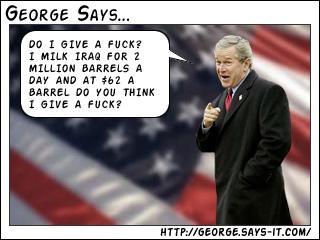
It'll go up to around $3 a gallon so when it drops to an average of $2.85 Americans will rejoice and accept it.
You ain't seen nothing yet.

Too bad years ago some boneheads in SA voted down the lightrail system that would have been a blessing during these times.
There are currently 1 users browsing this thread. (0 members and 1 guests)
 Posting Permissions
