Reply With Quote
A 10% haircut smarts no matter how big you are.
yes, a record. so the what? stupid comparision.
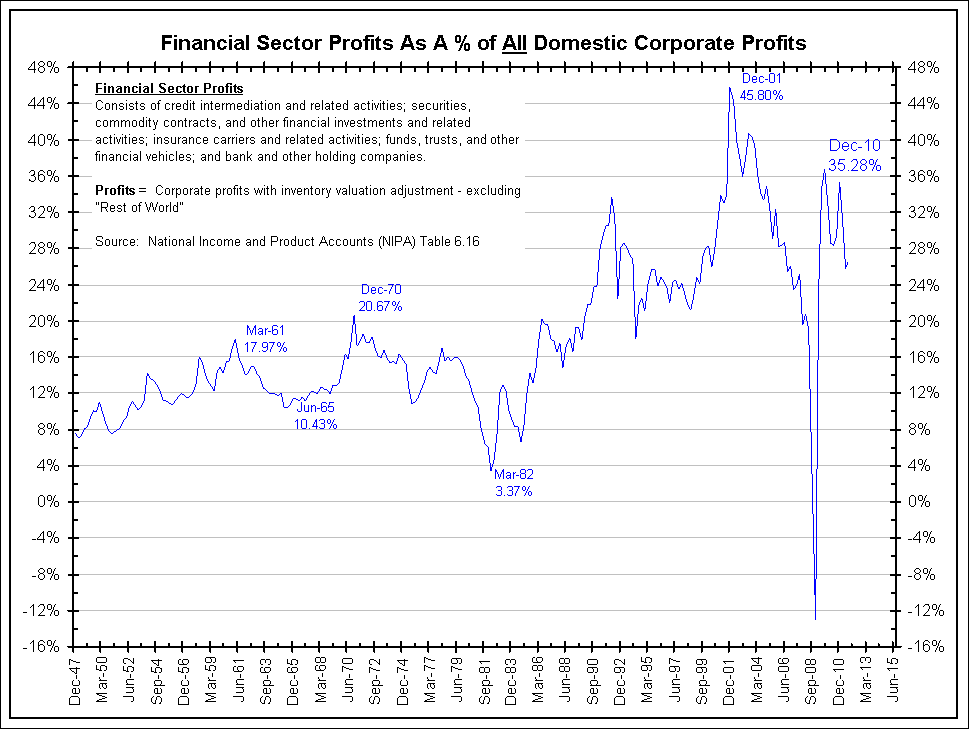
financial sector's profits, aka the Bull Vampire Squid profits, as %age of total US profits is now something like 30%.

A 10% haircut smarts no matter how big you are.

So, who actually pays the $2B? I mean, I know the bank does, but is there any regulation that says that the cost of the fine is payable only by shareowners and not passed along to consumers? If it is just passed along, does it really hurt them?
Serious question. I don't know how something like this works.
It's purely the bank's call as to how they come up with the money to pay the fine. If they want to pass it along to consumers, they can, and probably will.
Thanks for the info. That is what I assumed, but I really didn't know.
That is the sort of thing that makes me think it is less onerous than it would be if had to be payable from shareowners somehow (not sure how), or if they were unable to take a tax deduction for it. There seem to me to be so many ways for the fine payer to reduce the true impact of the fine that it is not all that impressive. If the Board of Directors or senior management were each responsible for a big fine, that would seem to me to be more meaningful. Otherwise, it seems to me that the eventual fine payers are more likely to be the bank's customers and/or the taxpayers.
I get what you're saying, and generally agree, but it's just one of those situations I don't think you can do anything about. If a parent gets a speeding ticket there's no way to make sure that he/she doesn't cover some of that cost by getting their kid a cheaper Christmas present. Sucks, but it is what it is.
Matt Taibbi: After Laundering $800 Million in Drug Money, How Did HSBC Executives Avoid Jail?
Matt Taibbi:
Exactly, exactly. And what’s amazing about that is that’s Forbessaying that. I mean, universally, the reaction, even in—among the financial press, which is normally very bank-friendly and gives all these guys the benefit of the doubt, the reaction is, is "What do you have to do to get a criminal indictment?" What HSBC has now admitted to is, more or less, the worst behavior that a bank can possibly be guilty of. You know, they violated the Trading with the Enemy Act, the Bank Secrecy Act. And we’re talking about massive amounts of money. It was $9 billion that they failed to supervise properly. These crimes were so obvious that apparently the cartels in Mexico specifically designed boxes to put cash in so that they would fit through the windows of HSBC teller windows. So, it was so out in the open, these crimes, and there’s going to be no criminal prosecution whatsoever, which is incredible.
The amazing thing about that rationale is that it’s exactly the opposite of the truth. The message that this sends to everybody, when banks commit crimes and nobody is punished for it, is that you can do it again.
You know, if there’s no criminal penalty for committing even the most obvious kinds of crimes, that tells everybody, investors all over the world, that the banking system is inherently unsafe. And so, the message is, this is not a move to preserve the banking system at all. In fact, it’s incredibly destructive. It undermines the entire world confidence in the banking system. It’s an incredible decision that, again, is met with surprise even with—by people in the financial community.
http://truth-out.org/video/item/1333...ves-avoid-jail
TB"10% haircut"
one dime out the one year's dollar of profits.
UBS Expected to Pay at Least $1 Billion in Rate-Rigging Case
The Swiss financial giant UBS is close to finalizing a settlement with authorities over the manipulation of interest rates, a deal that is expected to include at least $1 billion in fines.UBS is in discussions with United States, British and Swiss authorities,
http://mobile.nytimes.com/2012/12/13...-case.xml?f=19
And all the other banks around the world?

IT it roughly one month's worth of profits for that en y.
What they need is to put executives in jail, IMO.
Trusting the shareholders to pressure the management... not overly effective IMO, as shareholders will look the other way if the money is good, just like anyone else.

Ze Germans have the right idea.
German police raids Deutsche Bank offices in tax fraud probe

Barofsky sounds off:
Steal a thousand dollars once, go to prison; steal a thousand million while committing hundreds of felonies, accept a decimation of the year's profits.Nothing, however, was quite as it appeared. Sure, HSBC paid a record fine, but there was something vitally important missing from yesterday's press conference: actual criminal charges for obvious criminal conduct.
Some perspective: HSBC sent more than $800 million in bulk cash from Mexico to the United States, a good chunk of which apparently represented proceeds from some of the most notorious Colombian drug cartels. As someone who tried the first narcotics money laundering case involving extradition from Colombia, let me assure you that this is a lot of money, the discovery of which usually generates vigorous prosecutions and lengthy prison sentences. And it wasn’t HSBC’s only dirty business: There were also hundreds of millions of more dollars of illegally disguised transactions with rogue nations such as Iran and Sudan.
Why no criminal charges? Why instead only some remedial measures and a "historical" fine that can be measured in weeks -- not years -- of earnings? It certainly wasn’t for lack of evidence. No, instead the government determined that HSBC is not only too big to fail, but also too big to jail. As the New York Times first reported, even though there were strong voices within DOJ pushing for criminal charges, the big banks' best friends within the government (the Treasury Department, of course, and other unnamed regulators) were too fearful that an indictment could destabilize the global financial system. Yes, it's 2008 all over again. In the name of systemic stability, a megabank again escapes accountability for its actions, rescued by compliant officials.
http://economix.blogs.nytimes.com/20...othy-geithner/As the problems escalated, Mr. Geithner came to stand for providing large amounts of unconditional support for very big banks – including Citigroup, where Robert Rubin, his mentor, had overseen the dubious hiring of a chief executive and more general mismanagement of risk. (While a director of Citigroup, Mr. Rubin denied responsibility for what went wrong.)
Rather than moving to change management, directors or anything about the big banks’ practices, Mr. Geithner favored more financial assistance – both from the budget (through various versions of the Troubled Asset Relief Program), from the Federal Reserve (through various kinds of cheap loans) and from all other available means, including insurance for private debt issues provided by the Federal Deposit Insurance Corporation.
In official discussions, Mr. Geithner consistently stood for more support with weaker (or no) conditions. (See “Bull by the Horns,” by Sheila Bair, former chairwoman of the F.D.I.C., for the most credible account of what happened.)
Mr. Geithner’s appointment as Treasury secretary in January 2009 allowed him to continue to scale up these efforts.
In retrospect, what helped stem the panic was the joint statement of Feb. 23, 2009, issued by the Treasury, the F.D.I.C., the Office of the Comptroller of the Currency, the Office of Thrift Supervision and the Federal Reserve, that included this statement of principle:
The U.S. government stands firmly behind the banking system during this period of financial strain to ensure it will be able to perform its key function of providing credit to households and businesses. The government will ensure that banks have the capital and liquidity they need to provide the credit necessary to restore economic growth. Moreover, we reiterate our determination to preserve the viability of systemically important financial ins utions so that they are able to meet their commitments.Mr. Geithner is often given credit for pushing bank stress tests in spring 2009 as a way to back up this statement, so officials could assess the extent to which particular financial ins utions needed more loss-absorbing equity. But such stress tests are standard practice in any financial crisis.
Much less standard is unconditional government support for troubled banks. Usually such banks are “cleaned up” as a condition of official assistance, either by being forced to make management changes or being forced to deal with their bad assets. (This was the approach favored by Ms. Bair when she was at the F.D.I.C.; her book lays out realistic alternatives that were on the table at critical moments. The idea that there was no alternative to Mr. Geithner’s approach simply does not hold water.)
Any fiscally solvent government can stand behind its banks, but providing such guarantees is a recipe for repeated trouble. When Mr. Geithner was at Treasury in the 1990s and Mr. Rubin was Treasury secretary, the advice conveyed to troubled Asian countries – both directly and through American influence at the International Monetary Fund – was quite different: clean up the banks and rein in the powerful people who overborrowed and brought the corporate sector to the brink of financial meltdown.
In Mr. Geithner’s view of the world, the 2010 Dodd-Frank financial reform legislation fixed the problem of too-big-to-fail banks. Outside of Treasury, it’s hard to find informed observers who share this position. Both Daniel Tarullo (the lead Fed governor for financial regulation) and William Dudley (the current president of the New York Fed) said in recent speeches that the problems of distorted incentives associated with too big to fail were unfortunately alive and well.
Ironically, despite the fact that the Obama administration failed to rein in the megabanks and allowed them to become larger and arguably more powerful, this has not helped the Republicans in electoral terms.
As Ms. Noonan puts it bluntly: “People think the G.O.P. is for the bankers. The G.O.P. should upend this assumption.”
This is a significant opportunity for anyone with clear thinking on the right – someone looking for a Teddy Roosevelt trustbusting or Nixon-goes-to-China moment. Again, Ms. Noonan gets it right: “In this case good policy is good politics. If you are a conservative you’re supposed to be for just treatment of the individual over the demands of concentrated elites.”
Recall that some grass roots conservatives are already there: House Republicans initially voted down TARP, the former presidential candidate Jon Huntsman’s plan to end too big to fail received widespread applause from many Republicans and a number of influential commentators, including George Will and Ms. Noonan, have advocated ending too big to fail.
This would play well in the Republican presidential primaries – and even better in the general election. Watch PBS “Frontline” on Jan. 22 for an articulate presentation of why serious potential financial crimes were not prosecuted during the first Obama administration, and think about how to turn these facts into political messages.
A smart candidate could even mobilize plenty of financial-sector support in favor of breaking up or otherwise restricting the too-big-to-fail financial en ies. The megabanks have very few genuine friends.
The lasting legacy of Timothy Geithner is to create the perfect electoral issue for Republicans. Will they seize it?
http://www.nationalaffairs.com/publi...casino-financeThe logical place to begin is by correcting a mistaken premise that has informed conservatives' resistance to financial regulation. Much of their opposition stems from the view that efforts to constrain the activities of financial firms represent inappropriate government interference in our market economy. And as conservatives are defenders of the market, they must necessarily be defenders of the financial-services industry, or must at least be opponents of financial regulation.
In adopting this pose, conservatives make errors of both tactics and principle. There is powerful evidence to suggest that the modern financial industry largely serves its own interests at the expense of the rest of the economy, rather than creating wealth more broadly. Opponents of financial regulation designed to address such rent-seeking behavior are therefore easily perceived as defenders of misbegotten privilege rather than of free-market compe ion. A sounder approach would be to focus on championing free markets in real goods and services, defending the role of financial intermediaries when they serve those markets and supporting regulation when they instead prey on the rest of the economy.
The tensions between a thriving democratic capitalism and today's brand of finance have unfortunately been lost on many conservatives. Their reflexive defenses of all private enterprise have blinded them to the real harms that the financial sector — often propped up by government supports — has inflicted of late on other sectors of the economy. But recent economic analyses, such as one by economist Thomas Philippon, have shown that the growing size and inefficiency of the financial sector have become a tax on real business activity. As the figure below illustrates, in 1980, the financial sector's share of gross domestic product passed its share of GDP at the height of the financial boom of the 1920s; it has continued to increase ever since, reaching its peak (of more than 8% of GDP) in the 2000s.
One could argue that some of this growth results from firms' increasing use of financial instruments, or the fact that the typical American requires more financial services. But Philippon adjusts for these factors and finds that, even when they are taken into account, the financial sector has bloated because its overall efficiency has declined by nearly 50% since the 1970s — despite the information-technology revolution, and despite the supposed benefits of financial deregulation.
Our financial markets, then, have simply gotten more expensive. But are they at least providing increased value, better services, and other benefits to justify the cost? Again, Philippon suggests not. With co-authors Jennie Bai and Alexi Savov, he shows that, even with deregulation and the advance of information technology, markets are no better at predicting the future prices of assets than they were in the past. The added expense has not improved the quality of the information markets are credited with supplying.
Moreover, Mark Aguiar and Mark Bils show that, over the period from 1980 to 2007, the fraction of fundamental risk borne by individuals has stayed constant or increased, indicating that the extra expense of our financial markets has not provided valuable insurance. In other words, despite the massive innovation that, according to the financial sector's champions, was supposed to reduce and spread the risks individual investors face, Aguiar and Bils show that today's financial markets may actually increase those risks. Indeed, as Aguiar and Bils do not address the fallout from the financial crisis, their paper probably understates the problem; the allocation of risk has probably worsened since the late 1970s. It is therefore likely that the additional cost of the financial sector is in fact paying for wasteful gambling and bailout arbitrage — where banks take risks financed by taxpayers, as discussed below — rather than valuable economic activity.
http://bizbeatblog.dallasnews.com/20...egabanks.html/Here are some highlights of the proposal, according to Fisher, with more details tomorrow:
– Restructure too-big-to-fail banks into smaller, less-complex ins utions so risks can be effectively disciplined by regulators and market forces.
– Restrict federal deposit insurance to only commercial banks.
– Clarify that the federal safety net programs apply only to a commercial bank and its customers and not to customers of any affiliated subsidiary or the holding company.
— Limit the Federal Reserve’s discount window loans to only commercial banks — and no banking affiliates or a parent company.
– Require customers, creditors and counterparties of a banking affiliate and of the senior holding company to sign a simple disclosure statement acknowledging their unprotected status.
– Possibly add more restrictions (or bans) on the ability to move assets or liabilities from banking affiliate to banking affiliate within a holding company.
that's national income, financial sector has much larger %age of total corporate profits, like approaching 30% of ALL profits.
Last edited by boutons_deux; 01-18-2013 at 01:57 PM.
could be. a cite would be nice, though.
Note how it explodes after the VRWC stoolie St Ronnie The Diseased takes office and cuts taxes and deregulates financial sector.
see how it ed under Bill Clinton and exploded again after Bush and Obama saved the banks and the Fed offered them open-ended arbitrage on the money supply.
*crickets*
What St Ronnie started, and he started LOTS of VRWC , simply continued its unstoppable momentum, because the wealth=power of the financial sector means they own the government and know they are impervious to any serious regulation, and esp to being broken up. The Dems are passively compliant. The US an accelerating disaster and failed democray is really the 1% vs the 99% Class War, not right vs left.
Bull .The financial innovations conceived and promoted by Bill Clinton, Larry Summers and Bob Rubin helped turn the financial sector into what it is today. Barack Obama oversaw the bailout and subsequent lenience toward megabanks that led them to become bigger and riskier than before.
The Dems actively collaborated in both the failure and the class war you speak of. The idea that they stood by idly, wringing their hands, would be hilarious were it not so pathetically wrong.
"Bill Clinton, Larry Summers and Bob Rubin"
Clinton has admitted that he ed up, with Wall St "stars in his eyes", by being suckered by Summers, Rubin, Greenspan, Phil Graham, etc, etc, all 1% VRWC major players, into laying the groundwork of the financial sector's criminal frauds of the 2000s.
Barry isn't much better, hiring Wall St into his original WH staff and continuing with repeated failure/Wall Streeter Jack Lew at Treasury.

Let's give jack a chance before we summarily write him off as a Wall Street lackey.
http://www.salon.com/2013/01/17/hey_...w/?mobile.html
There are currently 1 users browsing this thread. (0 members and 1 guests)
 Posting Permissions