Reply With Quote
Interesting read. Martenson doesn't appear to factor in the usage reduction that the US has achieved over the last couple of decades tho.
Don’t Fall for the Shale Boom Hype – Chris Martenson Interview
We are in the midst of an amazing energy boom, but by sweeping the idea of peak oil under the rug we are ignoring a significant fact: the relationship between hydrocarbon reserves and flow rates are not the same as they used to be—reserves have increased but flow rates are not as high or sustainable.
Perhaps the most important thing we need to pay attention to is net energy returns, on which we run society. Massive new discoveries are only netting a fraction of the returns compared to earlier decades.
Now, between the 1960s and the 1980s, the world saw roughly a 6% per year growth in oil output. From 1980 to 2000, roughly 1.5%. And since then, almost flat, maybe a .1% growth in oil output.
So shale oil discoveries may be massive in terms of the total number of barrels of oil–but what they lack are high and sustained flow rates. And there’s a lot of confusion out there in the press right now, with several analysts that should know better, waving their hands at increasing reserves and then making the utterly wrong conclusion that peak oil is a defunct theory.
Now, to illustrate this, imagine we just found a trillion barrels 40,000 feet down. Yeah, that would awesome, right? No more peak oil, at least for a long time, right? Well, what if due to technological considerations, we could only get a few wells installed, and the max flow rate we could get from that reservoir was 100,000 barrels per day. Oh, that’s it? Well, that’s nice, but it doesn’t really help the overall situation, where we’re experiencing roughly 4,000,000 barrels per day,per year declines in existing conventional crude oil fields. That is, reservoir size and flow rates were well-correlated several decades ago, because the stuff just flowed out of the ground so easily, but now that we have to drill tens of thousands of feet to achieve a single well flow rate on the order of 100 barrels per day/per well in the shale plays, or we even have to scoop up tarry sand in giant machines and then power wash the bitumen off of it, oil just don’t quite flow quite like it used to.
There’s a new relationship between reserves and flow rates, and it’s a fraction of the old rate. And it’s an entirely new world, and this has been missed by the less insightful analysts and commentators out there. I am optimistic about the new reserves and flows but not because I happen to think they allow us to forget about the challenges and snap back to ‘how things used to be.’ We’re in a new regime of higher oil prices and that alone sets today well apart from the past.
Read more at http://www.nakedcapitalism.com/2012/...BHRP7teRtT4.99

Interesting read. Martenson doesn't appear to factor in the usage reduction that the US has achieved over the last couple of decades tho.
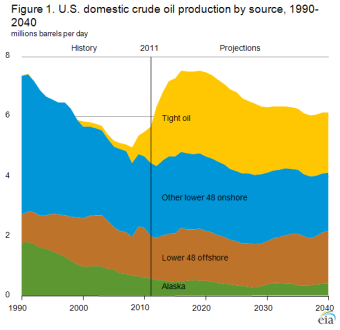
The EIA seems to peg tight oil a little more generously.
http://www.eia.gov/forecasts/aeo/er/...ve_summary.cfm
Energy usage
A measure of the viability of oil shale as a fuel source is the ratio of the energy produced to the energy used converting it (Energy Returned on Energy Invested - EROEI). The value of the EROEI for oil shale is difficult to calculate for a number of reasons. Lack of reliable studies of modern oil shale processes, poor or undo ented methodology and a limited number of operational facilities are the main reasons.[20] Due to technically more complex processes, the EROEI for oil shale is below the EROEI of about 20:1 for conventional oil extraction at the wellhead.[20]
A 1984 study estimated the EROEI of the different oil shale deposits to vary between 0.7–13.3:1.[21] More recent studies estimates the EROEI of oil shales to be 1–2:1 or 2–16:1 – depending on if self-energy is counted as a cost or internal energy is excluded and only purchased energy is counted as input.[20][22] According to the World Energy Outlook 2010, the EROEI of ex-situ processing is typically 4–5:1 while of in-situ processing it may be even as low as 2:1.[4] Royal Dutch S has reported an expected EROEI about 3–4:1 on its in-situ test project.[8][23][24]
Internal energy (or self-energy) is energy released by the oil shale conversion process that is used to power that operation (e.g. obtained by combustion of conversion by-products such as oil shale gas), and therefore reducing the use of other fuels (external energy).[20] There are different views as to if the internal energy should be added to the calculation as cost or not. One opinion is that internal energy should not be counted as an energy cost because is does not have an opportunity cost, unlike external energy used in the process. Another opinion is that internal energy is used for performing useful work and therefore should be added to the calculation.[20] It might also be argued that internal energy should be included as energy invested because it contributes to CO2 emissions.[20][22] However, EROEI then becomes a measure of environmental acceptability rather than economic viability.
http://en.wikipedia.org/wiki/Oil_shale_economics#Energy_usage
There are currently 1 users browsing this thread. (0 members and 1 guests)
 Posting Permissions