Reply With Quote
"believed to be from North Korea"
tee, hee.
Whenever ya's need a boogeyman it's either Russia, China, or, N. Korea.

NK has ramped up attacks on crypto since 2017
Looks like the Lazarus Group got ~$1.5 billion this time
https://www.coindesk.com/business/20...s-biggest-hackMajor cryptocurrency exchange Bybit has seen total outflows of over $5.5 billion after it suffered a near $1.5 billion hack that saw hackers, believed to be from North Korea’s Lazarus Group, drain its ether cold wallet.
The total assets tracked on wallets associated with the exchange plunged from around $16.9 billion to $11.2 billion at the time of writing, according to data from DeFiLlama. The exchange is now looking to understand exactly what happened.

"believed to be from North Korea"
tee, hee.
Whenever ya's need a boogeyman it's either Russia, China, or, N. Korea.
rollbacks not possible, some insiders say
hackers win?
https://www.msn.com/en-us/money/othe...re/ar-AA1zB1XKYuga Labs Blockchain vice president, who goes by the X handle 0xQuit, said the impact of a rollback would be much “larger than $1.5B.”
“Thousands of innocent people would lose money, thousands more would gain money they shouldn’t,” Quit said in an X post. Quit added:
Ethereum is now the home of decentralized finance and the settlement layer for countless rollups. You can't just rewind that sort of infrastructure.
what people will do for money is bonkers
https://www.cryptopolitan.com/crypto...e-a-meme-coin/A crypto trader known as MistaFuccYou shot himself live on X (formerly Twitter) after losing his last $500 in a meme coin rug pull on Friday night.
Before pulling the trigger, MistaFuccYou loaded a revolver on stream and said: “If I die, make me a meme coin.” The gun misfired twice. On the third attempt, it fired.
The livestream, which ran for over 30 minutes after his death, had him bleeding out while the crypto community reacted in real-time as meme coins using his name flooded the market within minutes.
MistaFuccYou, who also went by “Im really poor,” was 23 years old, according to users on X and Reddit. His posts on X show a bit of mental health struggles, and some in the community believe the suicide was also tied to a breakup as he used to talk about his “shorty,” but suddenly stopped around two weeks before the incident.
Minutes after he died, a meme token called “Mistacoin” appeared, with a developer sending him 70% of the total supply before his death. Reactions on Crypto Twitter were mixed. Some traders rushed to buy the tokens, betting on the hype. Others condemned the community. One X user broke it down:
“So let me get this straight. This guy starts streaming live on X. Gets scammed. Asks for refunds. Pulls out a six-shooter. Says ‘If I die, make a meme out of me,’ pulls the trigger three times. Dies. Stream continues for 30 minutes. And people instantly create a meme coin? WTF?”“The meme coin industry is pure evil,” another person wrote. “This guy literally went live to play Russian Roulette to pump a coin, and it ended up killing him.”

Ouch. Bitcoin finally crashed below 90k. Down to 87k and rapidly falling. It's over for this bull cycle.
BUY THE DIP
But, .........but, it's still dipping, Trixie.
under 80k and still falling
weird that trump is pumping these downmarket crypto names, wonder who's getting the juice besides trump

I wonder where DJT is getting the money for this
is DOGE stealing from the US Treasury?
(fwiw, Trump's own meme coin is on Solana)
plausible
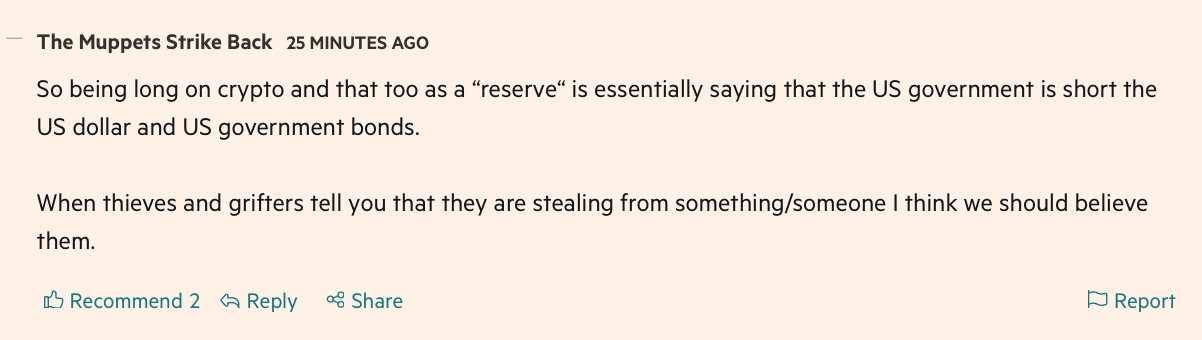
This was the end goal of crypto aligning behind Trump - the crypto economy has very few actual dollars in it and relies on finding new people to hold the bag to get their dollars. The US government is the ultimate bag holder and they’re going to use your tax dollars to bail out crypto owners.
Definitely a "cash out the temporary up tick" moment in time...
Individual states, including very deep red states in the upper Plains, have pretty unanimously ruled out having a state Bitcoin or crypto reserve. Trump is saying this but it will never pass through Congress. Too many traditional conservatives who don't like crypto and then the Democrats will vote pretty much in unison against it just because Trump is for it. It would never go through the Senate. Too many fiscal establishmentarians.
Solana still isn't doing that great even after today's unusual Sunday pump. Cardano shot up the fastest, I wouldn't call it downmarket, really all of those he tweeted are all the A-tier cryptos. Solana has kind of had a weak bull cycle to begin with and Ethereum still hasn't even had an annual gain, sitting about where it was right before the election even after today's pump.
XRP is still the big winner of the Trump election so far (could change) and, unsurprisingly, Litecoin did next to nothing today (it seems to have an odd unique behavior that is INELASTIC of what BTC and the rest do).
comments at FT

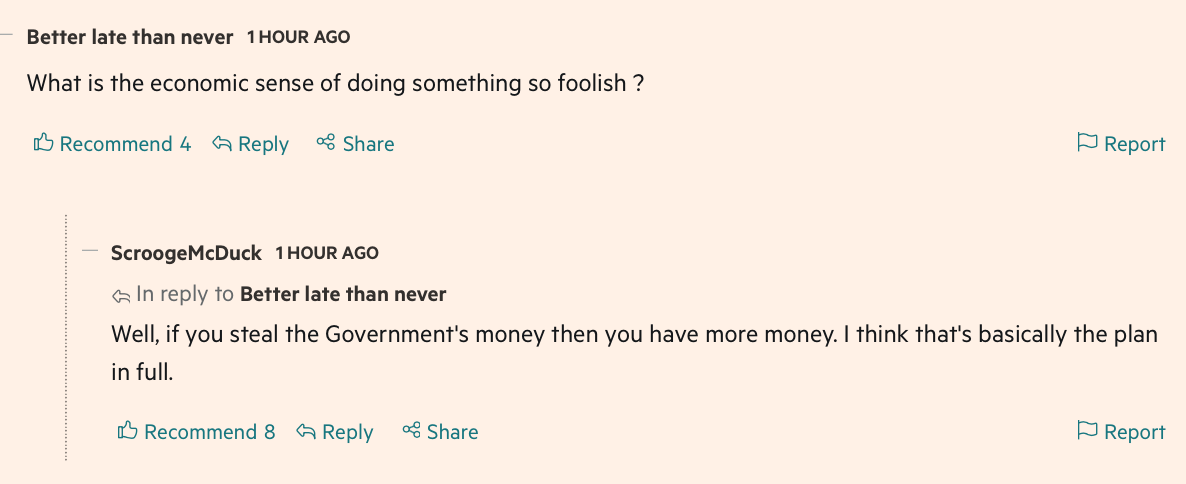
we can't afford park rangers, but we can afford a Bitcoin bailout
anyone care to explain how this helps anyone besides the handful of billionaires in Trump's administration?

Everything except Cardano lost yesterday's gains which is kind of in the middle of its $.60s to $1.1 range in the $.80s but still trending back downward.
got knocked down by Trump's new business taxes


They'll never touch this
scott had a good reply: it can be used as slush fund for political patronage more broadly
Bankruptcy expert Adam Levitan of Credit Slips thinks the GENIUS Act creates an implicit government backstop for stablecoins
Now we’re again at another peak crypto moment, and it appears that the industry has learned …. nothing (or perhaps everything, if you’re cynical), as it is pushing federal stablecoin legislation, the so-called GENIUS Act, that is going to lull a lot of investors into thinking that stablecoins are safe assets, namely that a stablecoin is always redeemable for US dollars at a 1:1 ratio. It’s not. A stablecoin will maintain a 1:1 peg … until it doesn’t, and once that happens, stablecoin investors are going to be taking serious haircut in the ensuing bankruptcy. None of the insolvency provisions in the GENIUS Act change that. There is no way to eliminate credit risk for free, but the GENIUS Act sets up expectations: I fear that this legislation is going to make unsophisticated investors wrongly believe that credit risk on stablecoins is not an issue. If that happens, the GENIUS Act is setting the stage for a federal bailout of disappointed cryptocurrency investors when a stablecoin issuer goes belly-up and investors discover that they don’t have the protections they thought they had.
In other words, the GENIUS Act is creating an implicit guaranty of stablecoins, which means it is creating an implicit subsidy of the whole DeFi world that operates outside the reach of anti-money laundering regulations. What genius thought this up?https://www.creditslips.org/creditslips/By creating a regulatory regime for stablecoins, the federal government will “own” any problem that arises in the market. And here’s the pernicious operation of its ineffective insolvency provisions: they promise to have created safety for stablecoin investors at no cost, but because it cannot deliver on that promise, it sets up a situation where the government has to deliver safety otherwise, on its own dime. In other words, it sets up a bailout. When there is another crypto crash and stablecoin owners realize that their going to incur major losses, they will come crying for a bailout, noting how critical stablecoins are for the whole DeFi world and how they thought their investments were safe because of the GENIUS Act.
Crypto discussions at HUD
https://www.propublica.org/article/h...an-developmentDennis and HUD spokesperson Kasey Lovett both denied the accounts of their colleagues. “The department has no plans for blockchain or stablecoin,” Lovett said. “Education is not implementation.”
Robert Judson, the EY executive involved in the conversations, confirmed that they took place. “We as a firm were having discussions with select individuals at that agency,” he said when reached by phone. Judson told ProPublica he would seek EY’s approval for a full interview, then didn’t call back.
The White House, EY and Musk did not respond to requests for comment.
HUD officials held at least two meetings about the blockchain proposal last month. A list of attendees to the first meeting included staffers from the offices of the CFO and Community Planning and Development. CPD administers billions of dollars in grants that support low- and moderate-income people, including funding to develop affordable housing, run homeless shelters, support disaster recovery, relocate domestic violence survivors and build parks, sewers and community centers. It was the CFO’s office that called for the meeting, one person told ProPublica.
Also listed as a meeting attendee was Judson from EY. For years Judson has advocated for the blockchain, a digital ledger of sorts that creates an immutable record of transactions saved across multiple computers. Boosters of the technology cast it as a way to cut middlemen such as banks and credit card companies out of financial transactions and make those transactions more transparent and secure. Judson has written that the blockchain can help organizations prevent money from being siphoned off for unintended purposes. “As digital assets such as stable coins or digital currencies take hold, more powerful applications will emerge for integrated value exchange,” he wrote. Dennis, who served as HUD CFO in the first Trump administration, also wrote, in a 2021 book, that the agency should use technology such as “blockchain, robotics, and next-generation financial management systems.”
Stablecoins are backed by reserves including traditional currency, commodities and Treasury securities. That is supposed to ensure that their value — unlike that of, say, Bitcoin — doesn’t fluctuate. However, on several high-profile occasions, the value of stablecoins has done just that.
At the HUD meeting, attendees discussed a “proof of concept” project in which CPD would begin to track the funding going to a single CPD grant recipient and possibly subrecipients on the blockchain. The need for the project was “not well articulated,” one attendee later wrote in meeting notes.
Following the meeting, a HUD official wrote and circulated a memo within the agency panning the idea. “Without exaggeration, every imaginable implementation of this at HUD appears dangerous and inefficient,” the memo reads.
There are currently 1 users browsing this thread. (0 members and 1 guests)
 Posting Permissions