Reply With Quote
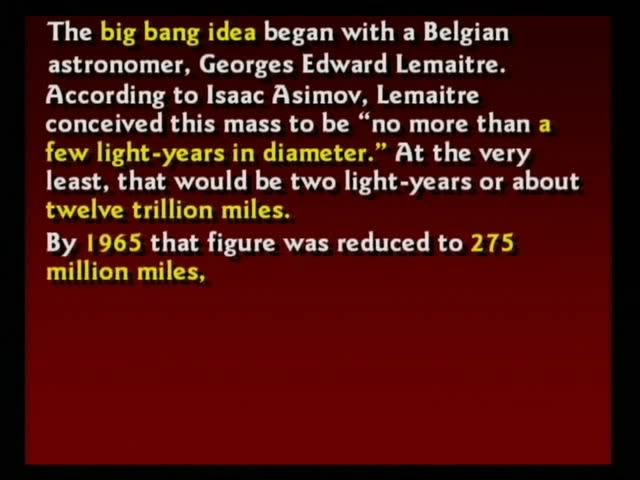
then they changed the "Theory"
1965
1972
1974
1983


Some people have no idea how many times Science had to cover Darwin's Bull by changing the "Theory" of the size of the "mass" that exploded.

then they changed the "Theory"
1965
1972
1974
1983

There's an obvious explanation for this. It's common sense, really. Before I answer, though, I want you think for a few minutes of a reason why the population hasn't exploded to ridiculously large numbers.
Okay, now that you thought about it, tell me one reason why the population would not have exploded. Play Devil's Advocate for a moment and think from the other side.
You tell me.
Where are all the people?
Six billion people live on planet Earth. That sounds like a lot of people. Well, I would not want to invite them all to a barbecue at my house! However, they could all fit into an area the size of England, with more than 20 square metres each. Many of us live in cities, so we have the impression that the world is bursting with people. However, much of the world is sparsely populated.
Nevertheless, many wonder at how the population could have grown to six billion from who survived the Flood that wiped out everyone else about 4,500 years ago. When you do the figures, it confirms the truth that everyone on Earth today is a descendant of the survivors of the flood. Not only that, but if people have been here for much longer, and there was no global Flood , there should be a lot more people than there are—or there should be a lot more human remains!
Many people have problems understanding growth rates of things. When the population doubles from 16 to 32, it does not seem like much, but when it doubles from three billion to six billion it seems like a lot more. But, it is exactly the same rate of growth. Given enough generations, the number of people being added with each generation becomes astronomical. It’s like compound interest on an investment—eventually the amount being added each year becomes very great.
To illustrate this, think of the story of the inventor of chess. His king offered him a reward, but instead of gold he asked for one grain of rice doubled for each successive square on a chessboard. The number of grains would have been 1, 2, 4, 8, 16, 32 etc. The 10th square would have 512; the 20th, 524 thousand; the 30th, 537 million. The amount of rice on the last square1would have been a number so great—vastly in excess of the total world rice harvest at present—that it would have represented wealth far exceeding that of the king. Such is the power of compounding. And population growth is compound growth—that’s why so many people are now being added each year. It’s not necessarily that people are having more children than they once did, or that fewer people are dying.
What causes population growth?
The population grows when more people are born than die. The current growth rate of the world population is about 1.7% per year.2 In other words, for every 100 million people, 1.7 million are added every year; i.e. births net of deaths.
Many assume that modern medicine accounts for the world’s population growth. However, ‘third world’ countries contribute most of the population growth, suggesting that modern medicine is not as important as many think.
Population growth in a number of South American and African countries exceeds 3% per year. In many industrialized countries with modern medical facilities, the population growth is less than 0.5%. Some relatively wealthy countries are actually declining in population.
The move from agriculture to manufacturing/technology has been a big factor in slowing population growth in industrialized countries. Farmers needed to have sons to help with the farm work. This was particularly necessary before mechanization. My own family records show that in the early- to mid-1800s in Australia, couples commonly had 8–10 surviving children. One couple had 16! And this was before the discovery of the germ basis of disease,3 aseptic surgery,4 vaccines3 and antibiotics. Opportunity to expand, combined with biology, saw growth in population of 4% or more, plus increases due to immigration. High rates of population growth were also seen in Quebec, Canada, from 1760 to 1790, following the British conquest of Canada in 1759,5 and well before the impact of modern medical knowledge.
In industrialized countries, the advent of social security pensions and retirement plans (superannuation) has probably been another major factor in the decline of population growth. These schemes mean that people do not see the need to have children for security in their old age. Furthermore, people can now easily choose how many children they have because of modern birth control methods, such as the contraceptive pill.
What growth rate is needed to get six billion people since the Flood?
It is relatively easy to calculate the growth rate needed to get today’s population from Noah’s three sons and their wives, after the Flood. With the Flood at about 4,500 years ago, it needs less than 0.5% per year growth.6 That’s not very much.
Of course, population growth has not been constant. There is reasonably good evidence that growth has been slow at times—such as in the Middle Ages in Europe.
Let us take the average of all births in the first two post-Flood generations as 8.53 children per couple. The average age at which the first son was born in the seven post-Flood generations in Shem’s line ranged from 35 to 29 years , with an average of 31 years,7 so a generation time of 40 years is reasonable. Hence, just four generations after the Flood would see a total population of over 3,000 people.
Do the math...

Last edited by mouse; 10-16-2012 at 10:59 PM.
Sigh. I knew you wouldn't give me an answer. You know, one of the most important aspects of being a good debater is knowing the opponent's stance (even better than they know it). The fact that you don't think about what your oponent's stance would be, shows how far behind you are.
Nevertheless, I will hold your hand through this so that you understand the answer. But first, I will ask you two "yes" or "no" questions (all you have to post in your response to this post is "yes" or "no" for both questions):
1.) Do you honestly want to know the answer to the question you posed? Yes or no?
2.) Do you stick by your stance? I don't want you backpedaling and claiming that your position was misunderstood. Are you saying that there would be billions, possibly trillions, more people on earth right now if it was billions of years old? Yes or no?
And if you are going to plagiarize, remove the personal information of the guy you are stealing from.
Producing facts?
2.) Do you stick by your stance? I don't want you backpedaling and claiming that your position was misunderstood. Are you saying that there would be billions, possibly trillions, more people on earth right now if it was billions of years old? Yes or no?
I didn't say a thing this is public knowledge.
you can play your s game all you want.
Science tries to push the evidence to Geology.
geology passes the question to Biology
in the end, no one wants to support Darwin
Are you seriously incapable of answering yes or no to my inquiries? All I want from you right now are answers to my questions.
Is the answer to my first question yes or no?
Is the answer to my second question yes or no? You are posting these things as "proof" that the earth is not billions of years old, so it would be reasonable to assume that you actually think this is a good argument.
If you want to actually discuss this subject, we will. All you have to do is answer those questions.
You do want to discuss this population matter, right?
Last edited by redzero; 10-16-2012 at 11:23 PM.
Are you saying you paid that person in your Avatar before you used it?
Do you have glass dildo that far up your High horse ass your going to pull out the copy write card?
I would have more respect for you to just not post and not involve yourself in this public humiliation.
But we all know form your postings your a Nat buzzing around the fresh .
Where are all the bodies?
Evolutionists also claim there was a ‘Stone Age’ of about 100,000 years11 when between one million and 10 million people lived on Earth. Fossil evidence shows that people buried their dead, often with artifacts—cremation was not practiced until relatively recent times (in evolutionary thinking). If there were just one million people alive during that time, with an average generation time of 25 years, they should have buried 4 billion bodies, and many artifacts. If there were 10 million people, it would mean 40 billion bodies buried in the Earth. If the evolutionary timescale were correct, then we would expect the skeletons of the buried bodies to be largely still present after 100,000 years, because many ordinary bones claimed to be much older have been found.12 However, even if the bodies had disintegrated, lots of artifacts should still be found.
Now the number of human fossils found is nothing like one would expect if this ‘Stone Age’ scenario were correct. The number found is more consistent with a ‘Stone Age’ of a few hundred years, Many people groups could have used stone tools having lost the technologies of metal smelting.
Okay, mouse, I will go ahead anyway, because you probably will try stalling by not answering my questions.
What is one major thing a civilization would need to grow and prosper?
I'll go with:

Population Statistics
The evolutionary idea proposes a "stone age" of about 100,000 years estimating that about 10 to 100 million people lived. Don Batten in his column "Where are all the people?" "If there were just one million people alive during that time, with an average generation time of 25 years, they should have buried 4 billion bodies, and many artifacts…If the evolutionary timescale were correct, then we would expect the skeletons of the buried bodies to be largely still present after 100,000 years, because many ordinary bones claimed to be much older have been found."
It is important to understand the rate of population growth. when a population doubles from three billion to six billion people it seems incredible but it is the same rate of growth. Like compound interest, the amount of people being added each year grows very fast. The growth rate of the world's population today has been estimated at about 2 % per year. The average growth rate needed to produce the six billion people in today's population Of course, many things including war and disease affect population growth and the calculations are influenced by many unknown events of history. However, even when considering these variables, what is known about true history remarkably confirms the ages proposed by the Bible and illustrates the impossibility of millions of years.
The problems with the old-earth position by considering the simple mathematics of population statistics. "…Suppose man has been around for one million years, as evolutionists teach. If present rates are typical there should be about 10 to the power 8600 people alive today! That's 10 with 8600 zeros following it. This number is obviously absurd, and no evolutionist would claim it to be accurate." To illustrate how outrageous this large number is, consider the number of seconds that have ticked off the clock since the beginning of time on the evolutionist's timescale. Today, evolutionists estimate the age of the universe from 12 to 15 billion years old, but for the sake of example let's say it's 30 billion years old. The number of seconds in 30 billion years is less than 10 to the 18th power!
If a two percent growth rate seems too high, Morris continues, "…Let's assume man has been here for one million years. We can calculate the population grown rate necessary to produce today's population in that length of time from an original pair, and we find it to be only 0.002 percent, quite different from known measured rates throughout recorded history."
"Even so, starting one million years ago, with a growth rate of 0.002 percent, and a present population of six billion, can you guess how many people would have lived and died throughout history? The number is so large, it is meaningless, and it's approximately the number which could just fit inside the volume of the entire earth! If all these people lived and died, where are their bones?"
In addition to the obvious problem with the lack of human bones in the fossil record many other problems exist; what about: the bones of the millions of years of human ancestors, the bones of the animals (not just one million years but 300 million years) , the volume of plants that would have existed during this time, etc. Thus, considering the most conservative estimates of the evolutionary timescale the numbers just don't add up for evolution. (Rather, the numbers add up too much.)
Population size and population growth rates indicate that of a young earth is a much more realistic explanation of the past then the old ages proposed by evolution .
Another point the Darwin clones avoid.....
The Dead Sea:
The Dead Sea is in Israel. It is receives fresh water from the Sea of Galilee via the Jordan River. The Dead Sea has a very high salt content. Even so, it continues to get saltier since it has no outlet other than by evaporation. Scientists have measured the amount of salt added each year by the Jordan River; and they have also calculated the amount of salt in the Dead Sea. From these it is possible to estimate how long this process has been going on for. Assuming a constant rate of salt/water flow, and a zero salt level at the beginning, then the age of the Dead Sea is only 13,000 year old.

how is this more important than a couple having sex on a restaurant table?
According to your Atheist pals those are two snails having sex.
You didn't answer my question.
Put the script down. Your creationist websites aren't going to help you right now. Answer my question in your own words.
What is one major thing a civilization would need to grow and prosper?
A Club of they're own.
Organic material in Dinosaur bones:
The fact is that dinosaur bones carbon date the same age as fossil mammoths, saber-toothed tigers, and Neanderthals: i.e. only thousands of years old: as opposed to millions. In this regard, dinosaur bones have been found to still retain collagen, elastin, and laminin: which should have decayed in less than 50,000 years.
The Oldest Fossil Trees have about 1600 tree rings. this isn't rocket science people.
So you're not actually going to respond seriously? I thought so.
For all your posturing, when it comes down to it, you're too stupid and dishonest to have an actual debate with.
Pssssst!
Why not try and bring some evidence the earth is billions of years old or try and maybe debunk my evidence the earth is not Billions of years old,
and then maybe you can say you know how to debate someone who doesn't go around asking how many jelly beans are in a jar.

not being able to think in such gigantic spans of times or conceptualize 15 billion years versus 50 million or even 100,000 really hinders the human mind tbh
I am trying to debunk one of your pieces of "evidence," but you don't seem like you actually want to talk about it.
http://en.wikipedia.org/wiki/Radiocarbon_dating
"The age of the Earth is 4.54 ± 0.05 billion years (4.54 × 10⁹ years ± 1%). This age is based on evidence from radiometric age dating of meteorite material and is consistent with the ages of the oldest-known terrestrial and lunar samples. Following the scientific revolution and the development of radiometric age dating, measurements of lead in uranium-rich minerals showed that some were in excess of a billion years old"
Just thought I'd give you some evidence even if you'll discredit it. Enjoy your argument
There are currently 1 users browsing this thread. (0 members and 1 guests)
 Posting Permissions