Page 4 of 5 FirstFirst 12345 LastLast
Results 76 to 100 of 111
  1. #76
    Veteran
    My Team
    San Antonio Spurs
    Join Date
    Mar 2009
    Post Count
    97,536
    dollarize? the pegs them to the Fed.

    they go back to their own currency, and deflate. Germans will adore those super cheapo vacation weeks in Greece.

    Germans got big deflation switching to Euro, others got inflated.

    ‘Secret’ History of the Greek Crisis

    Put simply, in recent years, Greece has become an oligarchy. The very rich avoid civic responsibility. Few pay taxes. They fill Piraeus harbor with mega-yachts and put their money abroad rather than investing in Greek industry. It does not appear that even the self-proclaimed “revolutionary” Syriza government can alter this situation.

    https://consortiumnews.com/2015/07/12/secret-history-of-the-greek-crisis/


  2. #77
    Veteran
    My Team
    San Antonio Spurs
    Join Date
    Mar 2009
    Post Count
    97,536
    Greece Has Made No Preparation for a Grexit

    This is as bad as we’ve feared. We regularly warned that there were no signs that Greece was preparing in a meaningful way for a Grexit (high level discussions like “first we seize the Bank of Greece building” don’t cut it), but sources close to Syriza have said in public what amounted to the same thing, that the government was completely preoccupied with the tactics of the negotiations and was not thinking or acting beyond that.

    From the BBC’s Robert Peston
    (hat tip Nathan):

    So the first rather chilling thing I’ve learned, from well-placed bankers, is there have been no conversations between the Bank of Greece, the government or regulators and Greece’s commercial banks about the technicalities of leaving the euro and adopting a new currency.


    This is astonishing – and some would say pretty close to criminal – given that on Wednesday night the president of the European Union, former Polish prime minister Donald Tusk, was explicit that this weekend’s negotiations were all about whether Greece would stay in the eurozone.

    It’s “close to criminal” not to have considered it when European leaders told the Greek government before the election that they regarded an “Oxi” vote as tantamount to leaving the Eurozone and the ECB stopped increasing the ELA. The ECB has the means to force a de facto Grexit and top European officials were saying with a united voice that they were prepared to go that far.


    I’ve been saying privately for weeks that this feels like Lehman: one side not willing or able to hear it won’t get its rescue, the other side not choosing or able to hear (until very late in the game) that they weren’t getting the message and neither side preparing for the rupture.

    The Administration never called a bankruptcy lawyer to understand what a securities firm bankruptcy would mean. Lehman’s attorney filed only a short-form bankruptcy, which meant the firm collapsed in the most destructive manner possible.


    http://www.nakedcapitalism.com/2015/...+capitalism%29


  3. #78
    🏆🏆🏆🏆🏆 ElNono's Avatar
    My Team
    San Antonio Spurs
    Join Date
    Apr 2007
    Post Count
    153,473
    [SIZE=3][FONT=arial]dollarize? the pegs them to the Fed.

    they go back to their own currency, and deflate. Germans will adore those super cheapo vacation weeks in Greece.
    They can still do it and stay pegged to a strong currency. ie: they can simply regulate that whoever was earning 30 euros an hour now earns 10 dollars an hour (effectively 9 euros) after the conversion to dollars. It's a defacto shredding of salaries and pensions, which is exactly what's going to happen when they switch to their own currency.

    There's a few reasons to do this:
    - If they switch to their own currency, it probably would be a more violent crash
    - They instantly become compe ive in the region
    - For an economy based heavily on tourism like theirs, the switch provides cheaper tourism on a readily available currency
    - It fiscally keeps them tied to a foreign currency, which means they'll still need to address their out of control spending
    - It keeps inflation at bay, which is one of the worst problems when doing a currency conversion
    - It prevents speculative attacks on the new currency
    - The euro is bound to take a hit if/when they get kicked out. Moving to another strong currency automatically allows them to reap the benefits

  4. #79
    dangerous floater Winehole23's Avatar
    My Team
    San Antonio Spurs
    Join Date
    Nov 2008
    Post Count
    115,169
    IMF calls for debt relief:

    The International Monetary Fund has set off a political earthquake in Europe, warning that Greece may need a full moratorium on debt payments for 30 years and perhaps even long-term subsidies to claw its way out of depression.

    "The dramatic deterioration in debt sustainability points to the need for debt relief on a scale that would need to go well beyond what has been under consideration to date,” said the IMF in a confidential report.


    Greek public debt will spiral to 200pc of GDP over the next two years, compared to 177pc in an earlier report on debt sustainability issued just two weeks ago.


    The findings are explosive. The do ent amounts to a warning that the IMF will not take part in any EMU-led rescue package for Greece unless Germany and the EMU creditor powers finally agree to sweeping debt relief.

    http://www.telegraph.co.uk/finance/e...bt-relief.html

  5. #80
    dangerous floater Winehole23's Avatar
    My Team
    San Antonio Spurs
    Join Date
    Nov 2008
    Post Count
    115,169
    Doug Henwood in March, 1998:

    Americans accustomed to thinking of Western Europe as a less austere and less orthodox way of doing capitalism should revise those thoughts immediately; Europe is now run by econocrats and central bankers, and it has become the most austere and most orthodox region of the world, with balanced budgets and hard money taking the front seat, and everything else either in the back seat or left behind entirely.
    http://www.leftbusinessobserver.com/EMU.html

  6. #81
    Veteran
    My Team
    San Antonio Spurs
    Join Date
    Mar 2009
    Post Count
    97,536

  7. #82
    Veteran
    My Team
    San Antonio Spurs
    Join Date
    Mar 2009
    Post Count
    97,536

  8. #83
    dangerous floater Winehole23's Avatar
    My Team
    San Antonio Spurs
    Join Date
    Nov 2008
    Post Count
    115,169
    You're missing the point cavilling at details. Neo-liberalism as it is practiced by European central banks and EU technocrats, was a radical shift from the status quo ante. One wonders considering the example of Greece, how compassionate, fair and humane the new Europe is compared to the old one.

    Europe has tacked sharply to the right. Whole countries are now sacrificed to keep creditors whole.

  9. #84
    dangerous floater Winehole23's Avatar
    My Team
    San Antonio Spurs
    Join Date
    Nov 2008
    Post Count
    115,169
    God forbid a lender should ever have take a loss on a bad loan.

  10. #85
    Veteran
    My Team
    San Antonio Spurs
    Join Date
    Mar 2009
    Post Count
    97,536
    You're missing the point cavilling at details. Neo-liberalism as it is practiced by European central banks and EU technocrats, was a radical shift from the status quo ante. One wonders considering the example of Greece, how compassionate, fair and humane the new Europe is compared to the old one.

    Europe has tacked sharply to the right. Whole countries are now sacrificed to keep creditors whole.
    yeah, ok, neo-liberalism everywhere, ok.

    USA bailed out damaged Euro banks in the Banksters Great Depression.

  11. #86
    dangerous floater Winehole23's Avatar
    My Team
    San Antonio Spurs
    Join Date
    Nov 2008
    Post Count
    115,169
    sure, why not?

  12. #87
    Veteran
    My Team
    San Antonio Spurs
    Join Date
    Mar 2009
    Post Count
    97,536
    the banks and post-WWI,II Germany got bailed out, but the banks and germany won't bail out Greece.

  13. #88
    🏆🏆🏆🏆🏆 ElNono's Avatar
    My Team
    San Antonio Spurs
    Join Date
    Apr 2007
    Post Count
    153,473
    Terms of Greece’s Surrender:

    http://yanisvaroufakis.eu/2015/07/15...is-varoufakis/

    Also interesting from him:

    http://yanisvaroufakis.eu/2015/07/14...irst-thoughts/

    The last bit about the coup I thought was interesting.

  14. #89
    Believe.
    My Team
    San Antonio Spurs
    Join Date
    Jan 2013
    Post Count
    269
    This proves that the eurozone, European Union, and the euro are jokes.
    You have noticed which country owns so many of the US bonds and what the current US debt limit is?

  15. #90
    Veteran
    My Team
    San Antonio Spurs
    Join Date
    Mar 2009
    Post Count
    97,536
    VAMPIRE SQUID NEWS


    How Goldman Sachs Profited From the Greek Debt Crisis

    he Greek debt crisis offers another illustration of Wall Street’s powers of persuasion and predation, although the Street is missing from most accounts.
    The crisis was exacerbated years ago by a deal with Goldman Sachs, engineered by Goldman’s current CEO, Lloyd Blankfein.


    Blankfein and his Goldman team helped Greece hide the true extent of its debt, and in the process almost doubled it. And just as with the American subprime crisis, and the current plight of many American cities, Wall Street’s predatory lending played an important although little-recognized role.


    In 2001, Greece was looking for ways to disguise its mounting financial troubles. The Maastricht Treaty required all eurozone member states to show improvement in their public finances, but Greece was heading in the wrong direction.


    Then Goldman Sachs came to the rescue, arranging a secret loan of 2.8 billion euros for Greece, disguised as an off-the-books “cross-currency swap”—a complicated transaction in which Greece’s foreign-currency debt was converted into a domestic-currency obligation using a fic ious market exchange rate.


    As a result, about 2 percent of Greece’s debt magically disappeared from its national accounts. Christoforos Sardelis, then head of Greece’s Public Debt Management Agency, later described the deal to Bloomberg Business as “a very sexy story between two sinners.”


    For its services, Goldman received a whopping 600 million euros ($793 million), according to Spyros Papanicolaou, who took over from Sardelis in 2005. That came to about 12 percent of Goldman’s revenue from its giant trading and principal-investments unit in 2001—which posted record sales that year. The unit was run by Blankfein.


    Then the deal turned sour.

    After the 9/11 attacks, bond yields plunged, resulting in a big loss for Greece because of the formula Goldman had used to compute the country’s debt repayments under the swap.

    By 2005, Greece owed almost double what it had put into the deal, pushing its off-the-books debt from 2.8 billion euros to 5.1 billion.


    In 2005, the deal was restructured and that 5.1 billion euros in debt locked in. Perhaps not incidentally, Mario Draghi, now head of the European Central Bank and a major player in the current Greek drama, was then managing director of Goldman’s international division.


    Greece wasn’t the only sinner. Until 2008, European Union accounting rules allowed member nations to manage their debt with so-called off-market rates in swaps, pushed by Goldman and other Wall Street banks.

    In the late 1990s, JPMorgan enabled Italy to hide its debt by swapping currency at a favorable exchange rate, thereby committing Italy to future payments that didn’t appear on its national accounts as future liabilities.


    But Greece was in the worst shape, and Goldman was the biggest enabler. Undoubtedly, Greece suffers from years of corruption and tax avoidance by its wealthy. But Goldman wasn’t an innocent bystander: It padded its profits by leveraging Greece to the hilt—along with much of the rest of the global economy. Other Wall Street banks did the same. When the bubble burst, all that leveraging pulled the world economy to its knees.


    Even with the global economy reeling from Wall Street’s excesses, Goldman offered Greece another gimmick. In early November 2009, three months before the country’s debt crisis became global news, a Goldman team proposed a financial instrument that would push the debt from Greece’s healthcare system far into the future. This time, though, Greece didn’t bite.


    As we know, Wall Street got bailed out by American taxpayers. And in subsequent years, the banks became profitable again and repaid their bailout loans. Bank shares have gone through the roof.

    Goldman’s were trading at $53 a share in November 2008; they’re now worth over $200. Executives at Goldman and other Wall Street banks have enjoyed huge pay packages and promotions. Blankfein, now Goldman’s CEO, raked in $24 million last year alone.


    Meanwhile, the people of Greece struggle to buy medicine and food.


    There are analogies here in America, beginning with the predatory loans made by Goldman, other big banks, and the financial companies they were allied with in the years leading up to the bust. Today, even as the bankers vacation in the Hamptons, millions of Americans continue to struggle with the aftershock of the financial crisis in terms of lost jobs, savings, and homes.


    Meanwhile, cities and states across America have been forced to cut essential services because they’re trapped in similar deals sold to them by Wall Street banks. Many of these deals have involved swaps analogous to the ones Goldman sold the Greek government.


    And much like the assurances it made to the Greek government, Goldman and other banks assured the municipalities that the swaps would let them borrow more cheaply than if they relied on traditional fixed-rate bonds—while downplaying the risks they faced.

    Then, as interest rates plunged and the swaps turned out to cost far more, Goldman and the other banks refused to let the municipalities refinance without paying hefty fees to terminate the deals.


    Three years ago,
    the Detroit Water Department had to pay Goldman and other banks penalties totaling $547 million to terminate costly interest-rate swaps.

    Forty percent of Detroit’s water bills still go to paying off the penalty. Residents of Detroit whose water has been shut off because they can’t pay have no idea that Goldman and other big banks are responsible.


    Likewise, the Chicago school system—whose budget is already cut to the bone—must pay over $200 million in termination penalties on a Wall Street deal that had Chicago schools paying $36 million a year in interest-rate swaps.


    A deal involving interest-rate swaps that Goldman struck with Oakland, California, more than a decade ago has ended up costing the city about $4 million a year, but Goldman has refused to allow Oakland out of the contract unless it ponies up a $16 million termination fee—prompting the city council to pass a resolution to boycott Goldman. When confronted at a shareholder meeting about it, Blankfein explained that it was against shareholder interests to tear up a valid contract.


    Goldman Sachs and the other giant Wall Street banks are masterful at selling complex deals by exaggerating their benefits and minimizing their costs and risks. That’s how they earn giant fees. When a client gets into trouble—whether that client is an American homeowner, a US city, or Greece—Goldman ducks and hides behind legal formalities and shareholder interests.


    Borrowers that get into trouble are rarely blameless, of course: They spent too much, and were gullible or stupid enough to buy Goldman’s pitches. Greece brought on its own problems, as did many American homeowners and municipalities.


    But in all of these cases, Goldman knew very well what it was doing. It knew more about the real risks and costs of the deals it proposed than those who accepted them.

    “It is an issue of morality,” said the shareholder at the Goldman meeting where Oakland came up. Exactly.


    http://robertreich.org/post/124342268010


  16. #91
    Veteran
    My Team
    San Antonio Spurs
    Join Date
    Mar 2009
    Post Count
    97,536
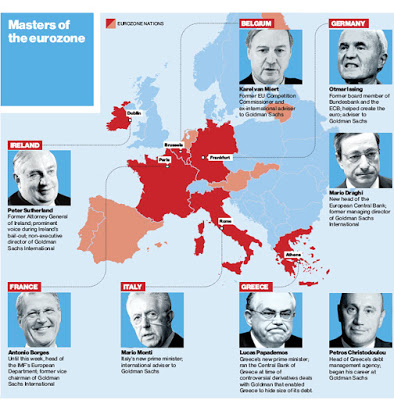
    Gaius Publius: Goldman Sachs – Masters of the Eurozone


    Interesting headline, yes? I have a two-point intro and then the piece.

    First, when a “private” group’s chief individuals flow back and forth constantly between government and that group, the group can be said to be “part” of government, or to have “infiltrated” government, or to have been “folded into” government. (Your phrasing will be determined by who you think is the instigator.)

    For example, a network of private “security consulting” firms does standing business with the (Pentagon’s) NSA, and by some accounts performs 70% of their work. Are those firms part of the NSA or not? Most would say yes, to a great degree. It’s certain that the NSA would collapse without them, and many of these firms would collapse without the NSA (though many have other … ahem, international … clients, which starts an entirely different discussion).


    As another example, the role of mega-lobbying firms as a fourth branch of government was explored here. Same idea.


    In the case of the security firms, one might say they have been “folded into” government. In the case of the lobbying firms, one might say they have “infiltrated” government. I hope you notice the difference; both modes of incorporation occur.


    Second, consider how in general the “world of money” and the parallel world of “friends of money” — its enablers, adjuncts, consiglieri and retainers — flow in and out of the world of government, of NGOs, of corporate boards, of foundation boards, attends Davos and the modern Yalta (YES) conference, and so on. Now consider how someone like Hillary Clinton — not money per se, though she has a chunk, but certainly a “friend of money” — ticks off most of those boxes (foundation board, corporate board, government, Davos, Yalta, and so on). There are many people like Hillary Clinton; she’s just very front-and-center at the moment.


    What we’re about to see is the infiltration of “friends of money” into key positions in the eurozone, and in particular, the infiltration of friends of money from one huge repository of money and guardian of its perquisites — the megabank Goldman Sachs — into those governmental positions.


    “Goldman Sachs Conquers Europe”


    I stole the subhead above from the U.K. paper The Independent. I’m not sure it’s a metaphor. Check the chart at the top and
    notice how many Goldman Sachs alumni are actually in charge of economic policy in Europe, much like GS alumni are in charge (literally) of economic policy in the U.S. government.

    Which suggests the questions:


    • Where are the current loyalties of these Goldman Sachs employees?
    • Does Goldman Sachs run economic policy in the U.S.?
    • Does Goldman Sachs run economic policy in the eurozone?


    http://www.reuters.com/article/2015/...ame=healthNews


  17. #92
    dangerous floater Winehole23's Avatar
    My Team
    San Antonio Spurs
    Join Date
    Nov 2008
    Post Count
    115,169
    German Minister of Finance Wolfgang Schäuble was prepared “to give Greece €50 billion” had Yanis Varoufakis, his Greek counterpart at the time, agreed to his country leaving the eurozone, a high level source who recently spoke to Schäuble has revealed.

    The German minister was described by the source like “a true European” who had nothing against Greece, but favoured harsh medicine for a good cause.


    Schäuble was reported to assume that the leftist Syriza government would favour leaving the eurozone, a move consistent with its ideology. And he was prepared to put money on the table to encourage it to take this step
    .

    Schäuble was quoted as asking how much Greece wants to leave the euro by France’s Mediapart. This is said to taken place before the 5 July referendum, in which a vast majority of Greeks rejected the international creditors’ proposals.


    But according to the information obtained by Heard in Europe, Schäuble had in mind a concrete figure – €50 billion – had Syriza opted for Grexit.
    http://heardineurope.blogactiv.eu/20...quit-the-euro/

  18. #93
    dangerous floater Winehole23's Avatar
    My Team
    San Antonio Spurs
    Join Date
    Nov 2008
    Post Count
    115,169
    IMF draws a line in the sand over debt relief:

    The IMF has indicated it will not take part in a third bailout for Greece unless a deal is reached on making Athens' debt sustainable, a move that underlines the difficulty of reaching an overall agreement by next month's deadline.

    "The IMF can only support a programme that is comprehensive," an IMF official told journalists on Wednesday reports Reuters.


    The official also said there was "no expectation" that talks over the coming weeks will reach the stage that allow the IMF to approve a new programme.


    Meanwhile the FT reported that an IMF board meeting on Wednesday concluded Athens' high debt and poor level of implementing reforms means it is not eligible for a loan.


    The conclusion means that while the Washington-based Fund will take part in bailout negotiations - which started earlier this week in Athens - it will potentially not decide whether to agree to the programme for several months.


    A summary of Wednesday's board meeting, seen by the FT, says the IMF will only take part once eurozone lenders have "agreed on debt relief".
    https://euobserver.com/economic/129808

  19. #94
    Veteran
    My Team
    San Antonio Spurs
    Join Date
    Mar 2009
    Post Count
    97,536
    disaster/vulture capitalism: predatory banks make BAD risky loans that go into default, banks bailed out, borrower gets screwed, gets its assets taken over by vultures.

    Greek MOU foresees rapid sale of ports, grid operator, airports

    Greece will move rapidly to privatize its ports, regional airports and its power grid operator under a memorandum of understanding (MOU) agreed with its international lenders.

    According to the 29-page MOU, a copy of which was obtained by Reuters, Greek privatization proceeds, excluding bank shares, are expected to total 6.4 billion euros between 2015 and 2017.


    The MOU lists a range of measures that the Greek government must implement in order to obtain a new three-year bailout program that is expected to total roughly 85 billion euros.


    http://www.reuters.com/article/2015/...edName=topNews


  20. #95
    dangerous floater Winehole23's Avatar
    My Team
    San Antonio Spurs
    Join Date
    Nov 2008
    Post Count
    115,169
    Perhaps the best way to show what a mess Europe is in is the €3 billion deal they made with Turkey head Erdogan, only to see him being unmasked by EU archenemy Vlad Putin as a major supporter, financial and who knows how else, of the very group everyone’s so eager to bomb the heebees out after Paris. It could hardly have been more fitting. That’s not egg on your face, that’s face on your egg.


    But Brussels thinks it’s found a whipping boy for all its failures. Greece. It’s fast increasing its accusations against Athens’ handling of the 100s of 1000s of refugees flooding the country. Everything that goes wrong is the fault of Greece, not Brussels. The EU has so far given Greece €30 million in ‘assistance’ for the refugee crisis, while the country has spent over €1.5 billion in money it desperately needs for its own people. But somehow it’s still not done enough.


    The justification given for this insane shortfall is that Greece doesn’t blindly follow all orders emanating from Europe’s ‘leaders’. Orders such as setting up a joint patrol of the Aegean seas with … yes, Erdogan’s Turkey. Where Greece gets next to nothing as the children keep drowning, Turkey gets €3 billion and a half-baked promise to join the Union sometime in the future.


    Which was never going to happen, the EU would blow up before Turkey joins and certainly if it does, and most certainly now that Russia’s busy detailing the link between the Erdogan cabal and Europe’s supposed new archenemies -move over Putin?!, which, incidentally, are reason for France to ponder a kind of permanent state of emergency; ostensibly, this is Hollande’s way of exuding confidence. ‘We must protect our way of life’.


    Given Schengen -while it lasts-, which effectively erases all frontiers, this de facto means permanent emergency across the entire EU. And that, to a degree, though the two may seem unrelated, plays into the EU’s insistence to station foreign border guards (military police) at Greek borders. A, we can’t put it in different words, completely insane demand to which Alexis Tsipras’ government has apparently even acceded.


    Insane because once you have foreigners deciding who can enter or leave your country, you’re effectively a country under occupation. It really is that simple.
    http://www.theautomaticearth.com/201...er-occupation/

  21. #96
    dangerous floater Winehole23's Avatar
    My Team
    San Antonio Spurs
    Join Date
    Nov 2008
    Post Count
    115,169
    We are not specialists in the Greek cons ution -terribly hard to read-, but we very much question whether an elected government can decide to give up its nation’s sovereignty this way. Two -related- issues here are: 1) does the EU have the legal capacity to force this (EU border guards agency Frontex) on a member state, and 2) does Tsipras have the legal capacity to sign over the sovereignty of his country to foreigners?


    Brussels may claim that Athens voluntarily ‘invited’ in German and Polish ‘officers’, but that’s far short of even half the story. EU countries have been complaining about the way Greece has dealt with the refugee crisis, stating that it is not capable of protecting its borders, which it ‘should’ under Schengen.


    Nonsense of course. Athens is very capable of protecting its borders, but it has stated -quite correctly, it would seem- that it protects its borders from enemies, and the refugees are not enemies. The reason the refugees keep arriving -and/or drowning-, mind you, has a lot more to do with Angela Merkel’s ‘invitation’ for them to come, and with Turkey’s eagerness to let them leave, than it does with anything Greece has done. Or not done.


    But that’s not what Brussels talks about. Far from it. The EU claims it has the power to take over, even if Greece would resist. Reuters quotes a EU official as saying: “One option could be not to seek the member-state’s approval for deploying Frontex but activating it by a majority vote among all 28 members..”


    In other words, if 15 countries vote to occupy Greece, it’s a done deal.
    same

  22. #97
    dangerous floater Winehole23's Avatar
    My Team
    San Antonio Spurs
    Join Date
    Nov 2008
    Post Count
    115,169
    Norbert Haring, Chairman of the ECB shadow council, on who's running the show in the Europe:

    In November, 2002, two of the most significant flagships of the financial press, the German Handelsblatt and the American Wall Street Journal, had a brilliant idea: we will create, they said, a "shadow council", consisted of some of the most important academic economists, but also economists from the private sector. The council will conduct monthly meetings prior to the ECB board of directors, for the purpose to suggest whether the base interest rate should be increased, reduced, or, remain stable.

    Despite the fact that this council has no ins utional characteristics, its existence as a consulting tool was planned by the Maastricht Treaty. Soon, it was transformed into an informal "ins ution", the decisions of which are reaching the headquarters of the ECB in Frankfurt.


    Essentially, the target of this shadow council, as was mentioned sometime by Wall Street Journal, was to build a bridge for the big gap between the British central bank and the German Bundesbank.


    From the first day, Handelsblatt's Norbert Häring, has been set the president and coordinator of the council. He participates in every meeting, without the right of voting. When I met him a few days ago in Brussels for the filming of the do entary This is not a coup, I was prepared to face another passionate supporter of the European ins utions. Speaking at phone, however, he warned me that his view does not express the decisions of the shadow council. But there was nothing that could prepare me for the "bombs" he would attempt to plant at the euro-system foundations.


    At the start of the interview, he told me that “It is scandalous the fact that a central banker, like Stournaras, can state publicly that he had blocked the attempt of the [Greek] government to create a parallel currency, without ending in prison.” He also said that “This time, we don't have a silent coup”, like in the case of Cyprus, Italy, or, Ireland, “but a real coup that violates the responsibilities of the central bank and interferes [with] the political life of a country.


    According to Häring, the ECB has been transformed now into a powerful player who speaks directly with the biggest banks of the planet without being controlled [...] by the ins utional tools of the EU. He explains to me that “The so-called independence of the ECB and of national banks is iconic. The fact that the elected governments are not able to affect ECB's decisions means that the influence of other players increases. I refer of course to the big financial ins utions. ECB always lies on the side of the big banks.


    According to Häring, ECB is able now to decide whether will sustain a government in power, or, will let this government collapse under the pressure of the markets - and that's exactly what happened with Berlusconi administration in Italy.


    He says that “The national central banks consist part of the ECB system and have a terrifying ability to blackmail governments.” Through the exchange of big bond packages, they provoke big interest rate fluctuations, forcing governments to give them anything they want in return. At the same time, “they continuously give information to the ECB, through which it can blackmail the governments.

    http://failedevolution.blogspot.gr/2...-confirms.html

  23. #98
    dangerous floater Winehole23's Avatar
    My Team
    San Antonio Spurs
    Join Date
    Nov 2008
    Post Count
    115,169
    IMF admits it threw Greece under the bus to save banks and the Euro, and gravely miscalculated the pain it would cause:

    The International Monetary Fund’s top staff misled their own board, made a series of calamitous misjudgments in Greece, became euphoric cheerleaders for the euro project, ignored warning signs of impending crisis, and collectively failed to grasp an elemental concept of currency theory.


    This is the lacerating verdict of the IMF’s top watchdog on the fund’s tangled political role in the eurozone debt crisis, the most damaging episode in the history of the Bretton Woods ins utions.


    Many do ents were prepared outside the regular established channels; written do entation on some sensitive matters could not be located


    It describes a “culture of complacency”, prone to “superficial and mechanistic” analysis, and traces a shocking breakdown in the governance of the IMF, leaving it unclear who is ultimately in charge of this extremely powerful organisation.
    The report by the IMF’s Independent Evaluation Office (IEO) goes above the head of the managing director, Christine Lagarde. It answers solely to the board of executive directors, and those from Asia and Latin America are clearly incensed at the way European Union insiders used the fund to rescue their own rich currency union and banking system.
    http://www.telegraph.co.uk/business/...ses-for-the-i/

  24. #99
    dangerous floater Winehole23's Avatar
    My Team
    San Antonio Spurs
    Join Date
    Nov 2008
    Post Count
    115,169
    The three main bailouts for Greece, Portugal and Ireland were unprecedented in scale and character. The trio were each allowed to borrow over 2,000pc of their allocated quota – more than three times the normal limit – and accounted for 80pc of all lending by the fund between 2011 and 2014.

  25. #100
    dangerous floater Winehole23's Avatar
    My Team
    San Antonio Spurs
    Join Date
    Nov 2008
    Post Count
    115,169
    The IMF persistently played down the risks posed by ballooning current account deficits and the flood of capital pouring into the eurozone periphery, and neglected the danger of a "sudden stop" in capital flows.


    “The possibility of a balance of payments crisis in a monetary union was thought to be all but non-existent,” it said. As late as mid-2007, the IMF still thought that “in view of Greece’s EMU membership, the availability of external financing is not a concern".
    At root was a failure to grasp the elemental point that currency unions with no treasury or political union to back them up are inherently vulnerable to debt crises. States facing a shock no longer have sovereign tools to defend themselves. Devaluation risk is switched into bankruptcy risk.


    “In a monetary union, the basics of debt dynamics change as countries forgo monetary policy and exchange rate adjustment tools,” said the report. This would be amplified by a “vicious feedback between banks and sovereigns”, each taking the other down. That the IMF failed to anticipate any of this was a serious scientific and professional failure.

Thread Information

Users Browsing this Thread

There are currently 1 users browsing this thread. (0 members and 1 guests)

Posting Permissions

  • You may not post new threads
  • You may not post replies
  • You may not post attachments
  • You may not edit your posts
  •