Reply With Quote
I'm singing the same tune, I didn't change.

This is what I said around this time last year. Just lately Fauci has commented that the counting method has changed. Odd eh?

I'm singing the same tune, I didn't change.

Texas just stopped counting active cases.
Odd eh?
Not at all, Fauci blows with the political wind, just like you.

I'll boil this down for ya, Winester...
President Trump: 400k dead of the COVIDPERIOD
MF Biden: 600k dead of the COVID.
& counting, son. No end in sight.
WHO study estimates excess global deaths in 2020-1 at ~16 million, far above the ~6 million officially recorded COVID deaths.
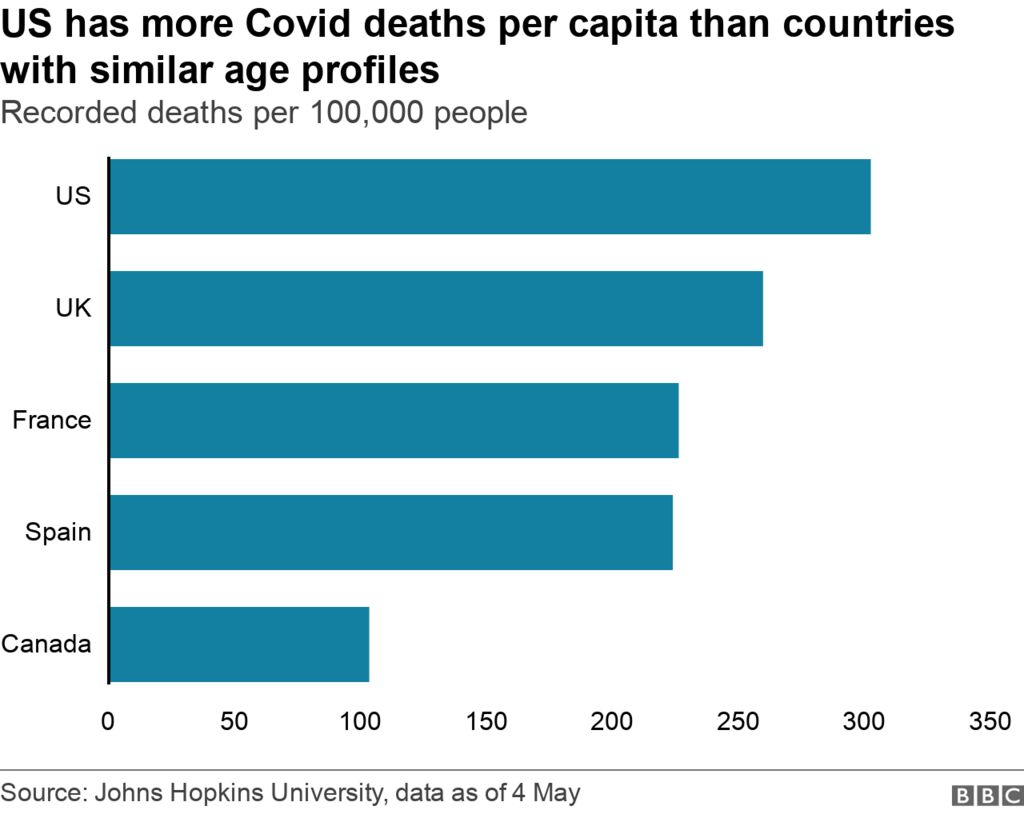
Pretty much any way you slice it, the US has fared worse than comparable countries.
https://www.bbc.com/news/61333847The US is approaching one million Covid deaths - the highest total officially recorded anywhere in the world.
But a new report from the World Health Organization (WHO) shows several other countries recorded more deaths above their normal levels than the US over the last two years.
So does the US really have the highest Covid death toll, and by what measure?
US deaths above global average
There's no international standard for measuring deaths or their causes, and countries record deaths in different ways, which makes comparison difficult.
But experts say one of the most accurate measures is how many extra deaths are recorded in a country above the number that would have been expected to die in an average year.
Many countries publish excess death data, but some poorer nations don't or do it far less frequently.
The WHO has published a report calculating every country's excess death count for 2020 and 2021.
This measure takes into account deaths not directly due to Covid, but as a consequence of the pandemic, such as people being unable to access hospitals for the care they needed.
It also accounts for poor record-keeping in some regions.
The report concludes that, although the US was not the worst hit country in the world by this measure, it remained in the top five in terms of overall numbers of deaths.
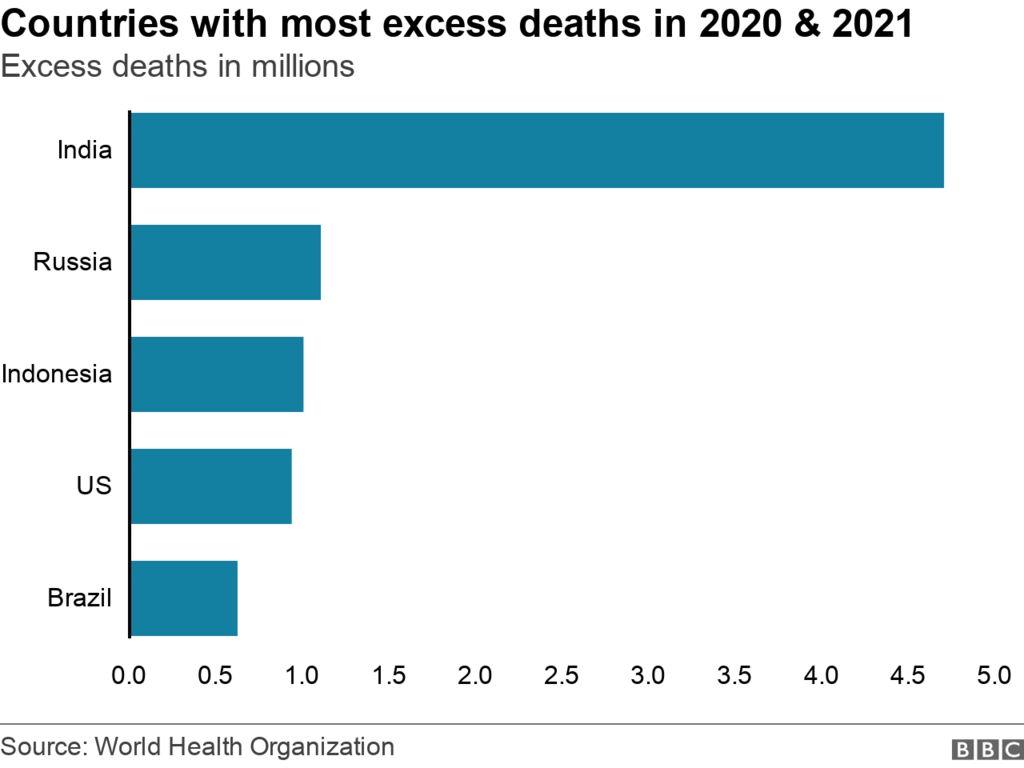
According to the WHO, in 2020 and 2021 the US recorded more than 930,000 excess deaths, behind India (4.7m), Russia (1.1m) and Indonesia (1m).
The WHO's numbers are largely consistent with statistics from the Economist which run into 2022, as well as other excess death studies.
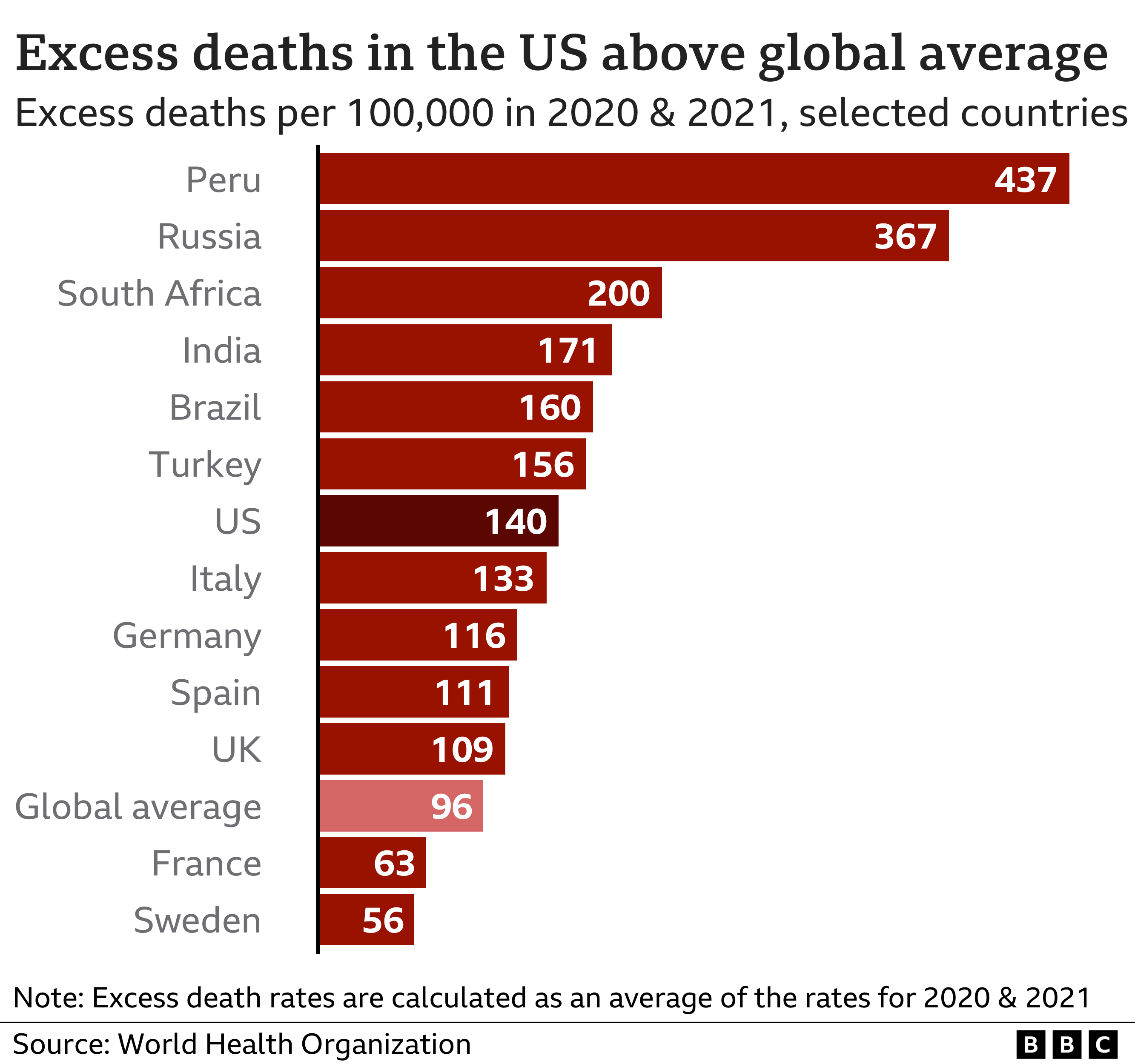
When adjusted for population size, the US slips down the rankings with 140 excess deaths per 100,000 people. But it remains a long way above the global average of 96 per 100,000 - and it's also one of the worst performing among the most developed nations.
Prabhat Jha, an epidemiologist who worked on the WHO report, says: "The US has about a 15% undercount using excess deaths compared to official Covid deaths - that's mostly a result of some of the early problems that occurred with nursing home deaths being missed."
"On the whole the US isn't missing many deaths compared with, say, India," he adds.
What about the official Covid death numbers?
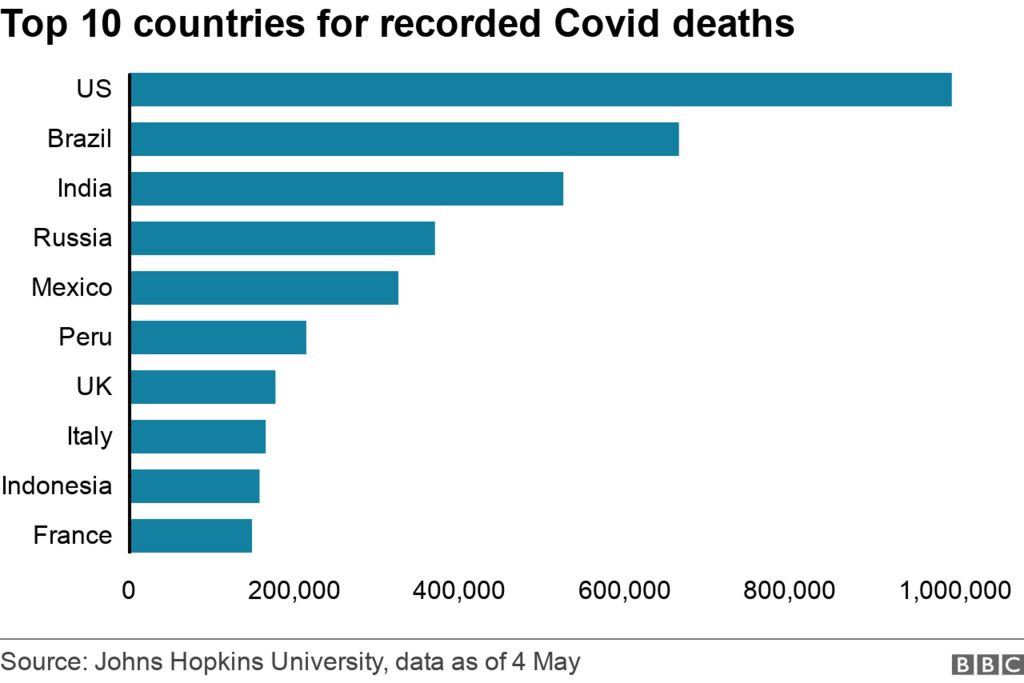
The US has recorded the most deaths from coronavirus in the world - over 300,000 more than the next closest country, Brazil.
But the US has a larger population than many other countries.
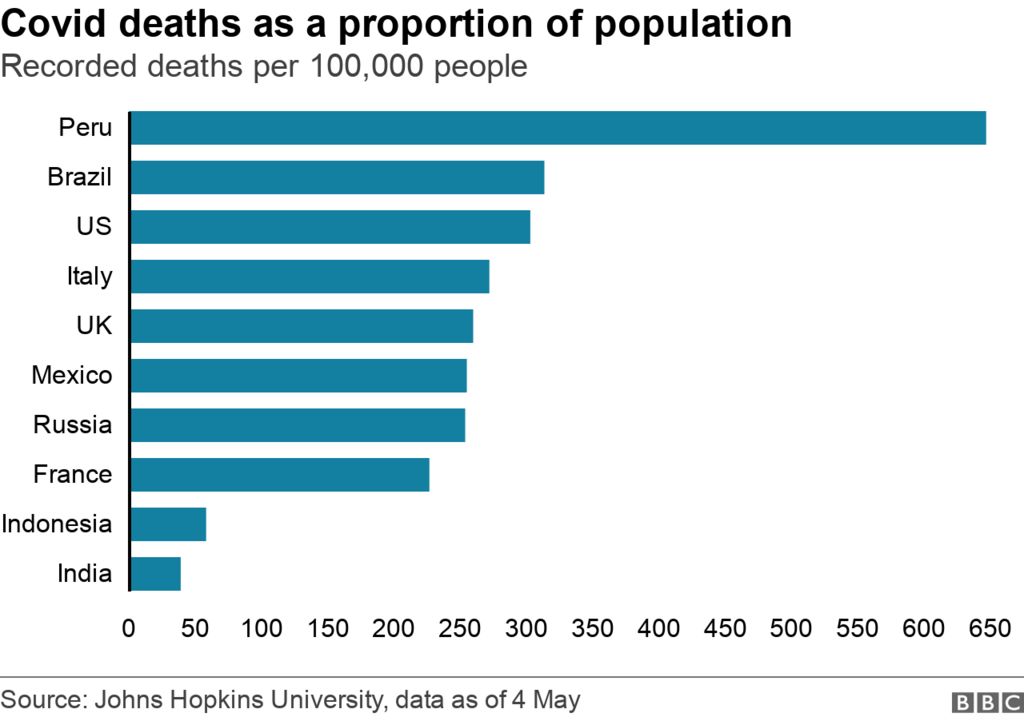
When you look at the same top 10 countries in per capita terms, the US is below both Brazil and Peru for recorded Covid deaths.
Overall the US ranks 18th in the world in recorded Covid deaths per capita, according to Johns Hopkins University data.
"Short term I think the per capita confirmed death rate is a pretty good indicator" says Justin Lessler, professor of epidemiology at the University of North Carolina.
"The US is not the highest, but it's certainly on the higher end."
Experts say it's also important to take the average age of a country's population into account.
"We should compare with countries which have similar age structures as we know Covid has a higher fatality rate in the elderly - so we should compare apples to apples," says Bhramar Mukherjee, professor of epidemiology at the University of Michigan.
When comparing with Spain, UK, and France, as well as neighbouring Canada - developed countries with similarly aged populations to the US - the US has performed worse.
"A lot of the European countries - like the UK, France and Spain - are reasonable to compare, and they've had lower per capita death rates. It's not night and day, but the US is on the upper end of that spectrum," says Professor Lessler.
and apparently has for some time, quite apart from COVID
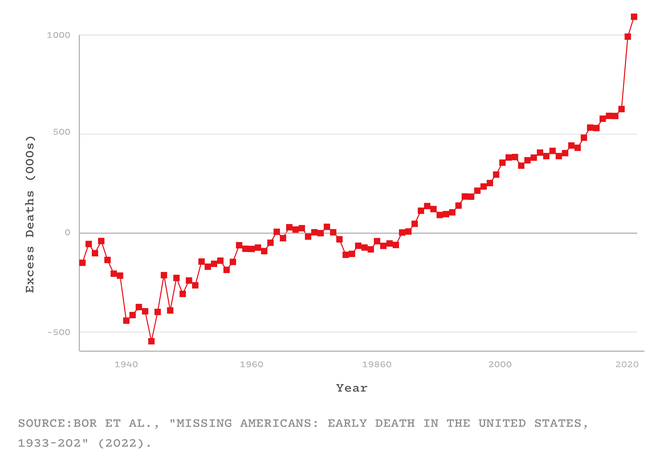
https://www.theatlantic.com/health/a...-rates/670591/Jacob Bor has been thinking about a parallel universe. He envisions a world in which America has health on par with that of other wealthy nations, and is not an embarrassing outlier that, despite spending more on health care than any other country, has shorter life spans, higher rates of chronic disease and maternal mortality, and fewer doctors per capita than its peers. Bor, an epidemiologist at Boston University School of Public Health, imagines the people who are still alive in that other world but who died in ours. He calls such people “missing Americans.” And he calculates that in 2021 alone, there were 1.1 million of them.
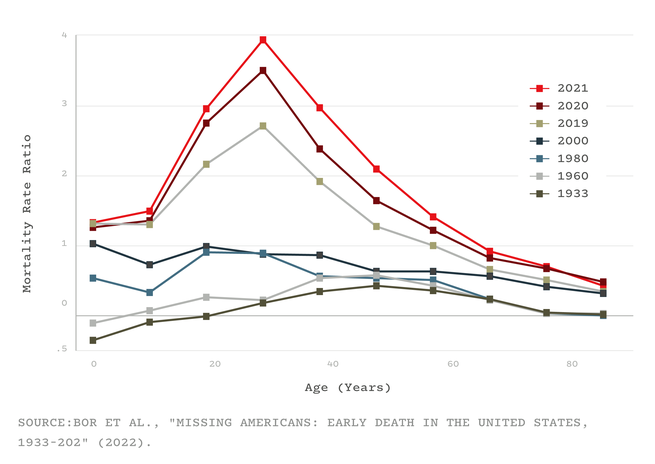
Bor and his colleagues arrived at that number by using data from an international mortality database and the CDC. For every year from 1933 to 2021, they compared America’s mortality rates with the average of Canada, Japan, and 16 Western European nations (adjusting for age and population). They showed that from the 1980s onward, the U.S. started falling behind its peers. By 2019, the number of missing Americans had grown to 626,000. After COVID arrived, that statistic ballooned even further—to 992,000 in 2020, and to 1.1 million in 2021. Were the U.S. “just average compared to other wealthy countries, not even the best performer, fully a third of all deaths last year would have been prevented,” Bor told me. That includes half of all deaths among working-age adults. “Think of two people you might know under 65 who died last year: One of them might still be alive,” he said. “It raises the hairs on the back of my neck.”
These counterfactuals puncture two common myths about America’s pandemic experience: that the U.S. was just one unremarkable victim of a crisis that spared no nation and that COVID disrupted a status quo that was strong and worth restoring wholesale. In fact, as one expert predicted in March 2020, the U.S. had the worst outbreak in the industrialized world—not just because of what the Trump and Biden administrations did, but also because of the country’s rotten rootstock. COVID simply did more of what life in America has excelled at for decades: killing Americans in unusually large numbers, and at unusually young ages. “I don’t think people in the United States actually have any awareness of just how poorly we do as a country at letting people live to old age,” Elizabeth Wrigley-Field, a sociologist at the University of Minnesota, told me.
Several studies, for example, have shown that America’s life expectancy has tailed behind other comparable countries since the 1970s. By 2010, that gap was already 1.9 years. By the end of 2021, it had grown to 5.3. And although many countries took a longevity hit because of COVID, America was once again exceptional: Among its peers, it experienced the largest life-expectancy decline in 2020 and, unlike its peers, continued declining in 2021. But Bor says that people often misinterpret life-expectancy declines, as if they simply represent a few years shaved off the end of a life. Someone might reasonably ask: What’s the big deal if I die at 76 versus 78? But in fact, life expectancy is falling behind other wealthy nations in large part because a lot of Americans are dying very young—in their 40s and 50s, rather than their 70s and 80s. The country is experiencing what Bor and his colleagues call “a crisis of early death”—a long-simmering tragedy that COVID took to a furious boil.
In every country, the coronavirus wrought greater damage upon the bodies of the elderly than the young. But this well-known trend hides a less obvious one: During the pandemic, half of the U.S.’s excess deaths—the missing Americans—were under 65 years old. Even though working-age Americans were less likely to die of COVID than older Americans, they fared considerably worse than similarly aged people in other countries. From 2019 to 2021, the number of working-age Americans who died increased by 233,000—and nine in 10 of those deaths wouldn’t have happened if the U.S. had mortality rates on par with its peers.
US life expectancy declined again in 2021
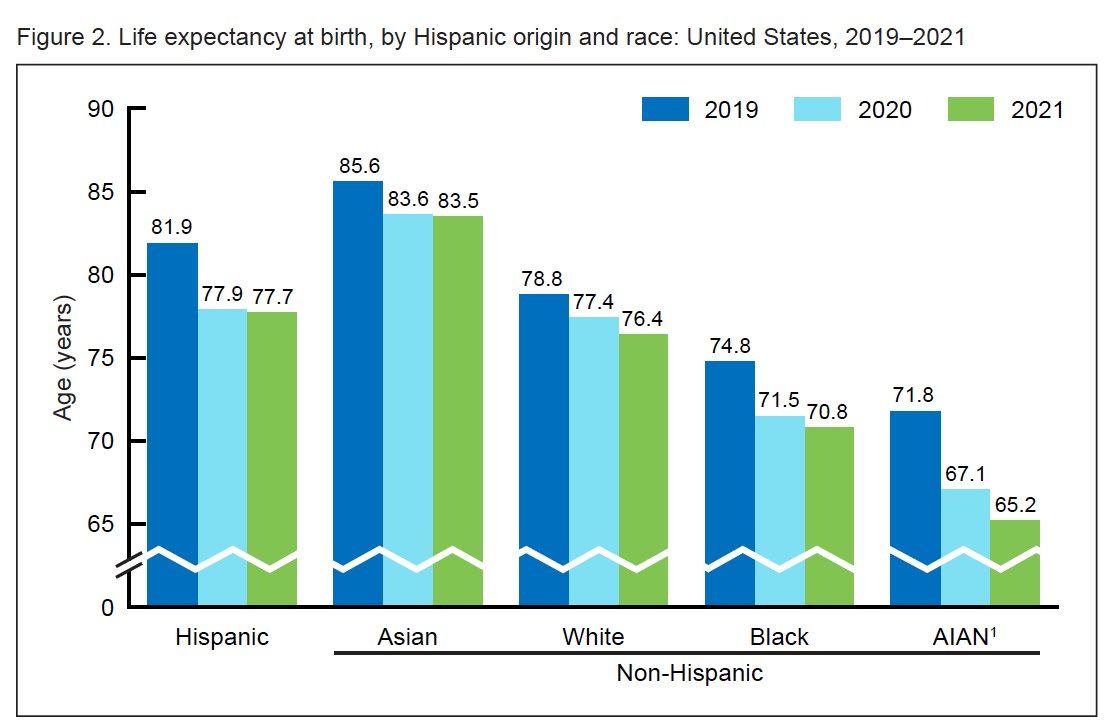
https://www.statnews.com/2022/08/31/...utive-decline/Americans born in 2021 can expect to live for just 76.1 years — the lowest life expectancy has been since 1996, according to a new government analysis published Wednesday. This is the biggest two-year decline — 2.7 years in total — in almost 100 years.
The Covid-19 pandemic is the primary cause of the decline. However, increases in the number of people dying from overdoses and accidents is also a significant factor.
American Indian and Alaskan Native people have experienced a particularly precipitous drop in life expectancy since 2019, going from 71.8 to 65.2 years. This kind of loss is similar to the plunge seen for all Americans after the Spanish Flu, said Robert Anderson, the chief of the mortality statistics branch of the National Center for Health Statistics, a division of the Centers for Disease Control and Prevention.
“It’s a ridiculous decline,” Anderson said. “When I saw a 6.6 year decline over two years, my jaw dropped. … I made my staff re-run the numbers to make sure.”
What's the take away, or are you just tweet dropping for s and giggles?
it's newsworthy, Marcus Aurelius. COVID put a walloping on us.
DMC admits he can't interpret the chart.
"it's just a cold"
Trash and his mafiya, right wing hate media, misled, for political points, 100Ks of Americans to sickness and death
nobody held responsible.
"excess excess mortality"
The strong correlation of excess deaths with waves of infection suggest that deaths are significantly undercounted.
Recent data can be noisy, as the C.D.C. slowly processes death certificates. But almost every week for more than six months, the agency has calculated that total excess mortality was 50 percent larger, and often almost twice as large, as the number of official Covid-19 deaths, which we tend to regard as the central public health anomaly of the age.
And though the pattern has continued for three years, there isn’t medical or scientific consensus about what is driving it. Instead, perhaps several hundred thousand “unexpected” deaths have been explained only by loose conjecture. “We’ve got to figure this out,” the University of Minnesota epidemiologist Michael Osterholm told me. “And in order to do that, you’ve got to have that discussion: Wait a minute, this is bigger than people think.”https://www.nytimes.com/2023/02/02/o...?smid=tw-shareFaust’s own analysis suggests that the excess excess is larger during periods of low testing and smaller during periods of high testing. “I suspect, in the fullness of time,” he said, “we’re going to figure out that of these 200,000 to 300,000 excess deaths, that 80 to 90 percent of them were just Covid.”
unsurprisingly, maternal deaths ed in 2021
https://www.npr.org/sections/health-...21-cdc-reportsIn 2021, the U.S. had one of the worst rates of maternal mortality in the country's history, according to a new reportfrom the Centers for Disease Control and Prevention. The report found that 1,205 people died of maternal causes in the U.S. in 2021. That represents a 40% increase from the previous year.
These are deaths that take place during pregnancy or within 42 days following delivery, according to the World Health Organization.
The U.S. rate for 2021 was 32.9 maternal deaths per 100,000 live births, which is more than ten times the estimated rates of some other high income countries, including Australia, Austria, Israel, Japan and Spain which all hovered between 2 and 3 deaths per 100,000 in 2020.
It's not just the bad living, living in the USA is bad for you, unless you're over 75.
https://www.npr.org/sections/health-...ife-expectancyJust before Christmas, federal health officials confirmed life expectancy in America had dropped for a nearly unprecedented second year in a row – down to 76 years. While countries all over the world saw life expectancy rebound during the second year of the pandemic after the arrival of vaccines, the U.S. did not.
Then, last week, more bad news: Maternal mortality in the U.S. reached a high in 2021. Also, a paper in the Journal of the American Medical Association found rising mortality rates among U.S. children and adolescents.
"This is the first time in my career that I've ever seen [an increase in pediatric mortality] – it's always been declining in the United States for as long as I can remember," says the JAMA paper's lead author Steven Woolf, director emeritus of the Center on Society and Health at Virginia Commonwealth University. "Now, it's increasing at a magnitude that has not occurred at least for half a century."
Across the lifespan, and across every demographic group, Americans die at younger ages than their counterparts in other wealthy nations.
"American children are less likely to live to age 5 than children in other high-income countries," the authors write on the second page. It goes on: "Even Americans with healthy behaviors, for example, those who are not obese or do not smoke, appear to have higher disease rates than their peers in other countries."
The researchers catalog what they call the "U.S. health disadvantage" – the fact that living in America is worse for your health and makes you more likely to die younger than if you lived in another rich country like the U.K., Switzerland or Japan.
"We went into this with an open mind as to why it is that the U.S. had a shorter life expectancy than people in other countries," says Woolf, who chaired the committee that produced the report. After looking across different age and racial and economic and geographic groups, he says, "what we found was that this problem existed in almost every category we looked at."
wow, if accurate

https://jessicawildfire.substack.comHow many times has the pandemic ended now?
I’ve lost count.
The pandemic officially “ended” back in May, but the virus just won’t cooperate with the affluent decider class. As I wrote the other day, the media is trying to celebrate a new “milestone” by selling a fake drop in excess deaths. That part isn’t surprising. They’ve been trying to end the pandemic for years.
Here’s the strange part: I would’ve thought the CDC would at least quietly announce somewhere they were changing their baseline for calculating excess deaths. They wouldn’t just keep it a secret.
Would they?
Well, anyone who’s popping champagne over a “drop” in excess deaths isn’t looking at the real numbers. I ran my own stats using CDC data. It shows that our health agencies have definitely been moving the goalpost.
Even The Economist raised an eyebrow.
Here’s what they said:
Our central estimate for the world’s current total mortality rate exceeds projections from 2019 by 5%, or 3m lives per year.They describe Covid as killing at a “slower, steadier pace than in 2020-21.” We flattened the curve, but not exactly how we expected. Misguided and misinformed by everyone with a microphone, the public wound up creating a virus that spreads freely all year long, with micro-surges every season.
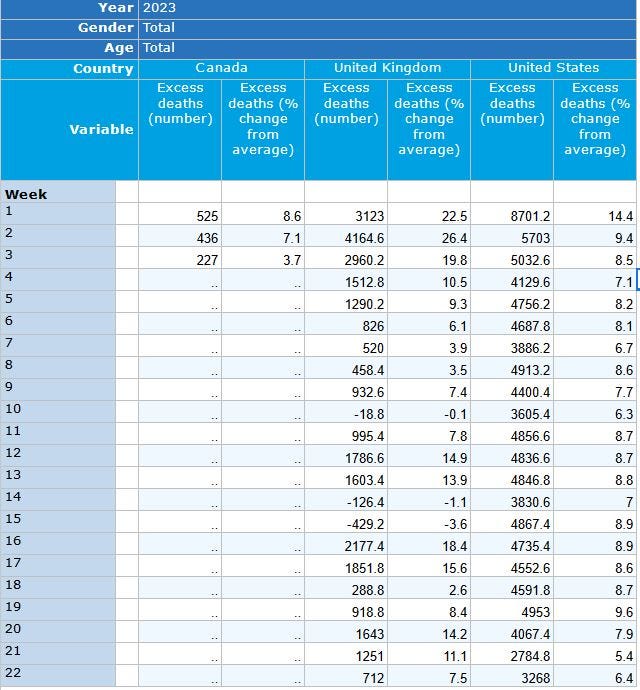
Then you have the OECD’s numbers:
It looks to me like we’re still running with an excess mortality rate anywhere from 6 to 14 percent, depending on the week. Even during the spring, we were hitting close to 9 percent. That’s not what I would call “over.”
Here’s what else I did:
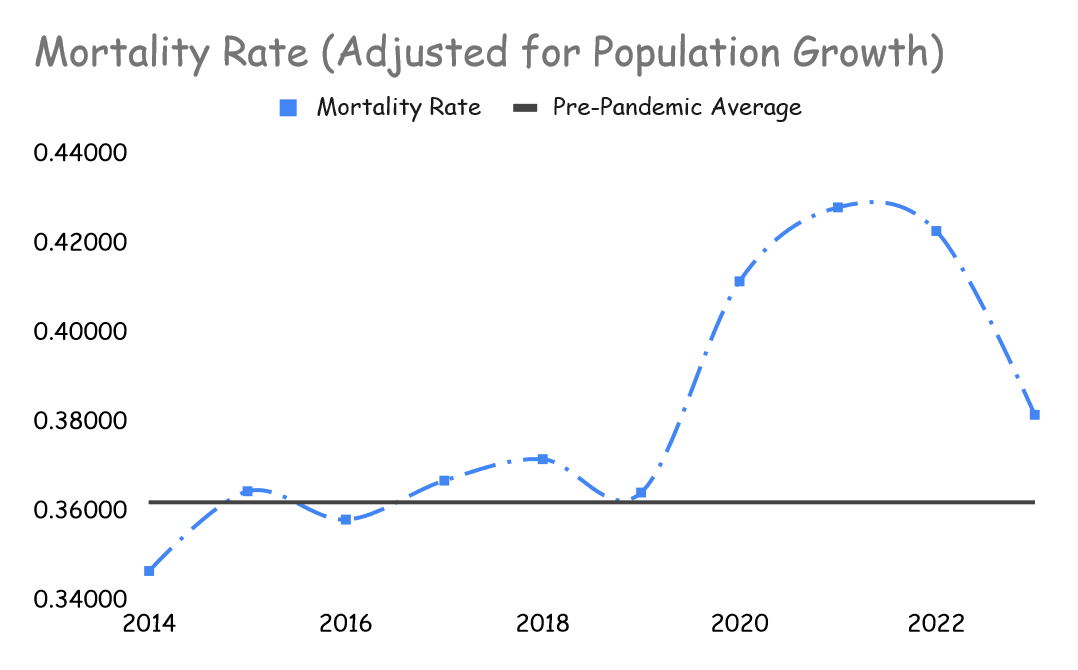
After my previous post, someone pointed me in the right direction for the CDC’s monthly mortality counts for 2014-2019. With that, I could dig into the numbers. Some Covid minimizing troll said I should factor in population growth, so I did. Hey, why not? I calculated my own mortality rates by dividing total deaths Jan-May by the population for each individual year. Then I averaged the rates from 2014-2019 to get a pre-pandemic baseline (shown below).
Here it is:
My own excess mortality rate.
Magically, my own spreadsheet math corresponds with The Economist and The OECD. We’re looking at an excess mortality rate that’s still considerably higher than anything we saw before the pandemic started. Remember, this chart takes population growth into account. It shows 5.5 percent excess deaths.
At least the excess death rate is moving in the right direction.
It’s still not anywhere close to “normal.”
There are currently 1 users browsing this thread. (0 members and 1 guests)
 Posting Permissions