Reply With Quote
I am a Republican, and I do not believe that by paying higher taxes, my life will be better. I KNOW I can make better use of that money than the government can.

I don't have the answer, but I know what we have already is unsustainable. Current Medicare/SS payroll deductions go to pay current retiree expenses. The average retiree now is getting almost 1.5 times the medicare benefits than they paid in adjusted for inflation. There are currently 3 workers now paying for 1 retiree benefits. By the time you guys in your 40s retire there will be only two paying the benefits. The whole system is unsustainable even without all the green deal promises.
I am a Republican, and I do not believe that by paying higher taxes, my life will be better. I KNOW I can make better use of that money than the government can.

No WC
Social Security - $939 billion - 23.58%
Other - $614 billion - Spending on unemployment compensation, federal, civilian and military retirement, some veterans’ benefits, the earned income tax credit, the Supplemental Nutrition Assistance Program, and other mandatory programs - 15.41%
NonDefense - $610 billion - Spending on many programs related to transportation, education, veterans’ benefits, health, housing assistance, and other activities - 15.31%
Medicare - $591 billion - 14.84%
Defense $590 billion - 14.82%
Medicaid - $375 billion - 9.42%
Net Interest - $263 billion - 6.60%
Total (my calculation) $3982 billion - CBO chart says $4 trillion
https://www.cbo.gov/system/files/115...eralbudget.pdf
Where are you getting these numbers? Are you counting military retirement or veteran's benefits as defense? See CBO breakdown above.

Muh a who you callin ? You was literally just eatin my Carlos’ asshole out a few minutes ago.

I probably should've been more clear in my response to Koriwhat and not just said "social safety net" programs as a blanket description. He was obviously referring to welfare programs (food stamps, Medicaid, etc) that subsidize the supposed "irresponsible and lazy." We can take Social Security and Medicare off the list, since those are safety nets for elderly citizens who paid into them over the course of their (working) lives. And there you go, we spend far more on defense building outdated conventional weapons like 1.5 trillion dollar fighter plane projects and funding bases in countries we've never heard of. Is this a spending of your tax dollars you approve of? Conservatives like to bang the "small government, less spending drum," but seem to lack the courage to call out wasteful military spending.
Here's the conservative projection phenomena at work again. When you read/hear Democrats/Liberals advocate for higher taxes, you clutch your purse and think they want your money. I'm going to out on a limb and say your household income is anywhere from 200K-1 million. No. What we (they) want is a more balanced tax bracket. It makes no sense to me that someone who makes 30 million per year pays the same amount of taxes as someone who makes 700K per year. And it sure as doesn't make a lick of sense that someone who makes 30 million dollars per year only pays about 50% more in taxes than someone making 100K per year, despite making 300 times as much money.
Last edited by midnightpulp; 02-17-2019 at 09:59 PM.
Please take my post as written. If I wanted to project, I would. You are the one projecting - about what I think and my income. I am simply telling him that higher taxes would not better my life.
I'm not projecting. I'm assuming your financial situation to explain to you that when democrats/liberals advocate for higher taxes, they're not endorsing that the middle and even upper-middle classes pay more in taxes. The tax bracket ends at 600K per year, meaning someone making 600K per year pays the same amount in taxes (in percentage) as someone making 6 million per year. This isn't a fair outcome. And yes, your life would be better if people making over 1 million per year were taxed more. That extra revenue could be put toward infrastructure renovation, schools, scientific and medical research, and, get this, better border security! Bet that last one is a selling point, ain't it? If you make over 1 million per year and were say taxed 10% more, no, you wouldn't experience any decline in lifestyle unless you're an extremely greedy pig. Aren't you a Christian? Eye of the needle, rich man, heaven, camel and all that.
Maybe you can confuse the stupid ones on here by claiming the guy making 30 million pays the same tax as the guy making 700,000, but you are talking percentages not dollars. The guy making 30 million obviously pays a of a lot more.
Repugs early strategy is to slander the Dems as baby killers, and call them socialists, knowing that you ignorant Repug base types have no ing idea what democratic socialism is
Last edited by boutons_deux; 02-18-2019 at 07:56 AM.
And the 39% tax hit affects the guy making 700K per much more than it does the guy making 30 million dollars per year. When someone makes this argument, I like to analogize income to calorie intake. Let's say a 2000 calorie per day intake is the proverbial "poverty line." To make the math a bit easier, I'm going to compare a 100K income and a 10 million dollar income. The 100K income is like 10K calorie per day diet, while the 10 million dollar income is like a 1 million calorie per day diet. It should be obvious that taxing each at 40% puts the lower earner closer to the poverty line than the higher earner. Even taxing the lower earner at 10% and the higher earner at 90% still puts the lower earner closer to the poverty line.
This is also why the "it's relative" argument doesn't make sense, either. A 10 million dollar per year earner wouldn't see any lifestyle changes at all being taxed 10 or 20 percent more than he already vs. a 100K per year earner. Oh, so the former can't buy another house in Italy. Boo in' hoo. Now we can indeed make the argument that if that 10 million dollar per year earner is using that capital to grow his business, translating into raises for employees and new hirings, then yes, a tax break should be strongly considered. But if he's using the tax cut to simply indulge his greedy materialism or get more wealthy off passive capital gains investments, then he doesn't deserve it.
I also anticipate the "bitterness at the rich" and "well, that Oligarch earned his money through working harder and smarter than others. Why punish him?" arguments.
I'll casually invent a "law" here that states the more wealth one has, it becomes less and less a result of "smart and hard work" and more a result of luck.
Thought experiment time, Let's say two people start working on the plans for a widget that will change the world at the same time. Inventor A's parents are millionaires, Inventor B lives in rural Appalachia. They finish their blueprints for this world changing widget at the exact same time. Inventor A can simply call his parents and ask for funding. Inventor B doesn't have that privilege. Even if he immediately emails his plans to a VC, he's still not getting seed capital nearly as quickly as Inventor A. Inventor A's version obviously gets to market quicker, he becomes a gazillionaire, and is feted as a "genius" who bootstrapped himself into becoming the world's richest man through "hard and smart work."
Maybe Inventor B figures out a way to get his product to market that does the same thing at a lower price, but then Inventor A's company hits him with intellectual property lawsuits.
The ultimate point of this thought experiment is not to explore free market dynamics, but to illustrate how there's a variety of forces at work that go into making a successful person, and it's not all merely the result of individual grit, talent, and hard work.
https://blogs.scientificamerican.com...n-we-realized/The results of this elucidating simulation, which dovetail with a growing number of studies based on real-world data, strongly suggest that luck and opportunity play an underappreciated role in determining the final level of individual success. As the researchers point out, since rewards and resources are usually given to those who are already highly rewarded, this often causes a lack of opportunities for those who are most talented (i.e., have the greatest potential to actually benefit from the resources), and it doesn't take into account the important role of luck, which can emerge spontaneously throughout the creative process. The researchers argue that the following factors are all important in giving people more chances of success: a stimulating environment rich in opportunities, a good education, intensive training, and an efficient strategy for the distribution of funds and resources. They argue that at the macro-level of analysis, any policy that can influence these factors will result in greater collective progress and innovation for society (not to mention immense self-actualization of any particular individual).
Last edited by midnightpulp; 02-18-2019 at 07:28 AM.
lucky wealth is to be born wealthy
60% of the wealthy inherited their wealth
socio/economic mobility is greatly decreased in USA, now below that of western Europe
born poor, die poor.
born wealthy, die wealthy
That argument was used in the 1991 "Luxury Tax". Turned out to be a dismal failure and decimated the east coast boat industry among others.
Nowhere in my argument did I advocate for a luxury tax.
bull
Money flows. "greedy materialism" is just a weighted phrase to say someone bought something that others produced that is the result of actual productive jobs producing desired goods and services.
The concept that only soaking the rich to pay for the utopian green dream is absolutely flawed. The financial weight of building the green dream will ultimately weigh heaviest on the middle class.
Wilbur Ross's 150 million art collection was "produced by people with actual productive jobs". All those artists are dead.
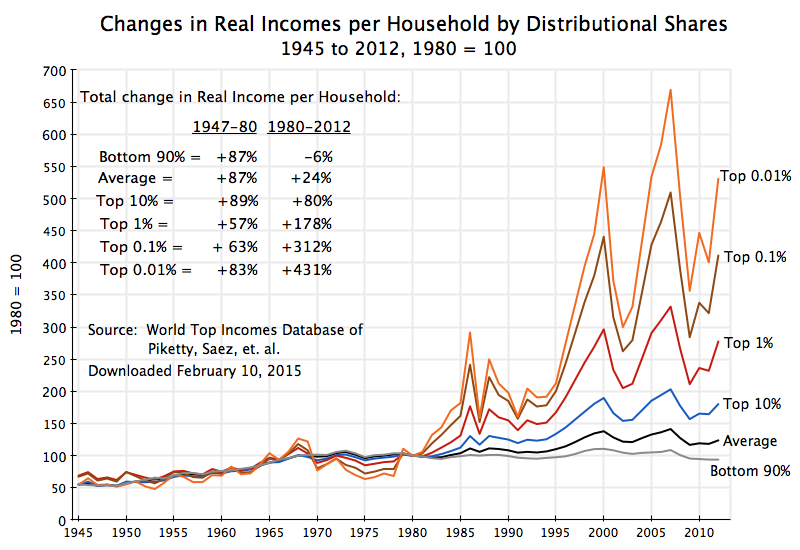
I'm not necessarily talking about soaking the rich to pay for the green new deal. I advocate soaking the rich because I believe it's morally just. Do you think someone making 10 million dollars per year paying 50% more in taxes (by rate) than someone making 100K per year is just and fair? You'll tell me yes. But I ask the question. Which income would you rather have? 10 million taxed at 80 percent or 100K not taxed at all? This illustrates that these incomes aren't "relatively equal, " as the argument goes. Proof is in the pudding. Look how each income group grew at a nearly identical rate at the beginning of the New Deal up until the Reagan Tax Cuts.

Bottom 90% growth has stalled, while the top 10% has grown. All the data I've explored suggests tax cuts for the rich do not "trickle down." Why do you believe this to be so? Oh, I know. The projection phenomenon again. You're equating your small business situation with that of a Fortune 500 company. You tell yourself that a tax cut for you would translate into raises for your employees, new hires, etc, and think that Fortune 500 companies operate similarly. Unlike them, you're not beholden to shareholders. The verdict is out on this. The big corps used these tax cuts that are supposed to "trickle down" to buy back stock and inflate share prices. If it really "trickled down" we'd see bottom 90% growth keep pace with top 10% growth.
What other contributing factors led to these results? You are being intellectually dishonest by singling out tax cuts as the cause.
Okay. Stock buybacks were an illegal practice until the SEC legalized it in 1982. The shareholder primacy concept has come to totally dominate corporate philosophy over that time. We can talk about recessions, globalization, etc all we want, but for 40 in' years the bottom 90% income has stalled. That's enough of a time frame to sort out any "noise" to see if the post-Reagan economic philosophy really "lifts all boats." It obviously didn't. On the contrary, the post-New Deal economic philosophy also got a 40 year trial and seemed to prove its worth in keeping inequality in check and growth consistent among every group.
How many more years of trial do you need in order for you accept it doesn't "trickle down?"
Do stock buybacks really bother you? So the companies bought their own stock. Big deal. What if they took the money and bought another companies stock...would that bother you as much? Did the people they bought the stock from not receive money for the stock? Did they not pay taxes on the gains? Did these people not spend or reinvest the money in other areas that provide jobs and services?
Last edited by CosmicCowboy; 02-18-2019 at 08:51 AM.
It's a simple fact that technological advances and globalization in the last 50 years has killed menial, repe ive jobs in the US and they are never coming back. That is the cause. You can't legislate or class warfare your way to the return of these jobs.
You're theorizing, where I prefer to look at the data. If that "reinvestment" had the efficacy you're claiming, we'd see a growth rate similar to that pre-Reagan. Yes, stock buybacks bother me. They bothered the SEC too before 1982. Another graph.
Again, how many more years of "trial" do we need? Do you think the suddenly income e for the richest over Reagan's first term it's just a magical coincidence?
Uhhh gee. What followed right after the New Deal? WWII. The rest of the modern world was blown to while the US was safe in North America. We came out of WWII as the global economic superpower by default. Unemployment was low and GDP growth was off the charts. Yeah there were some ups and downs but the trend was sharply up into the mid 70's. Gee. What technology really took hold in the mid 70's?. I bought my first IBM PC then.
There are currently 1 users browsing this thread. (0 members and 1 guests)
 Posting Permissions