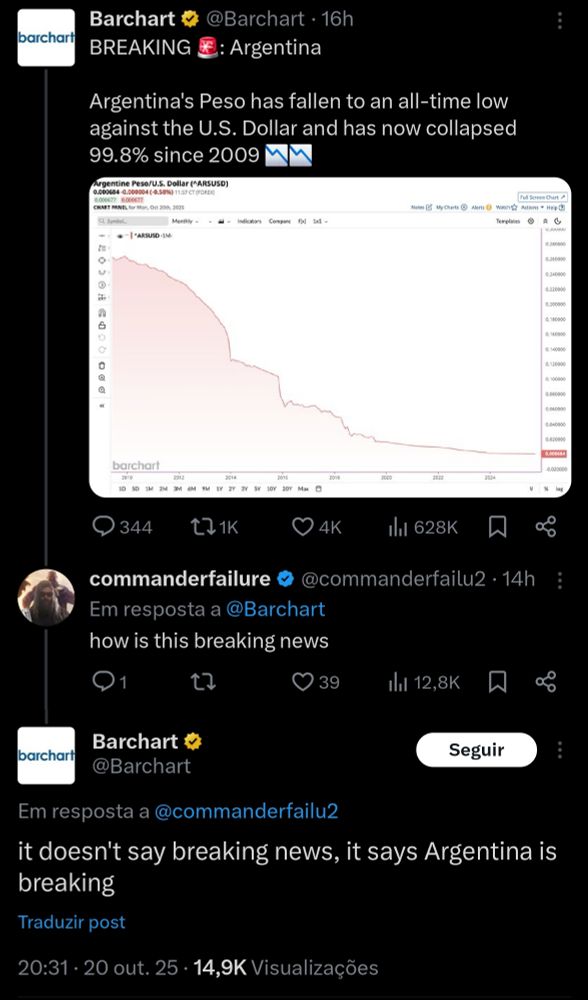
OP was right -- this did seem impossible.
https://x.com/Megatron_ron/status/1980487880968675640


Argentina rejects socialism
You're giving them $40 billion to reward their failure.

Everyone should.
Huge win for freedom and sanity in Argentina and Trump's Monroe Doctrine 2.0
Why?
What is the doctrine?
Is it written down?
Link?
Domination fetish
South America gets a say
new golden age


Similar debasement trade option as the USA -- birds of a feather
https://www.france24.com/en/americas...in-three-mileiArgentina's poverty rate climbs to nearly one in three under Milei
Argentina's poverty rate increased to 32.3 percent in the first half of 2026, partly erasing gains made under President Javier Milei as incomes fail to keep step with rising prices, official statistics showed Thursday.
The rate grew 4.1 points compared to the last half of 2025, the national statistics agency Indec said.
The rate of extreme poverty also shot up from 6.3 percent to 7.5 percent.
Children were the worst hit, with 44.5 percent of Argentines aged 14 years and younger classified as poor, and 10.8 percent as extremely poor.
...
The manufacturing and retail sectors have hemorrhaged jobs due to falling purchasing power and Milei's decision to threw open Argentina to foreign compe ion, leading to a surge in imports.
Some 30,000 companies have closed since he took office, and unemployment rose to 7.9 percent in the second quarter of this year, the highest level since 2021.
Economists say that, more than unemployment, poverty is being driven by the high rate of informal work.
"The biggest problem is job insecurity, not unemployment, because when families are deprived...they have to invent a job, which can be collecting waste, street vending, selling food at the train station," said Donza.
liberation!
https://www.nakedcapitalism.com/2026...c-miracle.htmlIn March this year, JP Morgan even agreed to host the annual Argentina Week, a gathering aimed at attracting foreign investment in the country, at its New York headquarters. Dimon gave the opening address. Which is why it may have come as a bit of shock to President Javier Milei and his economic team when they read the US bank’s latest report on the Argentine economy, published just a few days ago. The first paragraph sets the tone:
The preliminary data for July comes on the heels of a 0.6% contraction in the second quarter of 2026. In other words, the Argentine economy is once again on the brink of a technical recession — for what would be the ninth time in 32 years. According to economists consulted by Bloomberg, the only way of avoiding that fate is if economic activity were to grow by around 6% between August and September, which is, to put it mildly, highly unlikely.We expected a weak activity print in July, consistent with the soft backdrop that characterized the second quarter. However, the reported contraction significantly exceeded our forecast of roughly -1% m/m. Argentina posted its worst monthly performance since the April 2020 lockdown, with the monthly activity indicator declining 2.9% m/m, sa and -1.4% relative to July 2025. Excluding the 2020 lockdown, the late-2008 global financial shock and the 2018-19 period of financial stress, no month since 2008 has registered a larger decline.
Of course, this tired old script has played out many times before in Argentina. As the lawyer and financial analyst Carlos Masláton notes, this is not the first time JP Morgan has pulled the plug on a totally unsustainable economic project after years of peddling said project:
JP Morgan, is this a joke? How are they going to say right now that things are going wrong in Argentina? They did not stop praising Caputo and Milei’s plan for three years, although they should have known that overvaluation of the exchange rate paid for with interest rates and debt does not work and explodes, and now they say that they are disappointed?As others have pointed out, the bank has probably already got what it wanted, anyway. After nearly three years of Milei’s economic miracle, which prioritises short-term profits from financial speculation over the real economy, financial speculators have gorged themselves on vast sums of easy, guaranteed money that will probably soon run dry.
Always the same, JP Morgan… I know how the international financial establishment works, but there are hundreds of thousands of naïve people who believe it and who think that if a Wall Street source says it, it’s because everything is fine.
The Palestinian-Jordanian economist Saifedean Ammous explains how the so-called “financial bicycle” works, how it became the most important industry in Argentina, and why it is wholly unsustainable:
Since Milei came into office in December 2023 and reneged on his promise to shut the central bank, he announced that the peso exchange rate would be allowed to decline against the US dollar at a controlled pace of 2% per month. In February 2025, this was reduced to 1% per month, and by the end of April 2025, the crawling peg was removed, and the government announced its intention to keep the peso trading in the range between 1000 and 1400 pesos per dollar.Former JP Morgan banker and current Economy Minister Luis “Toto” Caputo, who already helped bankrupt the Argentina state in 2018 as finance minister under Marci, is “the main Argentine idealogue of the financial bicycle”, warns Máslaton.
In the bond market, the Argentine government was offering its bonds with absurdly high interest rates that exceed the rate of devaluation of the peso against the dollar. This creates a huge arbitrage opportunity. Any individual can now buy bonds and make a return that exceeds the devaluation of the peso. This is particularly tempting to people who have dollar savings. If the bonds are offering 5% a month, and the peso only devalues by 2% a month, then you are making a nice 3% per month return. This is what is called the carry trade, or in Argentina, la bicicleta financiera. A true ponzi scheme, la bicicleta is currently the most important industry in Argentina. If you’re riding la bicicleta in Argentina, your children go to bed well-fed every day. If you’re not riding it, they are highly likely to go to bed hungry.
The bicicleta is obviously unsustainable, because as the government offers high yields on its bonds, it needs to create more pesos, which devalues the peso. It is impossible for this bicicleta to run forever, because it’s impossible for the government to keep offering yields that are higher than the devaluation of the currency, because the higher the yields, the more currency is created, and the more the currency will face pressure to decline. There must inevitably come a point at which the peso devalues significantly, at a rate exceeding the yield on the bonds. At that point, the bicicleta breaks down and the people riding it lose money. As soon as that happens, it becomes highly likely that the devaluation will increase, and that the bicicleta riders will leave, and there ensues a mass exodus from the bicicleta ponzi. The bicicleta riders dump government bonds and pesos, and instead seek safety in dollars… The peso collapses, the bonds collapse, and the government is left having to beg the IMF for a bailout.
There is one major difference, however, between 2018 and now, and that is the Milei government’s attempts to remove all limitations on foreign ownership of Argentine land. Those attempts just received a major fillip yesterday after the Argentine Supreme Court restored a presidential decree by Milei that scraps limits in place since 2011.
The Cons utional Andrés Gil Dominguez warned on Twitter that following the ruling “any foreign natural or legal person or any foreign state can now buy all rural land wherever they want – including border areas – without any limit.” In other words, the next time Argentina’s economy collapses, which seemingly could be quite soon, everything will be put on sale — presumably at bargain basement prices.
Asked in a recent interview whether a foreign investor should be able to buy an entire village or an entire province, of which there are only 23 in Argentina, Foreign Minister (and former JP Morgan banker) Pablo Quirno said: “yes, that will produce benefits (he actually used the word “beneficios“, which can also mean profits) for Argentina”.
There are currently 1 users browsing this thread. (0 members and 1 guests)
 Posting Permissions


 Reply With Quote