inside baseball, Musk is suing Open AI
Elon demanded majority equity. On September 4, 2017, Shivon wrote in a message to Greg, “And he sounded fairly non-negotiable on his equity being between 50-60 so moot point on having majority”. On one call, Elon told us he didn’t care about equity personally but just needed to ac ulate $80B for a city on Mars.
"we can't make money without stealing your "
OpenAI is begging the British Parliament to allow it to use copyrighted works because it's supposedly "impossible" for the company to train its artificial intelligence models — and continue growing its multi-billion-dollar business — without them.
As The Telegraph reports, the AI firm said in a filing submitted to a House of Lords subcommittee that using only content from the public domain would be insufficient to train the kind of large language models (LLMs) it's building, suggesting that the company must therefore be allowed to use copyrighted material.
"Because copyright today covers virtually every sort of human expression — including blog posts, photographs, forum posts, scraps of software code, and government do ents — it would be impossible to train today's leading AI models without using copyrighted materials," the company wrote in the evidence filing. "Limiting training data to public domain books and drawings created more than a century ago might yield an interesting experiment, but would not provide AI systems that meet the needs of today's citizens."
OpenAI went on to insist in the do ent, submitted before the House of Lords' communications and digital committee, that it complies with copyright laws and that the company believes "legally copyright law does not forbid training."
"if the law interferes with us making money, the law must yield"
"robot" related
the status of consumers is quite degraded in the Internet of Things, they even don't own what they paid for, and they have little protection against getting screwed by unscrupulous tech bros.
Startups Implosion Will Render $800 Emotional Support Robots For Children Into Useless Bricks | TechdirtEmbodied is the name of a startup company that produced “emotional support robots” for children. Now, I’m going to leave to the side my own natural revulsion to the very concept of this product. I can feel the weight of my own 42 years pressing down on my brain and fueling my desire to shout to all who will listen, “What the is the matter with you people!?!?” Maybe these robots were useful in helping children and maybe they weren’t. I certainly am not qualified to say either way.
But I damned sure know they aren’t going to be useful any longer, as Embodied has announced that it is closing up shop, shutting down support for the robots it sold, which means these emotional support robots will no longer emotionally support anyone at all, be they children or otherwise. This is a result of the company losing a critical fundraiser in its latest funding round and its inability to secure any other source of needed funding.
When it first announced Moxie in April 2020, Embodied described the robot as a “safe and engaging animate companion for children designed to help promote social, emotional, and cognitive development.” It advertised play built around “best practices in child development and early childhood education”; changing weekly themes, like empathy, friendship, and respect; and activities like meditation, reading, and drawing with the bot.I’ll remind you again that this is a device designed to provide emotional support to young children. Imagine if a father came home to his child and informed them that one day in the near future he would be going out for a pack of cigarettes and never come back, to employ an old cliché. Not today, mind you. But soon! And perhaps he would stick around just a little bit longer, but, hey, no ing guarantees here, you little brat! That might be emotionally devastating for a child who is using that robot/father for emotional support, no?
But soon, none of those features will be available, making the pricey children’s toy virtually useless. According to Embodied, Moxie can’t perform core functionality without cloud connectivity. Worse, owners apparently have an uncertain and limited amount of time until the devices are bricked. Per Embodied:
“We don’t know the exact date when services will cease. It is likely to happen within days. However, we are exploring options to keep Moxie operational for as long as possible, although we cannot provide any guarantees.”
But don’t worry, Embodied is here to help… by giving you some talking points for talking to your kids about their robot friend becoming an empty husk of its former self.
Since Embodied marketed Moxie as a companion and development toy for children, there’s concern about kids potentially suffering an emotional toll after the robot abruptly becomes inoperable. Embodied has responded by promising to provide a guide for telling children about Moxie’s demise. Online, however, customers are already sharing videos of their sad kids learning that their robot friend will stop playing with them, as Axios pointed out.At this point, the emotionally distressed child might want to demand his or her money back for his departed father, to torture the analogy further. But that money is very much not forthcoming.
In addition to the robot being bricked, Embodied noted that warranties, repair services, the corresponding parent app and guides, and support staff will no longer be accessible.
Embodied said it is “unable” to offer most Moxie owners refunds due to its “financial situation and impending dissolution.” The potential exception is for people who bought a Moxie within 30 days. For those customers, Embodied said that “if the company or its assets are sold, we will do our best to prioritize refunds for purchases,” but it emphasized that this is not a guarantee.
Embodied also acknowledged complications for those who acquired the expensive robot through a third-party lender. Embodied advised such customers to contact their lender, but it’s possible that some will end up paying interest on a toy that no longer works.
"dead internet theory"
bots customizing ads and posts for other bots to click on
didn't Elon get in trouble for doing something like this not too long ago?

also
“Neither Microsoft, nor Meta, nor Google or Amazon seem to be able to come up with a profitable use case, let alone one their users actually like, (…) and investor interest in AI is cooling.”Godot Isn't Making itGenerative AI is the perfect monster of the Rot Economy — a technology that lacks any real purpose sold as if it could do literally anything, one without a real business model or killer app, proliferated because big tech no longer innovates, but rather clones and monopolizes. Yes, this much money can be this stupid, and yes, they will burn billions in pursuit of a non-specific dream that involves charging you money and trapping you in their ecosystem.

I mean, it’s a useful tool. But if you understand how it works, you also understand the limitations.
There’s definitely a giant bubble right now. I’m much more interested in advances in Quantum computing as an actual game changer.
This very detailed "LLMs in 2024" roundup by Simon Willison strikes me as being fair, but much of it is beyond my competence.
Things we learned about LLMs in 2024LLMs need better criticism #
A lot of people absolutely hate this stuff. In some of the spaces I hang out (Mastodon, Bluesky, Lobste.rs, even Hacker News on occasion) even suggesting that “LLMs are useful” can be enough to kick off a huge fight.
I get it. There are plenty of reasons to dislike this technology—the environmental impact, the (lack of) ethics of the training data, the lack of reliability, the negative applications, the potential impact on people’s jobs.
LLMs absolutely warrant criticism. We need to be talking through these problems, finding ways to mitigate them and helping people learn how to use these tools responsibly in ways where the positive applications outweigh the negative.
I like people who are skeptical of this stuff. The hype has been deafening for more than two years now, and there are enormous quan ies of snake oil and misinformation out there. A lot of very bad decisions are being made based on that hype. Being critical is a virtue.
If we want people with decision-making authority to make good decisions about how to apply these tools we first need to acknowledge that there ARE good applications, and then help explain how to put those into practice while avoiding the many unintiutive traps.
https://old.reddit.com/r/ABoringDyst..._instagram_is/TOS are wild these days, they just make an effortless click and disable half your phone's functionality and spam you with nag screens until you press it. And the nag screens don't say "We will harvest your image, voice, and soul and use it to profit", they say "You need to enabled advanced cuddly services to be able to view maps! Accept now?"
Muddling through algorithm decay and the lack of standards for evaluating AI tools in healthcare shows the priority given to white elephant AI investment over patient outcomes. Putting unproven technology ahead of patient welfare in the hopes that it will eventually save costs and lives is bassackwards.
"Everybody thinks that AI will help us with our access and capacity and improve care and so on," said Nigam Shah, chief data scientist at Stanford Health Care. "All of that is nice and good, but if it increases the cost of care by 20%, is that viable?"
Government officials worry hospitals lack the resources to put these technologies through their paces. "I have looked far and wide," FDA Commissioner Robert Califf said at a recent agency panel on AI. "I do not believe there's a single health system, in the United States, that's capable of validating an AI algorithm that's put into place in a clinical care system."
https://www.cbsnews.com/news/health-...i-cost-humans/The FDA has approved nearly a thousand artificially intelligent products.
A team at Stanford University tried using large language models — the technology underlying popular AI tools like ChatGPT — to summarize patients' medical history. They compared the results with what a physician would write.
"Even in the best case, the models had a 35% error rate," said Stanford's Shah. In medicine, "when you're writing a summary and you forget one word, like 'fever' — I mean, that's a problem, right?"
Sandy Aronson, a tech executive at Mass General Brigham's personalized medicine program in Boston, said that when his team tested one application meant to help genetic counselors locate relevant literature about DNA variants, the product suffered "nondeterminism" — that is, when asked the same question multiple times in a short period, it gave different results.
Aronson is excited about the potential for large language models to summarize knowledge for overburdened genetic counselors, but "the technology needs to improve."
proposed solution: have AI monitor AI
Experts interviewed by KFF Health News floated the idea of artificial intelligence monitoring artificial intelligence, with some (human) data whiz monitoring both. All acknowledged that would require organizations to spend even more money — a tough ask given the realities of hospital budgets and the limited supply of AI tech specialists.
"It's great to have a vision where we're melting icebergs in order to have a model monitoring their model," Shah said. "But is that really what I wanted? How many more people are we going to need?"
sidebar:
https://www.courtlistener.com/docket...tman-v-altman/Annie Altman sued her brother Sam Altman the founder of OpenAI for “rape, sexual assault, sexual abuse, molestation, sodomy, and battery” from 1997 to 2006, with attacks starting when she was only 3 years old
cui bono?
https://www.switchyardmag.com/issue-4/power-failureIt’s unlike anything that has come before. For seven decades, the balance between economic growth and the power requirements to sustain that growth followed divergent trend lines. We had steady growth while our power needs remained mostly flat. In the 2010s, for example, the US economy expanded by a ulative 24 percent, but electricity demand remained unchanged, according to energy research firm Wood Mackenzie. That balance is now being radically upended. And the unprecedented energy demands of artificial intelligence represent a potentially calamitous divergence. The International Energy Agency (IEA) has said the electricity usage of data centers worldwide might double in just four years. US electricity demand alone could jump 20 percent by 2030, driven mostly by AI, according to a Wells Fargo analysis.
By 2050, the global electricity demand for AI and data center will be nine times higher, at 4,500 trillion-watt hours of electricity. That’s up from only 500 trillion-watt hours last year. A figure impossible to wrap your head around. “I’ll see if I can get some perspective, but it is a very large amount,” wrote Mark Thomton from Wood Mackenzie, when I asked for some way to translate the unit of measurement into something more comprehensible. He emailed back, within the hour, apparently stumped. “Unfortunately, we don’t have an easy way for you to conceptualize it.”
But one part is possible to visualize: the lines. Electricity flows through thousands and thousands of miles of high-voltage lines within the US grid—an astonishing 150,000 miles of transmission corridors, enough to circle the equator six times. These corridors are the backbone of industrial development. It’s been called the largest machine on Earth, a marvel of engineering. But it also has, ulatively, released more heat-trapping greenhouse gasses into the atmosphere than any other machine on earth. This machine is getting bigger, much bigger, both in Ohio, and across the country—but for whom?
https://rodneybrooks.com/predictions...25-january-01/We all know about FOMO, Fear Of Missing Out. In late 2023, for a talk on generative AI that I gave at MIT, I coined another acronym, FOBAWTPALSL, Fear Of Being A Wimpy Techno-Pessimist And Looking Stupid Later. Perhaps that one is a little bit too much of a mouthful to catch on. These two human insecurities lead people to herd-like behavior in establishing and propagating the zeitgeist on almost any topic.
They lead to people piling on the hype fiestas, rushing to invest (money, effort, or hope) in marginal ideas once they have become a little bit popular, or believing our airspace is being invaded by foreign drones.
“Mounting evidence, and lack thereof, suggests that perhaps the whole craze has been a sort of communal fever dream fueled by crowd mentality, confirmation bias and a general distrust in all things official.”
That quote is from the drone story linked to above, but it could well as been about the hype that we are moving towards AGI (Artificial General Intelligence).
I want to be clear, as there has been for almost seventy years now, there has been significant progress in Artificial Intelligence over the last decade. There are new tools and they are being applied widely in science and technology, and are changing the way we think about ourselves, and how to make further progress.
That being said, we are not on the verge of replacing and eliminating humans in either white collar jobs or blue collar jobs. Their tasks may shift in both styles of jobs, but the jobs are not going away. We are not on the verge of a revolution in medicine and the role of human doctors. We are not on the verge of the elimination of coding as a job. We are not on the verge of replacing humans with humanoid robots to do jobs that involve physical interactions in the world. We are not on the verge of replacing human automobile and truck drivers world wide. We are not on the verge of replacing scientists with AI programs.
Breathless predictions such as these have happened for seven decades in a row, and each time people have thought the end is in sight and that it is all over for humans, that we have figured out the secrets of intelligence and it will all just scale. The only difference this time is that these expectations have leaked out into the world at large. I’ll analyze why this continues to happen below in the section on AI and ML.
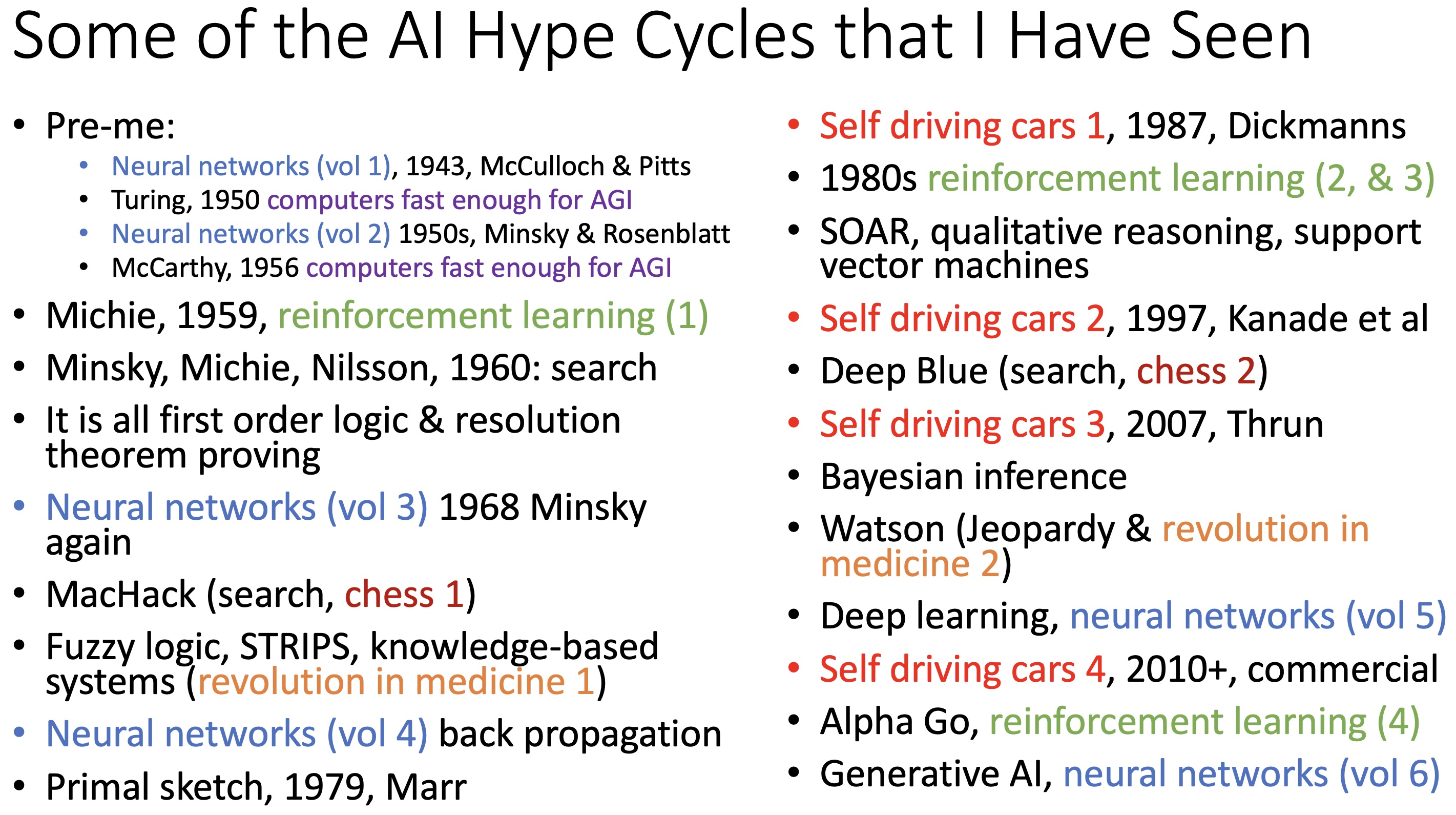
Here is a list of some of those hype cycles that I, personally, have perceived and lived through, as taken from my presentation at MIT in late 2023 that I referenced above re FOBAWTPALSL.
Really, was there really hype about all these things? Yes, there was, within the circles that cared. Those circles have gotten wider and wider and when reigning world chess champion Garry Kasparov was beaten by I.B.M.’s Deep Blue computer under tournament conditions in 1997 it was widely reported in the popular press, And it was declared that it was all over for humans.
Back in February 2011 a computer program named Watson played on the television game show Jeopardy against all time human champions. John Markoff, legendary technology reporter at the New York Times, wrote stories about this the day before the compe ion, and the day after, when Watson had indeed beaten the humans, with the same questions (fed as text to it as the same time as the humans heard the questions) all running on a cluster of machines not connected to an outside network. Here are three successive paragraphs from the second of those stories.
For I.B.M., the future will happen very quickly, company executives said. On Thursday it plans to announce that it will collaborate with Columbia University and the University of Maryland to create a physician’s assistant service that will allow doctors to query a cybernetic assistant. The company also plans to work with Nuance Communications Inc. to add voice recognition to the physician’s assistant, possibly making the service available in as little as 18 months.My personal experience at that time was people I did not know, but who had heard about my role at MIT (as director of the MIT AI Lab, and then founding director of MIT CSAIL, the Computer Science and Artificial Intelligence Lab) would come up to me and ask about the future of medicine. The people were variously doctors or health industry executives. I reassured them that medicine as we knew it then would stay much the same and was not about to be rendered obsolete.
“I have been in medical education for 40 years and we’re still a very memory-based curriculum,” said Dr. Herbert Chase, a professor of clinical medicine at Columbia University who is working with I.B.M. on the physician’s assistant. “The power of Watson- like tools will cause us to reconsider what it is we want students to do.”
I.B.M. executives also said they are in discussions with a major consumer electronics retailer to develop a version of Watson, named after I.B.M.’s founder, Thomas J. Watson, that would be able to interact with consumers on a variety of subjects like buying decisions and technical support.
And then in 2016 Geoff Hinton, one of the key architects of Deep Learning (which has had undeniable impact on the world) said:
“People should stop training radiologists now. It is just completely obvious that within five years deep learning is going to be better than radiologists.”
More people asking me whether this was true. It wasn’t in five years and it isn’t now. We need more radiologists than ever. And yes they do use deep learning tools to help them see some things they wouldn’t otherwise see. But they also understand anomalies using causal reasoning and we would be in a sorry state if all radiology was done by programs today.
Now look at those plum colored paragraphs above again as you take yourself way back in time to a year or so ago when ChatGPT was just a baby AGI, You can find stories just like this one if you subs ute “ChatGPT” for “Watson” and “Microsoft” for “I.B.M.”
The things confidently predicted in 2011 (and in 1979, and in 2016) about the end of doctors didn’t happen then and it is not happening now. Nor are all the other jobs ending.
Today I get asked about humanoid robots taking away people’s jobs. In March 2023 I was at a tail party and there was a humanoid robot behind the bar making jokes with people and shakily (in a bad way) mixing drinks. A waiter was standing about 20 feet away silently staring at the robot with mouth hanging open. I went over and told her it was tele-operated. “Thank God” she said. (And I didn’t need to explain what “tele-operated” meant). Humanoids are not going to be taking away jobs anytime soon (and by that I mean not for decades).
You, you people!, are all making fundamental errors in understanding the technologies and where their boundaries lie. Many of them will be useful technologies but their imagined capabilities are just not going to come about in the time frames the majority of the technology and prognosticator class, deeply driven by FOBAWTPALSL, think.
But this time it is different you say. This time it is really going to happen. You just don’t understand how powerful AI is now, you say. All the early predictions were clearly wrong and premature as the AI programs were clearly not as good as now and we had much less computation back then. This time it is all different and it is for sure now.
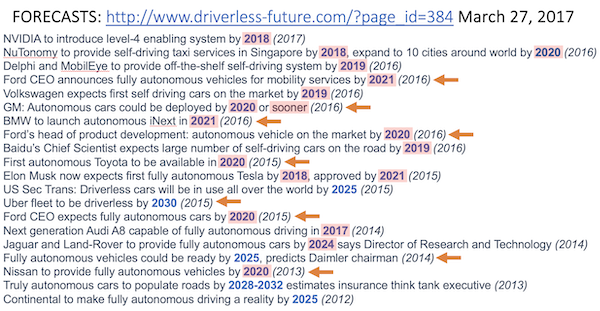
Here is a handy chart of failed predictions for robot cars:
Legend: Dates in parens: When prediction was made. Dates in blue: When prediction will come true. Pink shading: Wrong prediction. Orange arrow: retraction.
nah, they'll just fire you
https://finance.yahoo.com/news/wall-street-job-losses-may-071500049.htmlJamie Dimon, JPMorgan’s chief executive officer, told Bloomberg Television in 2023 that AI is likely to make dramatic improvement in workers’ quality of life, even if it eliminates some positions. “Your children are going to live to 100 and not have cancer because of technology,” Dimon said at the time. “And literally they’ll probably be working three-and-a-half days a week.”
Chief information and technology officers surveyed for BI indicated that on average they expect a net 3% of their workforce to be cut, according to a report published Thursday.Nearly a quarter of the 93 respondents predict a steeper decline of between 5% and 10% of total headcount. The peer group covered by BI includes Citigroup Inc., JPMorgan Chase & Co. and Goldman Sachs Group Inc.
Citi said in a report in June that AI is likely to displace more jobs across the banking industry than in any other sector. About 54% of jobs across banking have a high potential to be automated, Citi said at the time.
Elon threatened by Trump's favor for an AI rival
lol Trumpy infrastructure
https://techcrunch.com/2025/01/22/el...over-stargate/Billionaire Elon Musk and OpenAI CEO Sam Altman are fighting on X about Stargate, the enormous infrastructure project to build data centers for OpenAI across the U.S.
Stargate, announced Tuesday during a press conference at the White House, would funnel as much as $500 billion from investors including SoftBank and Middle East AI fund MGX into data centers to support OpenAI’s AI workloads. Partners in Stargate have initially pledged $100 billion, some of which is being put toward a data center under construction in Abilene, Texas.
Elon Musk claims that Stargate doesn’t have the money it says it does.
“They don’t actually have the money,” Musk wrote in a seriesof postson X on Tuesday. “SoftBank has well under $10 billion secured. I have that on good authority.”
Hours later, in a reply to a post criticizing Altman, Musk said, “Sam is a swindler.”
in the olden days, we called this a boondoggle

There are currently 1 users browsing this thread. (0 members and 1 guests)
 Posting Permissions


 Reply With Quote