


 Reply With Quote
lol propaganda from russia again
Still trying to convince themselves that trump team were NOT all traitors and sold out to russia

lol propaganda from russia again
Still trying to convince themselves that trump team were NOT all traitors and sold out to russia


Damn, shillary skull ed tsa good.

Durham swings and misses, Sussmann acquitted.
WHAT DURHAM PROVED. The trial of Michael Sussmann is before a jury in Washington, D.C. Sussmann is the Democratic lawyer who, according to special counsel John Durham, lied to the FBI in 2016 when, working on behalf of the Hillary Clinton campaign, he tried to plant a derogatory story about Donald Trump. The hope was that the FBI would start an investigation and then the campaign conversation would be: TRUMP IS UNDER FBI INVESTIGATION!
There is no doubt Sussmann lied to the FBI. There is no doubt he is guilty. But the trial is taking place in Washington, perhaps the deepest-blue jury pool in the United States. Durham's prosecutors are "facing a jury that has three Clinton donors, an AOC donor, and a woman whose daughter is on the same sports team as Sussmann's daughter," George Washington University law professor Jonathan Turley said recently on Fox News. "With the exception of randomly selecting people out of DNC headquarters, you could not come up with a worse jury."
So the jury might reject Durham's evidence — juries are free to do that. Or it might convict. Whatever it does, though, Durham has already made some important points about the actions of the Clinton campaign in the 2016 election.
The biggest point Durham has made is that an arm of the Clinton campaign developed a strategy to weaponize the FBI to investigate Clinton's political opponent. Starting around the time of the 2016 Democratic convention, with the Russian hack of Democratic National Committee emails, the Clinton campaign made a concerted effort to accuse Trump falsely of acting in collusion with Russia. At the Sussmann trial, Robby Mook, Clinton's campaign manager, testified that effort was focused on feeding information to reporters — the old-fashioned way to spread dirt.
But lawyers working for the campaign went beyond the old-fashioned way. They tried to enlist the FBI in the operation, to spur the investigation. That would turbocharge the story, allowing reporters to say the allegations were so serious that federal law enforcement was investigating.
That's why, when a team of pro-Clinton researchers came up with a theory that there were su ious computer connections between a Russian bank, Alfa-Bank, and the Trump campaign, Sussmann took it to the FBI. He did it on behalf of the Clinton campaign. He billed the campaign for the work. Yet he specifically told the FBI that he was not acting on behalf of the campaign, that he was just doing it as a concerned citizen. In September 2016, when Sussmann requested a meeting with then-FBI General Counsel James Baker, Sussmann texted, "Jim — it's Michael Sussmann. I have something time-sensitive (and sensitive) I need to discuss. Do you have availability for a short meeting tomorrow? I'm coming on my own — not on behalf of a client or company — want to help the Bureau. Thanks."
But Sussmann was doing it on behalf of a client — the Clinton campaign.
Besides showing that an arm of the Clinton campaign sought to weaponize the FBI, the Sussmann trial has shown that the FBI was eager to be weaponized. We learned that a senior FBI agent involved in the Trump-Russia investigation, Joe Pientka, sent a note to another agent about the Alfa-Bank tip: "People on the 7th floor to include Director are fired up about this server. Reachout and put tools on...it's not an option — we must do it." The FBI building's seventh floor is where top management, including then-Director James Comey, had offices.
So those are two major revelations from the Sussmann trial: Elements in and around the Clinton campaign sought to weaponize the FBI, and the FBI welcomed the effort — all in the name of defeating the Republican nominee for president.
In the end, the Alfa-Bank story did not have a big influence on the campaign. One or two reporters fell for it, but the FBI could never verify any of it, and much of the press stayed away — for one simple reason: It was bogus.
But remember, this was the same team of Clinton lawyers and the FBI that brought the world the Steele dossier. And that did have a big influence. Even though the FBI's agents could never verify the dossier's allegations — they were bogus, too — Comey wanted to include some of them in the Intelligence Community Assessment, which was the intelligence community's investigation into Russian interference in the 2016 campaign. And then, of course, Comey briefed both then-President Barack Obama and Trump, by then the president-elect, on it. And then the fact of those briefings leaked to the press — it must be important if top intelligence chiefs are briefing it to the president and the president-elect. And then the whole dossier leaked to the public, resulting in years of frenzied conversation and debate about its phony allegations.
So the Clinton strategy worked. No, it did not make Clinton president of the U.S. The voters just did not want that. But it did enormous damage to the Trump presidency and the Trump administration. We've been learning how the anti-Trump strategy worked for several years now, beginning with the evidence uncovered by Devin Nunes when he chaired the House Intelligence Committee. Now, the Durham investigation has told us even more. No matter the verdict, that is valuable.
https://www.washingtonexaminer.com/o...-durham-proved
Lol crying about oppo research and the media megaphone "damaging" politicians.
"But her emails"
You have no problem with a presidential campaign feeding multiple false stories to the FBI to get them to investigate a presidential candidate?
but but turley said!
She called it last week.
Closing arguments will begin later this morning in Special Counsel John Durham’s false statement case against former Hillary Clinton campaign attorney Michael Sussmann, after Sussmann made a last-minute decision on Thursday not to testify in his own defense. The evidence prosecutors elicited from witnesses over the last two weeks provides overwhelming proof of Sussmann’s guilt and destroys the many defense theories Sussmann’s legal team floated throughout the trial. Yet a conviction of a fellow D.C.-swamp dweller may be unattainable.
Last fall, the special counsel indicted Sussmann on one count of making a false statement in violation of Section 1001 of the federal criminal code. The special counsel alleged Sussmann lied to then-FBI General Counsel James Baker during a September 19, 2016 meeting.
In the meeting, Sussmann presented Baker with data and whitepapers that supposedly showed the existence of a secret communications network between the Russian-based Alfa Bank and the Trump organization. According to the indictment, Sussmann was acting on behalf of the Clinton campaign and tech executive Rodney Joffe when he met with Baker, but falsely told his friend that he was coming on his own behalf to help the FBI.
Before adjourning for the day on Thursday, presiding Judge Christopher Cooper provided instructions to the jury. Jurors will use those to decide whether to convict or acquit Sussmann following deliberations, which will begin either Friday afternoon or Tuesday following the long Memorial Day weekend.
“The government must prove beyond a reasonable doubt” five facts, Judge Cooper explained, namely that (1) “on September 19, 2016, the defendant made a statement or representation;” (2) “the statement or representation was false, fic ious or fraudulent;” (3) “that this statement or representation was material;” (4) “the false, fic ious or fraudulent statement was made knowingly and willfully;” and (5) “the statement or representation was made in a matter within the jurisdiction of the executive branch of the government of the United States.”
The government previously requested the court take “judicial notice” of the fact that the FBI is within the executive branch of the government, meaning the fact is conclusively established for the jury. While the parties disagree about what Sussmann said to Baker, Sussmann clearly “made a statement or representation” to the then-general counsel of the FBI, leaving jurors to focus on the other three elements.
Overwhelming Evidence to Convict
During today’s closing arguments, the government will remind the jury of the detailed evidence prosecutors presented over the course of the trial, including through nearly 20 witnesses. That evidence overwhelmingly established the three remaining facts prosecutors must prove.
First, the prosecution must prove Sussmann denied acting on behalf of any particular client when he met with Baker. Here, the government will stress Baker’s testimony. That had the former general counsel telling the jury he was “100% percent confident” Sussmann said during their September 19, 2016 meeting that he was not representing a client. “My memory on this point, sitting here today, is clear,” Baker told the jury.
While the defense took issue with Baker’s memory, those efforts should fail for two reasons. First, Baker’s testimony made clear he was a reluctant witness, not out to get Sussmann and feeling responsible for dragging his friend “into a maelstrom.” Second, prosecutors presented evidence that Sussmann texted Baker the night before their September 19, 2016 meeting, writing, “I’m coming on my own – not on behalf of a client or company. [W]ant to help the Bureau.”
Given that Sussmann denied representing a client the night before the meeting, a reasonable jury would find Baker’s testimony that he was “100 percent confident” Sussmann repeated the claim at the start of their meeting conclusive.
In addition to that evidence, the jury also heard from two of Baker’s colleagues in the FBI, who testified that the notes they took shortly after Baker met with Sussmann indicated Sussmann had told Baker he was not working on behalf of any client.
Even More Evidence He Lied
The evidence also overwhelmingly established that Sussmann’s claim that he was not working on behalf of any client was “false.” Specifically, the government elicited testimony from Sussmann’s former Perkins and Coie partner, Marc Elias, who served as the lead lawyer for the Clinton campaign, that Elias had hired the investigative firm Fusion GPS to conduct opposition research against Trump. Elias also told jurors he learned of the supposed Alfa Bank-Trump secret communication channel from Sussmann.
Elias also provided a detailed explanation of how law firm billing records work. Prosecutors admitted records showing Sussmann reported time spent on the Alfa Bank project to the Clinton campaign, and specifically billed the Clinton campaign for a project he worked on on September 19, 2016, the same day he met with Baker.
Elias had previously testified that he believed Sussmann’s only work on behalf of the Clinton campaign concerned Alfa Bank. Then on Wednesday, the government presented evidence Sussmann charged the Clinton campaign for the thumb drives used to transfer the Alfa Bank data to the FBI, providing pretty conclusive proof of the government’s assertion Sussmann was representing the Clinton campaign.
Other evidence supports the government’s argument that Sussmann was also acting on behalf of Joffe when he met with Baker. For instance, Fusion GPS’s Laura Seago testified that she first heard of the Alfa Bank theory at a meeting with Elias which Sussmann and his client Joffe also attended.
Also Lots of Evidence This Affected the FBI
The special counsel likewise provided substantial evidence related to the second factor, “materiality.” Here, the jury was instructed that Sussmann’s lie must have been “material,” meaning the statement “has a natural tendency to influence, or is capable of influencing, a discrete decision of the decision-making body to which it is addressed.”
In this case, the government presented testimony of several federal agents showing how Sussmann’s lie altered their decisions, with Baker testifying “he would not have taken the private meeting with Sussmann if he knew Sussmann was working on behalf of the Clinton team.” Baker also told the jury he had “vouched for” Sussmann and treated him as a sensitive confidential human source, protecting his iden y from other agents because he believed Sussmann had come to the FBI on his own.
Other agents also testified that they hit a roadblock in determining the source for the Alfa Bank data and that in assessing the data, knowing whether it came from someone with “a political affiliation or motivation” would affect the initial steps of an investigation.
Evidence Sussmann Lied On Purpose
Finally, the government must establish that Sussmann held the required “mens rea” or “guilty mind.” Section 1001, which criminalizes false statements, requires a defendant make the false statement “intentionally” or “knowingly.”
Cir stantial evidence can establish a defendant’s state of mind. So can the evidence admitted at trial, which included Sussmann’s congressional testimony with his acknowledgment that he was acting on behalf of a tech expert. All this provides overwhelming evidence that Sussmann’s lie was intentional.
In an attempt to counter this overwhelming evidence, during Sussmann’s closing argument his attorneys will likely hammer inconsistencies in statements Baker previously made concerning what Sussmann said during their September 19, 2016 meeting. Sussmann’s lawyers are also likely to highlight testimony they presented that the Clinton campaign did not want Sussmann to take the evidence to the FBI, including testimony from Clinton campaign manager Robby Mook. The government, however, countered that evidence with testimony establishing that Perkins and Coie attorneys and Fusion GPS held great discretion to act on behalf of the Clinton campaign.
The defense is also certain to highlight trial evidence showing the FBI’s national security concerns about Trump’s connection with Russia, as well as testimony touting Joffe’s reputation as a tech expert, to argue Sussmann held serious concerns about the data. But the special counsel will quickly counter that Sussmann’s concerns do not excuse him for lying to the FBI. Finally, Sussmann’s legal team will likely stress the testimony of character witnesses who spoke of Sussmann’s stellar reputation.
Why an Acquittal Is Likely Despite the Evidence
While there can be no certainty in predicting the jury’s eventual verdict, an acquittal seems likely—even with the overwhelming evidence of Sussmann’s guilt detailed. Baker’s trial testimony provided the clearest foreshadowing of this outcome when he told prosecutors, “I’m not out to get Michael. This is not my investigation. This is your investigation. If you ask me a question, I answer it. You asked me to look for something, I go look for it.”
Bill Priestap, who served as the assistant director of the Counterintelligence Division for the FBI in 2016, displayed an even more grudging demeanor in testifying on behalf of the special counsel. When questioned by prosecutors whether it was “important” for Sussmann “to fully disclose his ties to the Clinton campaign,” Priestap said it “would have been part of several factors,” telling the government attorney, “I’m struggling on your use of the word ‘important.’ It’s a motivation that is relevant, but not the only factor.”
If Baker, the man to whom Sussmann lied, adopts such a disinterested approach to justice, and Priestap, an assistant director at the FBI, shows disdain for the special counsel’s case, surely a jury of Sussmann’s peers will too.
The men and women of the jury live and work in D.C., with men and women like Sussmann, Baker, and Priestap. Their kids go to school together—literally in the case of one juror—and they likely can envision a friend or neighbor in Sussmann’s position.
While Sussmann’s lie was “material” in the legal sense, jurors seem likely to shrug the lie off as harmless, mentally parroting the woman several jurors acknowledged they donated money to when she ran for president in 2016: “What difference at this point does it make?”
I may be wrong. But I don’t think so.
https://thefederalist.com/2022/05/27...probably-wont/
that's what investigations are for -- to see what's prosecutable and what's not. plenty of people were convicted of lying to investigators, odd that they'd do that when there was absolutely no need to.
all that and you have clinesmith pleading guilty to probation for altering an email. origins of investigation were kosher and based on proper factual predicate. clinton attorney did not lie to the FBI (or if he did, not materially). no findings of bias having a material impact on any of the trump/russia investigation.
meanwhile trump let Flynn get dragged through the mud for years, supposedly had to sell his house to pay for legal bills, flynn hired an incompetent attorney who failed to get his case dismissed even when the new prosecutor was on board with dismissal, and only after all that did Trump pardon him
Durham using the media to spread information he couldn't prove in court, what a straight arrow.
Nice dodge, try again.
Is it okay for a presidential campaign to feed multiple false stories to the FBI to get them to investigate a presidential candidate? yes or no.
Bitter loss. Pick up the pieces---&---Let us proceed...
Sussmann 100% lied to the FBI and this was 100% jury nullification.
remember this doozy too
https://www.foxnews.com/politics/cli...-house-servers
although important to note that this was just a motion filed, not a "finding"... and that nowhere in the actual filing did Durham use the word "infiltrate" but rather that quote was from a (i kid you not) devin nunes aid... of course that quote got laundered into the article headline as though it came from durham
keep coping. unanimous verdict brah
Depends on what the meaning of ok is. Is it legal? I wouldn't know, honestly. Filing knowingly false reports is probably illegal, but giving mistaken tips to police is probably not. Political campaigns complaining about stuff they think is or should be illegal, for better and for worse, is a common political tactic. Throwing against the wall without regard to its truth or falsity is more or less Republican SOP, as characterized the by serial Benghazi probes. It's certainly unethical and not ok in that sense, but at this point it appears to be customary for both sides to try to trigger official investigations of the other side, "to damage them" in the eyes of voters.
You cheer it on when your side does it, and cry when it happens to yours.
Judge and Jury were totally legit
rittenhouse acquitted: omg based jury trial. innocent before proven guilty
chauvin convicted/sussman acquitted: omg partisan jury, rigged system
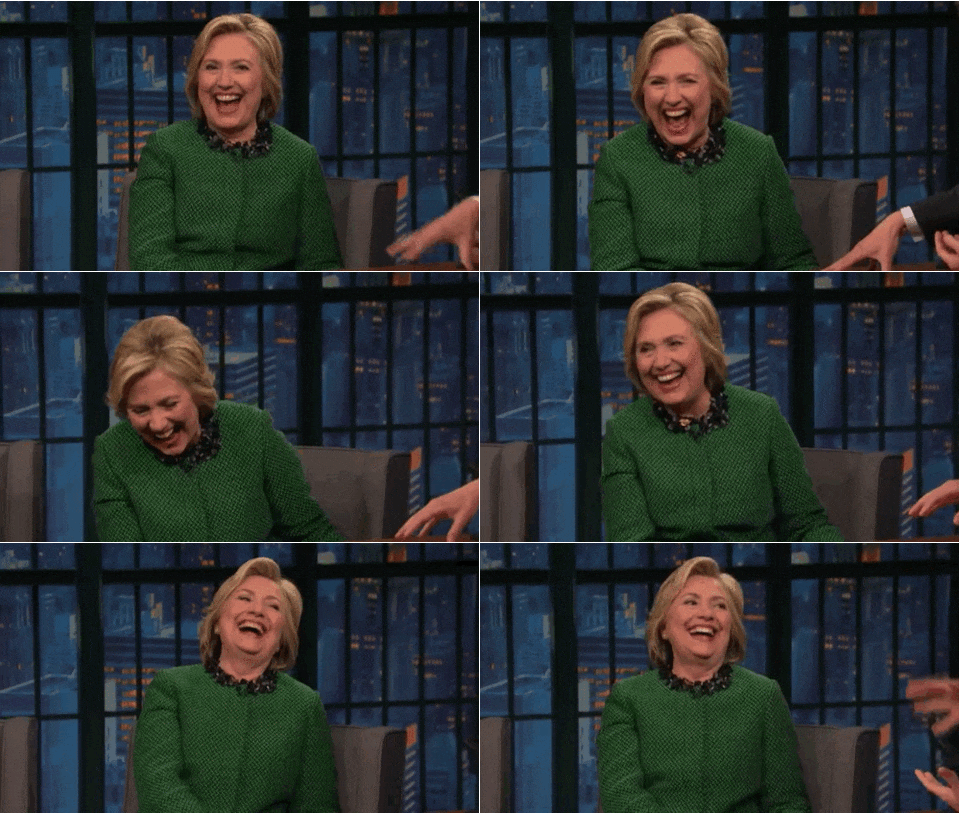
And once again, on news of Sussmann being acquitted, Shillary feasts on MAGA tears!!!!!
There are currently 34 users browsing this thread. (0 members and 34 guests)
 Posting Permissions

