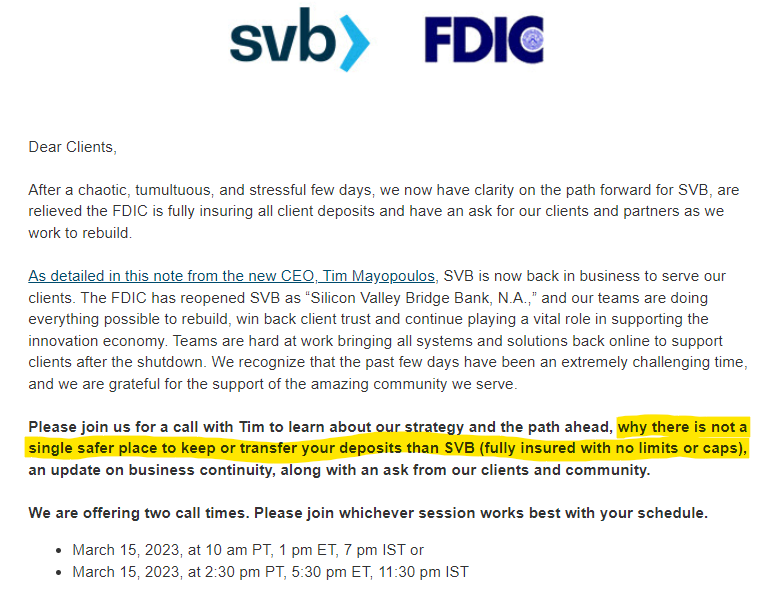
the deposit insurance is bailing out depositors, not the bank. im starting to think you just arent grasping the difference between the business and the customer
No, I get the difference. FDIC receivership isn't a bailout. Never said it was, don't think it is.
lol Talk about moral hazard
the only moral hazard here is that customers dont need to freak out over where they park their money, even if the bank itself eats dust

but how are we going to gamble with people's money???!?11?
Credit Suisse to Get Liquidity Backstop if Needed, SNB Says
Switzerland’s central bank and financial regulator said Credit Suisse Group AG will receive a liquidity backstop if needed, seeking to restore confidence in the troubled lender after a record slump in its shares.
“Credit Suisse meets the capital and liquidity requirements imposed on systemically important banks,” the Swiss National Bank and Finma said in a joint statement late Wednesday. “If necessary, the SNB will provide Credit Suisse with liquidity.”
Shares in Credit Suisse slumped by as much as 31% on Wednesday in Zurich trading, and its bonds fell to levels that signal deep financial distress, as persistent doubts over the scandal-ridden lender combined with a global selloff in banking stocks. The government, central bank and Finma have been discussing ways to stabilize the bank after a tumultuous day sparked by the firm’s largest investor ruling out increasing its stake, Bloomberg reported earlier.
https://www.bloomberg.com/news/artic...eeded-snb-says
---
tbh, Credit Suisse has been mismanaged for over a year now. Good time to clean up their act.

So much for TSA's "Switzerland CANNOT bail out Credit Suisse" retweet.
TSA will go back into the witness protection program..

TSA's copypasta expires on the starting line...again.
"Now, with the help of uncapped limits on insured deposits, the days of managing multiple banking relationships to achieve full FDIC protection are over"
https://americandeposits.com/history...verage-limits/As you can imagine, the more cash you need protected, the more banking relationships you will need to maintain. In the past, this created a great deal of additional work to monitor, manage and reconcile these accounts. Now, with the help of advanced fintech, the days of managing multiple banking relationships to achieve full FDIC protection are over.
true, mega-depositors no longer need to exercise due diligence about the safety of their deposits or their bank's risk profile. no need to worry about where to park their money. there's no need for depositors to hold bank management's feet to the fire, that's what regulators are for.
It's a balancing act. Bank confidence and moral hazard need to be balanced. Even the FDIC doesn't think deposit insurance is free of moral hazard. Suggesting that it is is either political cant or mistaken.
https://www.fdic.gov/deposit/deposit...oralhazard.pdf
Perhaps spurraider21 thinks the FDIC has come up with a perfect system of insurance, completely free of moral hazard.
On the one hand, depositors don't need to worry about their money anymore; on the other, banks don't have to worry about their depositors.
Clearly, zero moral hazard in this scenario.
If the bank acts poorly and dies it dies. They don’t need special protections and aren’t getting them. Depositors shouldn’t have to act as regulators. They’re customers.
believing that the customers of a bank should suffer because of bad actions of the bank is something i can’t wrap my head around
so then, mega depositors must be protected, no matter what, even if one foreseeable effect is that banks will be more careless about managing risk? do you still think this scenario is free of moral hazard, you see none?
it's one thing to say confidence in banking is more important than moral hazard in this case, quite another to say that the moral hazard doesn't exist.
Technically speaking, the FDIC hasn't officially upped their insured limit, AFAIK. This would be an exception, not the rule.
But, again, I think everyone knows what the problem is here: banks gambling with people's money. When the gamble fails, it's just another LLC that shuts down, and depositors end up holding the bag.
This is why regulations like Glass-Steagall and Dodd-Frank were important. This has happened before, and will keep on happening because self-regulation in this sector never worked.
This is recalled by heart, so the figure might be off a little, but at the time of its failure, SVB had enough assets to cover 90-95% of its deposits. Would it really have been so unfair fo unwary depositors to take a haircut on their uninsured deposits?
it's implicit, sure. we'll see if the FDIC has the stomach to enforce its cap. ignoring it in this case does make one wonder.
The closest thing we have to a moral hazard here is that customers don’t have to do their homework when deciding which bank to park their money in. That’s one I’m fine with. There’s not really moral hazard concerning the banks themselves though. They’ll still go under if they get caught with their pants down
SVB was handing out loans using borrowers' crypto coin for collateral!
SNB ponied up $54 million. The guy I quoted was wrong.
This isn't the gotcha you think it is.
So your source was wrong but not you?
What is your conspiracy theory this time and how is it different?
Chop, chop.
Up to $200M in deposits.
Looks like FDIC saved SV Angel.

There are currently 1 users browsing this thread. (0 members and 1 guests)
 Posting Permissions


 Reply With Quote