Page 83 of 84 FirstFirst ... 3373798081828384 LastLast
Results 2,051 to 2,075 of 2088
  1. #2051
    dangerous floater Winehole23's Avatar
    My Team
    San Antonio Spurs
    Join Date
    Nov 2008
    Post Count
    113,926
    Texas is a national leader in solar energy


    https://x.com/EvilMopacATX/status/1837145840294490571

  2. #2052
    dangerous floater Winehole23's Avatar
    My Team
    San Antonio Spurs
    Join Date
    Nov 2008
    Post Count
    113,926
    more Texans work in clean(er) energy than in oil and gas

    According to a new report from the US Department of Energy, Texas added more renewable energy workers than any other state — and passed 50,000 total renewable energy workers — in 2023.

    There’s more: Texas added over 8,000 new jobs in the energy efficiency sector last year, also more than any other state — we now have 170,000 energy efficiency workers. And tens of thousands more work on batteries, microgrids, electric vehicles, and other clean energy technologies.
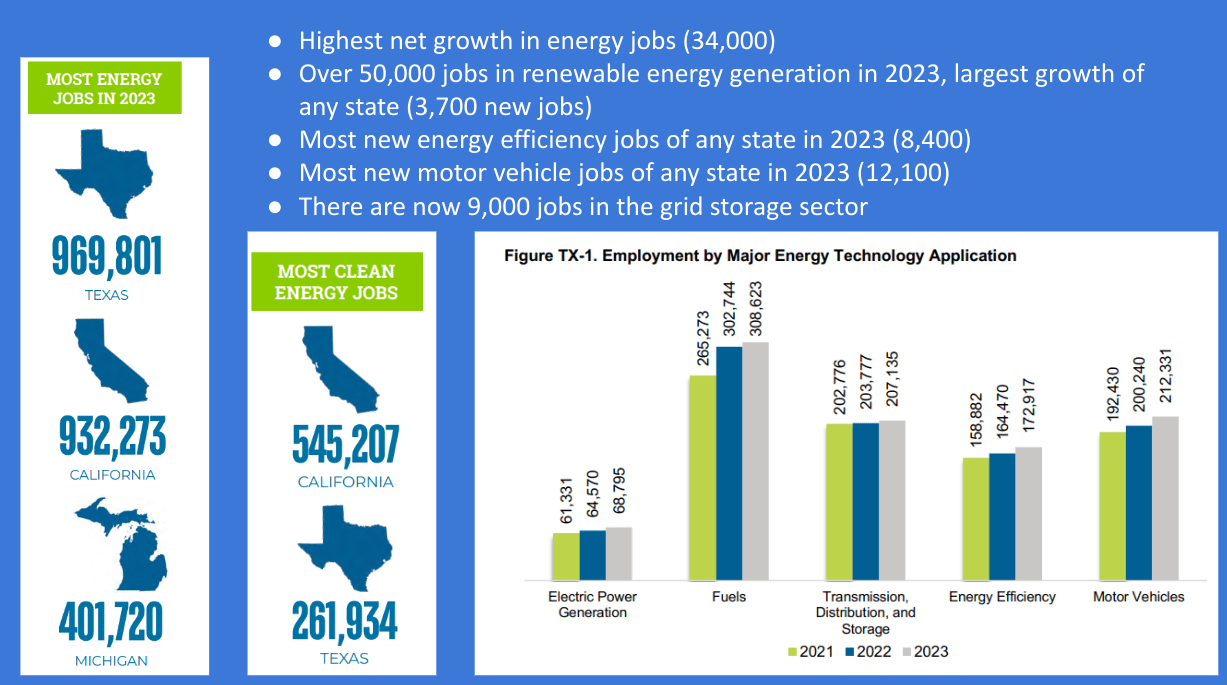


    From Rising Demand, Changing Supply presentation for TEPN paid subscribers, Sept. 13, 2024


    That means about a quarter-million Texans make their living in various clean energy sectors — more than in oil and gas.

    https://www.douglewin.com/p/clean-en...-already-great

  3. #2053
    dangerous floater Winehole23's Avatar
    My Team
    San Antonio Spurs
    Join Date
    Nov 2008
    Post Count
    113,926
    spare capacity and new markets for Texas energy, along with batteries and renewable energy, add to reliability.

    the main suspense is how hard Texas will suck off energy producers, while continuing to piss on the customer.


    The US Department of Energy (DOE) announces $1.5B for four transmission projects – including connecting the Texas grid to the Southeast grids for the first time ever.
    The projects, spanning multiple states, will add nearly 1,000 miles of new transmission lines and increase grid capacity by 7,100 megawatts (MW). They’ll boost grid reliability, lower energy costs, and support the clean energy transition.

    The projects will improve transmission congestion and resilience, especially as the country faces more extreme weather events. By improving connections between regions and making it easier to access renewable energy sources like wind and solar, these projects will make energy more reliable and cost-effective. They’ll also generate nearly 9,000 jobs, supporting local economies in Louisiana, Maine, Mississippi, New Mexico, Oklahoma, and Texas.


    froze over in Texas – the state will connect to the US grid for the first time via a fed grant | Electrek

  4. #2054
    dangerous floater Winehole23's Avatar
    My Team
    San Antonio Spurs
    Join Date
    Nov 2008
    Post Count
    113,926
    • Southern Spirit (Texas to Mississippi): This is a REALLY. BIG. DEAL. Spanning 320 miles, this HVDC line will link Texas’ isolated ERCOT grid with the Southeast grids for the first time, adding 3,000 MW of bidirectional capacity across Texas, Louisiana, and Mississippi. It’s designed to prevent outages like the ones during Winter Storm Uri that hit Texas hard in 2021. It’s expected to create 850 construction jobs and 305 permanent jobs.

  5. #2055
    Yam Tits's Bonespur Xray Ef-man's Avatar
    My Team
    San Antonio Spurs
    Join Date
    May 2006
    Post Count
    20,313

  6. #2056
    俺はまんこが大好きなんだよ baseline bum's Avatar
    My Team
    San Antonio Spurs
    Join Date
    Mar 2003
    Post Count
    97,881
    Would 3000MW in Feb 2021 have saved our grid that's designed by Abbott and Perry to fail? I doubt it.

  7. #2057
    dangerous floater Winehole23's Avatar
    My Team
    San Antonio Spurs
    Join Date
    Nov 2008
    Post Count
    113,926
    Would 3000MW in Feb 2021 have saved our grid that's designed by Abbott and Perry to fail? I doubt it.
    right, but it's a move in the right direction.

  8. #2058
    俺はまんこが大好きなんだよ baseline bum's Avatar
    My Team
    San Antonio Spurs
    Join Date
    Mar 2003
    Post Count
    97,881
    right, but it's a move in the right direction.
    Yeah better than nothing, but still sucks to get excited for a minute at having a functional grid only to see we're only adding the potential for another 3.5% of peak demand.

  9. #2059
    dangerous floater Winehole23's Avatar
    My Team
    San Antonio Spurs
    Join Date
    Nov 2008
    Post Count
    113,926
    Yeah better than nothing, but still sucks to get excited for a minute at having a functional grid only to see we're only adding the potential for another 3.5% of peak demand.
    headlines lie

  10. #2060
    dangerous floater Winehole23's Avatar
    My Team
    San Antonio Spurs
    Join Date
    Nov 2008
    Post Count
    113,926
    "I disclosed it, nbd"


    https://x.com/Sandi/status/1851999785605124430

  11. #2061
    dangerous floater Winehole23's Avatar
    My Team
    San Antonio Spurs
    Join Date
    Nov 2008
    Post Count
    113,926

    The ethics code for public officials in Texas, regarded as among the most lax in the nation, makes it legal for lawmakers to make money from doing business with companies they regulate. Still, [State Sen. Phil] King’s financial entanglement raises questions about whether he was tending to his own business or the state’s when he authored SB 1015 and other legislation, as well as when he waded into Oncor’s PUC dispute with its customers.
    https://www.texasmonthly.com/news-po...or-select-mat/

  12. #2062
    dangerous floater Winehole23's Avatar
    My Team
    San Antonio Spurs
    Join Date
    Nov 2008
    Post Count
    113,926
    stricter rules for everyday state employees than legislators

    “It is unfortunate, but par for the course in Texas,” said Alison Silverstein, an energy consultant in Texas who previously served as senior adviser to a Republican-appointed chair of the Federal Energy Regulatory Commission. She pointed out that a state employee would be barred by conflict of interest requirements from being a part owner of a company that did business with another company the employee regulated. But state lawmakers aren’t bound by such ethics rules. If we lived in a good-government state, it might be prohibited for any legislator to own a company that did business with the people he governs. But we don’t live in a good-government state.”

  13. #2063
    dangerous floater Winehole23's Avatar
    My Team
    San Antonio Spurs
    Join Date
    Nov 2008
    Post Count
    113,926
    large-user demand could outpace transmission capacity

    lawmakers have "signaled interest" in having large-users picking up some of the cost

    In Texas, the U.S. Energy Information Administration predicted that demand from large users — including but not limited to data centers — would grow by 60% this year, making up around 10% of the total forecast demand on the state’s main grid.

    Large users requiring 5,496 MW of power have been approved by ERCOT to connect to the grid, according to a September report. The EIA expects that by the end of this year, ERCOT will have approved 9,500 MW in total large-user demand — a 73% increase.

    That includes data centers and other large users like crypto mining facilities, which represent the biggest share of large users looking to connect to the grid, according to ERCOT.

    ...

    Nationally, data centers are expected to consume between 11% and 12% of total U.S. power demand by 2030 — up from around 3% and 4% of demand today, according to an analysis by McKinsey.
    The Public Utility Commission approved a rule in November requiring crypto mining facilities connected to the ERCOT grid to register their power usage with regulators.

    The projected growth in usage also means the grid will need more transmission lines, ERCOT CEO Pablo Vegas said in April.

    “The forecasted pace of load growth could exceed the pace at which transmission capacity can be built to support it,” Vegas’ presentation said. “A new era of transmission system planning is necessary to manage the large amount of prospective load.”

    Typically, the costs of building out transmission and distribution infrastructure are spread across a utility’s customers. But the major investments needed to support demand driven by large industrial users raised the question of who should foot the bill.

    Lawmakers have signaled interestin limiting the costs passed onto small energy consumers “by ensuring that industries with significant electricity demands bear a fair portion of their actual costs.”
    https://www.texastribune.org/2025/01...ter-boom-grid/

  14. #2064
    dangerous floater Winehole23's Avatar
    My Team
    San Antonio Spurs
    Join Date
    Nov 2008
    Post Count
    113,926
    there's a Uri-related class action lawsuit still out there

    On Wednesday, the Texas Supreme Court will hear oral arguments in a case in which 15,000 Texans and small business owners have sued the largest electric transmission and distribution utilities on allegations of wrongful death, personal injury and property damage. They are seeking billions of dollars in damages. The lawyers for the plaintiffs have accused the energy companies of gross negligence and intentional nuisance, claiming that the utilities decided where to cut power, favored some neighborhoods over others, intentionally took steps that made the power shortage worse, ignored numerous warnings to better winterize their systems and lied to their customers about the seriousness of the storm as it approached.

    Lawyers for the utilities are asking the justices to dismiss all these cases as frivolous, or at least issue a ruling that makes it considerably more difficult for the plaintiffs to win at trial.

    Existing law, according to legal experts, seems to favor the plaintiffs winning their arguments at the state’s highest court. However, most appellate law observers believe a majority of the justices could be interested in writing new law that would allow the energy companies to avoid ever facing trial.

    “Based on its previous decisions in Uri litigation, I suspect the Supreme Court’s ruling in this matter will once again be disappointing to the plaintiffs,” said Dallas appellate law expert Chad Ruback. “Thus far, the Supreme Court has held plaintiffs in Uri litigation to a very high burden, and I would be surprised if the court were to change course now.”

    Lawyers for the victims say that even if the Texas Supreme Court does not dismiss their cases, it will be at least another year before the first case could go to trial because very little discovery has been done and no witnesses have been deposed.

    “Our clients were devastated because of the decisions made by these companies, but they are starting to lose hope that they will ever get their day in court to examine and present the evidence,” said Houston trial attorney Derek Potts, who represents scores of individuals and small business owners in Winter Storm Uri litigation. “Texas law in these type of cases against energy utilities is unnecessarily complicated, and the Texas Supreme Court has not been a friend to people’s cons utional rights to trial by jury.”


    “The conduct of these electric companies was so bad the insurance companies are actually on our side in this litigation,” Potts said.
    https://www.dallasnews.com/business/...-winter-storm/

  15. #2065
    dangerous floater Winehole23's Avatar
    My Team
    San Antonio Spurs
    Join Date
    Nov 2008
    Post Count
    113,926
    experts are helping screw ratepayers with bogus projections

    What if I were to tell you about an obscure clique of consultants that concoct dubious economic analysis to convince regulators to side with corporations, enabling a massive rip-off of ordinary Americans? I think your curious, cautious response might be, “You’re going to have to be more specific.”


    OK, so this obscure clique has a name. They’re called the Society of Utility and Regulatory Financial Analysts, or SURFA. And they are a large part of the reason why you’re paying way too much for electricity.
    Ellis has an unusual profile for an anti-corporate crusader: He was the former chief economist at Sempra Energy, a consultant with McKinsey, an analyst for ExxonMobil, and an engineer for SoCal Edison. But in his current position as an independent expert witness who testifies before state public utility commissions, he has found an unusual set of cir stances where investor-owned utilities are applying their own bespoke economic logic to win themselves large electricity rate increases. According to Ellis’s estimates, this translates to $50 billion in excess costs for utility customers every year, or about $300 per household.
    The problem specifically involves investor-owned utilities, which provide 70 percent of the electricity in the U.S. These private utilities have increased residential electricity rates over the past three years at a rate 49 percent higher than inflation. Over the same period, publicly owned utilities have increased their rates 44 percent less than inflation.

    Such a discrepancy should not be possible, and indeed it hasn’t been over the prior 40 years. Utilities in the U.S. have by and large made a basic bargain: They get monopoly access to a coverage area to provide power, in exchange for a commitment to universal service and rate regulation by a state public utility commission. When utilities want a rate increase, they must face a hearing with a PUC, where the utility has to prove that the increase only affords them a “just and reasonable” profit, known as the rate of return.


    A tiny group of experts give testimony to PUCs in these rate-setting proceedings, estimating among other things how much return on equity utilities should receive. Four consulting firms provided 90 percent of the testimony in the sample of 60 proceedings that Ellis reviewed; in more than half of those proceedings, just two people gave the testimony.
    The experts use four different economic models to construct their estimates, Ellis explains in the paper. Two of them—the “risk premium” model and the “expected earnings” analysis—are used nowhere in any other area of finance. And the calculations are perfectly circular: The “just and reasonable” rates in the expected earnings analysis are based on future forecasts, in other words, on the future rates of return that the company expects to receive! The Federal Energy Regulatory Commission stated in 2022 that these two models “def[y] general financial logic,” and prohibited them from use in federal proceedings. But they are still used routinely at the state level.


    The long-term return for the broader stock market is roughly 6 to 7 percent annually. Investor-owned utilities were bringing back 9.6 percent in the first half of 2023, a rate that’s 30 percent above the total market. If anything, they should be bringing in less than the market average. The only reason they aren’t is because public utility commissions are allowing this “financial alchemy,” as Ellis calls it, to rule the day.
    https://prospect.org/environment/202...tricity-bills/

  16. #2066
    dangerous floater Winehole23's Avatar
    My Team
    San Antonio Spurs
    Join Date
    Nov 2008
    Post Count
    113,926
    Trump's new import taxes could put a kink in maintaining and building out the grid


    Take transformers, which are used to step up generation voltage for long-distance transmission, or step down voltage for distribution. There is a nationwide—and global—shortage of transformers, as lead times have surged from fifty weeks in 2021 to 120 weeks in early 2024. But US production of transformers meets only 20 percent of domestic demand.


    Before US President Donald Trump paused Mexico-related tariffs on February 4, Mexican-produced transformers—and other electrical components—were on the list of imports that were going to be slammed by a 25 percent tariff, which would have significantly impacted new electricity generation and transmission.


    Tariffs could theoretically push prices of finished goods above 25 percent due to “pancaking” taxes on cross-border shipments of intermediate goods, where each border crossing incurs a fee. Furthermore, across-the-board 25 percent tariffs on steel and aluminum will raise prices of a specialized steel product called grain-oriented electrical steel, which is used in transformers, elevating the price of transformers made in the United States.


    Higher prices for transformers, especially transformers imported from Mexico, because of tariffs will raise project-development costs and delay infrastructure upgrades, hitting Texas hardest. As the top US importer of transformer units, Texas relies heavily on Mexico, which supplies nearly half of all high-voltage transformer imports through the Laredo Census District.
    https://www.atlanticcouncil.org/blog...y-reliability/

  17. #2067
    dangerous floater Winehole23's Avatar
    My Team
    San Antonio Spurs
    Join Date
    Nov 2008
    Post Count
    113,926
    BBB guts solar, could lead to an energy crunch

    another self-inflicted, civilizational wound

    by an extreme, out of touch Republican Party

  18. #2068
    dangerous floater Winehole23's Avatar
    My Team
    San Antonio Spurs
    Join Date
    Nov 2008
    Post Count
    113,926
    Republicans just raised your electric bill

  19. #2069
    dangerous floater Winehole23's Avatar
    My Team
    San Antonio Spurs
    Join Date
    Nov 2008
    Post Count
    113,926
    taxing new solar and wind capacity is moronic

  20. #2070
    dangerous floater Winehole23's Avatar
    My Team
    San Antonio Spurs
    Join Date
    Nov 2008
    Post Count
    113,926
    the excise taxes for new wind and solar capacity were removed from the reconciliation bill, but the IRA tax credits still went away

    penny wise for pound foolish

  21. #2071
    dangerous floater Winehole23's Avatar
    My Team
    San Antonio Spurs
    Join Date
    Nov 2008
    Post Count
    113,926
    electricity prices are rising twice as fast as inflation, but Trump's nostalgic revanchism is subsidizing oil, natural gas and coal

    leaving the US behind in the global transition to a cheaper technical base and depriving the US of the opportunity to lead it

    The “One Big Beautiful Bill Act” (OBBBA) was signed into law on July 4th. The final legislation contains policies that would increase oil and gas leasing, cut fossil fuel royalty rates, repeal clean energy tax credits, and delay funding for agricultural and forestry conservation. The law will harm America by cutting new electricity capacity additions, increasing consumer power prices, and reducing U.S. GDP and job growth:

    • Power generation capacity will fall 340 gigawatts by 2035, raising costs to meet growing demand and damaging industrial compe iveness
    • Wholesale electricity prices will increase 25 percent by 2030 and 74 percent by 2035; electricity rates paid by consumers will increase between 9-18 percent by 2035
    • Household energy costs will increase $170 annually by 2035
    • America loses $980 billion in ulative GDP through the budget reconciliation window
    • Workers suffer 760,000 lost jobs by 2030
    https://energyinnovation.org/report/...gy-provisions/

  22. #2072
    dangerous floater Winehole23's Avatar
    My Team
    San Antonio Spurs
    Join Date
    Nov 2008
    Post Count
    113,926
    A U.S. analyst of Chinese technology said that the country has already solved its energy problem — at least in terms of power for its AI infrastructure. Rui Ma, founder of Tech Buzz China, posted on X that the country’s massive investments in advanced hydropower and nuclear technologies meant that its “electricity supply is secure and inexpensive.” This is in contrast to the U.S., where many AI data centers are disrupting its electricity grid and supply, resulting in a lack of supply and price increases for every user.
    https://www.tomshardware.com/tech-in...-term-ai-plans

  23. #2073
    dangerous floater Winehole23's Avatar
    My Team
    San Antonio Spurs
    Join Date
    Nov 2008
    Post Count
    113,926


  24. #2074
    dangerous floater Winehole23's Avatar
    My Team
    San Antonio Spurs
    Join Date
    Nov 2008
    Post Count
    113,926
    Texas grid strained by weak investment and growing data center demand

    Commies at OilPrice.com suggest regulatory protection for residential consumers

    The North American Electric Reliability Corporation (NERC) warned in November that the 24/7 energy demand of data centres will make it increasingly difficult to maintain sufficient electricity supply during times of high demand, such as if the temperature drops to an extreme low.

    During a severe winter storm, Texas’ power demand could rise to as much as 85.3 GW. While the state’s 92.6 GW electricity capacity would normally be enough to power this demand, the available power could decrease to roughly 69.7 GW during a severe weather event, meaning a deficit of over 15 GW.

    In a recent analysis, NERCstated, “Strong load growth from new data centres and other large industrial end users is driving higher winter electricity demand forecasts and contributing to continued risk of supply shortfalls.” It went on to say that while Texas will experience elevated risk during extreme winter weather, but the grid will remain stable during normal peak demand.

    Over 120 GW of projects have requested to be connected to the Texas grid, marking a 170 percent increase since January requests. Approximately 73 percent of these projects are data centres, according to ERCOT. If all these data centres are built, it would equate to the average annual power consumption of almost 154 million homes. However, experts believe that it is unlikely for the massive project pipeline to be developed in its entirety, as there is simply not enough power to serve it.

    Years of underinvestment in the U.S. grid, a lack of preparedness from utilities, and the rise in demand for data centres could lead to a power deficit if Texas, or another state, is hit by severe weather this winter. This demonstrates just how dramatically the tech sector is changing the landscape of power demand through data centre development. It also implies the need for stronger regulations to ensure that the electricity supply is sufficient and stable enough to meet demand before approving new projects.
    https://oilprice.com/Energy/Energy-G...of-Winter.html

  25. #2075
    dangerous floater Winehole23's Avatar
    My Team
    San Antonio Spurs
    Join Date
    Nov 2008
    Post Count
    113,926
    bad weather coming this weekend


Thread Information

Users Browsing this Thread

There are currently 1 users browsing this thread. (0 members and 1 guests)

Posting Permissions

  • You may not post new threads
  • You may not post replies
  • You may not post attachments
  • You may not edit your posts
  •