

 Reply With Quote
Is this, in your opinion, an important thing to do?

Is this, in your opinion, an important thing to do?
FAFO
lol Rick Wilson

https://www.publicnotice.co/p/trump-...dictator-logicWhile Trump and his henchmen deconstruct the administrative state, his lawyers are embracing the logic of dictatorship. The core argument emerging in their legal filings and executive orders — one without support anywhere in the Cons ution or the law — is that simply by being elected, Trump has the power to do whatever he wants.
Similarly, the administration’s argument that Trump’s sweeping changes to border enforcement are cons utional is based only on the assertion that if Trump thinks existing immigration laws are ineffective, he has the authority to basically make new ones on his own. This level of overreach is truly wild, and if Republicans in Congress were not fully in thrall to Trump’s dictatorial dreams, it would be a five-alarm fire in both the House and the Senate.

Waste of government time.
How's the health care plan coming?

What has he not been caught doing? What do you suspect he's doing?
The real crook, as many of us have known for years and some of us are just finding out, are the NGOs that have been sucking on the USAID teat for decades. NGOs like the Clinton Foundation who raped and pillaged the 98% of the funds they were given (by US taxpayers) to help Haiti. People like George Soros.
Acting as the Executive and deciding what happens in the Executive Branch is covered in Article II, Section 2 of the U. S. Cons ution. As far as I can tell, President Trump hasn't taken any Presidential Actions that aren't under his purview as the elected head of the Executive Branch.

Which is why if I were him I'd disavow any court that rules against him in these matters and would call for Marines to be brought to the White House in the event action would even be contemplated for him.
We may as well have this out now in broad daylight & plain view so everybody understands precisely what is happening.
Lol "as far as I can tell".
We know: you have a friend of a friend that's a lawyer that thinks these judges halting the actions are the ones that are wrong
Trump University always comes to mind for starters
have a real audit and lay the evidence before Congress to fix it
there's no legal basis for the president to dissolve agencies by decree
apparently a number of federal judges don't see it that way
Rape and business fraud should be enough.
Once upon a time merely being under investigation or indictment was disqualifying.
y'all's relationship with the law is totally contumelious and cynical, it only applies to your enemies and is a manifest injustice otherwise
You have this comin' for PA. & FL., Winester.
Your regrets are your own.
I've no sympathy for you.
this is redlining
the net effect of the whole of government anti-DEI push is resegregation
https://www.urban.org/urban-wire/dot...ties-most-needThe US DOT says it's planning to prioritize areas with high marriage & high birth rates for funding.Our new analysis @urbanins ute.bsky.social shows this would disproportionately fund:
—Communities with a higher white resident share
—Low-density areas
—High-income areas
—Car-dependent areas
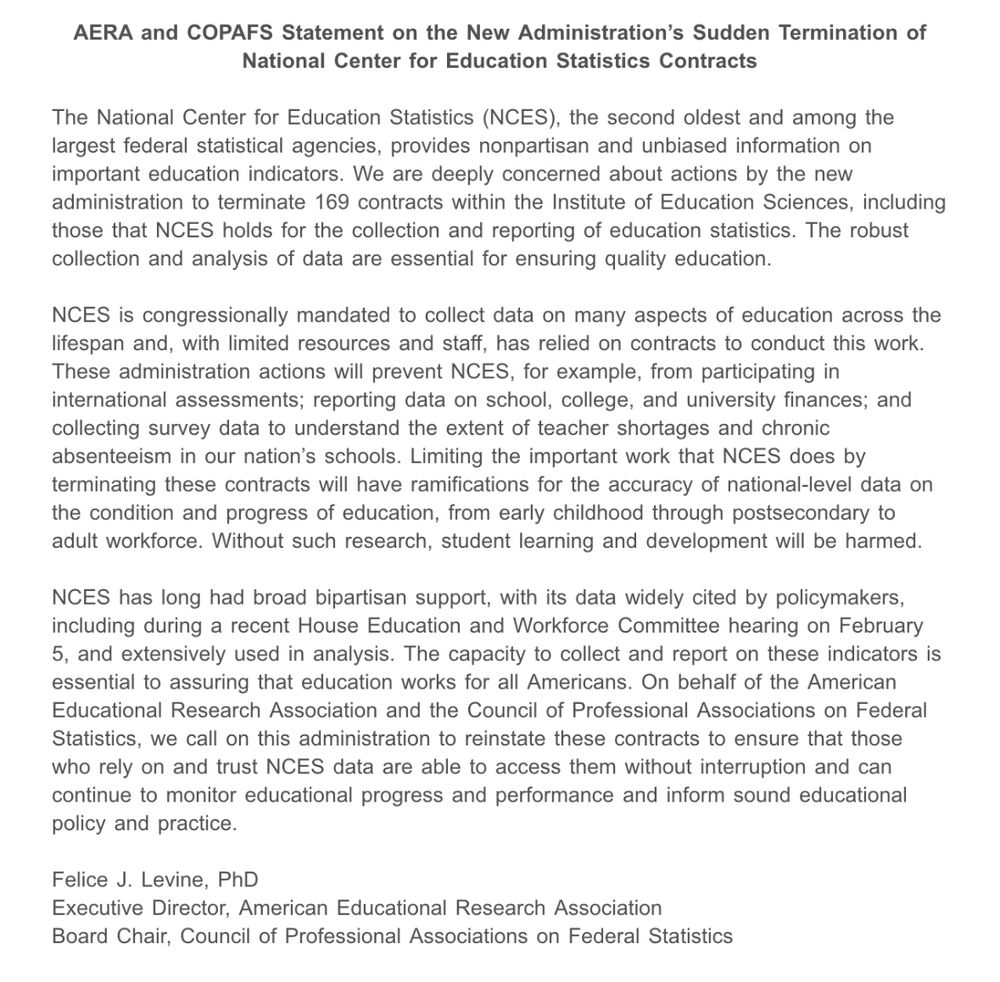
Trump doing a solid for the voucher lobby by getting rid of education statistics
Welp, at least canada/canadiens are still SANE and responding with way more balls than pussy democrat “leaders”…
fascinating conversation and message to the orange hitler;
Last edited by Spurs Homer; 02-11-2025 at 12:49 PM.
That's what he's trying to do.
Which agency did he dissolve?

Vance hit back at the judges for trying to restrict the president in his own sphere and overriding his decisions as to how best to carry out the law (the execute in the “executive branch”). As the Harvard law professor Adrian Vermeule put it an X post, reshared by Vance, “judicial interference with legitimate acts of state, especially the internal functioning of a co-equal branch, is a violation of the separation of powers”.
But the judges’ actions raise another vexing cons utional question: can a lower court with narrow local jurisdiction render so-called nationwide injunctions that purport to bind every American citizen? By seemingly refusing to comply, the Trump administration is effectively answering: no. In doing so, according to The New York Times, the Trumpians have triggered an unprecedented “cons utional crisis”. In recent years, as legal progressives have sought to limit presidential power when it’s held by the other side, it’s become a sort of truism that a lower court in Hawaii or, say, New Hampshire can put a stop to a federal policy covering the whole nation.
In fact, the argument isn’t obvious at all, and there is good reason to believe that America’s Founding Fathers would have been baffled by such gross assertions of judicial hegemony.
Start with the cons utional text. The first clause of Article III of the Cons ution reads: “The judicial Power of the United States, shall be vested in one supreme Court, and in such inferior Courts as the Congress may from time to time ordain and establish.” Read that carefully once more. This so-called vesting clause has at least two notable elements.
First, the only court that shall be established is the US Supreme Court. All other lower courts exist solely at the discretion of Congress, as they have since the Judiciary Act of 1789 — one of the first statutes the First Congress passed. But something created by statute can be taken away by statute. The Federalist’s Sean Davis might have appeared to be trolling when he noted on X that “Congress would be well within its right to just eliminate” any lower courts. In fact, Davis was restating a basic fact about America’s cons utional structure. That precarious state of the lower courts should already tell us something about their authority to neuter executive-branch policy for the whole country.
Second, and more relevant, is what the “judicial Power” means as it is used in Article III of the Cons ution. As the University of Chicago Law School professor Will Baude argued in a highly influential 2008 law-review article, “the judicial power is the power to issue binding judgments and to settle legal disputes within the court’s jurisdiction”.
The deepest question raised by this is the following: what is a federal court’s legitimate jurisdiction when it comes to issuing injunctions — a form of “equitable remedy” in legalese, meaning the court tells one party to perform some act (rather than award damages). In this case, for example, it’s courts ordering the executive branch that it has to automatically grant US citizenship to children born to unlawful migrants.
The answer is simple: when it comes to this kind of remedy, only the named parties to a particular lawsuit are bound by the judgment. So to follow our example: a lower court can only order the federal government to treat as an automatic citizen a specific infant born on US soil to an illegal mother from Honduras. Call him Baby Doe. But a lower court lacks the authority to force the executive branch to grant automatic citizenship to Baby Doe and all other similarly situated children nationwide.
As then-Stanford law professor Jonathan Mitc argued in a 2018 law-review article, an “injunction is nothing more than a judicially imposed non-enforcement policy” that “forbids the named defendants to enforce the statute” — or executive order — “while the court’s order remains in place.” There is no broader “writ of erasure” that permits a lower court to simply “strike down” a statute or an executive order.
Nationwide injunctions applying to all people across a vast continental nation have no basis in the Anglo-American legal tradition. Rather, the proper scope of a federal court’s power to issue such remedies is restricted to “the defendant’s conduct only with respect to the plaintiff”, as Samuel L. Bray, the Notre Dame legal scholar, argued in a 2017 law-review article
Sceptics of nationwide injunctions aren’t limited to the legal academy. They include Justice Clarence Thomas of the Supreme Court. As Thomas explained in his 2018 concurring opinion in the landmark Trump v. Hawaii case, historically, “American courts of equity did not provide relief beyond the parties to the case”, because “for most of our history, courts understood judicial power as fundamentally the power to render judgments in individual cases”. Presciently, Thomas concluded his opinion by warning: “If federal courts continue to issue them, this Court is dutybound to adjudicate their authority to do so”.
That day has not yet come, but it might soon enough, as the clash between the second Trump administration and legal progressives reaches a crescendo.
https://unherd.com/2025/02/anti-trum...-legal-crisis/
Let's see the do ents.
Complete transparency.
So the only federal court is the Supreme Court?
lol
It's possibly theses judges are either unfamiliar with, or are ignoring, several laws pertaining to budgetary matters, exclusive to the Congress and Executive; and, having nothing to do with the Judiciary.
In addition to the Impoundment Act of 1974, the following may apply:
The Anti-Deficiency Act.
The Federal Managers Financial Integrity Act.
Both of which basically state, the Executive is allowed to pause spending if, it is found (in the Anti-Deficiency Act) spending is in excess of that appropriated or (in the Federal Managers Financial Integrity Act) fraud, waste, and abuse are found. In both cases, such pauses in spending must be temporary and in accordance with the Impoundment Act of 1974. Since I couldn't find time frames (other than temporary) in either of those acts, I'm assuming [granted, I'm not a lawyer] the timeframes in the Impoundment Act apply. Prove me wrong.
I still maintain these activist judges are the ones committing the coup.
There are currently 40 users browsing this thread. (0 members and 40 guests)
 Posting Permissions
