Reply With Quote
You got the House, sassafras?
Nope.

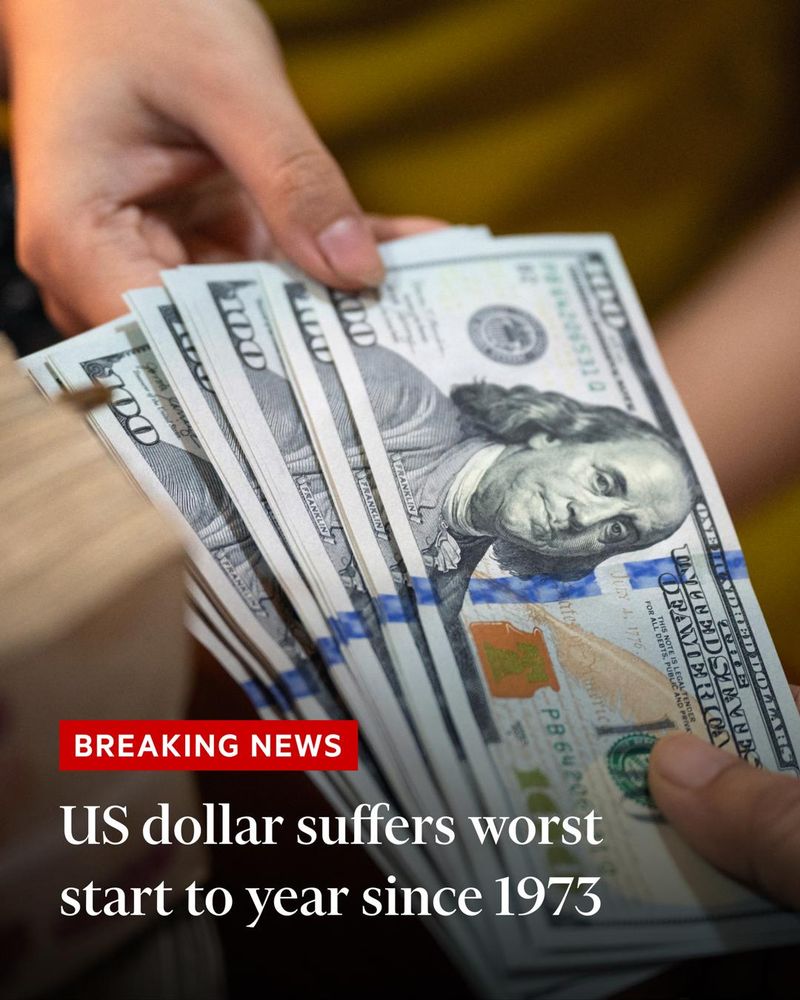
USD down significantly since Trump took office


You got the House, sassafras?
Nope.

Looks like Bessent's finally saying what we've known for years: the strong dollar screwed over Main Street while Wall Street got fat. A weaker dollar could bring back manufacturing jobs and help the middle class. About time we focus on earning strength, not faking it. Global banks can sweat.
Let’s dig into why this makes sense for America.
1. The strong dollar policy, started under Clinton, was a Wall Street win. It brought in foreign cash and kept stocks high, but it killed our factories. Cheaper imports meant lost jobs for regular folks. A weaker dollar flips that: our goods get cheaper abroad, so we can export more and rebuild manufacturing.
2. Middle-class Americans have been hurting. We’ve watched plants close and towns die while the elites in New York and D.C. got richer. Bessent’s “Main Street’s turn” line isn’t just talk. It’s a real shot at bringing back good-paying jobs for people who work with their hands, not just their laptops.
3. Sure, a weaker dollar might make your next iPhone pricier, and a trip to Europe could cost more. But what’s better: cheap gadgets or a steady paycheck? We’ve been trading short-term deals for long-term pain. Time to think about what keeps America strong for the next generation.
4. Global central banks are nervous, and I get it. They’ve leaned on the dollar forever. But why should we keep propping up their economies at our expense? Let them adjust. America needs to take care of its own first. We can’t keep playing world banker while our own house falls apart.
5. This isn’t a quick fix, and it won’t be painless. Inflation might tick up, and some big companies will grumble. But if we play this smart, with tax cuts and less red tape like Bessent says, we can grow our way out of it. We’ve done it before. Let’s do it again for the heartland.


Destroying the economy and prosperity to bring back minimum wage low margin manufacturing. A genius plan.

those mental gymnastics

What is the strategy for actually helping "Main Street"?
Making iPhones here?
Run a Poll, dad.
Only a simpleton like you would call this mental gymnastics. You currently think an overvalued dollar is a strong dollar and that it's a positive thing. Bessent is brilliant when it comes to monetary policy and if your TDS wasn't holding you back so much you'd be able to recognize what he's doing to China. When Trump's 4 years are over Bessent will be looked at as Trump's best pick, mark my words.
And no, I'm not posting this article for you to read as I know it's too many sentences for your pea brain.
Scott Bessent: Trump’s man who broke the Bank of England
"To hear him tell it, Scott Bessent was built just for this moment. “In the next few years, we are going to have to have some kind of a grand, global economic reordering,” the billionaire hedge fund investor predicted at an event last summer. “I’d like to be a part of it.”
By tapping Bessent, 62, for Treasury secretary, president-elect Donald Trump has granted that wish. He will be arriving to lead one of the most powerful offices in the world with the global economy at a crossroads.
Western governments have emerged from the pandemic with crippling debts just as increasingly bellicose rivals such as China and Russia assert themselves. Without dramatic economic surgery, Bessent reckons, America will tip into a “permanent, European-style malaise” and cede supremacy to China. “I think we are at a very unique moment here. We are the last-chance bar and grill for growing our way out of this.”
Bessent has not only studied such grand shifts, he has participated in them. As a young trader in London in 1992, it was he and Stanley Druckenmiller, both working for legendary investor George Soros at the time, who came up with the idea to bet against the pound. Soros will forever be known as “the man who broke the Bank of England” — and took the resulting $1 billion profit that bet yielded when Britain pulled out of the European exchange rate mechanism (ERM). But it was Bessent who set the wheels in motion behind the scenes."
"He rang Druckenmiller, Soros’s head of investment in New York. “He tells me the British housing market is in big trouble, and the British economy is in big trouble,” Druckenmiller recalled on a recent podcast. What did Bessent see? Britain was in recession and most people had floating-rate mortgages. If someone made a big enough bet against the pound, they could force the Bank of England into a corner. It could either protect the currency’s value by raising interest rates, or sever the long-held agreement that pegged the pound to the German deutschmark, which required the Bank to buy pounds in the market to maintain an agreed ratio with the German currency.
An interest rate increase would hurt millions of homeowners already suffering in the recession; Soros bet, rightly, that he could force the Bank to pull out of the ERM instead and give up the fight to defend the pound’s value. Buttressed by Bessent’s research, he made a $10 billion bet against sterling and that led to Black Wednesday — September 16, 1992 — when the Bank did indeed pull out of the ERM. The collapse in the pound’s value earned Soros more than $1 billion in a matter of weeks and ultimately led to the downfall of prime minister John Major. Bessent was an invisible hand behind the chaos.
Bessent earned a reputation for strategic thinking. Bob Diamond, the former Barclays boss who founded Atlas Merchant Capital in New York, said: “When our paths have crossed, I’ve always been struck by how thoughtful and strategic Scott is. He’s obviously highly capable and a great choice for Treasury secretary.”
"So what are likely to be Bessent’s priorities at the Treasury? At the event he spoke at last summer, he laid out a “three arrows” approach modelled on the radical overhaul of the Japanese economy carried out by then-prime minister Shinzo Abe between 2012 and 2020: slashing interest rates, cutting regulations and passing shareholder-friendly rules. In 2013, Bessent bet on the collapse of the yen — consequence of Abe’s strategy — while working for Soros. The trade generated a $1 billion profit. Twenty years after helping to break the Bank of England, Bessent broke the Bank of Japan.
With those lessons in mind, he has suggested a “3-3-3” approach for the Trump economic overhaul: target a 3 per cent economic growth rate (it is currently running at 2.8 per cent) through aggressive deregulation; increase America’s crude oil production by three million barrels a day to cut energy costs, and thus inflation; and slash the budget deficit to 3 per cent, or less than half its current rate of 7 per cent.
In practice, that would mean cutting more than $1 trillion (£800 billion), or 15 per cent, of the government’s annual budget. America’s national debt this year has topped $35 trillion, meaning that its $1.1 trillion interest bill is more than the budget of the Pentagon.
The stakes for not reducing this are, in Bessent’s mind, existential. “We were able to save the economic wellbeing of the country during the Great Depression by spending, and then we were able to save the world during World War Two,” he explained. “So we have to get this [debt] down, or we have no room for manoeuvre.”
So why might America need to manoeuvre? One needn’t guess. In a 2022 article, Bessent wrote of Trump’s first term as president: “[His] most enduring achievement may have been to wake the United States and the world to the growing dangers of an ever-more-antagonistic China.”
Like Trump, Bessent reckons that a great game is about to unfold, and he appears eager to move the pieces on behalf of his new boss."
https://www.thetimes.com/us/business...rump-kn8nj2nrm
Soros good now.
Yeah I'd like to know what "good paying job for people working with their hands" means to him and to tsa.
...Trump, with his small hands wretching the Magic Negro outta that Oval Office 1.20.2025 and tossing him ass over the teacup into the street.
Trump did that.
"...WASHINGTON (AP) — After President Donald Trump reversed course on his tariffs and announced he would pursue trade negotiations, he had a simple explanation for how he would make decisions in the coming weeks.
“Instinctively, more than anything else,” he told reporters this past week. “You almost can’t take a pencil to paper, it’s really more of an instinct than anything else.”
https://apnews.com/article/trump-tar...ebe8dfe8f136a5
everything is vibes with these idiots
He managed to kick The Magic Negro's Black ass outta that Oval Office 1-20-2025.
Let us proceed...
Trump is shrinking the US dollar and your purchasing power
https://www.marke ch.com/story/th...rther-eaf23c96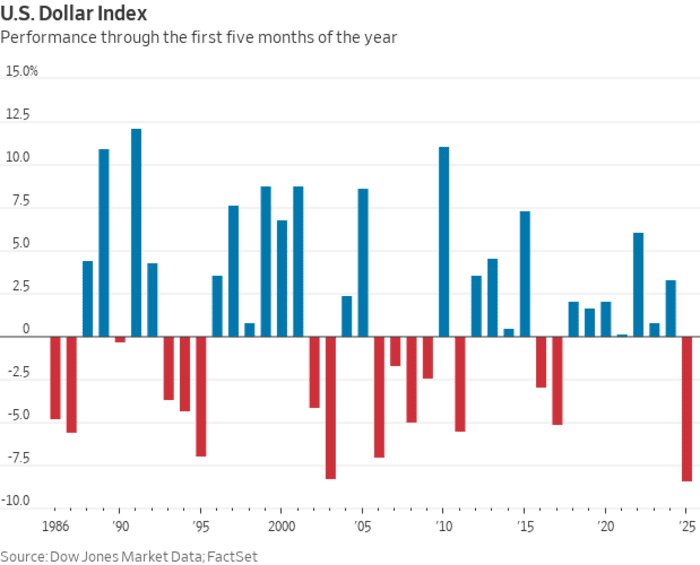
USD depreciation is underrated
that hissing sound is trust escaping
...and your budget getting smaller without you doing anything
Thanks, Donald Trump!
on.ft.com/4ev1ux1The US dollar has suffered its worst first half of the year since 1973, as Donald Trump’s trade and economic policies prompt global investors to rethink their exposure to the world’s dominant currency.
central banks hoarding gold, why?
https://kdwalmsley.substack.com/p/de...-china-and-theThe guys at Goldfix have a thesis, which is very compelling. They put the pieces together, and believe that the BRICS countries are setting up a financial system, based on a gold standard. Gold is being used as collateral, right now, and China is leading the expansion of the whole system.
Key to that is an international gold custody network. Vaults in China, Saudi, Southeast Asia, and Africa will serve as the plumbing of a new settlement system. Gold will be used as the underlying collateral, instead of US Treasury bonds and dollars.
In the SWIFT system today, it’s dollars that serve as the pools of liquidity, to make global trade happen. But a growing number of countries no longer view the dollar or US Treasury bonds as safe investments, and most certainly not if they can be seized or frozen by Western regulators. They need, instead, a new form of collateral that is free of politics, cannot be printed or inflated away, and recognized by everyone as a store of value.
Gold has always enjoyed those features, but there are big problems. How to verify the other party has gold?—that’s the trust issue. It also takes a long time to move gold. The SGEI in Shanghai is already set up to solve all those problems. China’s currency is the renminbi, or yuan, and in this system, renminbi will be the medium of exchange, backed by gold. Buyers and sellers in the new system don’t have to use renminbi in their trades, and probably will choose not to in bilateral trading with countries not China, but they can do so if they want.
So China will solve the trust and verification problem by opening vaults in friendly countries across the world. In Saudi, the appeal for China and Saudi Arabia is that oil trades can be quickly settled outside the dollar. In Southeast Asia, central banks there can pledge their gold for RMB credit lines, for their purchases of manufactured goods from Mainland China. In Africa and the Middle East, their gold can be used to finance new infrastructure. And this is an important wrinkle—respective BRICS members put some of their gold in the vaults of other countries. Your gold is here, my gold is there—you can go to your bank and count my gold, and I can do the same for your gold here.
That helps explain what’s happening in Singapore, we think. Vaults in Singapore are being used to custody gold deposits from China, India, Indonesia, and Gulf States. China, India and Indonesia are BRICS countries, and the question is why they would park their gold in Singapore instead of bringing it home. And that’s the answer: Singapore banks are highly regarded and trusted, and provide auditing and verification of the ownership of the gold in their vaults. Then blockchain systems make all the transactions happen very fast, in seconds. The gold sits still, but ownership of the gold can change instantly to finance trade, and change back upon settlement.
That feature-- instant convertibility, from renminbi to gold, or back—that is new.
https://www.wsj.com/finance/currenci...ravel-aeae581a“The ICE U.S. Dollar Index, which compares the U.S. currency to a basket of six others, just posted its worst first half of the year in more than 50 years. The dollar has tumbled 13% against the euro this year and 6% against the Japanese yen.”
There are currently 1 users browsing this thread. (0 members and 1 guests)
 Posting Permissions