

 Reply With Quote
this ing moron doesn't even know what shopping is.
https://x.com/atrupar/status/1920506794352251385

Is this true, Trump s?
The people never pay more because of tariffs?
https://x.com/Acyn/status/1920508286652330384
https://x.com/atrupar/status/1920506794352251385

Imagine the profit they're gonna make off the new tariff price.
https://x.com/Brad_Setser/status/1919785129867698243
Is this what tariffs are for?

Pharma tariffs are largely about long-term reshoring of Pharma manufacturing, not just a one year thing.
If Trump hadn't negotiated the USMCA, he probably would be calling it the worst deal ever negotiated. US automakers are angry because they built their supply chains around it and foreign brands had little incentive to pick the US over Mexico (or even Canada to some extent) for big investments.
Yes, it's about higher drug prices forever and an incredible windfall for the companies that hoard in advance of the permanent price increase.
Are you siding with Big Pharma?
It's what's happening because of tariffs. I'm not a fan.
You certainly seem to be in favor of all of it.
Are you not?
We are already charged the highest prices in the world for drugs.
I wouldn't mind the threat of tariffs bringing back some manufacturing. If prices really do get that much worse, then do what Europe does and look at price controls and other things to rein them in.
So you want them even higher.
If a lot more are eventually manufactured locally then there is NO tariff charged are those. None.
But they'll be priced higher to be in line with the tariffed drugs or vice-versa. Whichever is higher, that's going to be the one price for the proprietary drugs.
Unless you think every amount of every drug is going to be produced here.
If we're already charged the highest prices in the world, why aren't we looking at price controls and other things to rein them in right now? Trump pulled these tariffs out of his ass. He said so. You guys thinking this is 4D strategy is insane.
If you see much higher prices, then you'll see insurance companies push back and the government will too.
USA is already the profit engine for Big Pharma, so they aren't going to just walk away from this market.
It's not 4D chess -- It's straight forward. Apparently, we are looking at somethings. Keep an eye out in the next few weeks.
Huh? It's not straight forward. There's no logic behind any of it.
The Trump government?
what are you smoking?
Jesus Christ, this is unbelievably stupid.
You find a way to support Trump every single time.
Is this derp?

Trumplandia consists mainly of stupid bullies who make stupid, destructive decisions
https://warwickpowell.substack.com/p...alculation-andPerhaps the most consequential misstep was the 90-day grace period extended to all countries except China. What might have been intended as a strategic wedge to isolate China instead reshaped the game in ways that favoured all other players and further weakened the US’s position. This decision transformed a high-pressure bargaining game into a delayed coordination game. In this case, the dominant strategy for most countries was to wait, watch, and coordinate quietly with others.
While the US continues to conduct itself as if they are engaged in a bargaining game, everyone else has hedged to frame their strategies in the context of a coordination game in which they each have agency.
In repeated game theory, delaying moves in a scenario with uncertain payoffs often becomes optimal. This is especially so when the perceived cost of waiting is lower than the cost of misplaying a premature move. In this instance Trump’s 90-day hiatus removed the immediacy of decision-making, allowing other countries to stall. It also created the temporal space in which bilateral trade partners could feign cooperation with the US while pursuing other strategies. Unsurprisingly, many re-engaged with China or joined efforts to mitigate the impact of the US’s actions.
Take for example the following. In recent days, Japan and Hungary rebuffed Washington’s attempt to force them to decouple from China. This is quite remarkable given that Japan has long been subordinated to the US in geopolitical terms. Few can forget Japan’s caving in to Washington at the Plaza Accord. As for Hungary, this too shows some interesting dimensions. Hungary’s Prime Minister Viktor Orban is politically aligned with Trump, broadly speaking at least. There are strong philosophical sympathies. Yet, Hungary was not willing to jettison its economic interests in the face of American pressure. At the same time, the EU resumed economic talks with Beijing, while holding fire on its own retaliatory tariffs aimed at American goods. The UK inked a Free Trade Agreement (FTA) with India, pointing to these nations' willingness to forge trade relations outside of America’s orbit. ASEAN initiated internal coordination and, at the same time, deepened ties with China and the Gulf States. Japan, South Korea, and China met to revive stalled trilateral FTA talks. Meanwhile, ASEAN+3 finance ministers reaffirmed commitments to open and multilateral trade, and to take coordinated actions to ward off any macro downside risks of Trump’s tariffs.
The Trump Administration’s moves did not isolate China. Rather, they inadvertently triggered a counter-coordination game, where everyone else worked to insulate themselves from US pressure and build alternatives.

https://www.cnbc.com/2025/05/09/the-...e-tariffs.htmlThe aluminum sector isn’t moving to the U.S. despite tariffs — due to one key reason
Sweeping tariffs imposed by U.S. President Donald Trump on imported aluminum are reshaping global trade flows and inflating costs for American consumers. But they are falling short of their primary goal: to revive domestic aluminum production.
Instead, rising costs, particularly skyrocketing electricity prices in the U.S. relative to global compe ors, are leading to smelter closures rather than restarts.
...
The downstream impact of the tariffs is already being felt by Thule Group, a Hydro customer that makes cargo boxes fitted atop cars. The company said it’ll raise prices by about 10% even though it manufactures the majority of the goods sold in the U.S locally, as prices of raw materials, such as steel and aluminum, have shot up.
But while tariffs are effectively leading to prices rise in the U.S., they haven’t spurred a revival in domestic smelting, the energy-intensive process of producing primary aluminum.
What will it take to revive smelters in the U.S.?
The primary barrier remains the lack of access to compe ively priced, long-term power, according to the industry.
“Energy costs are a significant factor in the overall production cost of a smelter,” said Ami Shivkar, principal analyst of aluminum markets at analytics firm Wood Mackenzie. “High energy costs plague the US aluminium industry, forcing cutbacks and closures.”
...
“We are buying U.S. scrap [aluminium]. A local raw material. But still, the scrap prices now include, indirectly, the tariff cost,” Christophersen explained. “We pay the tariff cost in reality, because the scrap price adjusts to the Midwest premium.”
“We are paying the tariff cost, but we quickly pass it on, so it’s exactly the same [for us],” he added.
RBC Capital Markets analysts confirmed this pass-through mechanism for Hydro’s extrusions business, saying “typically higher LME prices and premiums will be passed onto the customer.”
This pass-through has occurred amid broader market headwinds, particularly downstream among Hydro’s customers.
RBC highlighted the “weak spot remains the extrusion divisions” in Hydro’s recent results and noted a guidance downgrade, reflecting sluggish demand in sectors like building and construction.
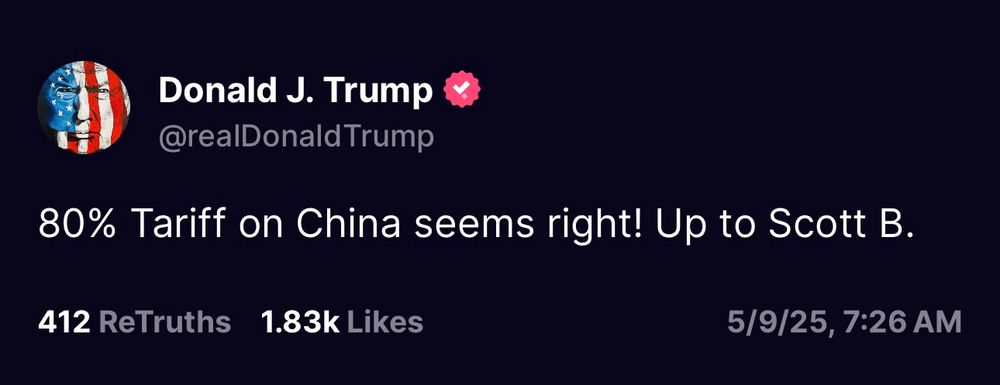
Trump backpedaling and begging the Chinese...without any concessions on their part
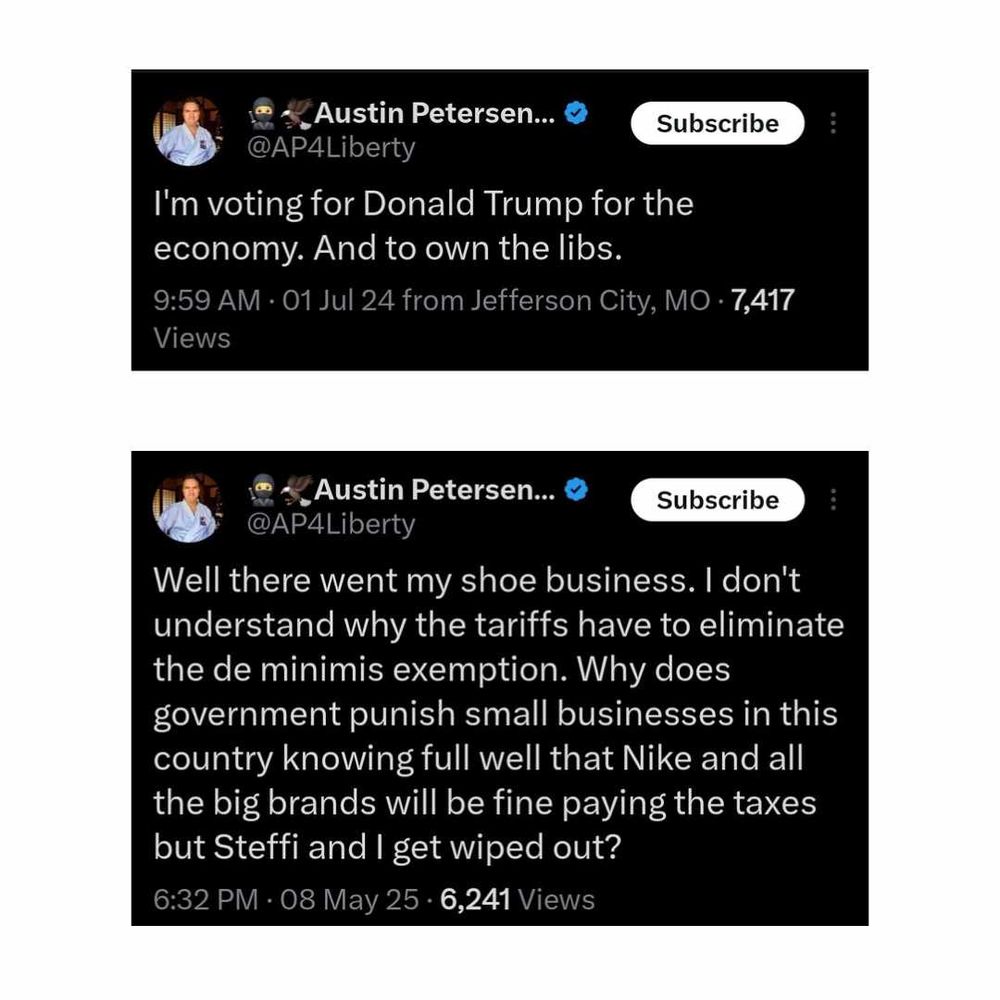
blaming "the government," but not the guy who did it to him
There are currently 1 users browsing this thread. (0 members and 1 guests)
 Posting Permissions


