Reply With Quote

This is Mileis aide talking to a bunch of foreign investors
I still talk to people that support this worm.
Their story is that all this social security program was a scam and everyone was getting free money.
Not sure what to believe tbqh. Im sure the truth is somewhere in the Middle
This is Mileis aide talking to a bunch of foreign investors
The right way to do declassification

*dangles shiny object*

Why is your Trump so bad at it then?

https://www.reuters.com/world/americ...al-2025-04-11/Argentina seals $20 billion IMF deal, tears down currency controls
BUENOS AIRES, April 11 (Reuters) - Argentina sealed a $20 billion, 48-month Extended Fund Facility deal with the International Monetary Fund on Friday and, in a major policy move ahead of the deal, dismantled key parts of its years-long currency controls and loosened its grip on the peso.
The IMF will disburse $12 billion by next Tuesday, while another $2 billion will become available by June.
The deal is expected to help Argentina "catalyze additional official multilateral and bilateral support, and a timely re-access to international capital markets," the IMF said.
"Key pillars of the program include maintaining a strong fiscal anchor, transitioning towards a more robust monetary and FX regime, with greater exchange rate flexibility," it added in a statement.
Earlier, the South American nation's central bank announced it would undo a fixed currency peg from Monday, letting the peso freely fluctuate within a moving band between 1,000 and 1,400 pesos per dollar, versus 1,074 at the close on Friday.
Argentina will eliminate major parts of the so-called "cepo" capital controls that have restricted access to foreign currency, the central bank said in a statement.
Companies, from this year, will also be able to repatriate profits out of the country, a key demand from businesses that could unlock more investment.
making Argentina much friendlier to money laundering would be quite the inducement if people trusted Argentinian banks
https://www.nakedcapitalism.com/2025...-paradise.htmlThe government calls the initiative the “Plan for the Historic Reparations of the Savings of Argentines”, and says it will take place in two stages.
“The first involves everything that the national executive branch can do and is within its reach. It will be applied by decree, which the President will sign in the next few hours, and the UIF will adapt its regulations to the new scheme,”said Milei’s spokesperson, Manuel Adorni. One of the decrees signed by Milei stipulates that there will be no fiscal control over cash operations involving sums lower than just under $50,000.
The second stage, said Adorni, “will consist of a bill [sent to Congress] to shield Argentine savers from here to the future, against the next administrations.”
Ask No Questions, Get No Answers
“I do not care in the slightest” how Argentines got their dollars, Milei said during a television interview on Monday, during which he appeared to encourage tax evasion and play down the risk of courting organised crime. From the Buenos Aires Herald:
Asked about dollars stemming from tax evasion, the president said that “taxes are robbery,” later adding: “people who tried to protect themselves from thieving politicians are heroes, not criminals.”Nick here. Even for someone who admits to having regular conversations with his dead dog through a medium, this is an absurd thing to say.
He went on to argue that organized crime such as drug trafficking should be combated by the Security Ministry and the Defence Ministry, without involving the economy. “You do not use the economy to fight crime,” he said.
After all, it is through the economy that criminal organisations are able to transform the proceeds of their activities into untraceable money that can easily be spent, or into assets that can be held or sold. What the Milei government is essentially proposing is to escalate its all-out war on the drug trade — which, let’s face it, is not very libertarian-minded — while essentially giving drug traffickers free reign to launder their money into the official economy.
Drug money is a huge source of liquidity for the global banking system — so much so that Antonio Maria Costa, head of the UN Office on Drugs and Crime, claimed in 2009 that drugs money essentially saved some banks in the US and Europe from collapse during the 2008-09 Global Financial Crisis, becoming “the only liquid capital investment available.”
Perhaps that is what this is ultimately about: remonetising Argentina’s financial system (and central bank) using the proceeds of crime and tax evasion, because something tells me it will be mainly criminals, both of the blue- and white-collar variety, (and not everyday Argentines) who will be taking advantage of the new rules. And even they may blanch at the idea of putting their money in Argentina’s banking system.
Now, back to the Buenos Aires Herald piece:
For the measure to work, he said, “the key is that nobody asks where you got your dollars. What’s more, I don’t care where you got your dollars. I don’t care in the slightest. That’s to say, economic issues are fixed in the economy. Issues of other kinds are fixed in the legal and judicial sphere. You have to understand that: they shouldn’t be mixed.”Here’s what Milei has to say about the suckers who have actually been complying with the law and paying their taxes over recent decades:
After the plans were announced, María Eugenia Marano, a lawyer focusing on economic crimes, told the Herald that allowing the population to use dollars with no questions asked facilitated bringing laundered money back into the financial system.
“Maybe [that person] didn’t have the talent, the guts or whatever it was to get out of the system. If everyone had managed to do the same, perhaps the politicians would have stopped stealing from us.”All of which is darkly ironic given the Milei government ramped up taxes on just about everyone, particularly the lower middle classes, as part of the economic shock program it began administering in December 2023.
liberating mattress money
Consumption, particularly among lower income groups, is also showing no sign of recovery as annual inflation remains at a still-high 47% while wages in the private sector continue to stagnate. In March consumption levels fell 5.4% year over year. It was the 16th consecutive month of decline. It is against this backdrop that the Milei government is seeking to lure billions of “mattress dollars” back into the official economy.
“It is not money laundering,” Caputo said, “it is the beginning of a new regime”:
“What we’re going to do is much deeper. It is the beginning of a new regime. In Argentina, the level of informality is so high as a result of two reasons: taxes and excessive regulations. Argentina assumes that 99.99% are criminals and this is not the case. We take this to a level of madness that leads people to escape formality.”
Two groups of people that will probably take advantage of the opportunity to recycle their undeclared dollars into the financial system are the members of Milei’s own team who have money abroad, including Caputo himself, the central bank governor, Santiago Bausili, the Minister of Justice, Mariano Cúneo Libaron, and Milei’s chief of staff, Guillermo Francos.
Caputo was implicated in the Paradise Papers scandal, which revealed that the then-minister of finance (and now-economy minister) had failed to disclose on taking office that he was a shareholder of offshore companies created to manage hundreds of millions of dollars in tax havens. Caputo could now potentially benefit from his own department’s proposed relaxation of Argentina’s tax evasion and money laundering rules.
So, too, could Latin America’s drug traffickers and other criminal groups as well as members of Milei’s government with ties to drug traffickers, including José Luis Espert, the founder and leader of the Avanza Libertad coalition.
US court orders Argentina to sign over 51% of its state-owned oil company
https://www.msn.com/en-us/money/news...ny/ar-AA1HINDaThe fate of Argentina’s state-run oil company was thrown into doubt Monday as a U.S. judge ordered the cash-strapped country to give up its 51% controlling stake in YPF in partial compensation for seizing the shares of former investors during its 2012 nationalization of the energy group.
The ruling — a dramatic effort to enforce a $16 billion U.S. court judgement against Argentina — presents a new headache for libertarian President Javier Milei, the ideological foil for left-wing former President Cristina Fernández de Kirchner who oversaw Argentina's contentious takeover of YPF and ensuing legal battles during her tenure (2007-2015). Milei vowed to appeal the ruling.
Fernández's abrupt move to seize control of YPF at the time helped bring serial defaulter Argentina further infamy for abandoning its global financial obligations. Milei inherited an economy in shambles after decades of reckless state spending and campaigned on pledges to privatize state companies.
In granting the request of former shareholders largely represented by Burford Capital, which finances litigation in return for a share of the winnings, Judge Loretta Preska of the Southern District of New York gave Argentina two weeks to transfer its shares in YPF to Bank of New York Mellon Corp, the major U.S. custody bank, according to the ruling seen by The Associated Press.
Because YPF is listed on the New York Stock Exchange, the plaintiffs could file the lawsuit in a U.S. district court. Shares of YPF closed down 5.6%.
The judgement stems from a long-running legal case that in 2023 saw Judge Preska find Argentina liable for $16.1 billion in damages and interest. The plaintiffs argue that the government should have launched a tender offer for stakes held by minority shareholders.
Milei, whose government has struggled to build up depleted foreign reserves, has vowed to appeal the ruling “to defend national interests" and blamed the problem on his political rivals.
US to the rescue, stabilizing Argentina's Peso

US is also helping Argentinian farm sector:
https://www.reuters.com/world/china/...ay-2025-09-23/Exclusive: China buys Argentine soybeans after tax drop, leaving US farmers sidelined
...
One of the traders said Chinese buyers had booked 15 cargoes.
The deals are a fresh blow for U.S. farmers, who are missing out on billions of dollars of soybean sales to China halfway through their prime marketing season as unresolved trade talks freeze exports and rival South
American suppliers led by Brazil step in to fill the gap, traders and analysts have said.
China has been gobbling up Argentina's raw soy amid the trade war, with Argentine exports hitting a six-year high in the 2024/25 season. Local processors, however, are feeling the pinch.
"It's clearly a concern," said Gustavo Idigoras, head of Argentina's soybean crushing chamber. "The temporary tax cut encourages China to take Argentina's soy."
China, the world's biggest buyer of soybeans, has yet to purchase any U.S. soybean cargoes from its autumn harvest, traders have said.
"These deals were done last night after Argentina's decision on export tax," said one of the traders, declining to be identified as they were not authorised to speak with media. "It clearly means that China doesn't need U.S. beans."
On Friday, Chinese President Xi Jinping and U.S. President Donald Trump held a phone call but neither side reported any update on agriculture, further squeezing Chicago soybean futures already near five-year lows.
...
https://www.msn.com/en-gb/news/world...wn/ar-AA1MZM44Panic in Argentina as economy on brink of collapse - £742m meltdown
...
His economic reforms thrilled international investors but also depressed economic activity.
On top of his current economic woes, Mr Milei is also mired in a corruption scandal involving his sister and chief of staff. His approval ratings have tumbled as a result.
Karina Milei is accused of profiting from a bribery scheme in Argentina's disability agency. The scandal threatens to sully the government's reputation ahead of national mid-term elections at the end of October. Ms Milei denies the claims.
A former Instagram cake-baker and tarot card reader, Ms Milei managed her brother's presidential campaign before becoming general secretary.
The Buenos Aires local election was widely viewed as a political test for Mr Milei's party and a barometer as to how it will perform in the mid-terms.
Mr Milei's party secured 34% of the vote in Argentina's biggest province, losing by a landslide to the left-leaning Peronist opposition, which gained 47% of the vote.
Economists said it was impossible, eh?
The trouble with Austrian Economics is that eventually you run out of other people's money
backing up a foreign currency is a bigger emergency for Trumplandia than US farmers losing their shirts because of Trump's tariffs
https://www.intellinews.com/us-in-ta...acking-402975/Washington and Buenos Aires are negotiating a potential $20bn currency swap arrangement as the United States prepares to deploy an array of financial instruments to support Argentina's beleaguered economy, Treasury Secretary Scott Bessent announced on September 24 following high-stakes talks between Presidents Donald Trump and Javier Milei a day prior.
Argentina is technically in an America so it's still America First!
still amazed that there's no verbal opposition to my position
philosophical cowards
the spiritual concordance is downplayed, despite of its RACIST appeal
Bessent is also saving a personal benefactor
https://popular.info/p/trumps-argent...ilout-enrichesLast week, Treasury Secretary Scott Bessent announced a $20 billion package to rescue the Argentinian economy. The risky taxpayer-financed deal, which involves trading U.S. dollars for Argentine pesos, has little upside for ordinary Americans. Argentina is not a significant U.S. trading partner, and its economy, long in turmoil, has little impact on the United States.
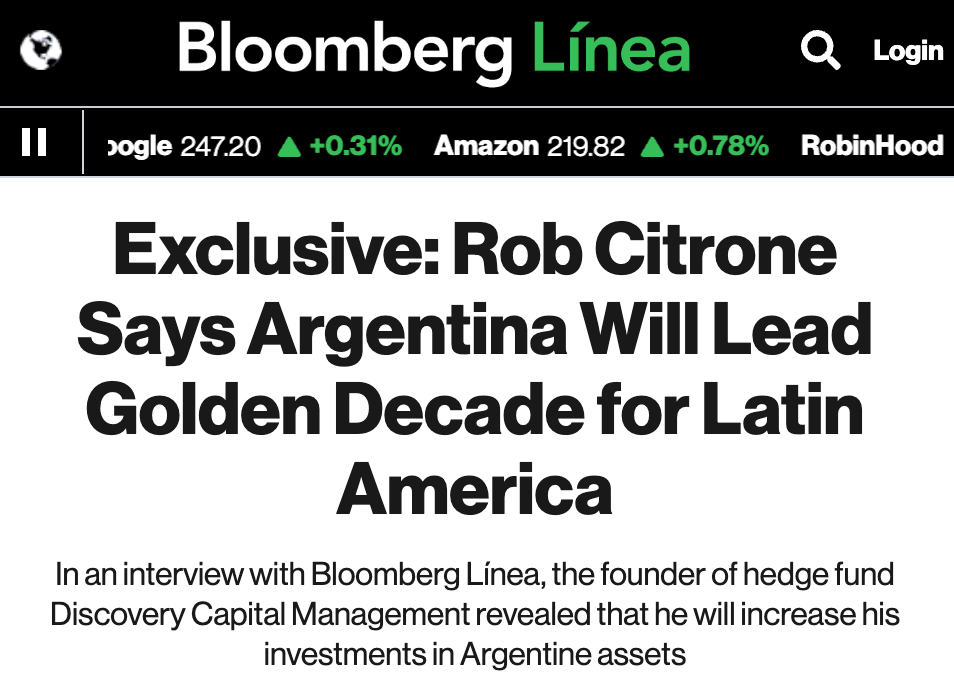
However, Bessent’s announcement had massive economic benefits for one American: billionaire hedge fund manager Rob Citrone, who has placed large bets on the future of the Argentine economy. Citrone, the co-founder of Discovery Capital Management, is also a friend and former colleague of Bessent—a fact that has not been previously reported in American media outlets. Citrone, by his own account, helped make Bessent very wealthy.
Since Javier Milei, a right-wing populist, became president of Argentina in December 2023, Citrone has invested heavily in Argentina. Citrone has bought Argentine debt and purchased equity in numerous Argentine companies that are closely tied to the performance of the overall economy. Due to Argentina’s massive debt load and chaotic economic history — in 2023, Argentina’s inflation rate was over 200% — Citrone purchased Argentine bonds with an interest rate of nearly 20%. (Citrone has declined to detail exactly “how much of the $2.8 billion he manages is invested“ in Argentina.)
Citrone, who is also a minority owner of the Pittsburgh Steelers, is effectively betting on Milei’s right-wing economic program, which emphasizes deregulation and sharply reduced government spending. Citrone viewed “the probability of default as minuscule,” even though Argentina has defaulted on its debts many times in the past.
In the short term, this appeared to be a savvy investment. After taking office, Milei fired tens of thousands of government workers, cut spending on welfare and research, and achieved fiscal balance. Inflation was reduced to around 40%, which spurred economic growth and foreign investment. Argentina’s economic rebound contributed to Discovery Capital’s 52% return in 2024.
Then it all came crashing down.
The austerity measures slowed economic growth, and unemployment ed to nearly 8%. Millions had a harder time making ends meet after Milei reduced or eliminated subsidies for transportation, medicine, and other necessities. Milei’s popularity slumped, leading to speculation that his party could be routed in the 2025 midterm elections, which would hamstring Milei’s ability to implement his agenda. This created an economic panic, with investors dumping the peso and liquidating other Argentine assets.
Milei has desperately attempted to keep inflation in check. Last week Argentina’s “central bank spent more than $1 billion to shore up the peso.” But Argentina was running out of foreign currency.
That spelled trouble for Citrone.
Then Bessent and the Trump administration came to the rescue, floating a $20 billion economic package that helped stabilize the Argentine peso and functioned as a political lifeline for Milei.
In early September, days before Bessent’s announcement, Citrone purchased more Argentine bonds.
Argentina First!
We must pay billions to farmers
Because we cut off their customers with tariffs
And pay billions to Argentina
Whose farmers are selling to the customers we forfeited
Because that is America First
*ARGENTINE PESO DROPS AS MUCH AS 2.1%, HITS RECORD INTRADAY LOW
US shoveling money at the Peso sellers, tbh
There are currently 1 users browsing this thread. (0 members and 1 guests)
 Posting Permissions