
 Reply With Quote
Ruh, roh.


Ruh, roh.
The average age of U.S. homebuyers is now 56, up from 49 last year.
In 1981, the year trickledown economics began, it was 31.
Average age was early 20's before FDR's New Deal

What year was that?
Or are you too emotionally fragile to post a number?
since 2020, this trend has accelerated
https://time.com/5888024/50-trillion...ality-america/This is not some back-of-the-napkin approximation. According to a groundbreaking new working paper by Carter C. Price and Kathryn Edwards of the RAND Corporation, had the more equitable income distributions of the three decades following World War II (1945 through 1974) merely held steady, the aggregate annual income of Americans earning below the 90th percentile would have been $2.5 trillion higher in the year 2018 alone. That is an amount equal to nearly 12 percent of GDP—enough to more than double median income—enough to pay every single working American in the bottom nine deciles an additional $1,144 a month. Every month. Every single year.
Price and Edwards calculate that the ulative tab for our four-decade-long experiment in radical inequality had grown to over $47 trillion from 1975 through 2018. At a recent pace of about $2.5 trillion a year, that number we estimate crossed the $50 trillion mark by early 2020. That’s $50 trillion that would have gone into the paychecks of working Americans had inequality held constant—$50 trillion that would have built a far larger and more prosperous economy—$50 trillion that would have enabled the vast majority of Americans to enter this pandemic far more healthy, resilient, and financially secure.
As the RAND report [whose research was funded by the Fair Work Center which co-author David Rolf is a board member of] demonstrates, a rising tide most definitely did not lift all boats. It didn’t even lift most of them, as nearly all of the benefits of growth these past 45 years were captured by those at the very top.
Whine didnt ever talk about Obama adding more to the national debt than all the presidents before him COMBINED.......lmao.....and he wont talk about Cali and New York as the most moved out of states with those democrats flooding into red states like Texas because of taxes in those blue states.....lmao.
Prove it.
you always want to change the subject
Because you never want to talk about democrat downfalls......but I will...and you dont like it....
You haven't been here for very long, Badmotorscooter.
I've had plenty to say about Biden and Obama that wasn't complimentary. I still say most of it.
You weren't here for it and you're still not here for it.
You're arguing with something in your own head.
is this good?

Whinehole with his bull scare tactics as usual....lmao. Its all the democrats have left....
I'm not scared of empirical measurement, are you?

THE MEDIAN AGE OF A U.S. HOME BUYER NOW SITS AT A RECORD HIGH OF 61 YEARS, PER NAR.
.
employers screwing workers for 50 years plus ac ulated inflation are the affordability crisis
https://prospect.org/2025/12/03/79-t...st-worker-pay/In the roughly 30 years following the end of World War II, the nation experienced an unprecedented period of broadly shared prosperity, with workers’ incomes rising in tandem with the nation’s growth in productivity. In 1947, workers captured 70 percent of the total national income; today, that has fallen to roughly 59 percent, while investment income has gained at workers’ expense. As a landmark 1995 study by economists Larry Mishel and Jared Bernstein for the Economic Policy Ins ute (EPI) revealed, a gap between the rise in productivity and the rise in median workers’ wages opened in the mid-1970s and has grown steadily wider since then; the difference between those two rates today is 55 percent. In the years between 1948 and 1979, when the egalitarian legacy of the New Deal was at its apogee, with high levels of unionization and progressive taxation and constraints on the financial sector, productivity grew by 108 percent and median worker’s compensation by 93 percent. In the years between 1979 and 2025, an EPI analysis found productivity grew by 87 percent but median worker’s compensation by a bare 33 percent.
The declining share of national income going to workers hasn’t entirely been the result of the shift from wage income to investment income. There’s also been a shift in the distribution of corporate income to the most highly paid employees, through stock options and other forms of compensation. A 2021 EPI study shows that between 1979 and 2019, real yearly wages for the bottom 90 percent of workers increased by 26 percent, while the wages of those in the 95th to 99th percentile increased by 75 percent, for those in the top 1 percent by 160 percent, and for those in the top 0.1 percent by 345 percent. Worker pay ratios over the past decade have shown that CEOs usually make about 300 times what their median-paid employee makes, a far cry from the 1960s, when the ratio was roughly 20-to-1.
What would America look like if the gap between worker pay and productivity hadn’t opened? A RAND Corporation study from earlier this year found that the bottom 90 percent of wage earners received about 67 percent of all taxable income in 1975. In 2019, the last year for which this data was available, they received 46.8 percent. Had that bottom 90 percent continued during the past half-century to make the same share of the national income they’d had in 1975, RAND calculates that by 2023 they would have made an additional $79 trillion. Just in the year 2023, they would have made an additional $3.9 trillion. As the size of the bottom 90 percent of the U.S. workforce is roughly 140 million people, that means that the average earner would have made about $28,000 more in 2023 than they actually did.
https://finance.yahoo.com/news/u-wor...214018586.htmlAs corporate earnings soar and the U.S. GDP balloons, the American workforce isn’t feeling the same boom. American workers are taking home less of the country’s overall wealth, data from the Bureau of Labor Statistics show, and employment in the U.S. is set to continue to slow.
Labor share, or the portion of the U.S.’s economic output that workers receive through salary and wages, decreased to 53.8% in the third quarter of 2025, its lowest level since the BLS started recording this data in 1947, according to its labor productivity and costs report published last week. In the previous quarter, labor share was at 54.6%. This decade, the labor share average was 55.6%.
Last edited by Winehole23; 01-19-2026 at 08:16 AM.
34 people have 12% of US income
commie WSJ echoes other posts in this thread
Data from the Federal Reserve shows that only the richest 1% of households have grown their share of overall U.S. wealth since 1990. Their share hit a record 32% in the third quarter of 2025, equivalent to $54.8 trillion.
Gains made by the billionaire class, the very top 0.1% of households and a subset of the 1%, have eclipsed the merely extremely rich. This group’s share of U.S. net wealth has risen nearly 6 percentage points to 14.4% since 1990.
The impacts of this are visible in booming sales at businesses that cater to the ultrarich. Wealth concentration is so intense that it is even causing a divergence among luxury-goods companies: Brands such as Cartier or Hermès that cater to the superwealthy are soaring, while sales at labels that rely on affluent middle-class consumers are slack.
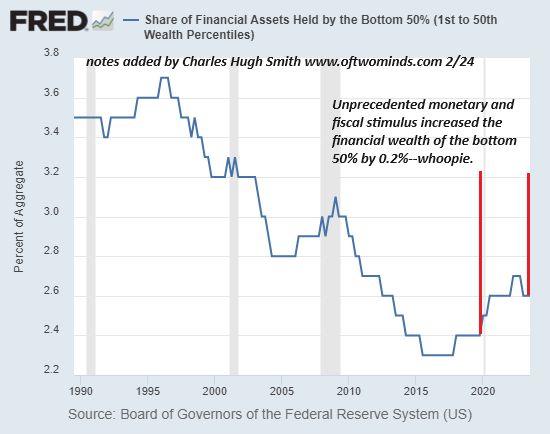
Meanwhile, the bottom half of American households have lost ground. Their 2.5% cut of the country’s wealth has slipped from 3.5% in 1990. Also striking: The share owned by the decile of wealthy households that rank just below the top 1% has shrunk slightly.
The tax code may be one reason why billionaire households have raced so far ahead of mere millionaires. One argument used to push back against calls for the rich to pay more into the system is that 1% of the highest earners pay 40% of income taxes, while 40% of Americans pay no income tax at all. This is true, but billionaires aren’t captured by this picture because most of their wealth lies outside the income-tax system.
Billionaires have ways to lower their tax bills that aren’t available to most Americans. A common strategy is to avoid salaries, which are heavily taxed. Ray Madoff, a law professor at Boston College and author of The Second Estate: How the Tax Code Made an American Aristocracy, points to Mark Zuckerberg’s dollar-a-year wage at Meta. Warren Buffett took an annual salary of $100,000 for decades.
Billionaires prefer to be paid in shares, which are subject to capital-gains taxes when sold. But they don’t need to sell to fund their lifestyles. Billionaires use borrowed money for living expenses, pledging their shares or other assets as collateral. The interest on the debt is much lower than a capital-gains tax bill would be, and their stock portfolios can continue ac ulating paper gains.A third of America’s billionaires have inherited their wealth. The ultrarich can use structures such as dynasty trusts to shield their assets from estate taxes for generations, while the step-up provision adjusts the cost basis of an inherited asset to its fair market value.
Amassing assets like stocks, borrowing against them rather than selling during the owner’s lifetime, and passing them to the next generation after death is sometimes called the “buy borrow die” tax-avoidance strategyhttps://archive.is/20260218110607/ht...-919.0-927.205Billionaires put less into the tax pot as a percentage of their wealth than wage earners. One working paper by the National Bureau of Economic Research found that the effective tax rate for the U.S.’s 400 wealthiest individuals is 24%—compared with 45% for top labor income earners.
“Very well-off Americans with high incomes have come to see themselves in the same camp as the very rich, even though their interests align much more with the middle class,” says Boston College’s Madoff.
Wealth concentration is increasingly clear in economic data. The top fifth of wealthiest households now account for nearly 60% of personal outlays, up from 50% in the early 1990s, data from Moody’s shows.
the major inflection point in this graph is the Great Financial Crisis of 2008-9

There are currently 1 users browsing this thread. (0 members and 1 guests)
 Posting Permissions