
Page 1 of 3 123 LastLast
Results 1 to 25 of 53
  1. #1
    Veteran
    My Team
    San Antonio Spurs
    Join Date
    Oct 2008
    Post Count
    1,636


    I'm new, so go easy on me.

    It looks like Obama is going to win. It also looks like Obama and his Democratic Congress will raise taxes.

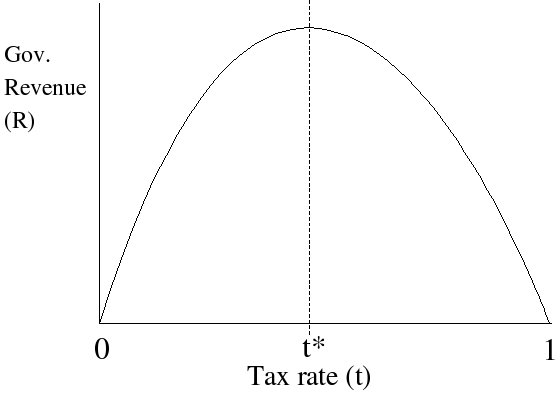
    What I've posted above is the Laffer curve. The main insight of the Laffer curve is that government revenue doesn't necessarily go up as you raise taxes. For instance, a 100% tax rate yields $0 government revenue (after all, who would work as a slave for the government, if they had a choice?). A 0% tax rate also yields $0 government revenue. So the ideal rate of taxation for raising government revenues is somewhere in the middle. Will Obama take us to the ideal level of taxation? Or will he raise taxes so much that government revenue will be less than it otherwise would be under current tax rates?

    I just think this is an interesting thing to consider. We have a huge deficit and debt to pay down. We are in the midst of a GLOBAL economic downturn. What should we do about taxes?

  2. #2
    Veteran DarrinS's Avatar
    My Team
    San Antonio Spurs
    Join Date
    Jun 2005
    Post Count
    42,561
    Raise the tax on the wealthy and give it to me. I'll invest it.

  3. #3
    🏆🏆🏆🏆🏆 ElNono's Avatar
    My Team
    San Antonio Spurs
    Join Date
    Apr 2007
    Post Count
    153,473


    I'm new, so go easy on me.

    It looks like Obama is going to win. It also looks like Obama and his Democratic Congress will raise taxes.

    What I've posted above is the Laffer curve. The main insight of the Laffer curve is that government revenue doesn't necessarily go up as you raise taxes. For instance, a 100% tax rate yields $0 government revenue (after all, who would work as a slave for the government, if they had a choice?). A 0% tax rate also yields $0 government revenue. So the ideal rate of taxation for raising government revenues is somewhere in the middle. Will Obama take us to the ideal level of taxation? Or will he raise taxes so much that government revenue will be less than it otherwise would be under current tax rates?

    I just think this is an interesting thing to consider. We have a huge deficit and debt to pay down. We are in the midst of a GLOBAL economic downturn. What should we do about taxes?
    So far he announced a tax hike from 36% to 39% on businesses making over $250K/year... Where that is on the Laffer curve, I don't know.

  4. #4
    Veteran
    My Team
    San Antonio Spurs
    Join Date
    Dec 2005
    Post Count
    15,842
    "It also looks like Obama and his Democratic Congress will raise taxes."

    Liar.

  5. #5
    Veteran
    My Team
    San Antonio Spurs
    Join Date
    Oct 2008
    Post Count
    1,636
    "It also looks like Obama and his Democratic Congress will raise taxes."

    Liar.
    ?

    Anyway, the purpose of this thread is to point out that higher taxes do not necessarily mean higher revenue.

    Higher capital gains taxes--which Obama supports as well--generally results in fewer realization events and less tax revenue. The Laffer curve is just a useful visual tool for understanding that good tax policy is a tricky proposition.

    If it were me, I would tinker with spending first because for the government it's easier to control the amount spent than the amount taken in.

  6. #6
    The D.R.A. Drachen's Avatar
    My Team
    San Antonio Spurs
    Join Date
    Nov 2004
    Post Count
    11,214
    The thing about government spending (as long as it is put in the right places), is that for every dollar received in taxes, $1 will be spent which will increase GDP by $1. If we were to lower taxes, then for every $1 saved in taxes by the consumer, there is likely only about .80 going to GDP due to savings rate. Even though most people will likely spend all of what they save on their tax savings, the rich will likely not spend all of the greater amount of their tax savings which will cancel out some of those in the lower classes. Another difference here is that people will most likely spend their money on end user consumables (clothes, food, gas, etc). The government on the other hand can spend each dollar on something and get more than $1 value out of it (research, etc). I dont think that this is the model that we need to have full time, but during an economic downturn, it seems that it would be useful. Once the economy has reversed direction, the government could stop some of its spending programs, and use that money to pay down the debt that it ac ulates during the downturn. I realize a few things, first this is ideal, and unfortunately it doesn't take into account human stupidity (lets spend exponentially more even during boom years, etc). Secondly, I didnt write this as eloquently as I possibly could because I about to start working and didnt have the time. Let me know if it is not understandable.

    P.S. the 20% savings rate may be different in actuality, I am just using it to show the point

  7. #7
    Veteran
    My Team
    San Antonio Spurs
    Join Date
    Oct 2008
    Post Count
    1,636
    The thing about government spending (as long as it is put in the right places), is that for every dollar received in taxes, $1 will be spent which will increase GDP by $1. If we were to lower taxes, then for every $1 saved in taxes by the consumer, there is likely only about .80 going to GDP due to savings rate. Even though most people will likely spend all of what they save on their tax savings, the rich will likely not spend all of the greater amount of their tax savings which will cancel out some of those in the lower classes. Another difference here is that people will most likely spend their money on end user consumables (clothes, food, gas, etc). The government on the other hand can spend each dollar on something and get more than $1 value out of it (research, etc). I dont think that this is the model that we need to have full time, but during an economic downturn, it seems that it would be useful. Once the economy has reversed direction, the government could stop some of its spending programs, and use that money to pay down the debt that it ac ulates during the downturn. I realize a few things, first this is ideal, and unfortunately it doesn't take into account human stupidity (lets spend exponentially more even during boom years, etc). Secondly, I didnt write this as eloquently as I possibly could because I about to start working and didnt have the time. Let me know if it is not understandable.

    P.S. the 20% savings rate may be different in actuality, I am just using it to show the point
    Well, I think this is beside the point, really. I'm talking about maximizing government revenues through taxation.

    Personally--having worked in government--I have a hard time believing that the government is better at spending, eh, "investing" our money than we are. It seems to me that government spending is by its very nature wasteful and thus a limited but necessary evil. I trust universities and industry to spend more efficiently on research than the government, for instance.

  8. #8
    The D.R.A. Drachen's Avatar
    My Team
    San Antonio Spurs
    Join Date
    Nov 2004
    Post Count
    11,214
    Well, I think this is beside the point, really. I'm talking about maximizing government revenues through taxation.

    Personally--having worked in government--I have a hard time believing that the government is better at spending, eh, "investing" our money than we are. It seems to me that government spending is by its very nature wasteful and thus a limited but necessary evil. I trust universities and industry to spend more efficiently on research than the government, for instance.
    Yeah, you are right, I didn't answer the damned question, and it pisses me off when people do that to me (or to other threads where I am interested in the opinions on the question). I think the answer of if we are at the pinnacle of the laffer curve or not, or where the tax hike for the top tier will push us along the laffer curve is "I dont know." I am not an economist, or social psychologist, etc. so I dont have access to the necessary data, and even if I did I probably wouldn't understand it. I can only draw upon the classes I have taken in the past, and my opinion. I guess if you want an answer, my opinion is that it won't hurt tax revenues to increase the taxes in that specific bracket (sp?). I think giving a little more money to the vast majority of Americans, especially those who are actually going to spend it, could be the way to respark the engine of the economy. I dont doubt that microeconomically some areas may suffer (yachting, spa treatments, etc.), but the macroeconomy should benefit by giving those money who will spend it. The stronger the macroeconomy the better the tax revenues. As to your point about research, I agree and disagree. If we have a truely cohesive plan of investment and a clear goal, the government is able to affect research in a very positive way (see manhattan project, while the outcome was negative, the actual organization of and knowledge gleaned from it were very valueable). I also think that Universities should play a major role as well, but which University has the spending power that the US Govt. has. I dont know if it should be a manhattan project, or if the US Govt should offer a lot of grant money, but I can see it both ways.

  9. #9
    Displaced 101A's Avatar
    My Team
    San Antonio Spurs
    Join Date
    Apr 2005
    Post Count
    7,711
    The thing about government spending (as long as it is put in the right places), is that for every dollar received in taxes, $1 will be spent which will increase GDP by $1. If we were to lower taxes, then for every $1 saved in taxes by the consumer, there is likely only about .80 going to GDP due to savings rate. Even though most people will likely spend all of what they save on their tax savings, the rich will likely not spend all of the greater amount of their tax savings which will cancel out some of those in the lower classes. Another difference here is that people will most likely spend their money on end user consumables (clothes, food, gas, etc). The government on the other hand can spend each dollar on something and get more than $1 value out of it (research, etc). I dont think that this is the model that we need to have full time, but during an economic downturn, it seems that it would be useful. Once the economy has reversed direction, the government could stop some of its spending programs, and use that money to pay down the debt that it ac ulates during the downturn. I realize a few things, first this is ideal, and unfortunately it doesn't take into account human stupidity (lets spend exponentially more even during boom years, etc). Secondly, I didnt write this as eloquently as I possibly could because I about to start working and didnt have the time. Let me know if it is not understandable.

    P.S. the 20% savings rate may be different in actuality, I am just using it to show the point
    Big problem with your theory is that it fails to take into account that the money supply, and wealth, is not fixed. The govt. for all its ability to succesfully distribute money, does not create wealth; private industry does that. A person who owns a factory that turns raw materials into cars, which are worth FAR MORE than the material he/she acquired to build the cars - could BURN their profits; but there would still be a positive economic effect on society. Profit is simply the carrot that encourages that person to do what they do, and create wealth - making the pie bigger for all of us.

  10. #10
    Veteran
    My Team
    San Antonio Spurs
    Join Date
    Dec 2005
    Post Count
    15,842
    You're lying about HUSSEIN raising taxes.

    "the purpose of this thread is to point out that higher taxes do not necessarily mean higher revenue."

    another HUGE LIE from the right is that tax cuts pay for themselves and stimulate the economy.

    Tell how the record/increasing federal deficit is being offset by taxcuts.

    Tell how dubya's huge taxcuts in 2001, and later, stimulated the economy. eg, the $800B cuts in estate tax.

  11. #11
    The D.R.A. Drachen's Avatar
    My Team
    San Antonio Spurs
    Join Date
    Nov 2004
    Post Count
    11,214
    Big problem with your theory is that it fails to take into account that the money supply, and wealth, is not fixed. The govt. for all its ability to succesfully distribute money, does not create wealth; private industry does that. A person who owns a factory that turns raw materials into cars, which are worth FAR MORE than the material he/she acquired to build the cars - could BURN their profits; but there would still be a positive economic effect on society. Profit is simply the carrot that encourages that person to do what they do, and create wealth - making the pie bigger for all of us.
    In the example I used (research) is creating intellectual property not creating wealth? That property could either be licensed to companies hoping to exploit this new knowledge, or could be set free in the public domain. Either way the results of this asset are making the pie bigger. Maybe I don't understand what you are saying, but even something as basic as creating a more efficient transportation system seems that it would create wealth (although indirectly). Could you please further explain (as I said, I fully admit that I am not an economist, I have opinions and learn as I go).

  12. #12
    Veteran
    My Team
    San Antonio Spurs
    Join Date
    Oct 2008
    Post Count
    1,636
    You're lying about HUSSEIN raising taxes.

    "the purpose of this thread is to point out that higher taxes do not necessarily mean higher revenue."

    another HUGE LIE from the right is that tax cuts pay for themselves and stimulate the economy.

    Tell how the record/increasing federal deficit is being offset by taxcuts.

    Tell how dubya's huge taxcuts in 2001, and later, stimulated the economy. eg, the $800B cuts in estate tax.
    What's wrong with you? I'm trying to have a civil discussion, and you're calling me a liar. Real mature.

    Is this guy always such a jerk?

  13. #13
    Veteran
    My Team
    San Antonio Spurs
    Join Date
    Dec 2005
    Post Count
    15,842
    I say your lie is that HUSSEIN will raise taxes.

    Waiting for your proof.

  14. #14
    The D.R.A. Drachen's Avatar
    My Team
    San Antonio Spurs
    Join Date
    Nov 2004
    Post Count
    11,214
    I say your lie is that HUSSEIN will raise taxes.

    Waiting for your proof.
    Full on Barack supporter here but he said that taxes will go up for those making over 250k (by way of allowing the expiration of the Bush tax cuts). This seems like raising taxes to me.

  15. #15
    Veteran
    My Team
    San Antonio Spurs
    Join Date
    Oct 2008
    Post Count
    1,636
    Anyway, moving on . . .

    In the example I used (research) is creating intellectual property not creating wealth? That property could either be licensed to companies hoping to exploit this new knowledge, or could be set free in the public domain. Either way the results of this asset are making the pie bigger. Maybe I don't understand what you are saying, but even something as basic as creating a more efficient transportation system seems that it would create wealth (although indirectly). Could you please further explain (as I said, I fully admit that I am not an economist, I have opinions and learn as I go).
    I think a compelling argument can be made that everything you mentioned--intellectual property, efficient transportation system--are far more efficiently pursued in the private sector. In fact, pretty much EVERYTHING is more efficiently pursued in the private sector. We tolerate (or should only tolerate) government waste and inefficiency in those areas in which the government provides essential public goods that the private sector cannot provide: national defense; enforcement of legal obligations and contracts through the courts; police and fire departments; essential roads (though even with most roads a compelling case can be made for privatization); and not much else.

    If the things you mentioned actually created wealth, don't you think there would be a market for those things? In other words, don't you think some enterprising individuals would exploit that opportunity to make some serious money?

  16. #16
    Believe. KenMcCoy's Avatar
    My Team
    San Antonio Spurs
    Join Date
    Sep 2008
    Post Count
    851
    I think there could be another 5-10% or so in taxes before the gov't actually started seeing diminishing returns. I think that the rate during the depression was at 50-60% before businesses just started saying "screw it, I'll park my money somewhere until the tax rate comes back down"...this was in '36 or '37 I believe.

  17. #17
    Veteran
    My Team
    San Antonio Spurs
    Join Date
    Dec 2005
    Post Count
    15,842
    Tax authorities around the world try to hit the maximum tax rate where it's high enough to bring in revenue but not so high as to encourage non-compliance and tax evasion.

    HUSSEIN is going raise taxes like 4% on like 15% at the top end, bringing the rate for that bracket to about where it was under Poppy Bush, while lowering the taxes on the bottom 85%. The Repugs claim this tax raise is communism and the end of the USA. And somebody wants to have a "civil" discusssion about taxes?

  18. #18
    Veteran
    My Team
    San Antonio Spurs
    Join Date
    Oct 2008
    Post Count
    1,636
    Tax authorities around the world try to hit the maximum tax rate where it's high enough to bring in revenue but not so high as to encourage non-compliance and tax evasion.

    HUSSEIN is going raise taxes like 4% on like 15% at the top end, bringing the rate for that bracket to about where it was under Poppy Bush, while lowering the taxes on the bottom 85%. The Repugs claim this tax raise is communism and the end of the USA. And somebody wants to have a "civil" discusssion about taxes?
    So . . . he IS going to raises taxes, then? So . . . why'd you call me a liar? Are you a liar? And what's wrong with trying to have a civil discussion about it? Did I say "communism" or the "end of the USA"?

    It's OK, I forgive you. Now leave.

  19. #19
    The D.R.A. Drachen's Avatar
    My Team
    San Antonio Spurs
    Join Date
    Nov 2004
    Post Count
    11,214
    Anyway, moving on . . .


    I think a compelling argument can be made that everything you mentioned--intellectual property, efficient transportation system--are far more efficiently pursued in the private sector. In fact, pretty much EVERYTHING is more efficiently pursued in the private sector. We tolerate (or should only tolerate) government waste and inefficiency in those areas in which the government provides essential public goods that the private sector cannot provide: national defense; enforcement of legal obligations and contracts through the courts; police and fire departments; essential roads (though even with most roads a compelling case can be made for privatization); and not much else.

    If the things you mentioned actually created wealth, don't you think there would be a market for those things? In other words, don't you think some enterprising individuals would exploit that opportunity to make some serious money?
    Oh, no, I absolutely believe just about every word of your post, though I think that the only thing that is left out of it (as to the research part) is the fact that no individual or corporation has the monetary buying power of the US government. I think that in certain cases if left to the private sector that the goals would eventually be reached, but if these goals had governmental support, they could be realized much sooner. This would create wealth sooner, which would grow the amount of wealth created exponentially. I am talking about the time value of money, specifically $1 created today is worth far more than $1 created 4 years from now because that dollar could be reinvested over the next 4 years creating more wealth. Even if that dollar isn't reinvested in research and is only put in a savings account, we now have interest that we don't have on the 2012 dollar (which has diminished buying power when compared to the 2008 dollar due to inflation).

  20. #20
    Cogito Ergo Sum LnGrrrR's Avatar
    My Team
    Boston Celtics
    Join Date
    Oct 2008
    Post Count
    22,399
    What's wrong with you? I'm trying to have a civil discussion, and you're calling me a liar. Real mature.

    Is this guy always such a jerk?
    *Shrug* Got me, I'm new.

  21. #21
    Veteran
    My Team
    San Antonio Spurs
    Join Date
    Dec 2005
    Post Count
    15,842
    "he IS going to raises taxes"

    yes, but you left out, dishonestly, how he is going to raise taxes a tiny amount on a tiny, high-end portion of the revenue scale, while leaving out, dishonestly, that he is going to LOWER taxes over the huge majority of the scale.

  22. #22
    Veteran
    My Team
    San Antonio Spurs
    Join Date
    Oct 2008
    Post Count
    1,636
    Oh, no, I absolutely believe just about every word of your post, though I think that the only thing that is left out of it (as to the research part) is the fact that no individual or corporation has the monetary buying power of the US government. I think that in certain cases if left to the private sector that the goals would eventually be reached, but if these goals had governmental support, they could be realized much sooner. This would create wealth sooner, which would grow the amount of wealth created exponentially. I am talking about the time value of money, specifically $1 created today is worth far more than $1 created 4 years from now because that dollar could be reinvested over the next 4 years creating more wealth. Even if that dollar isn't reinvested in research and is only put in a savings account, we now have interest that we don't have on the 2012 dollar (which has diminished buying power when compared to the 2008 dollar due to inflation).
    I see. Public-private partnership. As much as I would prefer private-private partnership, your point is well taken. Some people--like you--cite the Manhattan project as an example of government spending that yielded dividends in the private sector. I agree with that assessment--however, the purpose of the Manhattan project was to promote national defense and to win the war. You could also say that our military's huge R & D budget serves much the same purpose. Heck, the internet is derived largely from government research. Some people say NASA is an example of government spending that yields dividends in the private sector, but I don't know.

  23. #23
    Real Warrior Warlord23's Avatar
    My Team
    San Antonio Spurs
    Join Date
    Dec 2004
    Post Count
    6,025
    Interesting discussion.

    While I agree with the premise that the private sector generally does a more efficient job than the government in pursuing opportunities and creating wealth, people generally forget that government involvement is crucial to provide the jumpstart.

    History bears this out. The Pentagon system's research into military, space and computer technologies was the precursor to the private sector entering these areas, innovating upon initial development (done by the government), and making marketable products and services. See, private industry loves to take a good model and make money out of it, but it is far less willing to invest money in research that will prove that the aforementioned area is indeed worth pursuing.

    The Internet that we use today is nothing but the evolution of the ARPANET developed by the US Deptt of Defense. Microprocessor-based applications were originally developed to solve space/military problems such as space flight and missile guidance systems. The fact that a plethora of products from cell phones to cars contain microprocessors is a tribute to the initial investment. Also, most of the standards that have been adopted in the computing and internet worlds are a result of academic research.

    The point I am trying to make is that private capital loves not only the idea but a proven, tested practical application of the idea that can be used to make money. However they have not been as eager to invest in proving and testing whether a theoretical idea is financially feasible. They usually let government and academia handle that part.

    So let us not complement private enterprise too much. They have long fed off of government initiative, and have basically specialized in running the last lap of the race, while expecting government to run the first few laps.

  24. #24
    The D.R.A. Drachen's Avatar
    My Team
    San Antonio Spurs
    Join Date
    Nov 2004
    Post Count
    11,214
    I see. Public-private partnership. As much as I would prefer private-private partnership, your point is well taken. Some people--like you--cite the Manhattan project as an example of government spending that yielded dividends in the private sector. I agree with that assessment--however, the purpose of the Manhattan project was to promote national defense and to win the war. You could also say that our military's huge R & D budget serves much the same purpose. Heck, the internet is derived largely from government research. Some people say NASA is an example of government spending that yields dividends in the private sector, but I don't know.
    If you want a more current example of what the government could do perhaps they could externally increase funding for research at Universities, companies, etc. that are researching energy producing technology. Most specifically those that do not require fossil fuels. They could assist in the funding of energy delivery infrastructure (whatever that shakes out to mean).
    As far as nasa is concerned I think that this is one of the only examples that we have that our government supports basic science which I believe to be extremely important. We do know that due to NASA private industry has benefited. I am assuming your question is: do the benefits out weigh the costs?

  25. #25
    The D.R.A. Drachen's Avatar
    My Team
    San Antonio Spurs
    Join Date
    Nov 2004
    Post Count
    11,214
    Interesting discussion.

    While I agree with the premise that the private sector generally does a more efficient job than the government in pursuing opportunities and creating wealth, people generally forget that government involvement is crucial to provide the jumpstart.

    History bears this out. The Pentagon system's research into military, space and computer technologies was the precursor to the private sector entering these areas, innovating upon initial development (done by the government), and making marketable products and services. See, private industry loves to take a good model and make money out of it, but it is far less willing to invest money in research that will prove that the aforementioned area is indeed worth pursuing.

    The Internet that we use today is nothing but the evolution of the ARPANET developed by the US Deptt of Defense. Microprocessor-based applications were originally developed to solve space/military problems such as space flight and missile guidance systems. The fact that a plethora of products from cell phones to cars contain microprocessors is a tribute to the initial investment. Also, most of the standards that have been adopted in the computing and internet worlds are a result of academic research.

    The point I am trying to make is that private capital loves not only the idea but a proven, tested practical application of the idea that can be used to make money. However they have not been as eager to invest in proving and testing whether a theoretical idea is financially feasible. They usually let government and academia handle that part.

    So let us not complement private enterprise too much. They have long fed off of government initiative, and have basically specialized in running the last lap of the race, while expecting government to run the first few laps.
    good point!

Thread Information

Users Browsing this Thread

There are currently 1 users browsing this thread. (0 members and 1 guests)

Posting Permissions

  • You may not post new threads
  • You may not post replies
  • You may not post attachments
  • You may not edit your posts
  •