Reply With Quote
Depression-lite numbers for sure. In January the Fed projected 8.8% unemployment by the end of 2009.
Maybe we're just about to bottom out.

http://articles.moneycentral.msn.com...ent-rate.aspx?
An 8.5% unemployment rate is unmistakably bad. It's the highest rate since 1983 -- a year that saw double-digit unemployment, nearly 30 commercial bank failures and more than 15% of Americans living below the poverty line.
But the real national unemployment rate is far worse than the U.S. Department of Labor's March figure, announced today, shows. That's because the official rate doesn't include the 3.7 million-plus people who are reluctantly working only part time because of the poor labor market. And it doesn't include the workers who have given up scouring want ads for seemingly nonexistent jobs.
When those folks are added to the numbers, the unemployment rate rises to 15.6%. In March 2008, that number was 9.3%. The Bureau of Labor Statistics began tracking this alternative measure (.pdf file) in 1995.
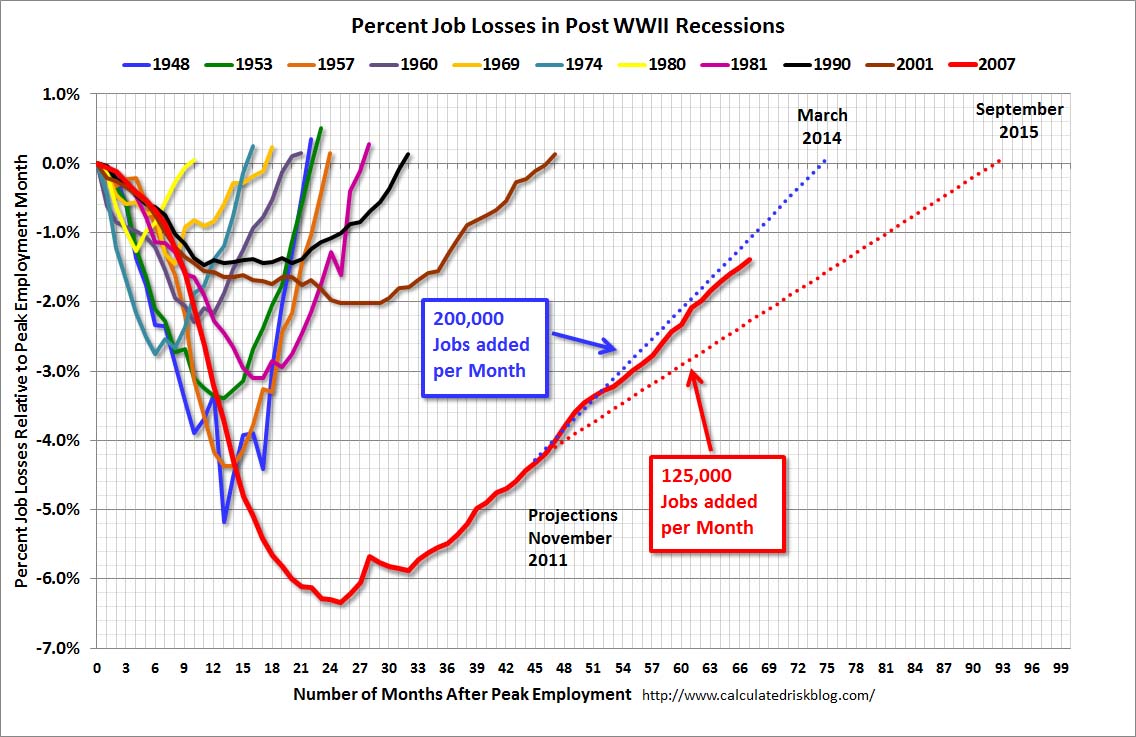
"The situation out there is very grim," says Heather Boushey, a senior economist at the Center for American Progress, a left-leaning think tank. "We have seen the mounting of job losses faster than any point since World War II. I have never seen anything escalate this bad."
Even the Department of Labor's expanded unemployment measure doesn't fully capture how difficult the job market is for American workers. It doesn't include self-employed workers whose incomes have shriveled. It doesn't look at former full-time staff employees who have accepted short-term contracts, without benefits, and at a fraction of their former salaries. And it doesn't count the many would-be workers who are going back to school, taking on more debt, in hopes that an advanced degree will improve their chances of landing a job.
Here's another way to look at the unemployment figures: More than 5 million people have lost their jobs since the start of the recession in December 2007. And more than 13 million people are unemployed. That's the highest number the U.S. has seen since it began tracking unemployment after World War II. For every job out there, more than four people are competing for it, says Boushey.
Mitch Feldman has seen the results of such intense compe ion firsthand. As president of New York executive placement firm A.E. Feldman Associates, he has watched lawyers accept paralegal jobs after failing to find any companies that are hiring. He has seen Ivy League-educated financial professionals accept lower-paid contract work after searching in vain for banking jobs.
"When some of the big investment banking firms had layoffs a year ago, those people were looking for permanent jobs," but now they're taking six-month and yearlong contracts, says Feldman. "And they're competing with other contractors who were on contract before. More supply, less demand, and the prices go down."
Some unemployed workers have become so frustrated by the difficulty of landing a job that they're exiting the labor market altogether. Prior recessions saw a e in the number of women choosing to be stay-at-home moms rather than continue to compete for work. This recession has seen a large e in the number of laid-off men opting to become stay-at-home dads -- or at least stay at home.
Once people stop looking for work, they're no longer en led to unemployment benefits.
Unemployment to worsen?
The employment situation on the horizon looks even worse. Typically, unemployment peaks six months to a year after the economy starts to recover, says Rebecca Blank, an economist with the Brookings Ins ution, a Washington, D.C., public policy think tank. Boushey believes the unemployment rate could reach double digits by the end of the year.
So, even if the recent stock market rally is a harbinger of economic recovery, that doesn't mean that unemployment rates will fall soon. Nor is an economic recovery a guarantee that unemployment will drop below 4%, as it did during the boom in 2000.
The way some economists see it, the U.S. has entered a downward spiral that could result in higher unemployment for the foreseeable future.
Right now, unemployment has helped fuel consumer cutbacks that have, in turn, pinched businesses' revenues. That has forced them to cut jobs in an effort to stem profit losses, continuing the cycle. Eventually, the hope is that government spending will employ more people and give businesses more revenue, leading to more spending and more hiring -- reversing the cycle.
But it might not happen that way. Spooked consumers, still reeling from an attack on all their assets, may simply not spend like they once did -- regardless of how much money the government pushes into the economy. Instead, they might save money in preparation for the tax increases they assume are inevitable or put it in safe assets like long-term Treasury bonds.
Businesses might also curb their spending. Instead of responding to sales increases with hiring, they could invest in relatively cheaper technology to replace eliminated positions.
Economists don't have to go back very far to find an example of a recovery that didn't push unemployment back to its prior lows. The lowest unemployment fell after the 2001 recession was 4.4% in December 2006 (it hit that number again in March 2007). That was significantly lower than the 6.5% high in 2003. But it wasn't close to the sub-4% rates seen in 2000.
That sort of recovery was what economists call a jobless recovery. "We weren't really growing wages and income for people in the bottom half of the economic distribution," says Alan Berube, an economist with the Brookings Ins ution.
-----------------------------------
This is going to get a lot worse before it gets better.

Depression-lite numbers for sure. In January the Fed projected 8.8% unemployment by the end of 2009.
Maybe we're just about to bottom out.

Fun with unemployment #s. And then there's the underemployment...
I'd say the bottom out is still a year away.
Get ready for inflation and interest rates
Smilie-free sarcasm. My bad.

Why are you laughing? I see the distinct possibility of troubled times like we had with president Carter.
Because just when these obamaclowns think the clouds have cleared and the light shall shine upon them, the next wave of the tsunami will arrive.

Gotta love the board Republicans' glee at the thought of things getting worse.
glee at the thought?
Recognition of the inevitable my friend. Not based solely on the actions of Obama, but failed long-term fiscal responsibility from decades of political officials.
Funny thing about Natural Law and the current system America has set up...no one, not even politicians, can hide the truth and the effects of their actions forever. This is the beauty of life.
Last edited by BonnerDynasty; 04-07-2009 at 05:01 PM.
Glee.
So are you saying it's Obama's fault? Because I stated even before he was elected that this was inevitable, and so did almost every Obama supporter on this site.
Only the repubs/conservative apologists stated that Obama is supposed to make everything better, so they can set him up for failure. Unfortunately, they are the only ones operating under such a black and white assumption.
So, which is it? Obama's fault or going to happen with or without him? Because if it's the latter, you're telling us stuff we already knew.
read the re-edit, of course it is not all obama's fault but he is taking this opportunity to grossly expand government control blah blah blah you've heard this song.
Going to be worse with these radical liberals who could care less about saving the America that once was, just as long as they can continue to craft the America they want.
It was morning in America after Carter killed inflation through Volcker, so I'm looking forward to that time.
It'd be so ing easy to get the economy going again. That's what is so disgusting about these big government snakes.
Not fix what is coming our way, but help to create jobs and get people working again.
Why does government want to send people checks instead of just letting them not pay fed taxes for 1 year?
Why must they continue printing and ing up our dollar, instead of letting the people keep their own money.
I know why, Chump will never know why. He will continue living in his big government ignorance faulting conservatives for their very existence as he goes through life blind and dumb.
By all means, get in there and fix it then.
Where's your doctorate in Economics? I'll be needing to see that now.
lol.
The people with the doctorates of Economics are the people who got us in this mess.
Or would you argue that mainstream economic thought has succeeded?
Just because economists have orgasms over monetary policy doesn't mean its the smart thing to do.

..it was unregulated free market capitalism that got us into this mess....choke on that....The people with the doctorates of Economics are the people who got us in this mess.

It would be funny if it wasn't so sad to watch some on the board (and those in the public eye as well) ask for the policies advocated by Herbert Hoover.
Are you talking about the Reconstruction Finance Corporation?
There are currently 1 users browsing this thread. (0 members and 1 guests)
 Posting Permissions