Reply With Quote
3 at best.

But he does have more than just a few.

3 at best.

you don't get out of the club much, do you.....

Your arguments are terrible. I'm not even citing carbon dating. You seem to think that since a few inconsistencies were found that you should throw out the entire body of evidence that argues the earth being over 4 billion years old! I'm waiting for a rational argument on your part, but I've yet to see one.


The Sun is shrinking. The solar radius changes at 2.5 feet per hour, half the 5 feet per hour change of the solar diameter. The distance from the sun to the earth is 93 million miles, and there are 5,280 feet in one mile. Assuming (by uniformitarian-type reasoning) that the rate of shrinkage has not changed with time, then the surface of the sun would touch the surface of the earth at a time in the past equal to
t = (93,000,000 miles) (5,280 ft/mile) (2.5 ft/hr) (24 hr/da) (365 day/yr) =
Radioisotope Aging Techniques
A technique which is very important to our estimates of the timescale on which the Solar System was formed involves measurement of the relative abundances of radioisotopes in rocks.
A radioisotope is a kind of atom that is not stable, and will turn into another kind of atom. For example a Rubidium 87 (symbolized by 87Rb) atom, which has 37 protons and 50 neutrons in its nucleus, will spontaneously turn into a Strontium 87 (symbolized by 87Sr) atom, which has 38 protons and 49 neutrons in its nucleus, if you let it sit long enough. This happens when one of the neutrons in the nucleus turns into a proton. When people talk about "radioactive decay" they're talking about one of a variety of processes like this, where the nucleus of atom of a radioisotope is changed because the particles in it spontaneously change (neutrons change to protons or vice versa or some quan y of particles leaves or is added).
Important to this is that a particular process (like the one above with 87Rb and 87Sr) happens spontaneously with a certain likelihood in a certain amount of time. The longer you leave a radioisotope atom sitting alone in a room, the more likely it will have decayed when you get back. We talk about the likelyhood P of its decaying. P is a number from 0 to 1, 0 being no likelihood and 1 being certainty. If you graph the likelihood of a 87Rb atom having decayed as a function of the time you leave it in the room, it looks like this
where P is likelihood and time is in gigayears, billions of years. What exactly does this graph say? To give an example, the value at 100 Gyr (100 billion years) is about .75; this means that if you leave a 87Rb atom alone for 100 Gyr, there is a 75% chance that it will have decayed to 87Sr when you return. You might be able to tell from the graph that in 49 billion years, an atom of 87Rb has a 50/50 chance (P=0.5) of having turned into an atom of 87Sr. Thus 49 billion years is the "half-life" of 87Rb. That is, if you leave one pound of it and come back 49 billion years later, only 1/2 pound will still be 87Rb and 1/2 pound will be 87Sr (since each atom has a 50/50 chance). Some of the atoms will change sooner (in one second, a 87Rb atom has about a 1 in a million million million chance of changing), some later, but when averaged, half of some large number of them will change in 49 Gyr. Other radioisotopes have other half-lives (for example Carbon 14 has a half-life of only about 5600 years).
So, if you know how much of a certain radioisotope and its daughter species (the kind it turns into) was in a rock when it first solidified, and you can measure how much of each is there now, you can tell how many half-lives have passed since the rock formed, simply because you know how fast that particular decay takes place. But you might ask, "Well, what if you don't know how much of both was in the rock when it formed? Or what if some 87Sr leaked out?" Well, you'd be right if you asked one of these questions. It's hard to know the answers. For this reason, more complicated techniques are used.
ISOCHRON TECHNIQUE
For example, there's another "isotope" of Strontium, 86Sr (it has one less neutron in its nucleus than 87Sr), which is chemically the same as 87Sr (neutrons don't strongly affect the chemical properties of an atom), and that means that if two different rocks form from the same material, they will have the same ratio of the two (86Sr/87Sr). But if the two rocks are chemically different (perhaps different minerals) then they'll have different percentages of 87Rb. So as the 87Rb decays, 87Sr will build up faster in the rock with the greater original percentage of 87Rb, and the ratios 86Sr/87Sr of the two rocks will change at different rates. How much the two ratios differ when you measure them tells you how long it's been going on. So you don't even have to know how much was in the rocks to begin with, just what the difference in the ratios is now.
There's a way to use a graph to get a quick idea of the age of a set of rocks that formed together. Say you take samples from 4 different rocks that formed at the same time, but have different relative amounts of Strontium and Rubidium, because they're different minerals. If they had just formed, then the ratio of percentages of the two isotopes of Strontium
87Sr/86Sr
would be the same for all 3 rocks. The ratio of the different elements, however,
87Rb/86Sr
would be different because they're different minerals. If you made a graph where the vertical axis was the first ratio and the horizontal axis was the second, and where each rock was represented by one point, then initially, the graph would be a horizontal straight line. As 87Rb decays into 87Sr, both ratios in each rock would change, the first going up and the second going down, Each point would move in a straight line toward the upper left because each Rb atom would turn into one Sr atom. The line connecting the sample points would gain in slope, as in the figure below. The steeper the line, the older the set of rocks. Note that you don't need to know any of the initial ratios, just the final ratios, and that ideally this can be done with only two rocks (as long as they're the same age and have different abundances of the 3 species).
Why is the slope proportional to the age of the rocks? Well, remember above it was stated that as the 87Rb decays, 87Sr will build up faster in the rock with the greater original percentage of 87Rb, and the ratios 86Sr/87Sr of the two rocks will change at different rates. In fact, the greater the 87Rb/86Sr, the greater the rate of change of 87Sr/86Sr. In other words, the farther to the right the point is in the diagram, the faster it will move upwards and to the left, and the relation between x position and y rate will be proportional.
The technique is a little more complicated than it sounds here because somtimes one of the species can leak out of the rock while its aging, and this has to be taken into account. But it's been used to find the age of many rocks on Earth, the Moon, and meteors. Various radioactive decay processes are used for this, and the ages of the oldest rocks all seem to be around 4.6 Gyr. This then, is how long ago the first rocks solidified, when the Solar System formed.
A more indepth discussion of this can be found at this site.
When the ages of rocks from various places in the Solar System are tested in this way, the results vary with the place of origin of the rocks. Below is a figure showing the age ranges of rocks from various different places.
These ranges are consistent with what we would expect. The Earth is the largest solid object in the Solar System, and so should be most internally active at this point in its history, while all smaller objects should have cooled sufficiently early on to have ceased producing rocks a short time into the history of the Solar System. So the asteroids and the Moon should have older rocks, which they do. Also, Earth's rocks vary greatly in age, since Earth has been actively making rocks since its formation, and so the ranges of ages of Earth rocks should be quite large, which this figure shows.
CARBON 14 METHOD
This same basic technique is used to find the ages of dead lifeforms which have been dead much less time than these truly ancient rocks. A different radioisotope is used, called carbon 14, which has a much shorter half-life, making it appropriate for shorter time scales.
You must think if you post enough charts it must be true? I can find a chart that shows Santa Clause really lives in Cleveland that doesn't make it true.
ISOCHRON ROCK DATING IS FATALLY FLAWED
by William Overn
For Exciting New Work On Radiometric Dating Showing a Young Earth, Click HERE
ABSTRACT
Radiometric rock dating, the methodology of determining the date of formation of a rock sample by the well-established rate of decay of the isotopes contained, depends on accurately determination of the starting points, the original concentrations of the isotopes. Many methods of estimating these beginning concentrations have been proposed, but all rest on tenuous assumptions which have limited their acceptance. This paper attempts to show that the Isochron-Diagram method contains a logical flaw that invalidates it. This most accepted of all methods has two variations, the mineral isochron and the whole-rock isochron. The logically-sound authenticating mechanism of the mineral isochron is applied to the whole-rock isochron, where it is invalid. The long-term stability of the whole-rock is applied to the mineral, where it is inappropriate.
When the isochron data are the result of the rock being a blend of two original species, the diagram is called a mixing line, having no time significance. This paper shows that all whole-rock isochrons are necessarily mixing lines. It is noted that by analogy the mixing-line logic casts strong su ion on the mineral isochron as well. Since only whole-rock isochrons play a significant role in the dating game anyway, isotopic geochronology can be rather generally discredited.
Keywords:
Age
Geochronology
Isochron
Isotope
Old-earth
Radiometric
Young-earth
Introduction:
Thanks mainly to the fact that they appear to be so constant, the decay rates of radioactive materials have become the primary mechanism for attempting to discover the age of rocks.[5,16] In addition to a constant rate of variation, however, any timing mechanism must also have a calibrated beginning point. A number of methods have been tried to calibrate the "radiometric clock". But they have all required unprovable and apparently unwarranted assumptions. Faure, in his textbook [9] refers to all of them as "assumed values" except for those obtained by the "isochron", or similar linear method.
The linear methods are several, and have in common the reduction of the data to a set which can yield a straight-line plot. Many exceedingly detailed descriptions of these methods are available.[1,2,5,16] A summary description of the Rb-Sr isochron is included below.
Arndts and Overn alerted the creationist community to the fact that in spite of the mathematical rigor of the isochron, it also has unwarranted assumptions, and the data carefully gathered and processed to indicate immense ages can more appropriately be dismissed as indicating the recent mixing of two or more magmas.[1,2,3] Dalrymple[6] challenged our analysis with five points, all of which were promptly and thoroughly refuted.[4]
In Dalrymple's latest book [7] he ignores the entire issue of the whole-rock isochron, only defending the mineral isochron. There is sound logic supporting the mineral isochron, but another fatal flaw. Individual mineral crystals are not closed systems. Even over the few thousands of years available in the young-earth paradigm, they are insufficiently stable to give acceptable data to the geochronologists.
The Rb-Sr Isochron Method
Rubidium and strontium occur as trace elements in many common rock types. Rubidium has two isotopes. 85Rb (stable, abundance 72%) and 87Rb (radioactive). 87Rb decays to 87Sr with a half-life of (approximately) 48.8 billion years. Strontium is stable in all natural forms, and in addition to the radiogenic 87Sr (7%), has isotopes 88Sr (82%), 86Sr (10%), and 84Sr (<1%).
The general method of dating is to take several samples of the rock, to determine the ratios of the Rb-Sr isotopes in each, and by simultaneous equations determine the probable beginning points for each, from which the age may be determined.[16]
For the sake of compatibility with the available laboratory instruments, the specific ratios chosen are 87Rb-86Sr and 87Sr-86Sr. The algebra is equivalent to a simple straight-line diagram as in Figure 1. where points a, b, and c represent the samples.
Here is graphically represented the fact that the amount of daughter isotope increases as the amount of parent increases in the sample. The magnitude of that increase (i.e. the slope of the line) depends on the time allowed for the decay process to transpire, or the age of the rock. If we extrapolate down the line to the zero intercept, we have a representation of a sample with no parent isotope to contribute to the daughter concentration. This must represent the initial daughter concentration.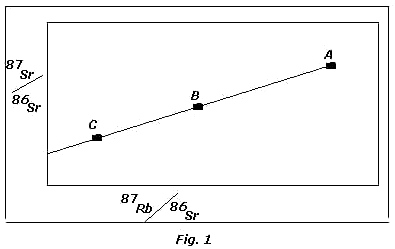
The slope is the age and the intercept is the initial daughter ratio. The scheme is mathematically sound. We must examine the assumptions.
For a problem to be solvable by simultaneous equations there must be as many independent equations as there are unknowns. The unknowns are the original 87Sr-86Sr ratio for each sample and the age of each sample. Each sample gives one equation, but introduces two additional unknowns. Regardless of the number of samples, there are never enough equations to cover all the unknowns.[16] These problems must be resolved by the assumptions.
The same age
It is assumed that all samples analyzed together are the same age. The word "isochron" (from the Greek "same time") symbolizes that. We do not dispute this assumption.
The same initial strontium ratio
If all initial 87Sr-86Sr ratios in the system are assumed to be the same, the scheme can be made to work, as the unknowns are reduced to two, the common age, and the common strontium ratio. Any two samples may now introduce the required two equations, and any more beyond that will simply improve the accuracy and the confidence level. This assumption is outside the experience based on field data, however, where the general case is that every sample has its own unique ratio. However, it can be rationally assumed that each sample we find has its own age and its particular rubidium concentration, which over time may have imparted a unique portion of daughter isotope. The assumed uniform strontium ratios should certainly be valid when applied to a rock system solidifying from a uniform genized melt. We must emphasize, however, that this enabling assumption must fail in the absence of an initial genized melt.
A "closed" system
If isotopes have migrated in or out of the sample during the aging period, the resulting data have no time significance. Isochrons are thought to be self checking in this regard, since with several samples an open system with random migration should scatter the points off of the straight line. Indeed, it often happens that there is a scatter of data, rendering the isochron worthless. But there are many occurrences of isochrons having acceptably straight-line form that are also rejected. Often "metamorphism" is cited as the probable cause, the system having opened, either partially or completely resetting the clock. [11,19] In order to assure an acceptably closed system, samples as large as 1 meter cubes have been suggested.[20] The assumption of a closed system for many of the isochrons, if they have not been questioned by the geochronologists, will not be challenged here. We note that these are generally obtained on the samples of larger dimensions, that is the whole-rock isochrons.
Independent equations
If the equations are not independent, the problem cannot be solved. This would be the case where all samples on the diagram plot on a single point. Although the single point on the diagram is valid, there is no way of finding a slope or intercept. If the melt were initially geneous and remained closed, it could be expected still to be geneous, and yield that single-point isochron. This should be the general case of the whole-rock isochron.
The need is to find samples with a variety of initial rubidium content but still having initial strontium ratios that are known to be uniform. The assumed initial geneous melt cannot be expected to give whole-rock samples with variable rubidium, but the assumed uniform 87Sr-86Sr ratios demand such an initial geneous melt.
The mineral isochron solves the dilemma. The mineral crystals have done the job in an elegant way. Crystals naturally form around a specific chemical composition, each atom occupying its naturally-assigned site. Foreign atoms just don't fit, either electrochemically or physically, and are strongly rejected. Depending on its concentration in the melt, a foreign element may have more or less acceptance in a crystal, based on its chemical and physical resemblance to one or another of the normal host elements. As the crystals form, each different mineral type accepts a different trace level of rubidium and of strontium. Because of their individual unique chemistry they each extract a different amount of rubidium and of strontium from the melt. The crystals of the individual minerals are used as the rock samples in the mineral isochrons.
MIXING
Often an isochron yields an unacceptable slope, indicating an age much too young or much too old to be compatible with the accepted model. [19] Frequently the slope is negative.[18,14] A common explanation for these cases is "mixing". It has always been recognized that the same straight-line plot as the isochron can be achieved if the original melt were a mixture of two original genized pools.[12] Figure 1. may also be used to illustrate this case. If points a and c are the compositions of the two original pools that partially merged to form the melt, any sample from the melt will occupy a place on a straight line between them, such as point b. No sample will be found above a or below c. Such a "mixing line" has no time significance, and the textbook warns to be wary of accepting such mixing as a true isochron.
Faure's text also proposes a test for mixing. [13] If a plot of 87Sr-86Sr vs 1/Sr (the concentration of strontium) shows a linear relationship, then mixing is indicated. A brief study conducted in 1981 showed a high degree of correlation to this mixing test in the isochrons being published.[3] A subsequent public dialog between Dalrymple[6] and Arndts & Overn [4] concluded that although the mixing test is strongly indicative of mixing, there are cir stances under which mixing would not be detected by such a test, and others wherein the test could give a false indication of mixing. The caution for the geochronologist would be to suspect any isochron, since there is no way to rule out mixing.
It is now clear, however, that there is at least one positive test for mixing. It is the whole-rock isochron itself. If the whole rock yields samples that give a linear plot, whether the slope is positive or negative, or whether the slope signifies an age that fits a preconceived model or not, there is no other known mechanism outside of mixing to which the data may be rationally ascribed.
Discussion
Mixing is an unfortunate misnomer that has become popular for describing rocks formed from two or more original melts, or from a melt becoming contaminated by isolated incorporation of local rock. Understand it to mean partial mixing, with resulting heterogeneity. Complete mixing would result in geneity, and would give only a single point to plot. No curve of any kind, nor even a scattering of points would occur.
This geneity is the assumed starting point in the history of the rock being dated. It then solidifies. But now, years later, we dig up 6 adjacent meter cubes of the rock, and discover that the normalized ratio of the parent (and incidentally of the daughter) is different in each cube, sufficient to plot as an "isochron". How can we rationally accept the assumed initial geneity? We can not.
What is needed but missing in the whole rock isochron is a mechanism to establish initial geneity, and then to extract heterogeneous samples. The mineral crystals do the job in an elegant way. Each type accepts a different level of contamination of the parent isotope, chemically determined. One cannot rationally extend this process back to the whole rock. It has been tried, but there is a fallacy . [5,20]
As we stated in 1986: [5]
The whole-rock isochron is justified on the basis that migration of the isotopes in a metamorphic event may be confined to distances of perhaps 1 cm. This is much larger than the average crystal size. Thus the original cons uents of each crystal will lie nearby. By taking samples of 100-cm dimensions, one could assure that the entire content of the original crystals are well represented by the sample, with very small error. However, this matrix is the original melt that was theorized to be geneous. The ability to find differences in the rubidium content among the samples violates the assumption of original geneity. Original in geneity is the only possible explanation: in other words, mixing.
This method of justifying the whole-rock isochron on the basis of the mineral is logically unsound. Within the larger matrix the tiny crystals may incorporate discrete trace elements and return them over time. But they are powerless to alter the composition of the whole-rock matrix.
It is claimed that fractional crystallization of magmas and separation of crystals from the remaining liquid result in suites of comagmatic rocks of differing composition. [10]. This may be true, but there is no experimental evidence that this can generally be applied to trace elements that are foreign to the crystals. Add the fact that trace elements are not securely held by crystals until temperatures are well below the melting points, and this postulate falls far short of explaining the variation in rubidium in whole-rock isochrons. Mixing is much preferred, particularly when it is noted that many data sets have negative slope, where mixing is always the accepted explanation. Often the negative-slope data pertain to large formations that particularly fit the hypothesis of slow cooling from a melt. [15,18]
In the case of the mineral isochrons the scheme postulates an initial geneous melt, represented by a single point on the diagram. As the crystals form, their differential solubility will move their individual points on the diagram horizontally , different distances. (Only horizontally, since the vertical is a ratio of two isotopes of the same element). The large volume of whole-rock isochrons, however, shows the general case to be an initial heterogeneous melt represented by the kind of diagram published as an isochron, and which we conclude is actually a mixing line. Any point in the melt can be represented as a point on the straight line. When mineral crystals form, each crystal will move its point off the straight line in one or the other horizontal directions. The result is a scattering of the points. The geochronologist discards it as one of the following:A three or more part mixture,The ability to obtain a whole-rock diagram, straight-line or not, can be considered proof that the data represent a "mixing line" rather than an "isochron". If mixing has not occurred, and the system has remained closed, then the whole-rock data must all lie on a single point. In fact, even if the whole-rock data show scatter, either mixing is indicated -- but of a complex nature, with more than two components -- or there have been subsequent alterations described as the system being open, or both.
Subsequent metamorphosis,
Not a closed system: In this case he recognizes that crystals really cannot be expected to be a closed system. They tend to continue to reject contaminants long after formation, the mobilities of foreign elements in crystals being a whole school of scientific study. The retention of trace elements in crystals is so inadequate that it has been possible to construct "Isochrons" from various parts of the same crystal.[17] It is common that when the mineral isochron fails, the geochronologist then produces a whole-rock isochron from the same formation.
Has any legitimate isochron ever been formed? It is improbable. There is ample evidence for mixing. Any "isochron" could be mixing. There is no way to rule it out. All whole-rock "isochrons" are mixing, and they are approximately 90% of all published. Many of the remaining (mineral) "isochrons" have a whole-rock point located close enough to the straight line to discredit them. Why should we expect any of the others to be "true isochrons", since mixing has the strongest probability?
If one possesses a strong faith in the antiquity of the rocks, one could rationally expect that an occasional mineral isochron is legitimate. But it would also require the whole-rock diagram to be concentrated in a single point. (Neither a straight line or scattered). Often a whole rock point is put on a mineral diagram. That does not meet the criterion. Several whole-rock samples must be obtained, using the same techniques required for the whole-rock method. Their individual data points must be identical, i.e. superimposed on the diagram. At that point mixing would not have been ruled out, but all available tests requiring mixing would have been eliminated.
In the dialog with Dalrymple [4] it was noted that he is unwilling to defend the whole-rock isochron. In his latest book [7] on the age of the earth he has included a section that describes the elegant process with which crystals (minerals) give the necessary heterogeneity to make the system work. He also shows why the mineral isochron cannot be relied upon for dating, but does not state that conclusion. He carefully avoids describing the whole-rock method, which leads the casual reader to conclude that it is validated by the same processes as is the mineral method. Nothing could be farther from the case. Dalrymple has seen our initial critique of the whole-rock method, [5] and is obviously reluctant to forthrightly claim any scientific merit for it. He has clearly sidestepped the issue.
Dalrymple [7] does not depend directly on isochron dating of rocks to date the earth, but rather on the lead-isotope ratios. He must be commended for his carefully pointing out the many assumptions involved. However, he finally ignores them and claims that the age has been determined within a very narrow margin.
His ultimate method is to take the radiometric ages of lead ores (Circa 2.6-3.5 Ga) and correct to the beginning. Again I point out that the "isochrons" used to date the ores, as well as those of the meteorites, that add so much to Dalrymple's confidence in the method, are most probably mixing. Note tables 7.4 and 7.5, [Ref 7] which give many meteorite ages. Almost all are whole-rock.
Additionally note that with all his enthusiasm for the isochron, Dalrymple characterizes the method as a "first approximation" [8]
As has been pointed out many times before, all radiometric methods including the linear-plot techniques have been effectively "calibrated" to the fossil dates by selecting among the discordant data those that fit the accepted stratigraphic model. [16] Since the proponents of the isochrons don't take them at face value, others should by equally wary.
See also: "Still No Proof For Ancient Age -A Response" by W. M. Overn and Russell T. Arndts
A technical analysis of "Isochrons" as defended by Dalrymple against creationist criticism, showing that despite mathematical sophistication, they are unreliable and are calibrated to "known ages" using the geologic column.
Link it up.
TlongII wants us to believe rocks found in different layers of earth are millions of years apart. Just like the fossils. And yet a tree was able to stay standing for millions of years though all those layers?
Mt. St. Helens
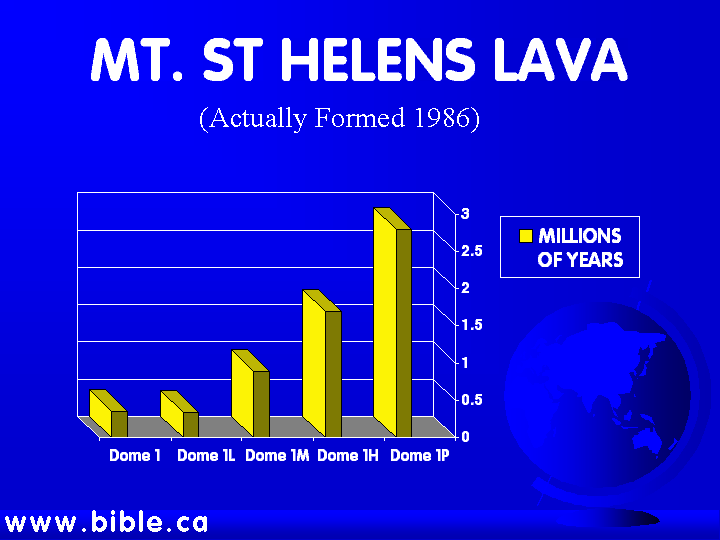
The new lava dome (dacite) from the at Mount St. Helens was formed in 1986. In 1997 five specimens were taken from this dome at five different locations and subjected to conventional Potassium-Argon dating. The results indicated ages of less than one half to almost three million years old, all from eleven year old rock.

+1 I'd never live in Cleveland.

Technically the sun's annual rate of radial shrinkage would have to be proportional to the sun's volumetric fuel consumption rate (in the sun's case, Hydrogen).
Those two variables aren't linearly proportional...
That said, the volumetric hydrogen consumption rate that is used to power the sun's nuclear reactions isn't linear either... a larger sun would create a larger gravitational field; which in turn would fuel the fusion reactions at a higher rate. That's why do ented radial shrinkage rates in the past were higher than today's rates (in our relatively 'short' history for measuring such rates).
Either way, a 4 or 6 billon year old model for Earth's age doesn't jive with what we know about the sun...
Last edited by Phenomanul; 05-27-2009 at 04:12 PM.
^ good point!
The Tlong's of the forum avoid talking about the sun. They avoid talking about Niagara Falls. If The earth was 1/4 of a Million years old Niagara would be as wide as China!

Except that landmass and tectonic plates are always moving. Niagara Falls hasn't always been there. Your assuming that Niagara Falls has been there since the beginning.
It hasnt. Its part of the Niagara escarpment which includes a small part of the great lakes. The great lakes where created by the great northern glacier, which also covered most of what is now the united states (including where Niagara is). The Niagara Escarpment was covered with a sheet of ice 2 - 3 kilometers thick (Wisconsin Glacier) 23,000 - 12,000 years ago.
The last glacial ice age occurred during three distinct periods of time during the past 65,000 years. The glacier originated east of Hudson Bay in northern Quebec and Labrador. This great glacier was known as "the Wisconsin Glacier".
The early Wisconsin Glacier covered the Niagara District and most of the northern North America 65,000 years ago. This glacier remained for a period of approximately 15,000 years before retreating 50,000 years ago.
The middle Wisconsin Glacier advanced again over the Niagara District 40,000 years ago. It remained for approximately 8,000 years before retreating 32,000 years ago.
The late Wisconsin Glacier advanced again 20,000 years ago. It remained for approximately 8,000 years before beginning its final retreat 12,000 years ago.
The plain of the lowest beach was 122 - 153 meters (400 - 500 feet) above present Lake Ontario (Lake Iroquois).
As the Glacier retreated, the water levels slowly lowered forming the four lakes.
Last edited by phyzik; 05-27-2009 at 04:24 PM.

+100 Exactly. Planet Earth is constantly changing and that is a no-brainer.
I love the continual use of biased creation website information.
actually I don't. It sucks.
There is no basis to assume a constant shrinkage.
source?
if it's from a creation website, I'm going to call you an idiot. Just sayin.
Another conundrum for creationalists. The farthest object in space that has been spotted so far is 13 billion light years away, it was a star going supernova. It took the light from that supernova 13.1 billion years to reach earth only recently. That means it must be at least that old. but the earth was only created a few thousand or even 10's of thousands of years ago? Seriously?
Perhaps they should carbon date the light to find a more reasonable figure.
Adam appeared to about "30" when he was born, so that could be it.....
although I wonder about Methuseluh......
he was 969 years old.......yet young earthers say the world is only several thousand years old......
at what point did people suddenly stop living so long and start living to only around 80 or so?
Isochron Dating as a Current Scientific Clock
By Calvin Krogman
Radioactive decay has become one of the most useful methods for determining the age of formation of rocks. However, in the very principal of radiometric dating there are several vital assumptions that have to be made in order for the age to be considered valid. These assumptions include: 1) the initial amount of the daughter isotope is known, 2) neither parent or daughter product has migrated into, or out of, the closed rock system, and 3) decay has occurred at a constant rate over time.
But what if one or some combination of these assumptions is incorrect? Then the computed age based on the ac ulation of daughter products will be incorrect (Stasson 1998). In order to use the valuable information provided by radiometric dating, a new method had to be created that would determine an accurate date and validate the assumptions of radiometric dating. For this purpose, isochron dating was developed, a process "that solves both of these problems (accurate date, assumptions) at once" (Stasson 1992).
A natural clock must meet four requirements. 1) The process must be irreversible. Isotope dating satisfies this requirement, as daughter products do not decay back to the original parent element. 2) The process must occur at a relatively uniform rate. It has been established through extensive experimentation that radioactive decay occurs at a constant rate. 3) The initial condition must be known. In this case, the initial condition is the amount of daughter isotope in the rock when it was formed. This amount is often unknown and is one of the downfalls of conventional radiometric dating. However, isochron dating bypasses this assumption, as explained below. 4) The final condition must be known. The final condition is the number of atoms of parent and daughter isotopes remaining in the rock and can easily be measured in a lab.
Isochron dating bypasses the necessity of knowing the quan y of initial daughter product in the rock by not using that value in the computation. Instead of using the initial quan y of daughter isotope, the ratio of daughter isotope compared to another isotope of the same element (which is not the product of any decay process) is used as the comparison for isochron dating. The plot of the ratios of the number of atoms of the parent isotope to the number of atoms in the non-daughter isotope compared to the number of atoms of the daughter isotope to the non-daughter isotope should result in a straight line that intersects the vertical y-axis (which is the ratio of daughter to non-daughter isotopes). This point of intersection gives the initial ratio of daughter to non-daughter isotopes, which would also be the ratio in a mineral that crystallized without any parent isotope present.
According to Brent Dalrymple (2004:68-69), "the trick to the isochron diagram is the normalization of both parent and daughter isotope to a third isotope." This third isotope is the non-decay product isotope of the same element as the daughter element. In the initial state, the graph of daughter isotope to the third isotope versus parent isotope to the third isotope should result in a straight, horizontal line.
The process of evaluating the daughter product as a ratio against another isotope of the same element is a valid method because, when a mineral or rock forms from a genous state, the elements that are assimilated into crystalline formation are very restricted. The key to the formation of crystals in the rock is that the process is selective between elements, but is indifferent to isotopes of the same element. Thus, the daughter product and any other isotopes of the same element will be incorporated into the minerals of a rock with the same ratio. This initial ratio allows the non-daughter product isotope to be representative of the initial amount of the daughter product (Stassen 1998).
As time progresses and decay occurs, the number of atoms of the parent isotope decreases, and the number of atoms of the daughter isotope increases accordingly. The amount of non-decay isotope in the sample does not change. Thus, as decay occurs, the parent ratio decreases and the daughter ratio increases. On an isochron diagram, this change in ratios shifts each measurement from the sample up and to the left at a one-to-one rate. As time progresses, the line connecting the measurements within the sample moves counter-clockwise around a point intersecting the y-axis, a point that represents the initial ratios (Dalrymple 2005:71).
Once the ratios are plotted, the age of the rock being dated can be determined based on the slope of the line. The steeper the slope of the line, the more decay has occurred in a sample and the older the sample is (Dalrymple 2005:71).
The features of the isochron method provide a way do reduce doubt and speculation about an age that is computed using these methods. Based on the assumptions of basic radioactive dating, the problem of an unknown initial amount of daughter isotope is eliminated by the definition of the isochron itself. The problem of contamination is "self-checking". If contamination has occurred within a sample, the ratios from the sample shouldn't fall on a line. Instead, the points would be in a scatter on the graph. Points that do not fall on a straight line suggest contamination, and this invalidates the results. However, by this same principle, points falling relatively close to a best fit line should provide an accurate date for the age of the rock being dated (Stasser 1992).
In most cases, the slope of the line generated by the isochron method gives an age for a rock sample of millions, or even billions of years. In general, these ages are supported by the science community, who declare that the Earth is about 4.5 billion years old. However, young-Earth creationists believe in an Earth that was created only 6,000 years ago. The old age provided by isochron dating methods obviously conflicts with the young age of only 6,000 years held by these creationists.
While isochron dates have been used by both old-Earth and young-Earth proponents to promote their respective viewpoints, attacks on isochron dating have also been made by young-Earth creationists, such as William Overn. These creationists challenge the assumptions made by the isochron dating method itself. The first of these assumptions, that all rocks and minerals that formed from the same genous mixture have the same age, is not disputed (Overn 2005). The second assumption of isochrons is that the initial ratios of the daughter isotope to the non-decay product isotope of the same element are uniform throughout the sample. This assumes that the two isotopes were incorporated in the same ratio in each mineral as the rock formed. While this should occur in an ideal, genized liquid state of rock, Overn (2005) states that "this enabling assumption must fail in the absence of an initial genized melt." He also states that field data suggests that each sample has its own, independent ratio. This can happen, but it causes the points on the isochron plot to be scattered, so it is easy to recognize.
One final assumption of the isochron method is that mixing, or re- genization, has not occurred. In that case, the ratios may become altered when the minerals re-crystallize. The problem with the isochron, then, is that the date being calculated is not the date that the rock was initially formed, but the date that it re- ginized and re-crystallized to its current state. The age being dated, then, is the age when the mineral was re-crystallized, not when it originally formed. This problem is undetectable even within the isochron's "self-checking" methods and can result in error when computing a given age for a rock. However, if the rocks and minerals are only partially re- genized, then not all ratios of isotopes in the rock may be altered. For example, one part of a rock might be heated enough to cause re- genization, while another part might not be heated at all. This partial re- genization should result in the ratios, when plotted on the isochron, not falling on the same line. Because the isochron wouldn't form a straight line, the results are considered invalid.
According to Overn (2005), violation of any of the assumptions above should produce a scatter of points rather than a line. In general, a violation of the assumptions of the isochron method does result in the points of the isochron not falling in a straight line. The main exception to this is when a rock has been completely re- genized; in which case the date recorded from the isochron method should be the correct date of the re-crystallization of the rock or mineral. It should be noted, however, that if too few minerals are being dated, there is an increased chance that the points would fall on a straight line by chance (for example, any two points can fit a straight line). As the number of mineral samples that are used in the isochron increases, the more confident we can be that the assumptions of isochron dating are valid, and that the date being reporded is accurate.
Recently, there was a creationist research team that set out to explore some of the assumptions of radiometric dating. The Radioisotope and the Age of the Earth (RATE) team explored different techniques used by scientists to obtain ages for rocks. In his book Thousands.Not Billions, Don De Young (2005) summarized the findings of the RATE team's research. Chapter 7 (p. 110-121) deals with the RATE team's exploration of isochron dating methods. As part of their research, the RATE team does not dispute that isochron dating is a valid method for dating the ages of rocks, nor do they dispute that the dates of millions or billions of years of age are accurate based on the usual assumptions. Instead, the RATE team challenges the assumption that decay rates have been constant over time. They propose that decay rates have been accelerated on several occasions, so that the isochron date given is correct for the amount of decay that has occurred, but the time that has elapsed is not the same as the age given.
Although these assumptions of the isochron method have been challenged by young-Earth proponents, isochron dating methods have been used by both young-Earth and old-Earth scientists to make claims about the age of the Earth based on the rocks they have dated. Both sides support isochron dating as a valid method, and both sides acknowledge that isochron dating is likely a more reliable source of dating rocks than simple ac ulation radioactive decay clocks.

I believe the creationists think light doesn't have a constant speed, or bends in space-time, or that light was 'created' on its way (which is the worst copout).

So now your not just happy to debate now your telling us where we can and can't get info from?
So as long as you don't post anything that Darwin said or from any Evolution site then I can read it? What do you guys care where info comes from, either you agree with it or you don't
BTW don't post anything from Google I will call you an Idiot Just sayin.
So rocks go from 4 billion years old to 12,000 years old? You guys crack me up! I prove to you the earth is not 4 billion years old and then you say "well Niagara falls was not there!"
Where was it? How did it get there? I see what we have here, You guys find a bone, a fossil, or rock and its millions of years old. The earth is 4 billion years old until I bring up Niagara falls and the rules change?
it's not part of evolution?
You guys are all over the map.
Since we have great minds like TlongII,Blake, Back2Basics,and phyzik reading this topic I have a question, if the earth is 4 billion years old why is the largest coral reef only a few thousand years old? Why is the oldest tree 20-45 thousand years old?
Don't worry i know your answer...If its something you believe in it has been here 4 billion years if its something I bring up? it was not there at the time its recent does not apply to your theories it must be wrong.
Funny how you guys seem to know what took place billions of years ago and yet you can't even explain how Stonehenge was built.
phyzik
There are currently 1 users browsing this thread. (0 members and 1 guests)
 Posting Permissions