Reply With Quote
Wrong Axelrod?

Did I mishear?
Wrong Axelrod?
Not even trying to make sense of this stuff. If you're trying to talk to me about the issues on topic, write a post in plain, clear English, please.

You don't use it. Why should I?
One needs to complete an extensive bibliography to understand your foolish nonsense.
Maybe that's why you keep handing out reading assignments.
You can't make yourself understood.
Pobrecito.
I try. English isn't my native language though. Feel free to ignore anything I write or to ask for clarifications.
Look, my own attainment in Spanish is only intermediate, so I can sympathize.
It's quite enough for me that you so regularly undertake to lecture US natives about US politics, lecturing us also about the importance of plain, clear English...
... is just too conceited. Sorry.
Whatever... another issue where you have nothing of substance to add, it seems.
More self quotation. You could at least come up with some new lines, mojojojo.

1.
Markets Fall Sharply Amid Fears on Debt and Jobs
Worries about Europe’s persistent debt troubles spilled into United States markets on Thursday, bringing stocks to new lows for the year amid fears that more countries would fall victim to crippling deficits.
Adding to the anxiety was a bleaker-than-expected report on the United States labor market. The Labor Department said the number of people filing first-time claims for unemployment increased by 8,000 to 480,000 last week, far above Wall Street’s estimates of 455,000.
The downward momentum on Thursday grew out of Europe, where nervousness about the fiscal health of three countries — Greece, Portugal and Spain — prompted concern that governments might be headed for default, and that the euro would continue to deteriorate. By day’s end, the major indexes had dropped about 3 percent, and the Dow was knocked within spitting distance of the 10,000 threshold, its largest loss since April.
After years of debt-fueled expansions, many European nations are only now confronting the realities of their budget woes. How Europe emerges from its mountain of debt will likely determine how fast the rest of the world recovers from the steepest economic downturn in decades.
“The question now is, ‘How big is this fire going to be?’ ” said Uri D. Landesman, head of global growth at ING. “What is panic, and what is legitimate, we don’t know at this point.”
On Thursday, investors were once again talking about the possibility that global markets could be in the midst of a steep decline, after months of roaring ahead even as the economic recovery faltered. As the toll on stocks worsened, investors began drawing up lists of countries that could be next to founder: they looked to Hungary, Poland, and Bulgaria, and began eyeing the Baltics.
The cost of insuring debt rose sharply as investors scrambled to protect their investments. Policy makers face tricky decisions in coming months as countries like Greece, Portugal and Spain wrestle with grave economic problems and others, like Britain, Germany and France, show signs of modest recovery. Spain is suffering from 19 percent unemployment and a budget deficit equal to 11.4 percent of gross domestic product, rivaling Greece’s 12.7 percent shortfall.
Investors have hoped that Greece’s problems were extreme and largely contained. But new alarms were set off on Thursday after Spain said its deficit might be worse than previously thought and officials in Portugal reported difficulty in selling treasury bills. Investors in Portugal demanded a higher interest rate, seeking compensation for taking a risk on the country’s debt.
2.
House agrees to $1.9 trillion more debt
3.
All the President's Budget Assumptions
The 2011 budget contains more rosy scenarios than a romance novel.
Veronique de Rugy
“Another manifestation of irresponsibility is the large budget deficits we are inheriting," wrote President Barack Obama in last year's budget message for fiscal year 2010 (which runs from October 2009 through September 2010). "These deficits, over time, will harm economic growth and impose burdens on our children and grandchildren," he continued. "For the past eight years, in a time of economic growth, the government spent recklessly on tax cuts for the few and hand-outs for the well off and well-connected, mismanaged billions of dollars in taxpayer money, and failed to honor the responsibilities we have to future generations."
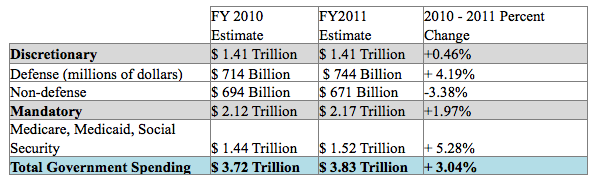
Given his firm grasp of the consequences of the situation, you would have thought that the president would cut government spending and try to reduce the deficit. Sadly, the table below shows that you'd be wrong.
Indeed, contrary to the promises Obama made last year, the deficit grew by over 10 percent between FY2009 and FY2010. And spending, which was projected to go down in FY2010 to $3,552 billion from its $3,938 billion FY2009 level, will actually climb by an estimated 6 percent. In total dollars, the deficit for FY2010 is projected by the government to reach $1.56 billion (last year, Obama projected it would be $1,171 billion).
And what did President Obama request in his recently released budget for FY2011? In his latest budget message he writes:
To help put our country on a fiscally sustainable path, we will freeze non-security discretionaryHere's the rough plan in table form.
funding for 3 years. This freeze will require a level of discipline with Americans’ tax dollars and a number of hard choices and painful tradeoffs not seen in Washington for many years. But it is what needs to be done to restore fiscal responsibility as we begin to rebuild our economy.
Expressed as a percentage of Gross Domestic Product (GDP), that means total government outlays will equal 25.1 percent of GDP, the second highest rate since 1945 (the highest was 25.4 percent for FY2010). Federal revenues will amount to 16.8 percent of GDP (up from its 14.8 percent level in FY2010). And the budget deficit will come to 8.3 percent of GDP, down from its FY2010 level. To put that number is perspective, remember that during the 1980s, a decade known for high deficits, the deficit average was 4 percent of GDP.
The only sector where spending might decrease is the area subject to the spending freeze (that area covers 13 percent of the budget, but the freeze won't take effect until next year). Since the budget came out, I have spent a long time trying to figure out how the freeze will work and exactly what it entails. Based on the budget data just released, however, there wasn’t enough information available to answer that question as of this writing.
So much for transparency. As economist and former Congressional Budget Office Acting Director Donald Marron put it on his blog after the budget numbers were released on Tuesday: "To fully understand the trajectory of non-security discretionary spending, you need to consider such obscure bits of budget arcana as the obligation limitations used for transportation funding (ob lims, to the initiated), the proposed conversion of Pell grants from discretionary to mandatory spending, the reassignment of bioshield from security to non-security spending, and the fact that Census spending is particularly high in fiscal 2010 because of the decennial census. I haven’t actually crunched the numbers, but that’s not my point tonight. Instead, my point is simply how hard it can sometimes be to match budget reality to budget communications."
It is also important to note the increase in defense spending (4.1 percent). Such an increase is not surprising, given that Obama is increasing troop levels in Afghanistan without withdrawing troops in Iraq any faster than President Bush would have done. But anyone who thought that Obama would be less of a hawk than his predecessor should have realized by now that this is a myth. In fact, this year the defense budget is the biggest in total real dollars in U.S. history.
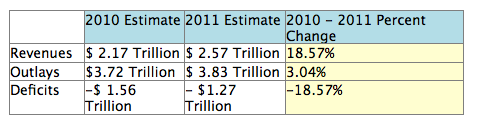
So spending is going up. And yet the president predicts the FY2011 deficit will shrink from its FY2010 level of $1.56 trillion to $1.2 trillion. Better yet, the president projects that by 2014 the deficit will decrease by more than half to reach $706 billion.
How does Obama hope to get there? He pencils in an 18.5 percent increase in revenue between FY2010 and FY2011.
Where will all this new money come from? First, the president assumes revenue from letting the Bush tax cuts expire on income earners making more than $250,000 per household. Then he assumes revenue from closing “loopholes” on the corporate income tax sides. (What he calls loopholes are just exemptions that were built into the corporate income tax system to help U.S. companies competing on the international market.) If Obama succeeds in repealing these exemptions without reforming the corporate tax code, however, there is no doubt that American companies will have a harder time making a buck and that the revenue stream they bring in will shrink.
Finally, the president's revenue estimate relies on optimism. His projected GDP growth and unemployment numbers are very rosy. In FY2011, the president assumes that the economy will growth by 5.1 percent (see Table S-13 of the Summary Tables). He assumes that the economy will grow by 6 percent in 2012. And he expects the unemployment rate to decline. While his jobs programs have failed miserably so far, he anticipates that next year the unemployment rate will drop to 9.2 percent. Better yet, in 2012 it will drop to 8.2 percent and will reach 6.5 percent in FY2014.
Given how unrealistic these projections are, relying on an 18.5 percent increase in revenue this year is simply not credible. Which puts the other numbers in President Obama's budget—which is already nothing to write home about—in an even harsher light.
And Obama continues the time honored tradition of adopting the "cross your fingers and hope the economy grows faster than the government" approach to defecit reduction.
Paul Krugman:
Well, as his hero used to say, "in the long run, we're all dead", so I can see his point.Let’s talk for a moment about budget reality. Contrary to what you often hear, the large deficit the federal government is running right now isn’t the result of runaway spending growth. Instead, well more than half of the deficit was caused by the ongoing economic crisis, which has led to a plunge in tax receipts, required federal bailouts of financial ins utions, and been met — appropriately — with temporary measures to stimulate growth and support employment.
The point is that running big deficits in the face of the worst economic slump since the 1930s is actually the right thing to do. If anything, deficits should be bigger than they are because the government should be doing more than it is to create jobs.
If you're running large defecits to spend money on things that will actually put people to work, then that's one thing. But not all spending falls into that category. So much of the stimulus bill went to things like extending health coverage for the unemployed, food stamps, and other welfare programs. Now I'm not saying those aren't worthy causes, but they're not things that are going to stimulate the economy.
Reading Krugman today reminded me of the Portuguese and Spanish governments and their comical disorientation with the current budgetary/funding crisis. Like Krugman, they also though they could just keep spending other's people money - especially "in the face of the current economic slump". They still don't know what have hit them. The Spanish government wants to nationalize the... rating agencies. According to these peculiar minds, they're the ones to blame because they cut Spain's debt rating. So, in their idea, the solution is to outlaw them and to create an European Union sponsored agency that would rate the credit of the EU governments. The Portuguese Finance Minister, blames the lenders - accusing them of being possessed by "animal spirits" (sic). Apparently he believes that insulting the guys you need is the best course of action. It's been a long time since I've been this amused with politics.
What are those things? Who's in the best position to decide as correctly as possible what are those things?
I'm extremely sceptical about the ability of a few politicians and bureaucrats to make that decision. Not because they're dumb, but because it's a problem way too complicated for centralized decisionmaking to solve it.
Yes, they are. More people should do philanthropy.Now I'm not saying those aren't worthy causes
There are currently 1 users browsing this thread. (0 members and 1 guests)
 Posting Permissions