Reply With Quote
Since it's so easy, why not let those market forces dictate when we switch over?

not to mention any president of the US has to slob the nob of Suadi's royal family in order to feed the voters/cons uents/contributors habits. Obama is just like every other president who has had to get on his knees before the defacto rulers of the free world to date.
But are you saying that ties to Saudi=ties to Saddam? I think even a dense dude like you can see the difference.

Since it's so easy, why not let those market forces dictate when we switch over?
What's your point? Are you trying to make the fact that two people who despise each other can still have a civil meeting, and handshake, into friendship?
God you're stupid.
What should he do? Pull out a 45 and shoot him during a political meeting?
Yes, he must be a subject of the Saudi king...
We sought him out because we thought he would be a better option than the Shah. why would rummy shoot him here? he was trying to aid and abet him right here.
Idiot.
All leaders make nice with each other, otherwise dialog becomes impossible.
My question is, why do so many democrats not in leadership positions make nice with these thugs?

Since Karl Popper, every student of scientific method knows that a statement such as "all swans are white" can be proved wrong, but it cannot be proved right. ... Industrial policy "fails most of the time", or "fails more often than it succeeds"—these are at least plausible arguments. But industrial policy fails always?
My advantage is greatly heightened by the fact that Mr Lerner is a scholar who is as reasonable as he is knowledgeable. So it is in his book "Boulevard of Broken Dreams" (2009) that we find one of the most effective ripostes directed at the market-fundamentalist account of American technological prowess. "The public sector", Lerner writes, referring especially to the role of the Department of Defense, "proved a critical catalyst to growth in Silicon Valley." And what is true of America is true worldwide as well: "Public programs played an important role in triggering the explosive growth of every other major venture market around the globe." With this said, what is left for me to add?
The white swans of this debate are known as "white elephants"—those colossal projects spawned by industrial policies that never fulfil their architects' dreams and end up bleeding their national treasuries dry. As we know, the landscape is strewn with such white elephants—Concorde, the Proton and the countless factories in the developing world operating at half capacity and at great loss.
But there are black elephants too, and in truth they are far more pervasive than the Tasmanian black swans that adorn the flag of the state of Western Australia. Beyond Mr Lerner's Silicon Valley and venture capital examples, we might mention South Korea's POSCO, possibly the world's most productive steel firm, and Dubai's Jebel Ali port, one of the world's largest and most successful ports—both established by public money and widely derided as uneconomic at the outset. Or we might mention the Chilean salmon industry—the creation of a public venture fund (Fundación Chile)—which stands in sharp contrast to the free-market brush with which Chile's economic success is so frequently (and so misleadingly) painted. If pressed further, we might add to the list Brazil's aircraft industry, Taiwan's and Singapore's electronics industries, China's auto and auto components industries, and many others.
Anyone who thinks failure is the norm in industrial policy should consider this factoid. Latin America experienced far more rapid productivity growth during the early post-war decades when it was heavily subsidising and protecting its "infant" industries than it has since the 1990s when those policies were chucked overboard. I would not wish to go back to those old policies—we can certainly do better. But despite its evident excesses, it is surely telling that "import subs ution", as Latin America's earlier economic strategy was called, outperformed anything the region has experienced since (or before).
The essence of economic development is structural transformation, the rise of new industries to replace traditional ones. But this is not an easy or automatic process. It requires a mix of market forces and government support. If the government is too heavy-handed, it kills private entrepreneurship. If it is too standoffish, markets keep doing what they know how to do best, confining the country to its specialisation in traditional, low-productivity products.
Economists understand well the role that industrial policy plays in successful cases. New industries require lots of capital that private entrepreneurs may not have. They require co-ordinated investments in related industries that individual entrepreneurs cannot organise by themselves. They generate demonstration effects and technological spillovers that raise social returns way above private incentives. All these are valid reasons for governments to give private investors a nudge.
The critic responds that all these ideas are fine, but the problem is in practice. Fixing these "market failures" is difficult and governments can just as easily mess it up. Once you open up the door to intervention, all kinds of special interests are likely to get into the act and try to divert policy to their own, selfish ends.
Quite true. But then again this is not that different from what happens when governments engage in, say, education policy, health policy, or tax policy. In each of these areas, governments are driven by economic and social goals that are often articulated loosely and targeted imperfectly. In each of them the policy process can be hijacked by special interests. Few but libertarians draw the conclusion from this that government departments should be abolished and schooling, health, or social insurance should be left completely to markets. We debate how best to provide these public services, not whether they should be provided at all.
So it should be with industrial policy. Fostering structural transformation and innovation is a central public purpose. Governments cannot evade the challenge. The only debatable question about industrial policy is not "whether" but "how."
as every president is. we are fortunate not to have to deal with the dealers directly, we elect officials to secure our fix.
I have already pointed out that the Chinese are investing rather heavily in renewables.
If one doubles the costs of oil relative to purchasing power, and one country has reduced its economic dependency on oil, while the other has waited for "market forces" to do it and is still highly dependent, where does the economic compe ive advantage lie?
I would bet China doesnt have big business at the helm.
You would lose that bet.
All state-owned companies tend to have one or two major stockholders who just *happen* to be generals or high-level politicians. This little factoid tends to stymie foreign companies trying to enter the Chinese market.
China's interlinking between government and business is much more pervasive and corrupt than the US by any measure.
This, coupled with the lack of legal protections and rising labor costs, are making US and European businesses start to think twice about jumping in.
China will grow by leaps and bounds, but is setting itself up for a major bubble down the road. I don't think that bubble will manifest itself for a good 5+ years if not 10+, but those two elements are prerequisites for nasty capital-destroying bubbles.
Wait a minute...
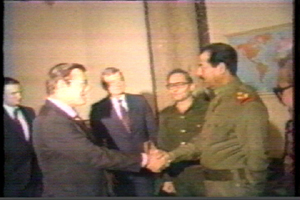
You show a picture with Rummy, what year was that picture? The Shah lost power to Ayatollah Khomeini in 1979, before Rummy was in such a position.
That picture was taken in December 1983.
You think you know your history? then how can this be related to the Shah?
My point of shooting was rhetorical. Just what is one suppose to do? Make your hatred known?
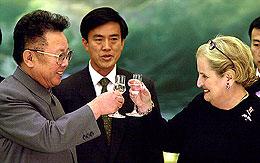
What do you think of these?
They look truly happy to be in each others company.
You don't think the free market sees this?
Hatred?
if you think politicians hold the same petty emotional bases as you and I, you are truly naive sir.
Until you explain the US relationship with Saddam during the 80's, I refuse to go further. This continual shape-shifting/hide-the-ball/pull-the-wool/confuse the audience/I know-you-are-but-what-am-I approach just doesnt carry enough weight to stay involved.
Saddam was a counterweight to the Islamic Republic of Iran established after they deposed the Shah in 1979.
http://en.wikipedia.org/wiki/Iran%E2%80%93Iraq_War
Saddam was a foil against a regime openly and actively hostile to the US at the time. That was why Mssrs Rumsfeld and Hussein were meeting.
We propped him up with no small amount of assistance to allow his much smaller country to defend itself against a rather maniacal, wild-eyed bunch of religious zealots.
Realpolitik in one of its more distasteful episodes.
I think you have a simplistic view of both men and relationships.
Oil will not "run out" in any depletion scenario currently contemplated by anybody for over a century.
That is a "strawman".
More accurate is the statement "cheap oil" is running out, if not already gone.
The world will not die, but we WILL have to figure out how to have modern agriculture with an increasingly scarce resource, because modern and efficient farms require good amounts of oil products to function.
Change is not easy, but I'm not one who believes if forcing it. If people think they need to manipulate certain aspects of it, then they need to think and and be certain they are right. There is no evidence strong enough to mandate commitment of resources to these endeavors.
glad the US people arent relying on you to make policy. this statement is flat-out assenine. this statement shows your stubborness has overtaken all reason. this statement sums you up as a conservative quack.
There is quite enough data to support allocating resources to this endeavor.
You have simply chosen to ignore it.
I read his statement as what it was: no matter how much evidence anyone presents, it will never be enough to convince WC. which is BS.
Too bad you cannot counter my points with scientific facts.
I haven't ignored it at all. There is not solid evidence.
Seriously, again...
Why wouldn't the energy companies invest more in green energy, to insure future profits, if your point was true?
There are currently 1 users browsing this thread. (0 members and 1 guests)
 Posting Permissions